TailVille
At a glance
Rough ranges for supplies, food and electricity in Korea (USD is approximate). Purchase or adoption fees are not included.
First-time snake owners who want an active animal that is easy to feed and pleasant to handle.
Forgetful keepers who might leave a lid unlatched, or households that won't accept frozen mice in the freezer.
1. Overview
The corn snake is a harmless, non-venomous snake from the woods, fields and farmsteads of the southeastern United States. Its orange and red saddles outlined in black are strikingly colorful, and even fully grown it stays slender, typically 120 to 150 cm long and 400 to 900 grams, which makes it easy to handle. Along with the ball python, it is the snake most often recommended to first-time keepers.
The reasons are clear. Corn snakes are docile and quickly get used to being handled, they eat frozen and thawed mice reliably, and they rarely go on the long hunger strikes ball pythons are known for. They tolerate a fairly wide range of temperature and humidity, which makes them easy to fit into an ordinary home, and decades of breeding have produced an enormous variety of colors and patterns.
There are things to watch for. Slim and endlessly curious, corn snakes are escape artists that will squeeze through any gap in a lid. They also live 15 to 20 years or more, and everyone in the household has to be comfortable with frozen rodents in the freezer. Get those two things right and a corn snake can be a rewarding companion even for a complete beginner.
2. Name and classification
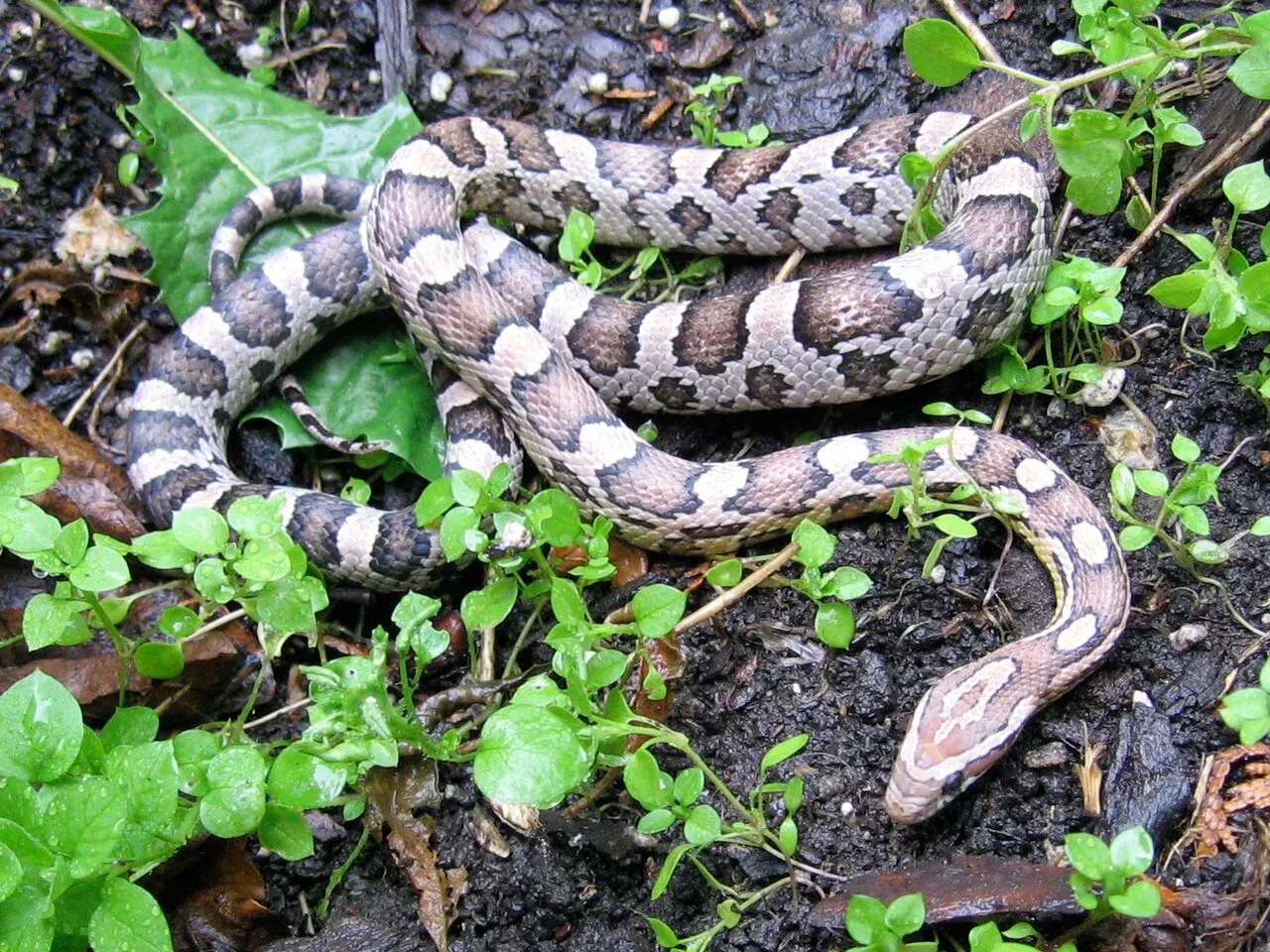
Antsterr at English Wikipedia · CC BY-SA 3.0
2.1. Scientific name and meaning
The current scientific name is Pantherophis guttatus. Carl Linnaeus described it in 1766 as Coluber guttatus, and for many years it was known as Elaphe guttata. In the early 2000s, molecular studies led to the North American rat snakes being split off into the genus Pantherophis, giving the name used today. Guttatus is Latin for spotted or speckled.
There are two popular explanations for the name corn snake. One holds that the snakes were common around corn cribs, where they hunted the rodents drawn to stored grain. The other points to the checkered black and white belly, which resembles the kernels of multicolored maize. Both are widely repeated, and nobody knows for certain which is correct. Keepers usually just call them corns.
2.2. Family and relatives
Corn snakes belong to Colubridae, the largest snake family. The genus Pantherophis contains several North American rat snakes, and the corn snake's closest relatives include the following.
| Species | Scientific name | Notes |
|---|---|---|
| Great Plains rat snake | P. emoryi | Close relative, gray-brown tones |
| Eastern rat snake (black rat snake) | P. alleghaniensis group | Black as adults, grows larger |
| Fox snake | P. vulpinus group | Northern range, brown blotches |
| Slowinski's corn snake | P. slowinskii | Found in Louisiana and nearby; its status is debated |
Corn snakes share a family with kingsnakes and milk snakes, which have similar care needs. Hybrids between these groups are bred and sold, so if you want a pure corn snake, check the lineage before buying.
3. History
Corn snakes range from southern New Jersey to Louisiana, with the heart of their distribution in Florida, Georgia, the Carolinas and Alabama. They are common in pine woods, forest edges, fields and around abandoned buildings and barns, and because they turn up wherever rodents gather on farms, farmers have long regarded them as useful neighbors.
Their history as pets began when American reptile enthusiasts started breeding them in the 1950s and 1960s. Captive breeding was established by the 1960s, and in the 1970s and 1980s the first morphs, such as the amelanistic, were fixed, earning the corn snake a reputation as a beautiful, easy-to-breed snake. It is impossible to tell the story of snake morph breeding without it. Countless morphs have been produced since, and virtually all pet corn snakes today are captive-bred.
The species reached Korean keepers through reptile shops in the 2000s. Being harmless, gentle, affordable and free of CITES paperwork, it is a common choice for a first snake there, appears at almost every reptile expo, and has many local breeders. In much of Europe and North America it holds a similar position as the classic beginner snake.
4. Body
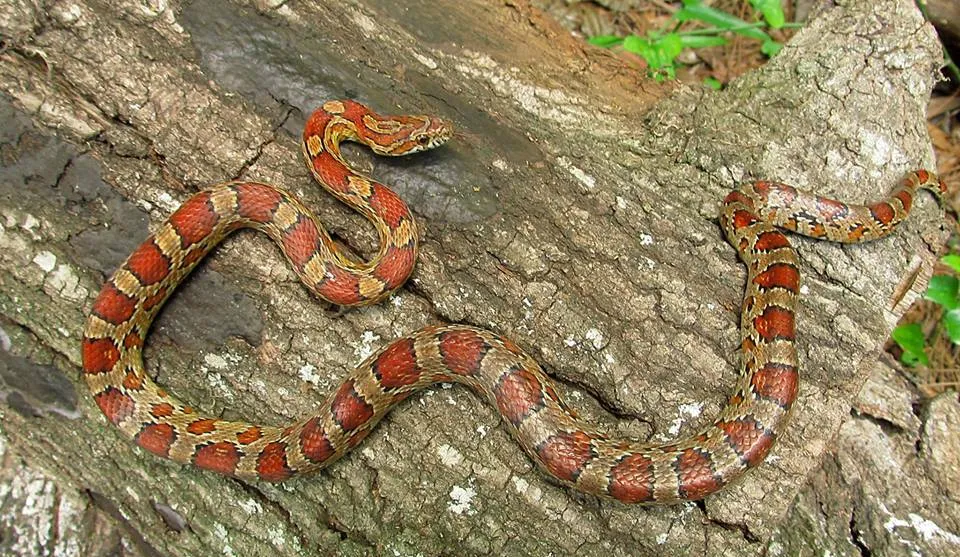
Glenn Bartolotti · CC BY-SA 4.0
4.1. Size and build
Hatchlings are pencil-thin, about 20 to 30 cm long and 6 to 10 grams. They reach adult size at two to three years, typically 120 to 150 cm and 400 to 900 grams. Large individuals approaching 180 cm exist but are uncommon. Size differences between the sexes are much smaller than in ball pythons, though males tend to be slightly longer with longer tails.
The body is long and slim, with a flat-bottomed, loaf-shaped cross-section. The edges of the belly are slightly angled, which helps the snake grip bark or the gaps in brickwork as it climbs. The head is only a little wider than the neck rather than the bold triangle of a python.
4.2. Pattern and scales
Wild-type corn snakes have a series of red saddles edged in black running down an orange or tan back. The belly is white with black squares in a checkerboard pattern, and the underside of the tail often carries dark stripes. A spearpoint-shaped marking on top of the head helps distinguish it from related species. Coloring varies by region, and especially vivid populations have their own names, such as the Okeetee type from South Carolina, known for bright colors and thick black borders.
The dorsal scales are smooth or only weakly keeled, and a single row of wide scales runs along the belly. Hatchlings are often dull and grayish and develop rich orange and red as they grow, so it is hard to predict adult color from a baby photo.
4.3. Senses and hunting
Unlike ball pythons, corn snakes have no heat-sensing pits. They rely instead on scent, collected by the flicking tongue, and on eyesight tuned to movement. That is why a thawed mouse wiggled gently with tongs gets a much better response. They have no external ears but are sensitive to ground vibrations.
They kill by constriction, wrapping coils around prey and squeezing. Research suggests constriction works mainly by cutting off the prey's blood circulation, subduing it quickly. Corn snakes have no venom, and their small, backward-curving teeth usually leave nothing worse than a few scratches.
4.4. Shedding and sexing
Growing snakes shed every two to four weeks and adults every one to three months. Before a shed the colors dull and the eyes turn cloudy blue; a few days later the eyes clear and the entire skin comes off in one piece. During this period the snake may refuse food or be a little defensive.
Tail shape gives a rough guide to sex. In males, the base of the tail behind the vent is thicker because of the hemipenes and tapers gradually, while in females the tail narrows abruptly just past the vent. Accurate sexing is done by probing, or by popping in hatchlings, and both should be left to an experienced breeder or vet because they can cause injury.
5. Morphs and colors
The corn snake was one of the first snakes to be bred for morphs. Some morphs change color, others change pattern, and combining them has produced a vast catalog of names. Most of the basic morphs are recessive, so both parents must carry the same gene for it to show.
| Morph | Inheritance | What it looks like |
|---|---|---|
| Normal (classic, Carolina) | - | Orange ground with black-edged red saddles |
| Okeetee | Locality, line-bred | Thick black borders and vivid red |
| Miami | Locality, line-bred | Gray or silver ground with red saddles |
| Amelanistic (amel) | Recessive | No black pigment: red, orange and white with red eyes |
| Anerythristic (anery) | Recessive | No red pigment: gray and black |
| Snow | Recessive combination | Amel plus anery, white with pink tones |
| Charcoal | Recessive | Like anery but lower-contrast gray-brown |
| Caramel | Recessive | Yellow and brown in place of red |
| Lavender | Recessive | Soft lilac and pinkish gray |
| Hypomelanistic (hypo) | Recessive | Reduced black, softer, brighter colors |
| Bloodred (diffused) | Recessive | Pattern fades, body tends toward solid red, no belly checkers |
| Motley | Recessive | Saddles connect or break into dots; clean belly |
| Stripe | Recessive | Pattern becomes four lines running down the body |
| Tessera | Dominant | Dorsal stripe with fine side markings |
| Palmetto | Recessive | White body scattered with colored scales |
| Scaleless | Reported as incomplete dominant | Few or no dorsal scales |
Combining these basics gives names such as blizzard (charcoal and amel), ghost (hypo and anery), butter (caramel and amel) and opal (lavender and amel). Adding a pattern morph lengthens them further: snow motley, ghost stripe and so on.
A real advantage of corn snakes is that most of their morphs have no known serious health problems. Scaleless snakes lack the protection of normal scales, though, and need extra attention to shedding and skin care, and heavily inbred lines have been reported to produce spinal kinks and eye problems. Reputable breeders keep lineage records and do not breed from deformed animals.
6. Behaviour
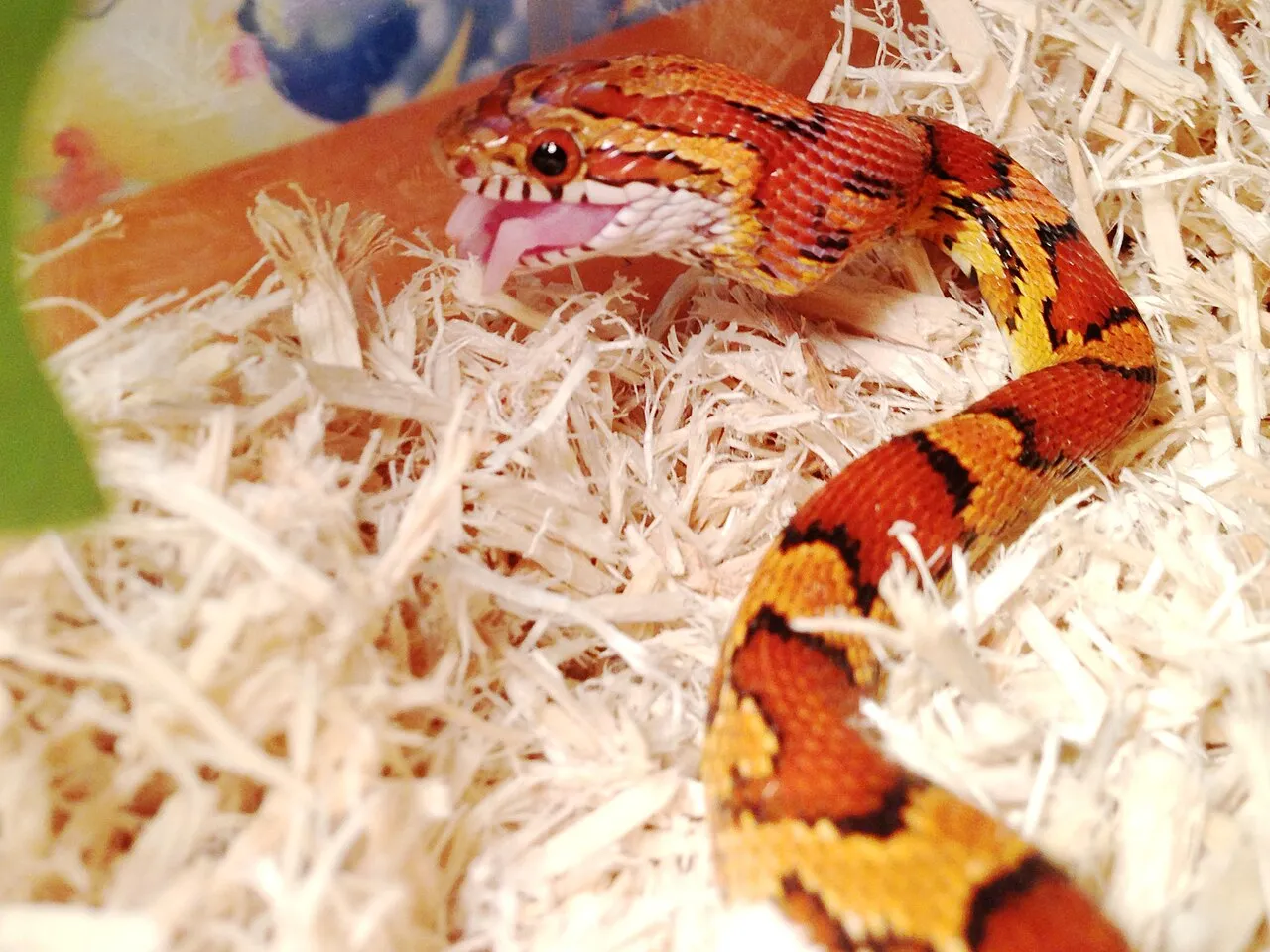
Dustin Miller · CC BY-SA 3.0
6.1. Life in the wild
Wild corn snakes are active mainly at dusk, at night and in the early morning. By day they shelter under fallen logs, in rodent burrows, among rocks or inside abandoned buildings, and they are rarely seen in the midday heat of summer. They live mostly on the ground but climb well and sometimes raid bird nests. Young snakes eat lizards and frogs, shifting to rodents as they grow. In the northern part of the range, corn snakes brumate underground for several months in winter.
6.2. At home
In captivity a corn snake rests during the day in a hide or burrowed into the substrate, then comes out in the evening to explore every corner. It is more active and curious than a ball python and tends to keep moving when handled, so let it flow from one hand to the other and handle it while sitting so it cannot fall far.
Hatchlings are often nervous, rattling their tails or drawing into an S-shape and striking, but short handling sessions of 10 to 15 minutes two or three times a week calm most of them quickly. Skip handling for 48 hours after a meal and just before a shed.
6.3. Reading the signals
- Rapid tail vibration: fright or a sense of threat; on dry leaves it can sound a little like a rattlesnake.
- Neck drawn back into an S-shape: a defensive pose; give it a moment.
- Slow tongue flicks while gliding forward: relaxed exploration.
- Pushing at corners or the lid with its head: looking for a way out; check that the lid is locked.
- Releasing a musky smell: a defensive response to fear; it washes off.
- Staying buried in the substrate: a shed may be coming, or the enclosure may be too bright or warm.
- Sitting in the water bowl constantly: it may be too hot, or mites may be present.
7. Life stages
Corn snakes grow fairly quickly, and once they are adult it is important to stretch feeding intervals so they do not become obese.
| Stage | Age | Approx. length and weight | Feeding interval | Notes |
|---|---|---|---|---|
| Hatchling | 0-6 months | 20-50 cm, 6-40 g | 5-7 days | Starts eating after the first shed; jumpy |
| Juvenile | 6 months-1.5 years | 50-100 cm, 40-250 g | 7-10 days | Rapid growth, colors brighten |
| Subadult | 1.5-3 years | 100-130 cm, 250-500 g | 10-14 days | Approaching breeding size |
| Adult | 3 years and up | 120-150 cm, 400-900 g | 10-14 days or longer | Weight control matters |
| Senior | 15 years and up | Varies | Longer still | Less active, some muscle loss |
Captive lifespan is typically 15 to 20 years, and many have lived well past 20. With age, appetite and activity fall, sheds come less often and lost muscle can make the spine show slightly. For seniors, drop the prey size by one step, lengthen the interval and see a vet if you find a lump or sudden weight loss. Because corn snakes almost never turn down food, overfeeding is easy. In an adult, a meal should leave only a slight bulge, and folds along the sides are a sign to feed less often.
8. Housing
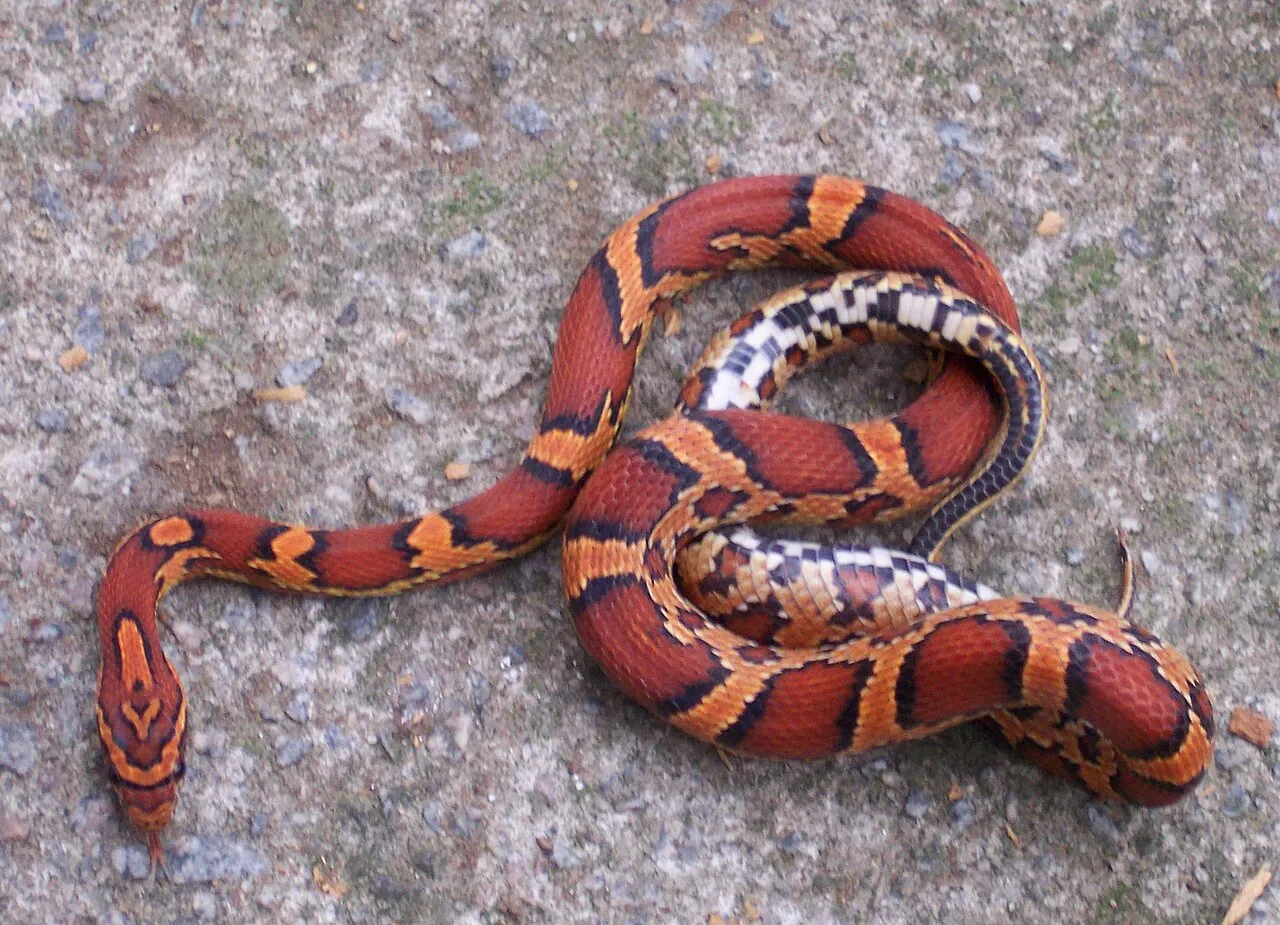
Jthatt~enwiki · CC BY-SA 4.0
8.1. Enclosure
An adult needs an enclosure of at least 90 x 45 x 45 cm, and 120 x 60 x 60 cm is better. Corn snakes are good climbers, so a taller enclosure with branches and cork lets you watch them move up and down as well as along the floor. Hatchlings can feel exposed or fail to find food in a large space, so many keepers start them in a 30 to 40 cm tub and size up as they grow.
Escape prevention comes first. If a corn snake can fit its head through a gap, the rest of the body can follow. Use a front-opening enclosure with a lock, or clip a mesh lid down firmly, and check cable holes and vent gaps. Hatchlings are tiny enough to slip through vents meant for adults.
8.2. Temperature and humidity
| Item | Target |
|---|---|
| Warm-side floor | 29-31 °C |
| Cool side | 22-25 °C |
| Night minimum | Above 20 °C |
| Humidity | 40-60 percent |
| Before a shed | 60-70 percent |
Corn snakes are comfortable a little cooler than ball pythons. In a warm home, summer room temperature may be enough, but during heat waves above 30 °C make sure the enclosure does not overheat. In winter, keep the warm side up to temperature with a heat mat, radiant panel or ceramic heater on a thermostat. Humidity is not critical, but adding a humid hide with damp moss or lightly misting part of the substrate before a shed helps the skin come off cleanly. A constantly wet floor leads to skin problems.
8.3. Substrate, lighting and equipment
Corn snakes love to burrow, and 5 to 8 cm of aspen shavings lets them tunnel and rest out of sight. Coconut chips, cypress mulch or a soil-based mix also work. Avoid cedar and pine shavings, whose aromatic oils can irritate the airways and skin.
UVB is optional, but more keepers now report that low-level UVB with plenty of shade benefits activity. If you add lighting, run it 10 to 12 hours a day on a timer.
- Lockable enclosure of at least 90 x 45 x 45 cm
- Heat mat or radiant panel and a thermostat
- A digital thermometer with humidity readout, plus an infrared temperature gun
- Two or three hides: warm, cool and humid
- A heavy water bowl that will not tip over
- Burrowing substrate such as aspen
- Branches and cork for climbing
- Long tongs and freezer space for frozen prey
- A scale and a log for feeding and sheds
9. Diet
9.1. What and how much
Frozen and thawed mice are the corn snake's staple, and most individuals stay healthy on mice alone for life. Choose prey about as wide as the thickest part of the body and no more than 1 to 1.5 times that width; after eating there should be only a slight bulge.
| Age | Interval | Prey size |
|---|---|---|
| Hatchling | 5-7 days | One pinky mouse |
| 6-12 months | 7-10 days | One fuzzy or hopper |
| 1-2 years | About 10 days | Weaned or small adult mouse |
| Adult | 10-14 days | One adult mouse; large snakes may take two or a small rat |
Thaw frozen mice slowly in the refrigerator or sealed in lukewarm water, then warm the outside. Hold the prey with tongs and wiggle it slightly and most corn snakes strike readily. Because their feeding response is strong, always feed inside the enclosure and make sure your hands do not smell of mice.
9.2. When it refuses food
Corn snakes are reliable feeders, but they may refuse food before a shed, in winter, during breeding season or right after moving to a new home. Check temperatures and hides first, then try again a week later. For a hatchling that keeps refusing pinkies, keepers sometimes leave the prey with the snake in a small container overnight, open the prey's head slightly to release more scent, or scent it with lizard. If the snake still refuses after several weeks, or loses weight, talk to a vet.
9.3. Things to avoid
- Leaving live prey in the enclosure overnight: rodents can badly injure snakes.
- Thawing in a microwave or boiling water: the prey can cook inside or burst.
- Prey more than 1.5 times the body width: regurgitation and digestive trouble.
- Feeding several snakes together: two snakes on one mouse can end with one swallowing the other.
- Handling right after a meal: a common cause of regurgitation.
- Wild rodents or lizards: parasites and rodent poison.
- Refrozen prey: bacterial growth.
10. Health
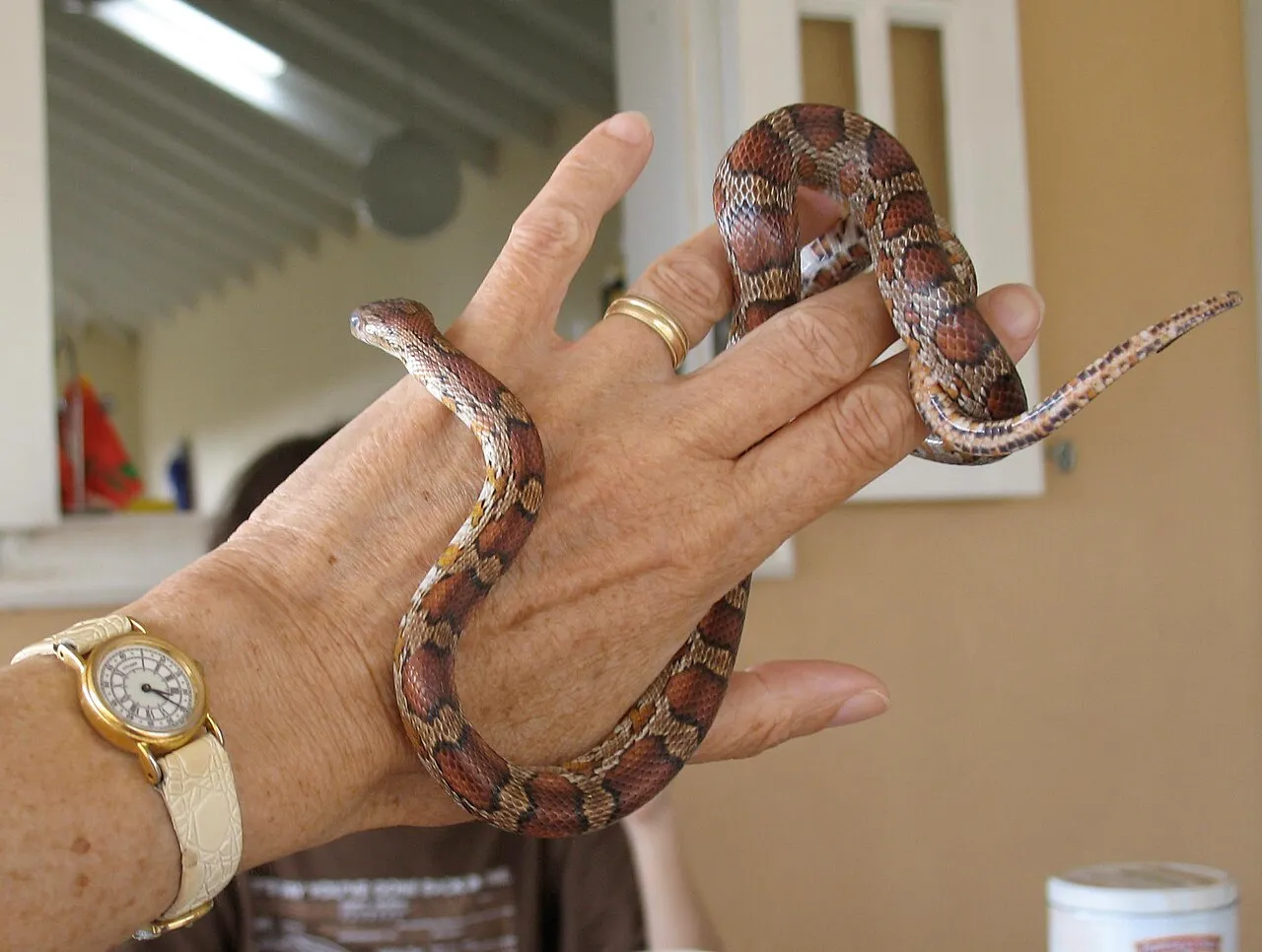
Corn snakes are hardy, but incorrect husbandry or animals of unknown origin can still bring disease.
| Condition | Main causes | Signs | Prevention |
|---|---|---|---|
| Respiratory infection | Low temperatures, poor airflow, excess moisture | Open-mouth breathing, mucus, wheezing | Proper gradient, ventilation |
| Stuck shed | Low humidity | Retained eye caps or tail tip, patchy shed | Humidity at 60-70 percent before sheds |
| Mites | Infested animals or equipment | Tiny black dots between scales, long soaks | Quarantine, disinfection |
| Cryptosporidiosis | Protozoan parasite | Repeated regurgitation, midbody swelling, weight loss | Reputable source, quarantine, hygiene |
| Mouth rot | Injury, weak immunity | Swelling, pus | Hygiene, correct heat |
| Scale rot | Wet substrate | Discolored belly scales, blisters | Keep the floor dry |
| Obesity | Overfeeding | Folds along the sides, low activity | Longer intervals |
| Egg binding (females) | No laying site, poor nutrition | Swollen belly, lethargy, overdue laying | Laying box, good nutrition |
Cryptosporidium is extremely difficult to treat in snakes. Suspect it if a snake repeatedly regurgitates a few days after eating or develops a firm swelling around the middle of the body. It spreads between snakes, so quarantine every newcomer in a separate room for 60 to 90 days and disinfect equipment and hands thoroughly.
If eye caps remain after a shed, do not pick them off; raise humidity or soak the snake in lukewarm water and wait for the next shed. See a vet who treats reptiles if you notice open-mouth breathing or mucus, regurgitation more than once, weight loss of over 10 percent, discolored scales or blisters, swelling or pus around the mouth, or a lump under the skin.
11. Breeding
Corn snakes are known for breeding easily. Females should be two to three years old, over 90 cm long and above 300 grams before breeding; younger females can be seriously depleted by egg production.
Breeders typically give a winter brumation of two to three months at around 13 to 16 °C beforehand. Food must be withheld for about two weeks first so the gut is empty, because undigested food left in a cooled snake can rot. In spring, temperatures are raised and the snakes are fed well, and the male is introduced after the female's next shed. Brumate only healthy snakes, and if it is your first time, ask an experienced keeper or vet for guidance.
About 30 to 45 days after mating the female has a pre-lay shed, and she lays 7 to 14 days after that. Clutches usually hold 10 to 30 eggs. Provide a laying box with damp moss in advance, because a female with nowhere to lay can become egg-bound. Incubated in damp vermiculite or perlite at 27 to 29 °C, the eggs hatch in about 55 to 65 days. Sex is not determined by temperature in corn snakes.
One clutch can mean dozens of hatchlings, each needing its own tub and a steady supply of pinkies, and some babies refuse their first meals and need weeks of coaxing. Do not breed without homes lined up, and if you plan to sell, check whether a business license is required.
12. Costs
Among pet snakes, the corn snake is one of the cheapest to set up and keep. The figures below are rough Korean ranges in won.
| Item | Typical cost (KRW) | Notes |
|---|---|---|
| Enclosure | 120,000-350,000 | 90-120 cm with a lock |
| Heating and thermostat | 60,000-150,000 | Heat mat or panel |
| Thermometers and IR thermometer | 20,000-50,000 | - |
| Hides, water bowl, branches | 30,000-70,000 | - |
| Substrate | 10,000-30,000 | Aspen |
| Hatchling tub | 10,000-30,000 | If starting with a baby |
| First vet check | 30,000-80,000 | Fecal test |
| Initial total (excluding the snake) | About 300,000-700,000 | - |
| Monthly frozen mice | 5,000-20,000 | Depends on life stage |
| Monthly substrate and supplies | 5,000-15,000 | - |
| Monthly electricity | 5,000-15,000 | Higher in winter |
| Monthly total | About 20,000-50,000 | - |
Common morphs such as normal and amel are inexpensive, while rare combinations can cost several hundred thousand won or more. A basic exam with tests runs to tens of thousands of won, and X-rays or surgery can cost much more. Buying frozen mice in bulk lowers the unit price, but check your freezer space, and your household's feelings about it, first.
13. Before you get one
- Can you care for a snake for 15 to 20 years or more?
- Can you store and thaw frozen mice in your freezer, and does everyone you live with agree?
- Will you check the lock every single time? Are your family and neighbors prepared in case the snake gets out?
- Will your landlord or building rules permit a pet snake?
- Have you already found a vet willing to see snakes?
- Who will check temperatures when you are away? Adults can skip a meal or two, but heating needs daily attention.
Buy from a seller who can share the hatch date, feeding history, prey type and size, and shed records. First-time keepers should look for a corn that has taken thawed prey several times in a row without fuss. A healthy corn snake flicks its tongue actively, feels strong in the hand and grips your fingers as it moves. Check for clean nostrils and mouth, silent breathing and no mites between the scales, and run your hand gently along the body to feel for kinks in the spine.
If your snake does escape, close every door to limit the search area, then work methodically: behind furniture, under and inside appliances, along curtain tops and in warm spots such as behind the refrigerator or around a computer. A thin dusting of flour on the floor overnight can reveal tracks. Leaving a warm hide and a water bowl in a corner sometimes tempts the snake to shelter there on its own.
14. Laws
The corn snake is not listed under CITES, so in most countries it is traded without special endangered-species paperwork, and it is not subject to the mandatory registration that applies to dogs in places such as Korea.
Wildlife trade rules are tightening in many places, however. In Korea, amendments to the wildlife act are phasing in licensing for wildlife sellers and importers and a system specifying which species may be imported and sold. How corn snakes are classified and what private rehoming requires may change, so check current guidance from the Ministry of Environment or a regional environmental office, and buy from licensed businesses or breeders.
Corn snakes are considered capable of harming ecosystems if they become established outside their native range. Introduced corn snakes have settled on several Caribbean islands, raising concerns about their impact on native wildlife, and in countries such as Australia, which strictly prohibits keeping exotic snakes, any corn snake found is treated as a dangerous invasive. Elsewhere, rules range from no specific restrictions to permits for all snakes, so check local regulations. Even in places with harsh winters, survival around heated buildings cannot be ruled out, so never release a corn snake. If you can no longer keep it, contact the seller or a reptile organization to find a new home.
15. In culture
Thanks to its bright colors, the corn snake is a favorite education animal. In zoos, natural history museums and school programs across North America and Europe, it is often the first snake children get to touch, because it is harmless, gentle and a manageable size, ideal for easing a fear of snakes.
In its native range, though, its pattern has often been mistaken for that of the venomous copperhead, and many corn snakes have been killed as a result. In the southeastern United States, a vague belief that red, patterned snakes are dangerous still costs corn snakes their lives, and conservation groups publish guides explaining how to tell the two apart.
Online, pastel morphs such as snow and butter are shared under captions comparing them to candy or macarons, and photos of a tiny hatchling coiled around a finger or peeking out of a mug are perennial favorites. Across social media in many languages, the corn snake is the face of the cute snake.
16. Trivia
- By vibrating its tail against dry leaves, a corn snake can produce a buzzing sound that resembles a rattlesnake's warning.
- Strong climbers, wild corn snakes sometimes raid bird nests for eggs and chicks.
- When frightened, it releases a musky fluid from glands near the vent; it smells strong but is harmless.
- Corn snakes are not normally snake-eaters, but cases of one swallowing another after both grabbed the same mouse have been documented, one more reason to house them separately.
- The amelanistic morph is generally traced back to animals found in the wild; pigment mutations occur naturally, if rarely.
- Belly checkers vary between individuals, and morphs such as bloodred and motley have almost none.
- Snakes have no eyelids and sleep with their eyes open, which makes it hard to tell whether one is asleep.
- Hatchlings slit their eggshells with a tiny egg tooth on the tip of the snout, which drops off soon after hatching.
Health notes are general information. If something seems wrong, contact a vet who treats this species.
FAQ
Is a corn snake bite dangerous?
No. It is non-venomous, and a bite feels like a scratch from a few pins; wash it with soap and water. Most bites come from feeding confusion or a nervous new arrival, so tong-feeding and a settling-in period prevent nearly all of them.
Corn snake or ball python for a beginner?
The corn snake is more forgiving because it eats reliably and copes with a wider temperature range. Choose a ball python if you prefer a heavier, slower snake, and a corn snake if you enjoy watching an active explorer.
My corn snake escaped. How do I find it?
Close doors to limit the search area, then check behind warm appliances, under drawers and along skirting boards with a flashlight at night. A light dusting of flour on the floor reveals tracks, and a warm hide with water left out often lures it back.
Further reading
Photo credits
Photos are freely licensed images from Wikimedia Commons. Authors and licenses are listed below.
- CornSnake.jpg — Ethan Porcaro · CC0
- Anerycorn.JPG — Antsterr at English Wikipedia · CC BY-SA 3.0
- Corn Snake Adult.jpg — Glenn Bartolotti · CC BY-SA 4.0
- Corn snake eating baby mouse.jpg — Dustin Miller · CC BY-SA 3.0
- Okeetee corn snake.jpg — Jthatt~enwiki · CC BY-SA 4.0
- Young corn snake, Nevis.JPG — Invertzoo · CC BY-SA 3.0