TailVille
At a glance
Rough ranges for supplies, food and electricity in Korea (USD is approximate). Purchase or adoption fees are not included.
First-time bird keepers and anyone who enjoys watching birds interact rather than handling them.
Anyone wanting a bird to hold and cuddle, or who would be bothered by constant soft beeping.
1. Overview
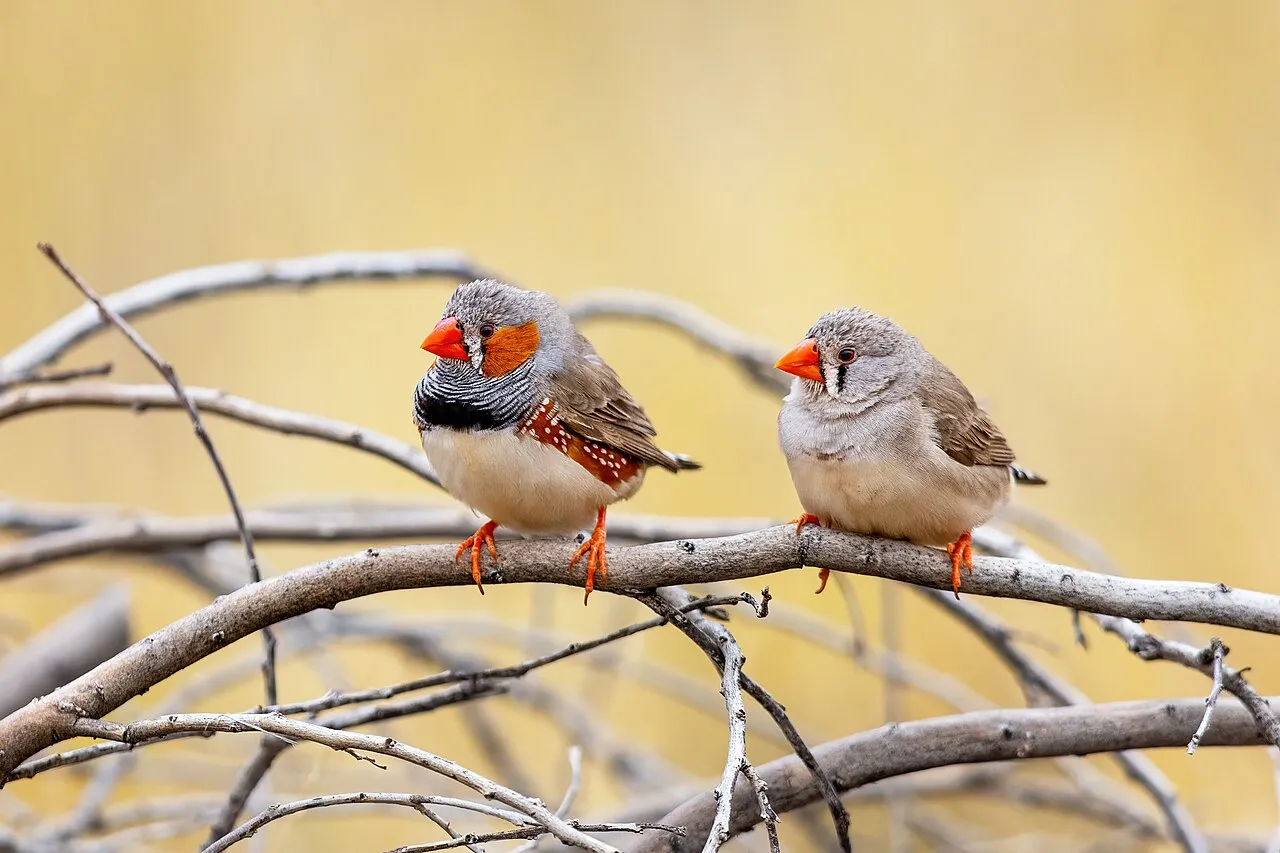
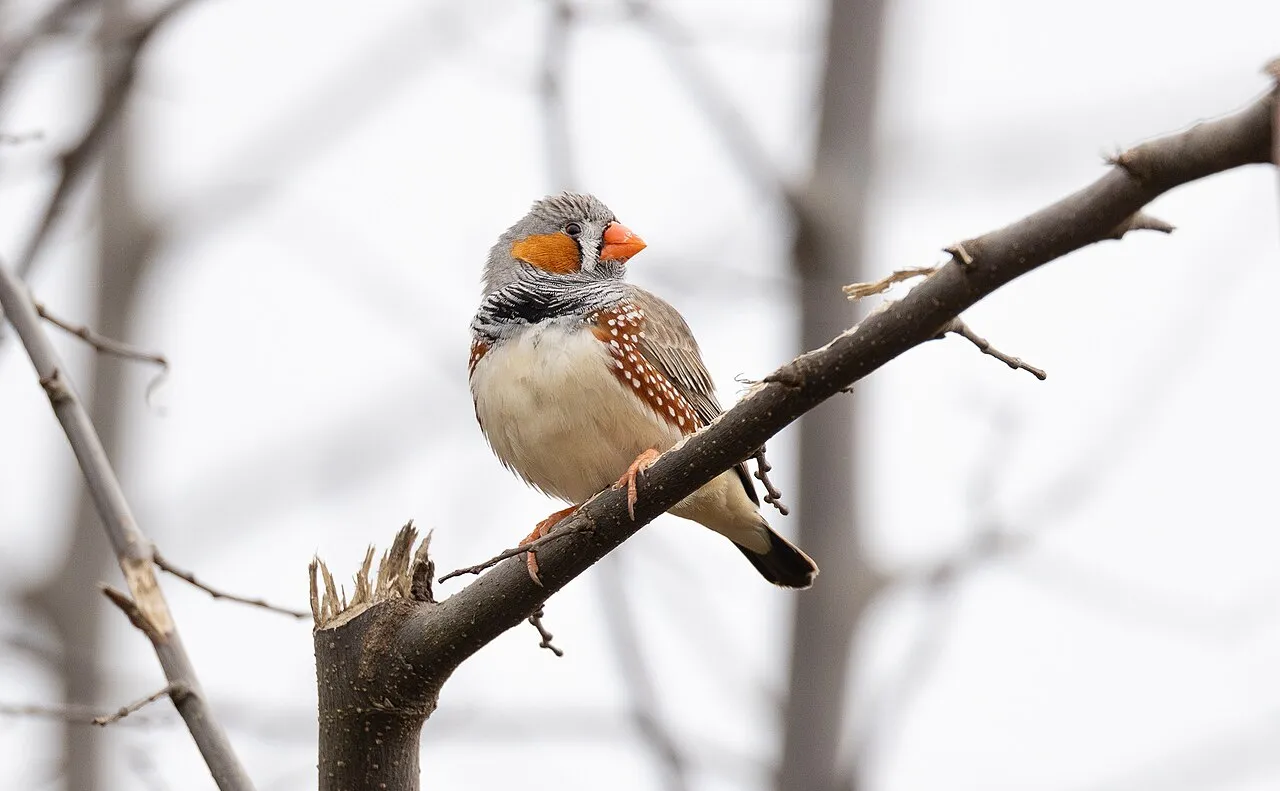
The zebra finch is a tiny Australian bird, barely 10 cm long, with a coral-red beak and a black-and-white 'teardrop' stripe beneath each eye. Males add bright orange cheek patches, chestnut flanks speckled with white and a finely barred throat and chest, the zebra stripes that give the species its English name.
Small, hardy and simple to feed and house, zebra finches are often recommended as a first bird. Pairs sit pressed together, chatting in little toy-trumpet beeps, and males repeat their short songs countless times a day. They are birds for watching rather than handling: most never become comfortable on a human hand, but a pair or small group going about its business is endlessly entertaining.
The zebra finch is also a scientific celebrity. Young males learn their songs by listening to their fathers, a process with intriguing parallels to how human babies learn to speak, and laboratories around the world use the species to study vocal learning and the brain. This article covers classification, history, appearance and colour mutations, behaviour, housing, diet, health, managing breeding, costs and the law.
2. Name and classification
2.1. Scientific name
The scientific name is Taeniopygia guttata. Taeniopygia combines Greek words for 'band' and 'rump', referring to the black-and-white barred upper tail, and guttata is Latin for 'spotted', after the male's white-dotted flanks. It belongs to the waxbill family, Estrildidae, which also includes the Java sparrow, society finch and Gouldian finch.
2.2. Australian and Timor zebra finches
There are two populations: one across mainland Australia and one on the Lesser Sunda Islands of Indonesia, including Timor. Virtually all pet zebra finches derive from the Australian population. Some recent taxonomies split them into two species, calling the Australian bird Taeniopygia castanotis and reserving Taeniopygia guttata for the island form, so you may see either name depending on the source.
2.3. The Korean name
The Korean name geumhwajo is written with characters meaning brocade, flower and bird, the same characters used in Japanese, a nod to the bird's ornate markings. Korean keepers also call it simply geumhwa or use the English 'zebra finch'.
3. History
3.1. From the Australian outback to the world
Zebra finches reached Europe around the nineteenth century and, thanks to how readily they breed, spread quickly. Australia has strictly limited commercial export of its native birds since about 1960, so the world's pet zebra finches are mostly descendants of birds bred in captivity for many generations. Over that time breeders developed numerous colour mutations, and in Britain and elsewhere a dedicated exhibition scene grew up around the species.
3.2. A model organism for science
From the late twentieth century the zebra finch became the leading laboratory species for studying birdsong. A young male memorises his father's song during a sensitive period in his first weeks and months, then practises until he produces his own version. The brain circuits involved are well mapped, making the species valuable for research on vocal learning, memory and neural development, and its genome was published in 2010.
3.3. Zebra finches in Korea
In Korea the zebra finch has long been a fixture of bird shops alongside Java sparrows, society finches and canaries. Exactly when it arrived is not well documented, but its low price and easy care made it a common first bird for children and a classroom pet. Today most birds sold are bred domestically.
4. Physical characteristics
Diego Delso · CC BY-SA 3.0
4.1. Size and appearance
| Measure | Typical range | Notes |
|---|---|---|
| Length | 10–11 cm | Including tail |
| Weight | 12–16 g | Show lines a little larger |
| Beak | Coral red to orange | Adults; juveniles have black beaks |
| Tail | Barred black and white |
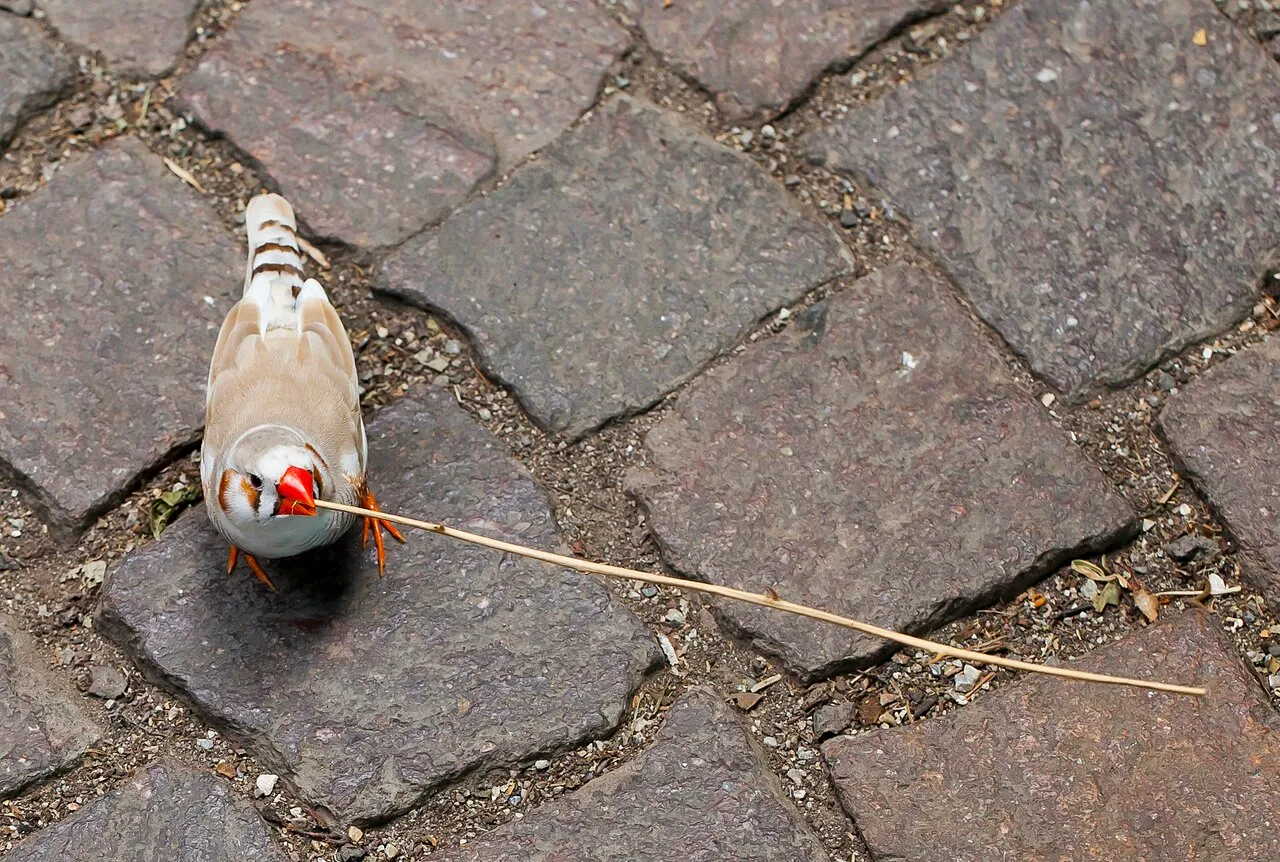
Zebra finches are small and plump with a short, conical beak perfect for husking tiny grass seeds. Legs are orange, and a vertical black stripe edged with white runs below each eye like a teardrop.
4.2. Telling males from females
Zebra finches are easy to sex. Mature males have orange cheek patches, chestnut flanks with white spots, fine black barring on the throat with a black breast band, and a deeper red beak. Females lack these markings, are plain grey-brown and have a more orange beak. Only males sing.
Juveniles of both sexes look like females with black beaks. Between roughly six and ten weeks the beak reddens and young males begin to show their markings. In white and some other mutations the markings are faint or absent, so beak colour and song are the main clues.
4.3. Senses and voice
Like most small birds, zebra finches have sharp eyesight and hearing and startle easily at shadows or sudden movement. Their basic call is a short nasal beep used to stay in touch with a mate or flock. A male's song is a brief phrase of about a second, repeated in bouts, and each male sings essentially the same song for life. None of this is loud, but it goes on all day, which some people find wearing.
5. Colour mutations
A long history in captivity has produced many colour mutations, including:
| Mutation | Appearance | Notes |
|---|---|---|
| Normal (wild type) | Grey body; males with orange cheeks and barring | The commonest |
| White | All white with a red beak | Hard to sex visually |
| Fawn | Soft brown instead of grey | Sex-linked inheritance |
| Black-cheeked | Black instead of orange cheek patches | |
| Penguin | White chest and belly, reduced barring | |
| Chestnut-flanked white | White body with colour remaining on male flanks and cheeks | |
| Black-breasted | Expanded black breast markings | |
| Pied | Irregular white patches | No two alike |
| Crested | A crest of feathers on the head | Pairing two crested birds is reported to cause problems |
Names and standards differ between countries and societies. Breeders usually pair crested birds with non-crested ones, because crested-to-crested pairings are associated with health problems in chicks.
6. Behaviour
Leoxiong · CC BY-SA 4.0
6.1. In the wild
Wild zebra finches live in flocks in the dry grasslands, scrub and waterholes of inland Australia. They feed mainly on fallen grass seed and visit water several times a day. Breeding is opportunistic: when rain brings a flush of seeding grass they nest almost regardless of season. Pairs typically stay together for life.
6.2. At home
At home a pair sits side by side, preening each other and exchanging soft calls. Males often perform a courtship dance for the female, standing tall, hopping side to side and singing. Given nesting material they carry it busily, and given a nest they sleep in it together.
Zebra finches prefer to keep their distance from people. A hand in the cage sends them to the far side, and being caught is very stressful. Placed where people pass regularly, though, they soon get used to human presence and relax enough to behave naturally while you watch.
6.3. Reading the signals
- Exchanging short beeps: everyday contact with a mate
- Male standing tall, feathers puffed, hopping and singing: courtship
- Sitting pressed together and preening: a strong bond
- Sleeked feathers and a thin, upright posture: frightened or alert
- Rapid, sharp repeated calls: alarm
- Open beak lunging at another bird: squabbling over space
- Fluffed up and hunched on the floor: unwell or cold; needs attention
7. Life stages
| Stage | Age | What happens |
|---|---|---|
| Incubation | about 12–16 days | Both parents sit on the eggs |
| Nestling | 0–3 weeks | Fed by regurgitation |
| Fledging | about 18–21 days | Leaves the nest |
| Independence | about 4–6 weeks | Feeds itself; can be separated from parents |
| Adult plumage | about 6–10 weeks | Beak reddens, male markings appear |
| Song learning | up to about 3 months | Males learn and finalise their song |
| Sexual maturity | about 3 months | Physically able to breed, though later is better |
| Senior | from about 5 years | Duller plumage, less activity |
Captive zebra finches usually live five to eight years, and some pass ten. Hens bred continuously are worn out and may die young. For older birds, lower the perches and keep food and water easy to reach.
8. Housing
8.1. Cage choice and placement
Zebra finches fly back and forth rather than climbing, so a long rectangular cage beats a tall one. For a pair, aim for at least 60 × 35 × 40 cm; for a group, consider a cage a metre or more long or an indoor flight. Bars must be 1 cm apart or less. Round cages offer no flight path and are not recommended.
Position the cage around eye level with one side against a wall for security, away from direct sun, draughts, kitchen fumes and the reach of cats.
8.2. Temperature, humidity and light
Coming from arid inland Australia, zebra finches tolerate warmth and dry air fairly well; indoors, 18–28°C and 40–60% humidity suit them. Avoid rooms that drop below about 15°C and sudden temperature swings. They need ten to twelve hours of darkness, so cover the cage at dusk. Very long artificial days encourage breeding, so avoid them if you don't want chicks.
8.3. Equipment checklist
- Long cage, at least 60 × 35 × 40 cm for a pair, bars 1 cm apart or less
- Two to four perches of different diameters, placed at each end
- Two seed dishes, ideally hopper-style to limit husk build-up
- Water dish or bottle and a bath
- Oyster shell grit or cuttlebone
- Floor paper or sand sheets
- A swing, as long as it doesn't block the flight path
- A nest, only if you intend to breed
- Night cover
- Small carrier
9. Diet
9.1. Staple diet
The staple is a finch seed mix of small seeds such as white and yellow millet, Japanese millet and canary seed. Adding some finch pellets can improve nutritional balance. Husks pile up on top of the dish and make it look full when it is actually empty, so blow or sieve them off daily and top up with fresh seed. A bird this small can get into trouble after only a few hours without food.
9.2. Greens, egg food and calcium
Offer finely chopped greens such as bok choy, Japanese mustard spinach and broccoli a few times a week, with millet sprays as a favourite treat. Egg food, either finely mashed hard-boiled egg or a commercial mix, once or twice weekly and more often during moult or breeding, provides extra protein. Keep oyster shell grit or cuttlebone available at all times, since calcium is vital, especially for laying hens.
9.3. Amounts
| Item | Approximate amount per bird | Frequency |
|---|---|---|
| Seed mix | 1–2 small teaspoons | Top up daily; never let it run out |
| Greens | A few fingernail-sized pieces | 3–4 times a week |
| Egg food | Half a teaspoon | 1–2 times a week, more when breeding or moulting |
| Millet spray | A short piece | 1–2 times a week |
| Grit or cuttlebone | Always available | |
| Water | Always available | Fresh daily |
9.4. Foods to avoid
- Avocado
- Chocolate, coffee and alcohol
- Onion and garlic
- Salty or seasoned food, biscuits and bread crumbs
- Damp, mouldy or stale seed
- Unwashed vegetables that may carry pesticide residues
Not a food, but equally important: avoid thread, pet hair and cotton fibres as nesting material, since they wrap around toes and cut off circulation.
10. Health and disease
10.1. Common problems
| Condition | Cause | Signs | Prevention and response |
|---|---|---|---|
| Air sac mites | Microscopic mites in the airways | Clicking breathing, open-mouth breathing, changed song | Quarantine new birds, vet care |
| Egg binding | Low calcium, excessive laying, hens too young | Hunched on the floor, straining with tail pumping | Calcium, limit breeding, urgent vet |
| Overgrown claws or beak | Perch type, nutrition, age | Difficulty gripping or eating | Varied perches, regular trims |
| Constricted toes | Thread or hair nesting material | Swollen or dying toes | Safe nesting material |
| Enteritis and diarrhoea | Bacteria, dirty water or food | Loose droppings, soiled vent | Daily water change, hygiene |
| Feather mites and lice | External parasites | Itching, feather damage | Cleanliness, vet treatment |
| Hypothermia | Cold room or illness | Fluffed and hunched | Warm room, supportive heat |
Tiny birds have minimal energy reserves, so once a zebra finch falls ill it can go downhill within hours.
10.2. When to see a vet
- Sitting fluffed and sleepy on the floor or a perch
- Tail bobbing with each breath or clicking sounds
- Sitting at the seed dish without actually eating
- Loose or discoloured droppings and a dirty vent
- A hen on the floor straining without passing an egg
- Swollen or discoloured toes
- Sudden silence in a singing male or a changed voice
If you see these signs, keep the bird warm, around 28–30°C, and contact an avian vet straight away. Few clinics treat very small birds, so find one in advance.
11. Breeding
Zebra finches are among the easiest of all pet birds to breed. Give a pair a nest and some material and laying soon follows, typically four to six eggs per clutch. Both parents incubate for about two weeks, chicks fledge at around three weeks and are independent by four to six. Parents often start the next round immediately.
That ease is the real management challenge. A hen that lays without a break exhausts her calcium and condition, risking egg binding and an early death. A common recommendation is to wait until hens are nine to twelve months old and limit them to two or three clutches a year. Every round of chicks also means more cages and more homes to find.
If you don't want to breed, keep same-sex birds or simply don't provide a nest. Swapping eggs for dummies and removing them later can help, but if a hen keeps laying, ask your avian vet.
12. Costs
Rough 2026 ranges in Korea for a pair:
| Item | Estimated cost (KRW) | Notes |
|---|---|---|
| Birds | around 10,000–30,000 each | Mutations can cost more |
| Cage | 40,000–120,000 | Long style |
| Perches, dishes, bath | 20,000–50,000 | |
| Cover, carrier, floor liners | 20,000–40,000 | |
| First vet check | 20,000–80,000 | Avian clinic |
| Start-up total (excluding birds) | about 100,000–250,000 | |
| Monthly seed, egg food and greens | 5,000–15,000 | |
| Monthly liners and supplies | 5,000–10,000 | |
| Emergency care | tens to hundreds of thousands | Egg binding and the like |
Running costs are low, but if your finches breed, cage space and food costs multiply quickly.
13. Before you get one
- Numbers and sexes: keep at least two; choose same-sex birds if you don't want chicks.
- Sexing: juveniles are hard to sex, so choose birds whose beaks have reddened and whose markings have appeared.
- Health: smooth feathers, bright eyes, a clean vent and silent breathing. Avoid any bird sitting fluffed and sleepy.
- Feet: check that all toes are intact and claws are not overgrown.
- Quarantine: if you already keep birds, house newcomers in a separate room for several weeks first.
- Expectations: if you want a bird that sits on your hand, a budgie or cockatiel is a better match.
- Sound: make sure all-day soft beeping won't bother you.
- Vet: locate a clinic that treats small birds before you need it.
14. Laws and regulations
Zebra finches are not listed on the CITES appendices and are kept without special permits in most countries. A few points are still worth knowing:
- Australia tightly controls the export of its native wildlife, so the world's pet zebra finches are captive-bred stock, and buying domestically bred birds is the norm.
- Importing birds into most countries involves veterinary certificates and quarantine, largely because of avian influenza risk.
- During outbreaks of highly pathogenic avian influenza, authorities may restrict bird fairs, sales or movements, even for pet birds.
- In some jurisdictions, keepers of exotic or non-native species must register or follow welfare codes; check local rules if you plan to keep a large flock or sell birds.
- Never release pet finches outdoors. In most climates outside Australia they will not survive, and release may count as abandonment.
In Korea zebra finches need no registration, but breeding for sale may fall under pet-business licensing rules.
15. Zebra finches in culture
Zebra finches rarely star as cartoon characters, but they are regulars in science documentaries and news as the bird that learns to sing. Stories about young males copying their fathers, and studies suggesting that sleeping finches' brains replay songs heard during the day, have made them familiar to readers of popular science.
In Australia they are a beloved emblem of the inland grasslands, a favourite of birdwatchers and photographers. In Korea they have long been a bird-shop staple alongside Java sparrows and society finches, valued as an easy small bird, and have featured in school lessons on animal reproduction and growth.
16. Trivia
- A male zebra finch crystallises his song from what he hears in his first months, then sings essentially the same tune for life. Males raised hearing a foster father's song tend to copy that instead.
- Studies suggest females prefer males that sing better or more often.
- Zebra finches can survive on remarkably little water for their size, one reason they thrive in the arid interior.
- A famous experiment found that females preferred males fitted with red leg rings over green ones, a result often cited in research on mate choice.
- In the wild they build a domed ball of woven grass with a side entrance, and captive birds given material will build something similar.
- The zebra finch genome, published in 2010, was among the first bird genomes sequenced, after the chicken.
Health notes are general information. If something seems wrong, contact a vet who treats this species.
FAQ
How do I tell males from females?
Mature males have orange cheek patches, chestnut flanks with white spots, a barred throat and they sing. Females are plain grey-brown. Some colour mutations are harder to sex.
Can zebra finches be hand-tamed?
A few hand-raised birds become tame, but most prefer to keep their distance. For a hands-on bird, a budgie or cockatiel is a better fit.
How do I stop them breeding?
Keep same-sex birds or don't provide a nest. Swapping eggs for dummies can help, but hens may keep laying, so ask your avian vet.
Photo credits
Photos are freely licensed images from Wikimedia Commons. Authors and licenses are listed below.
- Zebra finch group.png — see source · CC BY 2.5
- Australian Zebra Finch 0A2A3013.jpg — JJ Harrison · CC BY-SA 3.0
- Pinzón cebra (Taeniopygia guttata), Tierpark Hellabrunn, Múnich, Alemania, 2012-06-17, DD 04.JPG — Diego Delso · CC BY-SA 3.0
- Zebra Finch in Richmond Lowlands, 2023.jpg — Leoxiong · CC BY-SA 4.0