TailVille
1. Overview
Imagine an animal that can go from a standstill to nearly 100 km/h in a few seconds. That is the cheetah (Acinonyx jubatus), the fastest land animal on Earth. Long slender legs, a whip-like spine, a small head and a lightweight frame are all tuned for a single purpose: speed. Although it is a cat, the cheetah is not a member of Panthera like lions and tigers; it is the only living species in its own genus, Acinonyx.
That extreme specialisation comes at a cost. Cheetahs are weaker than the lions, hyenas and leopards that share their savannas, so they frequently lose hard-won kills and many cubs fall victim to these predators. They also have unusually low genetic diversity, which leaves them vulnerable to disease and change.
Cheetahs once roamed most of Africa, the Middle East and India. Today they survive mainly in eastern and southern Africa, with only a handful left in Asia, in central Iran. The IUCN lists the species as Vulnerable, though some scientists argue its small, declining numbers warrant a higher threat category.
2. Name and classification
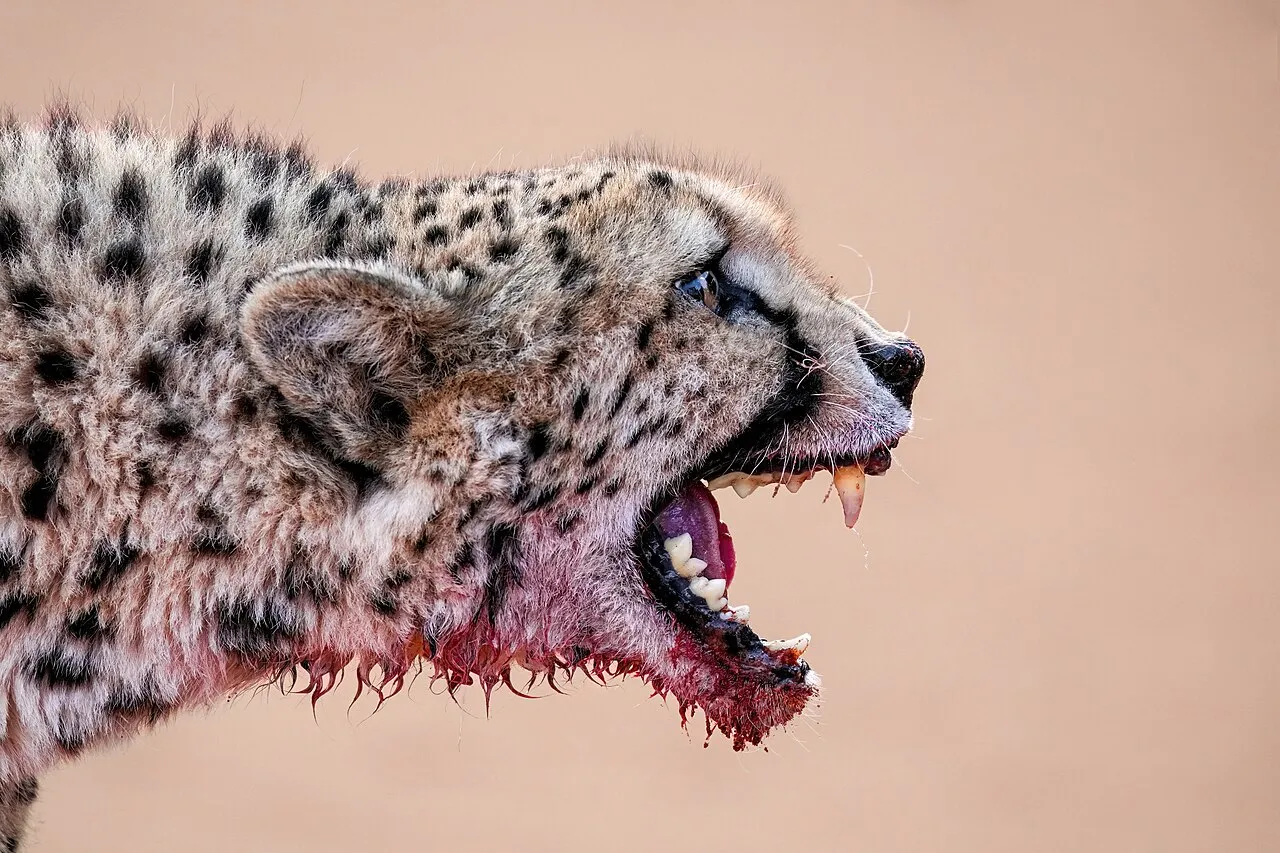
The English word cheetah comes from Hindi chītā, derived from a Sanskrit word meaning 'spotted' or 'variegated'. The British adopted the name in India, where cheetahs were long kept for hunting.
The genus name Acinonyx is usually translated from Greek as 'unmoving claw', referring to claws that cannot be fully sheathed like those of other cats. The species name jubatus is Latin for 'maned', probably a nod to the long, fluffy mantle of hair on a young cheetah's neck and back.
Within the cat family, cheetahs belong to the puma lineage along with the puma and the jaguarundi. Despite looking like leopards, cheetahs are actually more closely related to the cougars of the Americas.
2.1. Subspecies
Subspecies boundaries are debated, but in 2017 the IUCN Cat Specialist Group recognised four.
| Subspecies | Range | Situation |
|---|---|---|
| Southeast African cheetah (A. j. jubatus) | Southern and eastern Africa | Most numerous |
| Northeast African cheetah (A. j. soemmeringii) | Ethiopia, South Sudan and nearby | Poorly known due to conflict |
| Northwest African cheetah (A. j. hecki) | Sahara and Sahel | Very few, critically threatened |
| Asiatic cheetah (A. j. venaticus) | Central Iran | Probably only a few dozen or fewer |
The rare king cheetah, with bold stripes and blotches along its back, was once thought to be a separate species. It turned out to be a coat-pattern variant caused by a single recessive gene, the same gene linked to blotched tabby patterns in house cats.
3. Evolution
For years the cheetah's origins were tied to a striking American fossil. Miracinonyx, a Pleistocene cat of North America, looked remarkably cheetah-like, prompting the idea that cheetah ancestors arose in the Americas and crossed into Asia and Africa. Later genetic and anatomical work suggested Miracinonyx was closer to the puma, and its cheetah-like build is now widely seen as convergent evolution, similar bodies evolving independently for similar lifestyles.
The prevailing view is that the puma lineage's ancestors moved between the Americas and the Old World, and that the cheetah line became established in the Old World. Acinonyx fossils appear in Africa and Eurasia from roughly three million years ago, including the giant cheetah (Acinonyx pardinensis) of Europe and China, which may have approached a lion in weight.
Modern cheetahs' low genetic diversity is explained by population bottlenecks. Around the end of the last Ice Age, about 10,000 years ago, when many large mammals went extinct, cheetahs appear to have crashed to very small numbers before recovering, and some studies point to an earlier bottleneck around 100,000 years ago. In the 1980s researchers famously found that cheetahs could accept skin grafts from unrelated individuals with little rejection, a sign of how genetically similar they are.
4. Range and habitat
Most of today's cheetahs live in southern and eastern Africa. Nearly half are found in a band across Namibia, Botswana, Zimbabwe and South Africa, while the Serengeti–Mara ecosystem of Kenya and Tanzania is another stronghold. Tiny, scattered populations persist in the Sahara and Sahel, in countries such as Algeria, Niger and Chad.
Cheetahs favour open grassland, savanna and sparse semi-desert scrub, where they can see prey from afar and sprint without obstacles. They are more adaptable than often assumed, living on Namibian ranchland and in the arid mountains and rocky terrain of Iran, but they generally avoid dense forest.
Their range has shrunk dramatically, to roughly a tenth of its historic extent by some estimates. Cheetahs were declared extinct in India in the early 1950s and disappeared from Arabia and Central Asia during the 20th century. A large share of surviving cheetahs live outside protected areas, on farms and ranches, partly because parks crowded with lions and hyenas are actually hostile places for them. That makes their future heavily dependent on how they get along with people.
5. Body
A cheetah is built like a sprinter. A deep chest houses a large heart and lungs, the waist is narrow and the legs are long and slender. Its head is small and rounded relative to its body, reducing drag.
| Measure | Value |
|---|---|
| Head and body | about 1.1–1.5 m |
| Tail | about 60–85 cm |
| Shoulder height | about 70–90 cm |
| Weight | about 21–65 kg (males slightly heavier) |
| Top speed | about 93–104 km/h (measurements vary) |
| Acceleration | roughly 0 to 90 km/h in around 3 seconds |
The coat is tawny with roughly 2,000 solid black spots, each 2–3 cm across. Toward the end of the tail the spots merge into black rings, and the tip is white. Distinctive black 'tear lines' run from the inner eye to the mouth, thought to reduce glare and help the cheetah focus on distant prey in bright sunlight.
5.1. The secrets of speed
Many features combine to make the cheetah fast. Its exceptionally flexible spine coils and uncoils like a spring, stretching each stride to around 6–7 metres at full speed, with roughly three to four strides per second. Twice in each stride cycle all four feet leave the ground.
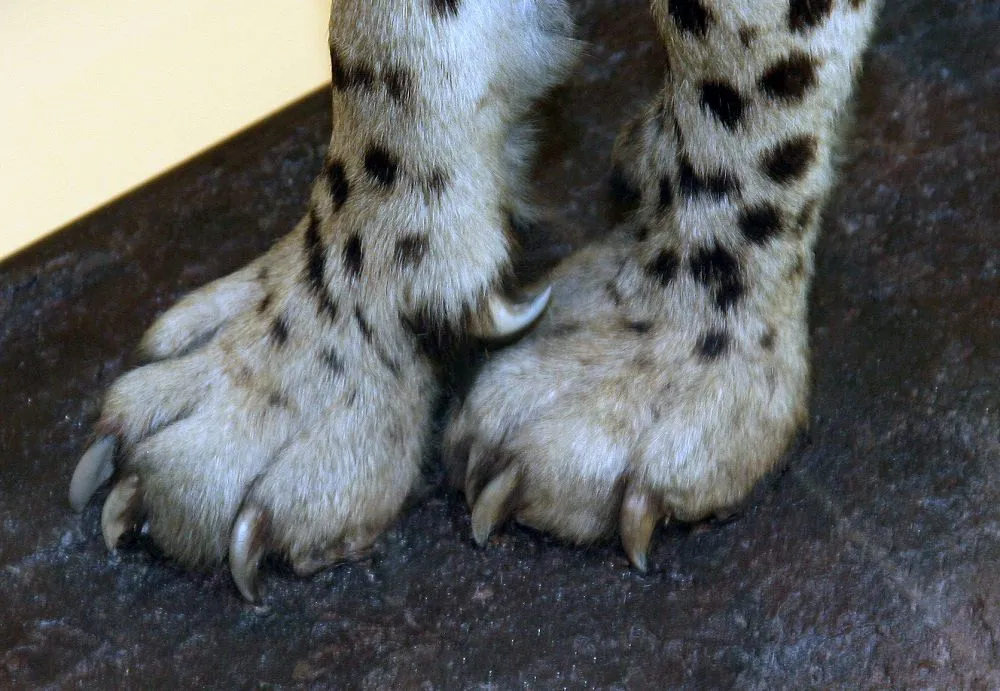
Its semi-retractable claws act like running spikes, and its hard, ridged foot pads resist slipping. The trade-off is blunt claws that are poor for climbing or holding prey, except for the sharp dewclaw on each front leg, which is used to hook and trip a fleeing animal.
A long, flattened tail works as a rudder and counterweight, swinging to balance the cheetah as it follows a gazelle's sudden turns. Enlarged nostrils and nasal passages pull in air during the sprint, and relatively small canine roots leave room for those airways, letting a cheetah keep breathing while clamping its prey's throat.
Studies of collared wild cheetahs found that acceleration, deceleration and turning ability matter more for hunting success than raw top speed. The cheetah is less a drag racer than a nimble sports car.
6. Behaviour and ecology
Unlike lions and leopards, cheetahs are mostly active by day, especially in the early morning and late afternoon. This is thought to help them avoid lions and hyenas, which are most active at night. In the midday heat they rest in shade, and they often climb termite mounds or fallen trees to scan their surroundings.
Cheetah society is unusual even among cats. Females are solitary except when raising cubs and roam huge home ranges of several hundred to over 1,000 km². Males, by contrast, often live in lifelong coalitions of two or three, usually brothers, though unrelated males sometimes join. Coalitions are more likely to win and hold territories and can tackle larger prey together; a five-male coalition in Kenya's Maasai Mara became famous for exactly that.
Territorial males defend relatively small areas and leave urine and dung on prominent trees and rocks. In East Africa these 'marking trees' are used by many cheetahs in turn, functioning like a community noticeboard. Males without territories wander widely, much like females.
7. Diet and feeding
Cheetahs mainly hunt small to medium antelopes of around 20–60 kg. In East Africa their classic prey is Thomson's gazelle; in southern Africa it is impala, springbok and young kudu. They also take hares, birds and warthog piglets, while male coalitions tackle young wildebeest and zebra and sometimes adult wildebeest.
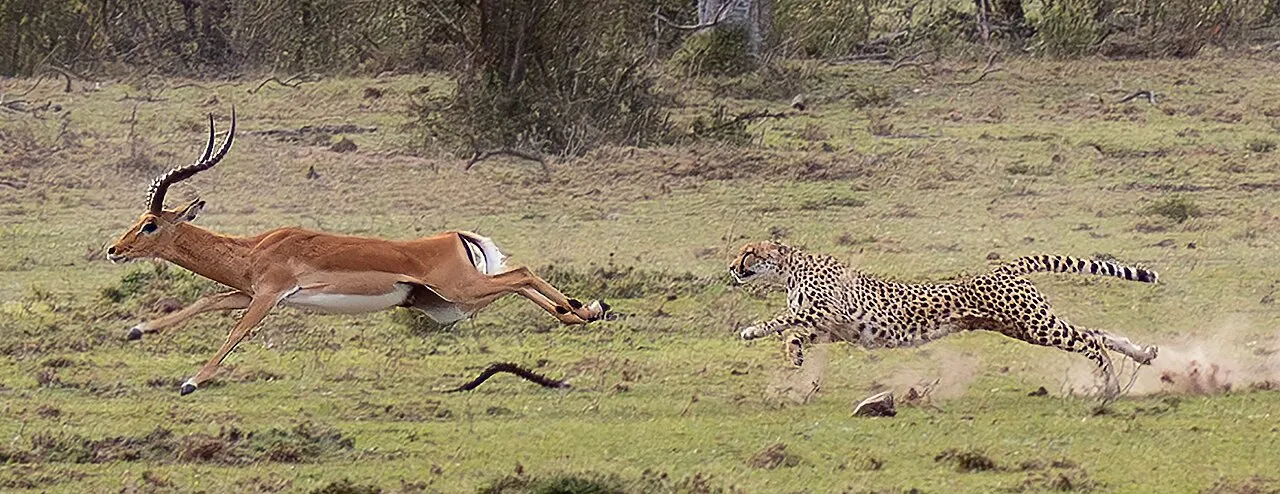
Hunting relies on eyesight. A cheetah picks a target from a vantage point, then stalks low to within about 50–100 metres before exploding into a sprint. It knocks the animal off balance by swiping at its hindquarters with the dewclaw, then clamps its throat, suffocating it over several minutes. Success rates vary but are often around 40–50%, high for a big cat.
The dangerous part comes afterwards. After a sprint a cheetah must rest, panting and overheated, for anywhere from a few minutes to half an hour. If lions, hyenas, leopards or even a crowd of vultures arrive, it usually abandons the carcass; some studies suggest 10–15% of kills are lost this way. So cheetahs eat fast, rarely linger at a carcass like lions do, and seldom scavenge.
Cheetahs can go long periods without drinking. In the Kalahari they may drink only every few days, getting moisture from blood and body fluids and sometimes from desert melons.
8. Reproduction and life cycle
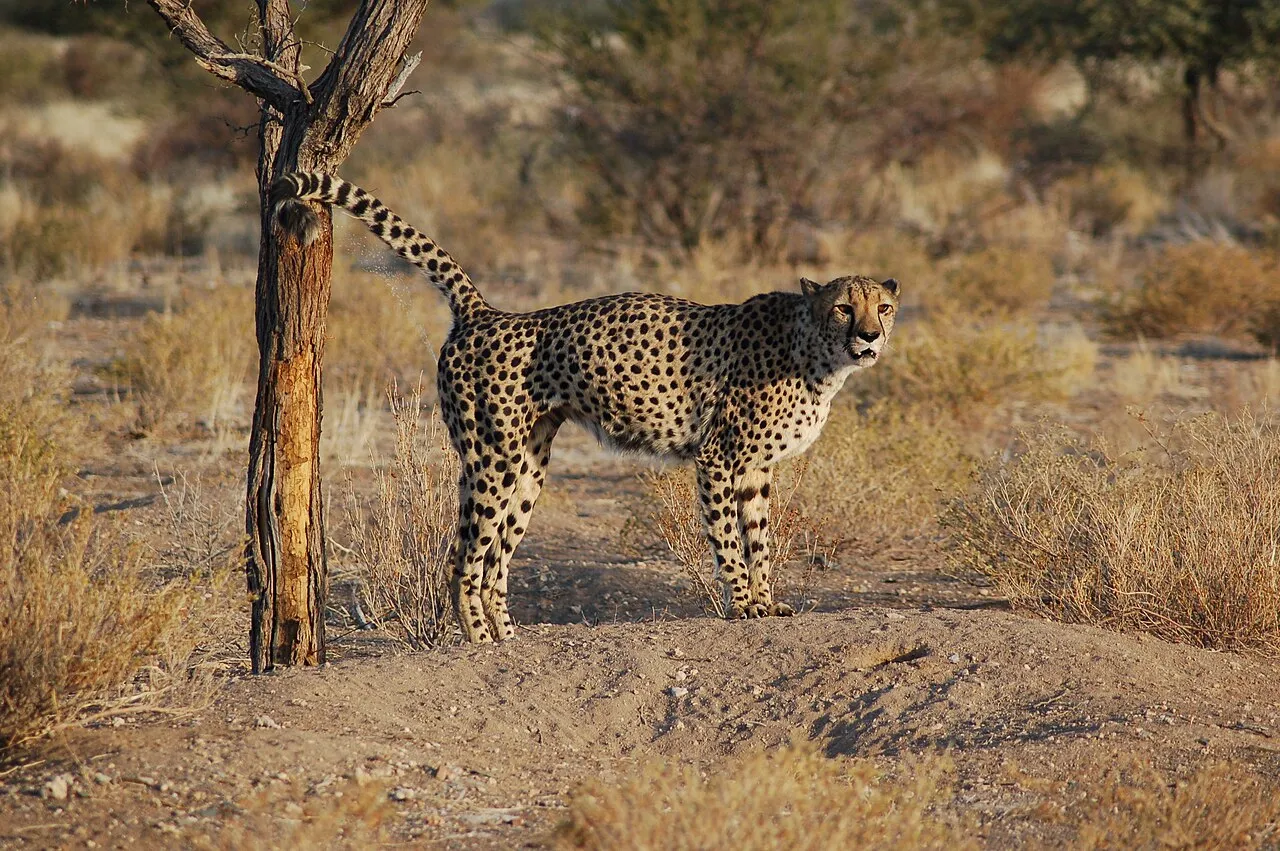
Joachim Huber · CC BY-SA 2.0
Cheetahs breed at any time of year. When a female comes into oestrus, males track her by scent and mating takes place over a short period. Females may mate with several males, and litters often have more than one father, which may help offset the species' low genetic diversity.
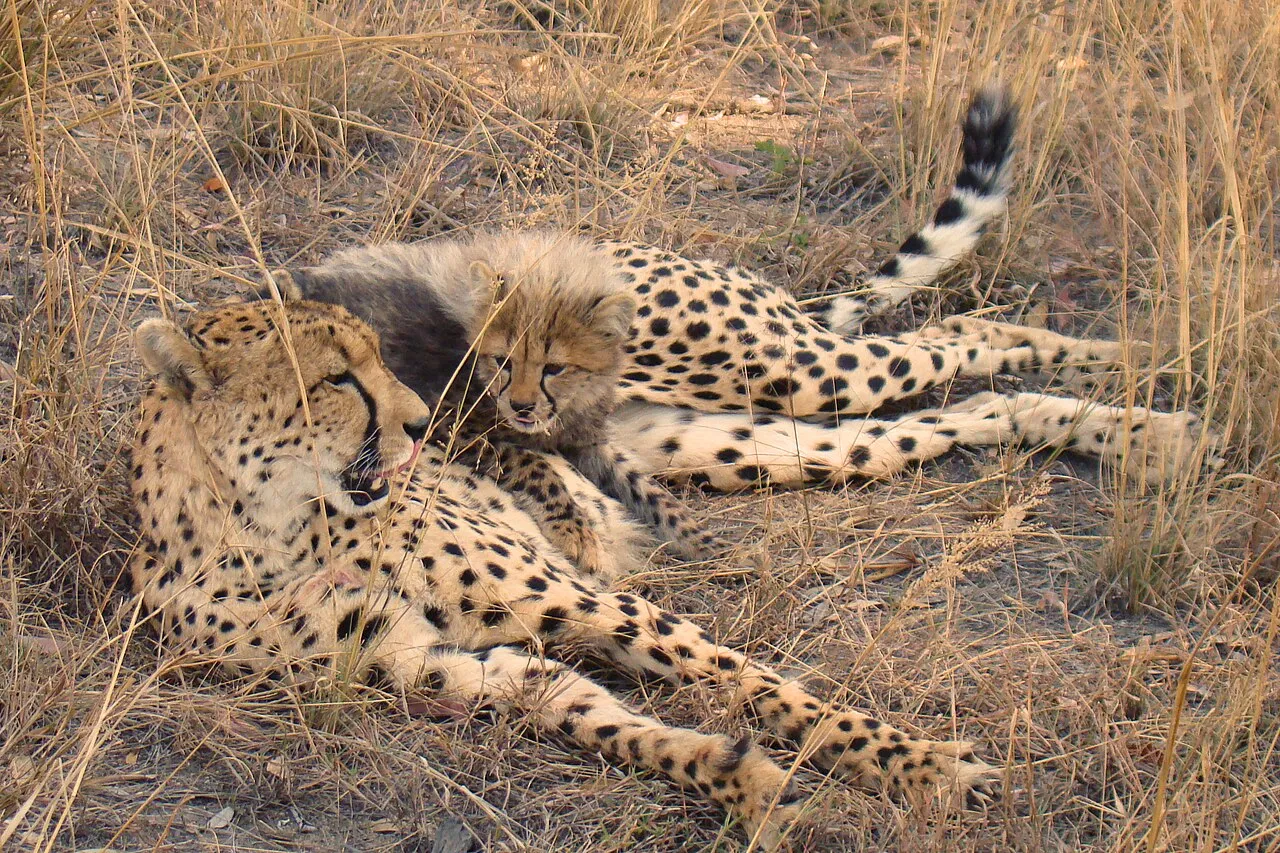
Gestation lasts about 90–95 days. In tall grass or a rocky hollow, the female gives birth to usually three to five cubs, occasionally up to eight, each weighing around 150–300 g. Cubs have a long, silvery mantle of fur along the back, which may help them hide in grass and is sometimes said to mimic the fierce honey badger, deterring predators.
| Stage | Age | What happens |
|---|---|---|
| Den period | 0–8 weeks | Mother moves the litter every few days |
| Following mother | 2–6 months | Starts eating meat; mantle shortens |
| Learning to hunt | 6 months–1.5 years | Mother brings live prey for practice |
| Independence | 1.5–2 years | Siblings stay together a few months, then split |
| First breeding | Females 2–3 yrs, males around 3 |
Cub mortality is extreme. One Serengeti study found that over 90% of cubs died before independence, mostly killed by lions and hyenas, though survival is much higher on southern African farmland where lions are scarce. Wild cheetahs usually live 8–12 years; captive animals sometimes pass 15.
9. Intelligence, communication and special abilities
Cheetahs cannot roar. Instead they make a high, bird-like chirp, used by mothers calling scattered cubs and by coalition males keeping in touch. Unlike roaring cats, cheetahs can purr continuously like house cats. They also growl, hiss, stamp their feet and make a stuttering call around courtship.
Vision is the cheetah's key sense. Its retina has a horizontal band of densely packed visual cells, a 'visual streak', giving sharp vision across a wide stretch of horizon and allowing it to spot prey kilometres away. During a sprint its head stays remarkably steady and locked on the target, thanks to a highly developed balance system in the inner ear.
Cheetahs are also capable learners. Mothers release injured or live young gazelles in front of their cubs so they can practise catching them; early attempts are clumsy but improve with time. Captive-raised cheetahs miss out on this schooling, which is one reason reintroducing them is difficult.
10. Predators and survival
The cheetah is both predator and prey. Lions kill cheetahs on sight, often without eating them, and especially target cubs. Spotted hyenas steal kills and eat cubs, leopards kill cubs and sometimes adults, African wild dogs harass cheetahs in parts of southern Africa, and eagles can take very young cubs.
Cheetahs survive mainly by avoidance: steering clear of lion and hyena hotspots, hunting by day when those predators rest, and abandoning kills at the first sign of danger. They are small and light, and any injury to a leg quickly leads to starvation, so fighting is rarely worth it.
Disease and genetics add to the risk. With little genetic variation, a single infection can sweep through a population; in the 1980s an outbreak of feline infectious peritonitis killed many cheetahs at a captive facility in Oregon, USA. High rates of abnormal sperm have also been reported.
11. Relationship with humans
Cheetahs almost never attack people and are relatively easy to tame, so they have served as hunting companions for thousands of years. Ancient Egyptian art shows collared cheetahs, and nobles in medieval Persia and the Arab world hunted gazelles with them. The most famous enthusiast was the 16th-century Mughal emperor Akbar, said to have kept thousands over his lifetime. Hooded cheetahs were carried to the hunting grounds on carts and released when prey was sighted.
Because cheetahs bred very poorly in captivity, nearly all hunting cheetahs were captured from the wild, which helped drain populations in India and the Middle East. One often-repeated story holds that, of Akbar's thousands of cheetahs, only a single litter was born in captivity. Hunting and habitat loss finished off India's cheetahs by the early 1950s; the last three are commonly said to have been shot by a local ruler around 1947.
Today, the sharpest conflict occurs on southern African farmland, where cheetahs take goats, sheep and calves and farmers have responded with traps and guns. In the late 20th century, thousands of cheetahs are estimated to have been killed this way in Namibia alone.
In popular culture worldwide, the cheetah has become shorthand for speed, appearing in car advertisements, sports branding and countless wildlife documentaries.
12. Conservation
The cheetah is listed as Vulnerable by the IUCN. A major study around 2016 estimated roughly 7,100 cheetahs left in the wild, and other surveys have generally produced figures in the 6,500–7,500 range. The authors of that study argued for uplisting to Endangered because of rapid declines. The Asiatic and Northwest African subspecies are considered Critically Endangered; Iran's Asiatic cheetahs appear to number only a few dozen adults or fewer in the 2020s.
The main threats are:
- Habitat loss and fragmentation, devastating for an animal that needs huge areas.
- Conflict with livestock farmers and retaliatory killing.
- Loss of prey to bushmeat hunting.
- The illegal pet trade, with cubs poached in the Horn of Africa, notably Somaliland, and smuggled to the Arabian Peninsula.
- Road deaths, a leading cause of mortality for Iran's last cheetahs.
One celebrated success is the livestock guarding dog programme run by the Cheetah Conservation Fund in Namibia. Large dogs such as Anatolian shepherds protect herds, cheetahs stay away and farmers have less reason to kill them. South Africa manages cheetahs across many small fenced reserves as a 'metapopulation', moving animals between sites to maintain genetic diversity.
In 2022 and 2023 India brought cheetahs from Namibia and South Africa to Kuno National Park in Madhya Pradesh under Project Cheetah, returning the species to India after about 70 years. The project drew criticism over whether African cheetahs belong in Asia and whether the park has enough space and prey, and several animals died early on from infections and other causes, though cubs have since been born and raised there.
The cheetah is on CITES Appendix I, which prohibits commercial international trade.
13. In zoos
Cheetahs were long considered the hardest big cat to breed in captivity. Females housed permanently with males often lost interest in mating, because this ignored their solitary lifestyle in the wild. Keeping the sexes apart and introducing them only when a female is in oestrus has greatly improved breeding success.
Cheetahs need to run to stay healthy, so some zoos use lure courses, where a bait on a fast-moving line lets them sprint at full speed. Because cheetahs are nervous and stress-prone, a number of zoos raise them alongside companion dogs from a young age to keep them calm.
Ethical concerns centre on the pet cheetah culture in parts of the Gulf and on attractions where tourists pet or pose with cheetahs. Even when such places claim an educational mission, critics argue they encourage cub trafficking and indiscriminate breeding.
14. Cheetahs in culture
Worldwide, the cheetah is shorthand for speed. Chester Cheetah, the mascot of Cheetos snacks, is a famous example, and footage of sprinting cheetahs turns up in car and sportswear advertising. Sprinters and fast footballers are often nicknamed 'the cheetah'. The curved carbon-fibre running blades used by amputee athletes were inspired by the shape of a cheetah's hind leg and are often called 'cheetah blades'.
In film and animation, Zootopia features the cheerful cheetah officer Clawhauser at the police front desk, and DC Comics' Wonder Woman has a long-running villain named Cheetah. The 1989 family film Cheetah told the story of children raising an orphaned cub in Kenya.
Historically, Mughal and Persian miniature paintings often depict hunting cheetahs, and ancient Egyptians linked cheetahs with the goddess Mafdet. For many people, though, the defining image remains the slow-motion documentary sprint across the savanna.
15. Trivia
- Cheetahs were long thought to quit chases because of overheating, but body-temperature studies of wild cheetahs found that temperatures could rise more from the stress of anticipation than from the sprint itself, suggesting overheating is not the whole story.
- Cheetahs are poor climbers by cat standards, but they will clamber up leaning trees to look around.
- The silvery mantle of a cub starts shrinking at about three months, though a short crest of longer hair often remains on an adult's neck.
- A cheetah named Sarah at the Cincinnati Zoo was clocked running 100 metres in about 5.95 seconds in 2012. Usain Bolt's world record for the same distance is 9.58 seconds.
- Because they hunt mostly in daylight, cheetahs are the big predator safari visitors are most likely to see make a kill.
- The spots are visible on the skin as well as the fur.
- Some ancient and medieval writers believed cheetahs were hybrids of leopards and lions.
Wild animals are not pets. Catching, trading or keeping them is illegal in most places. If you find an injured wild animal, call your local wildlife rescue centre.
FAQ
How long can a cheetah keep up top speed?
A full sprint usually lasts 20–30 seconds over a few hundred metres. Body heat and muscle fatigue build so fast that a cheetah gives up if it hasn't caught its prey by then.
How do you tell a cheetah from a leopard?
Cheetahs have solid round spots, black tear lines and long slim legs. Leopards have rosette-shaped ring markings, a stockier body and shorter legs, and are expert tree climbers.
Don't some people keep cheetahs as pets?
Cheetahs have been kept as status pets in parts of the Gulf, but this fuels cub smuggling from the Horn of Africa, and many cubs die in transit. It is a major threat to the species and illegal almost everywhere.
Photo credits
Photos are freely licensed images from Wikimedia Commons. Authors and licenses are listed below.
- Male cheetah facing left in South Africa.jpg — AfricanConservation · CC BY-SA 4.0
- 003 Cheetah hissing after a meal in Kalahari Desert Photo by Giles Laurent.jpg — Giles Laurent · CC BY-SA 4.0
- 1. DSC 8619 69 topaz cheetah chasing impala 8 legs in air (cropped).jpg — Clayhill1 · CC BY-SA 4.0
- A little cheetah lying on his mom A.jpg — original by Lukas Kaffer (Super.lukas); picture improved and changes by Algos · CC BY-SA 3.0
- Acinonyx jubatus -Southern Namibia-8.jpg — Joachim Huber · CC BY-SA 2.0
- Acinonyx jubatus 47zz.jpg — Photo by David J. Stang · CC BY-SA 4.0