TailVille
At a glance
Rough ranges for supplies, food and electricity in Korea (USD is approximate). Purchase or adoption fees are not included.
Patient keepers with room for a large tank and the willingness to maintain it for twenty years or more.
Families wanting a handleable pet for young children, or anyone whose living situation is uncertain over the long term.
1. Overview
Semi-aquatic turtles are the turtles that live mainly in water but regularly climb out to dry their shells and soak up heat. The term describes a way of life and a style of husbandry rather than a scientific group, so it covers everything from a thumb-sized musk turtle that creeps along the bottom to a cooter whose shell grows past 30 cm.
For much of the late twentieth century, the hatchling slider in a plastic dish was the world's default 'starter reptile'. Millions were shipped from farms in the southern United States, and many of those animals ended up released into ponds and rivers when they grew. Today, as more countries restrict sliders, keepers have shifted towards musk and mud turtles, map turtles, painted turtles, cooters where legal, and Australian side-necked turtles.
Keeping one well means running a small aquatic ecosystem. Turtles eat heavily and produce far more waste than fish of a similar size, so weak filtration leads to cloudy, smelly water within days. They also need three environmental factors at once: warm water, a hot dry basking spot and ultraviolet-B light. Miss any one and digestion, shell growth and immunity suffer.
The rewards are real. Turtles learn who feeds them, paddle to the front glass at mealtimes and develop distinct habits and personalities. Lifespans of 20 to 40 years, sometimes more, make them long-term companions rather than a passing project. This article covers the main pet species, their biology and behaviour, housing, diet, common illnesses, costs, legal points and some cultural history.
2. Name and classification
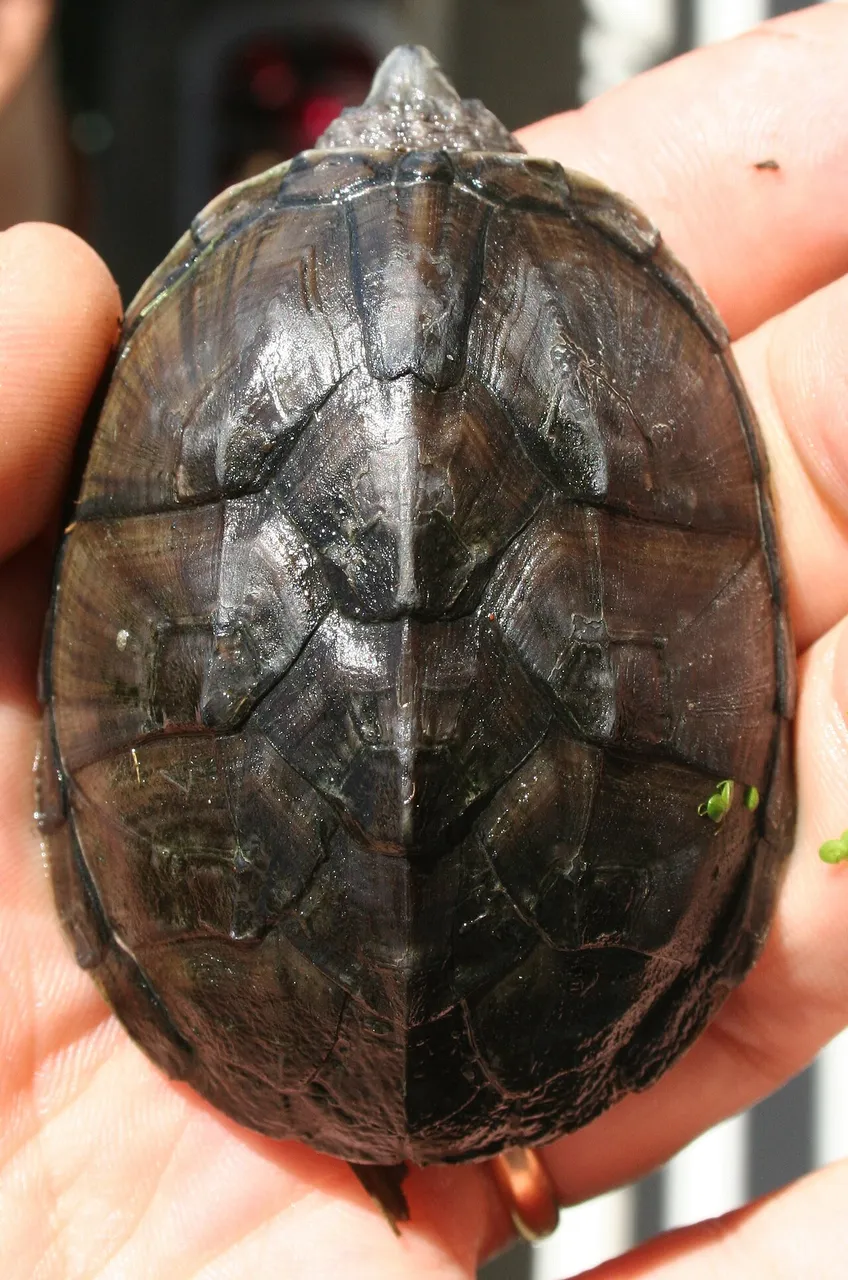
Uba~itwiki at Italian Wikipedia · CC BY-SA 3.0
2.1. Names
English draws a distinction that many languages do not. In most usage, 'turtle' can mean any member of the order Testudines, 'tortoise' refers to land-dwelling species, and 'terrapin' is used in Britain for small freshwater turtles and in North America mainly for the diamondback terrapin of brackish marshes. Keepers usually say aquatic or semi-aquatic turtle for the animals in this article.
Common names often hint at biology. Musk turtles, nicknamed stinkpots, release a strong odour from glands along the edge of the shell when grabbed. Map turtles are named for the contour-like lines on their shells, and painted turtles for their red and yellow markings. 'Cooter' is thought to come from a West African word for turtle that entered the dialects of the American South.
2.2. Taxonomy and relatives
All turtles belong to the order Testudines, which splits into two living suborders. Cryptodires, the 'hidden-necked' turtles, pull the head straight back into the shell in an S-shaped curve. Pleurodires, the side-necked turtles of the southern hemisphere, fold the neck sideways under the rim of the shell. Most pet aquatic turtles are cryptodires.
- Emydidae, the pond turtles: cooters, sliders, map turtles, painted turtles
- Kinosternidae, the mud and musk turtles: Sternotherus and Kinosternon
- Geoemydidae, Asian pond and leaf turtles, including Reeves' turtle
- Trionychidae, the softshells, with leathery, flattened shells
- Chelidae, the Austro-American side-necks, including the pink-bellied side-neck and the mata mata
Family matters in practice: a kinosternid wants shallow water and meaty food, while an adult cooter wants deep water and a mostly plant diet.
3. History
3.1. Turtle farms and the slider boom
The mass pet trade in aquatic turtles began on turtle farms in the southern United States in the mid-twentieth century. Farms in Louisiana and neighbouring states hatched red-eared sliders by the million each year and sold them as cheap novelties, often in plastic bowls with a tiny palm tree. After a wave of Salmonella infections in children, the US Food and Drug Administration banned the sale of turtles with shells under four inches in 1975, with limited exceptions.
The ban closed the domestic market but not the farms, which turned to export. Huge numbers of hatchlings went to Europe and Asia over the following decades. Released and escaped animals established themselves on every inhabited continent except Antarctica, and the red-eared slider is now on the IUCN's list of 100 of the world's worst invasive alien species.
3.2. Turtles in Korea
Korea has two native freshwater turtles: Reeves' turtle and the Chinese softshell. Reeves' turtle was once common in ponds and streams, but habitat loss and collection made it rare, and it is now protected as both a natural monument and an endangered species. Softshells have long been farmed for food and traditional medicine.
Pet turtles became a mass phenomenon in the 1980s and 1990s, when imported slider hatchlings appeared in stationery shops outside schools, street markets and tourist stalls. They were also bought in large numbers for Buddhist 'life release' ceremonies. Adult sliders soon turned up in reservoirs nationwide, and in 2001 the government listed the species as ecosystem-disturbing wildlife, later widening the listing to cover other species.
Since the 2010s, a more experienced hobby has favoured species that stay manageable, such as musk turtles, mud turtles and pink-bellied side-necks, and more keepers use large storage tubs or indoor ponds instead of glass tanks.
4. Body and anatomy
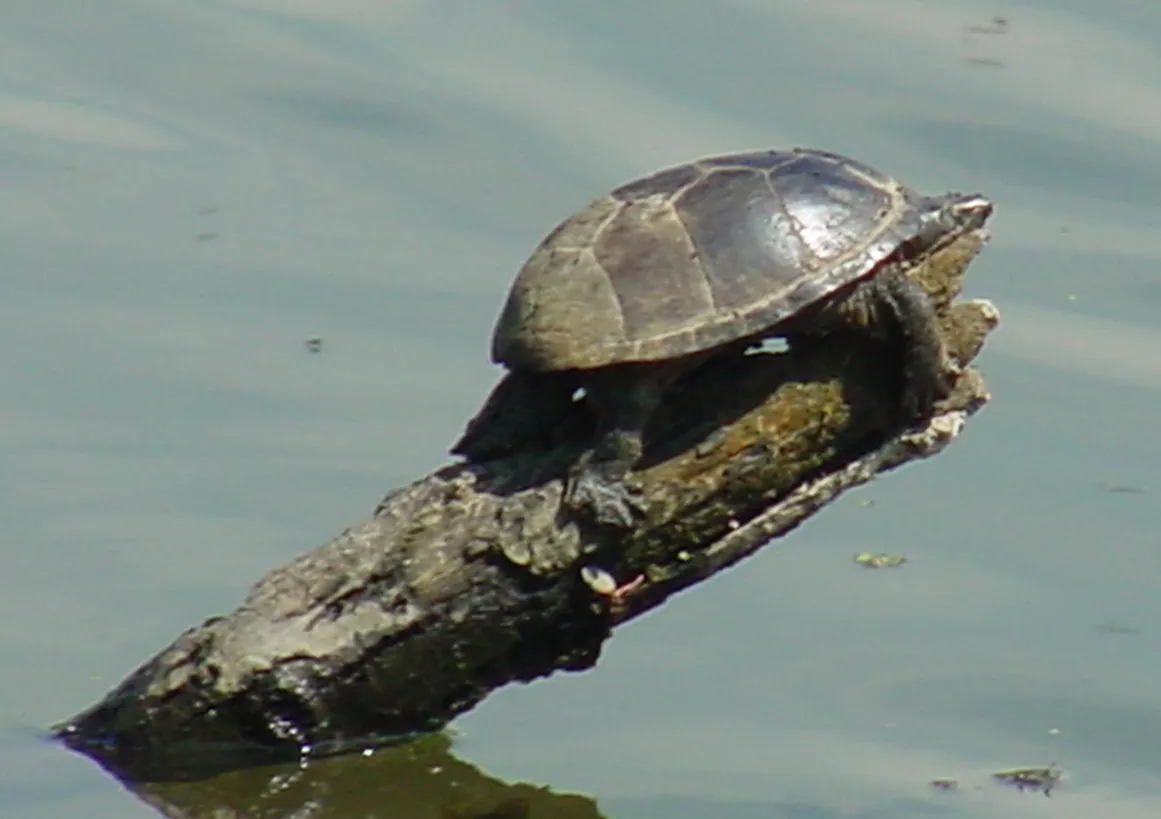
U. S. Fish and Wildlife Service - Northeast Region · Public domain
4.1. Shell
A turtle's shell is part of its skeleton. The ribs and vertebrae are fused to broad bony plates, which are covered by keratin scutes. Nerves and blood vessels run through it, so a damaged shell hurts and bleeds; it is never something the turtle can leave. The upper half is the carapace, the lower half the plastron, and the side connections are called the bridge.
Aquatic species tend to have lower, smoother, more streamlined shells than land tortoises. Some, such as map turtles and razorback musks, have a raised central keel. Pond turtles shed thin outer layers of individual scutes as they grow, which is normal and should not be confused with disease. Musk and mud turtles shed less visibly. Mud turtles have hinged plastrons that let them partly close up after withdrawing the head and limbs.
4.2. Senses and breathing
Aquatic turtles have good colour vision and are especially responsive to reds, oranges and yellows, which is why they often lunge at brightly coloured food or feeding tongs. They have no external ear opening; a thin tympanic plate behind each eye picks up low-frequency vibration, and they feel footsteps and tank disturbance more than airborne sound. The small barbels under the chin of musk turtles are thought to help them find food on the bottom.
All turtles breathe air with lungs and must surface to do so. When cold, their metabolism drops so far that they can stay submerged for long periods, and some species absorb a little dissolved oxygen through skin around the cloaca during winter dormancy. That makes water depth a safety question: a turtle should be able to reach the surface easily, and weak swimmers like musk turtles benefit from water no deeper than they can stretch to breathe.
4.3. Telling males from females
Most species can be sexed once the shell reaches about 8–10 cm.
- Tail: males have a longer, thicker tail with the vent beyond the edge of the shell; females have a short tail with the vent closer to the body.
- Plastron: male musk and mud turtles have a concave rear plastron that helps them mount females.
- Front claws: male sliders, cooters and painted turtles grow very long foreclaws, which they flutter in front of the female's face during courtship.
- Size: in most pond turtles females grow much larger; female map turtles can be roughly twice the length of males.
In many aquatic turtles, sex is set by incubation temperature rather than genes, with warmer nests generally producing more females.
5. Common pet species
The table lists the species most often kept. Sizes are typical adult shell lengths and vary with genetics and care.
| Species | Adult size | Notes | Difficulty |
|---|---|---|---|
| Common musk turtle | 8–13 cm | Bottom-walker, carnivorous | Easy |
| Razorback musk turtle | 12–15 cm | Tall, roof-shaped shell | Easy |
| Loggerhead musk turtle | 10–13 cm | Big head, strong bite | Moderate |
| Eastern mud turtle | 8–11 cm | Hinged plastron, shallow water | Easy |
| Painted turtle | 12–20 cm | Red and yellow markings, cold-tolerant | Moderate |
| Map turtles | males 8–13 cm, females 18–27 cm | Need clean, flowing water | Hard |
| Cooters | 25–35 cm | Large, herbivorous as adults | Hard (space) |
| Pink-bellied side-neck | 18–25 cm | Pink plastron, side-necked | Moderate |
| Spiny softshell | females over 30 cm | Leathery shell, needs sand | Hard |
Red-eared and yellow-bellied sliders remain common in some countries but are banned or restricted in many others, including the European Union and Korea. Even where legal, they grow to 20–30 cm and need several hundred litres of water.
For most first-time keepers, a musk or mud turtle is the sensible choice. They stay small enough to live their whole lives in a tank of around 100 litres, prefer shallow water, and are bold, active feeders. They can bite hard, though, so hold them by the rear of the shell.
6. Behaviour
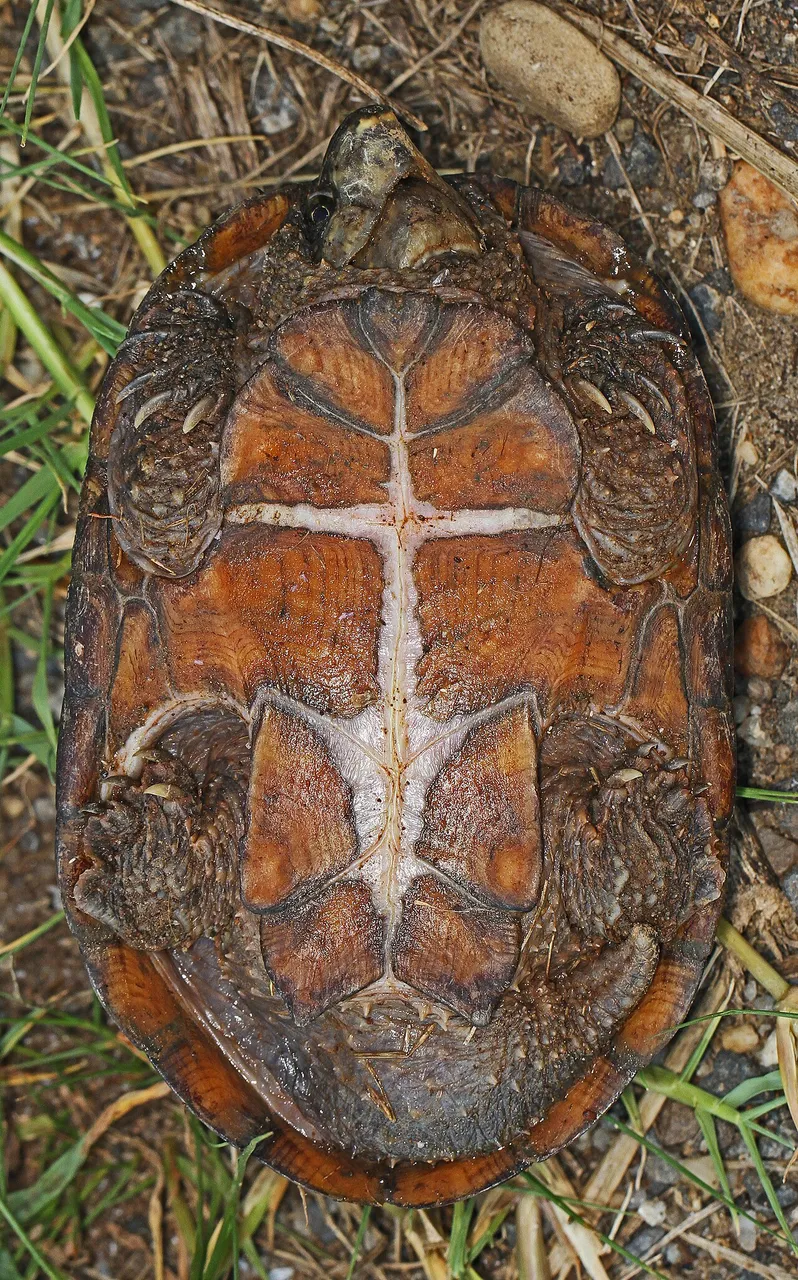
Judy Gallagher · CC BY 2.0
6.1. Life in the wild
Many pet species come from the ponds, swamps and slow rivers of eastern North America. Musk and mud turtles plod along shallow, weedy margins, probing leaf litter for snails, insect larvae, small clams and carrion. They are clumsy swimmers and rarely venture into open water.
Cooters and painted turtles are classic baskers. On sunny mornings they line up on floating logs and rocks, sometimes stacked on top of each other. Basking raises body temperature for digestion, dries the shell to discourage algae and parasites, and exposes the skin to UVB for vitamin D3 production. At the first sign of danger the whole row plops into the water. Species from temperate regions spend the winter dormant in pond-bottom mud, with their metabolism slowed to a tiny fraction of normal.
6.2. Behaviour at home
Pet turtles settle into a strikingly regular routine. When the lights come on they haul out, stretch their legs and neck under the lamp, and once warm they return to the water to forage or patrol. They learn their keeper's silhouette and footsteps quickly and will crowd the front glass, scrabbling at it with their forefeet. That begging is learned behaviour, not proof of hunger, and answering it every time is the fastest route to an obese turtle.
Very few aquatic turtles enjoy handling. Lifted out, they flail, empty their bladders, and musk turtles may release their scent or swing the neck back to bite. Keep handling to what maintenance requires. When several turtles share a tank, competition at feeding time and nipping at tails and feet are common; give generous space and visual barriers, and separate any animal that is being bullied.
6.3. Reading the signals
Turtles may look expressionless, but their behaviour says a lot.
- Basking with legs fully stretched out: relaxed and warming up.
- Never basking: the spot may be too cool, hard to climb or too exposed to people walking past.
- Refusing to leave the basking area: water may be too cold, or the turtle may be unwell.
- Swimming lopsided, or unable to dive: a classic sign of pneumonia.
- Eyes kept shut and refusing food: suspect vitamin A deficiency or poor water quality.
- A male fluttering his claws in front of another turtle's face: courtship, which can become harassment.
- A female restlessly digging on land or trying to climb out: she may be looking for a nest site, even without a male.
7. Life stages
Aquatic turtles grow slowly and live a long time. The table gives a rough outline for a small musk turtle; larger pond turtles follow a similar pattern on a bigger scale.
| Stage | Age | Size (musk) | Notes |
|---|---|---|---|
| Egg | 60–100 days to hatch | 2–3 cm egg | Temperature affects duration and sex |
| Hatchling | 0–1 year | 2–5 cm | Fastest growth, feed daily |
| Juvenile | 1–4 years | 5–9 cm | Diet settles, sex differences appear |
| Adult | 4–20 years | 8–13 cm | Breeding age, growth nearly stops |
| Senior | 20+ years | Stable | Less active, possible liver and joint issues |
Musk and mud turtles commonly live 20 to 30 years; painted turtles and cooters often reach 30 to 40 and occasionally more. Because turtles change so little outwardly, ageing is easy to miss. Watch for a gradual drop in appetite and basking, cloudy eyes, slower reactions, uneven scute shedding or soft shell edges, and steady weight loss. Weighing your turtle monthly turns vague impressions into data, and an annual check-up with a reptile vet is worthwhile once a turtle is middle-aged.
8. Housing
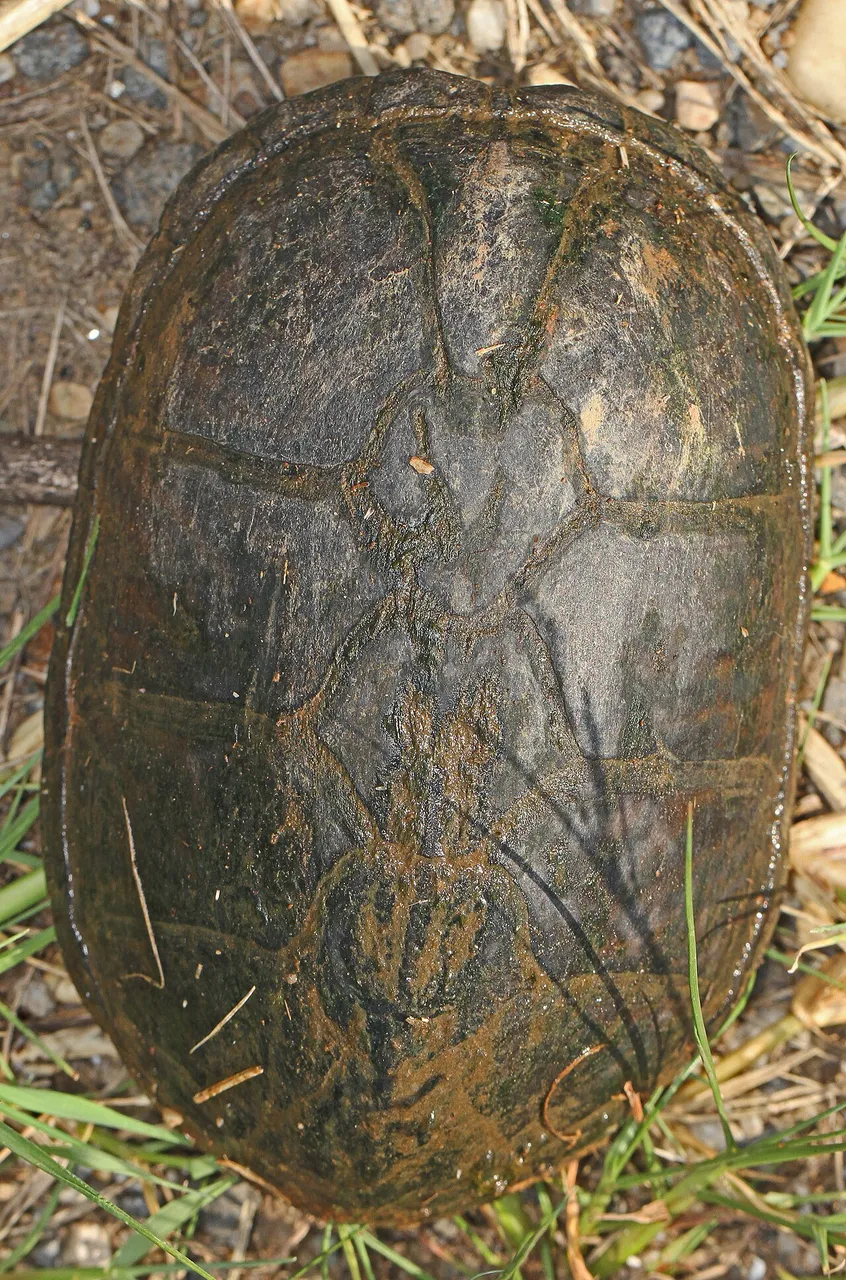
Judy Gallagher · CC BY 2.0
8.1. Tank and water
The usual rule of thumb is 10 litres of water per centimetre of shell: at least 100 litres for a 10 cm musk turtle and 250 litres or more for a 25 cm cooter. Aim for a footprint at least four to five times the shell length and two to three times its width. Large plastic tubs, stock tanks and preformed indoor ponds give far more space per pound than glass aquariums.
Match depth to the species. Musk and mud turtles do well in water one and a half to two times their shell length, with driftwood or dense plants as ladders to the surface. Cooters and map turtles are strong swimmers and appreciate depth. A bare bottom is easiest to clean; if you want substrate, use smooth river stones far larger than the turtle's head, or fine sand. Gravel small enough to swallow is a well-known cause of intestinal impaction.
Use a canister or large hang-on filter rated for two to three times the real water volume. Change 25–50% of the water weekly with dechlorinated, temperature-matched water, and test occasionally for ammonia, nitrite and nitrate.
8.2. Heat and light
Turtles are ectotherms: their body temperature follows their surroundings. Tropical and subtropical species do well with water at 25–28°C, while temperate species such as painted and mud turtles are comfortable at 22–26°C. Guard any glass heater or place it inside the filter, since a determined turtle can crack it.
The basking area must be large enough for the turtle to haul its whole body out and dry completely. Above it, a heat lamp should produce a surface temperature of 30–35°C, measured with an infrared thermometer rather than guessed. Mount a UVB tube over the same spot; a T5 5–6% tube about 30 cm above the shell, on for 10–12 hours a day, is a common arrangement, but follow the manufacturer's distance guide and replacement interval. UVB is invisible, so a lamp can still glow long after its useful output has faded.
Natural sunshine is excellent, but glass and most screening filter out much of the UVB, and an unshaded tub in summer sun can overheat in minutes.
8.3. Equipment checklist
- Tank, tub or indoor pond sized for the adult turtle
- Canister or large hang-on filter
- Submersible heater with a guard
- Basking lamp, ceramic socket and stand
- UVB tube (T5 preferred) with reflector
- Basking platform: floating dock, slate on bricks or a hang-on ramp
- Water thermometer and infrared thermometer
- Light timer
- Dechlorinator and a siphon or water-change hose
- Separate feeding tub, if you use one
- Cuttlebone and calcium powder
- Net, soft brush and cleaning gear kept apart from kitchen items
- Escape-proof lid or rim
A lid matters more than people expect. Turtles climb filter hoses and basking docks with surprising skill, and an escaped turtle on a dry floor can dehydrate fatally. Use mesh rather than glass so nothing blocks the UVB.
9. Diet
Diet depends heavily on species. Musk and mud turtles, and male map turtles, stay largely carnivorous for life. Cooters and pink-bellied side-necks shift towards plants as they mature. Every species needs more protein as a hatchling.
A quality commercial turtle pellet makes a good base. Floating sticks suit surface feeders, while bottom-feeding musk turtles find sinking pellets easier. Round this out with fresh foods suited to the species:
- Animal foods: frozen shrimp, bloodworms, mosquito larvae, snails, pieces of whole fish, insects
- Plant foods: romaine, bok choy, chicory, dandelion leaves, water lettuce, duckweed, anacharis and other aquatic plants
- Calcium: a cuttlebone floating in the tank, plus calcium powder once or twice a week
| Age | Frequency | Portion | Notes |
|---|---|---|---|
| Hatchling | Daily | About head-sized | High protein |
| Juvenile | 4–5 times a week | About head-sized | Add variety |
| Adult | 2–3 times a week | About head-sized | Herbivorous species can graze greens daily |
Turtles can only swallow underwater, so a separate feeding tub needs water too. Feeding there for 10–15 minutes keeps the main tank much cleaner.
Avoid processed and fatty meats, dog and cat food, bread, snacks and dairy, all of which cause digestive problems, fatty liver or imbalanced nutrition. Large amounts of spinach bind calcium, a diet of nothing but frozen fish can cause thiamine deficiency, and live feeder goldfish can carry parasites.
10. Health
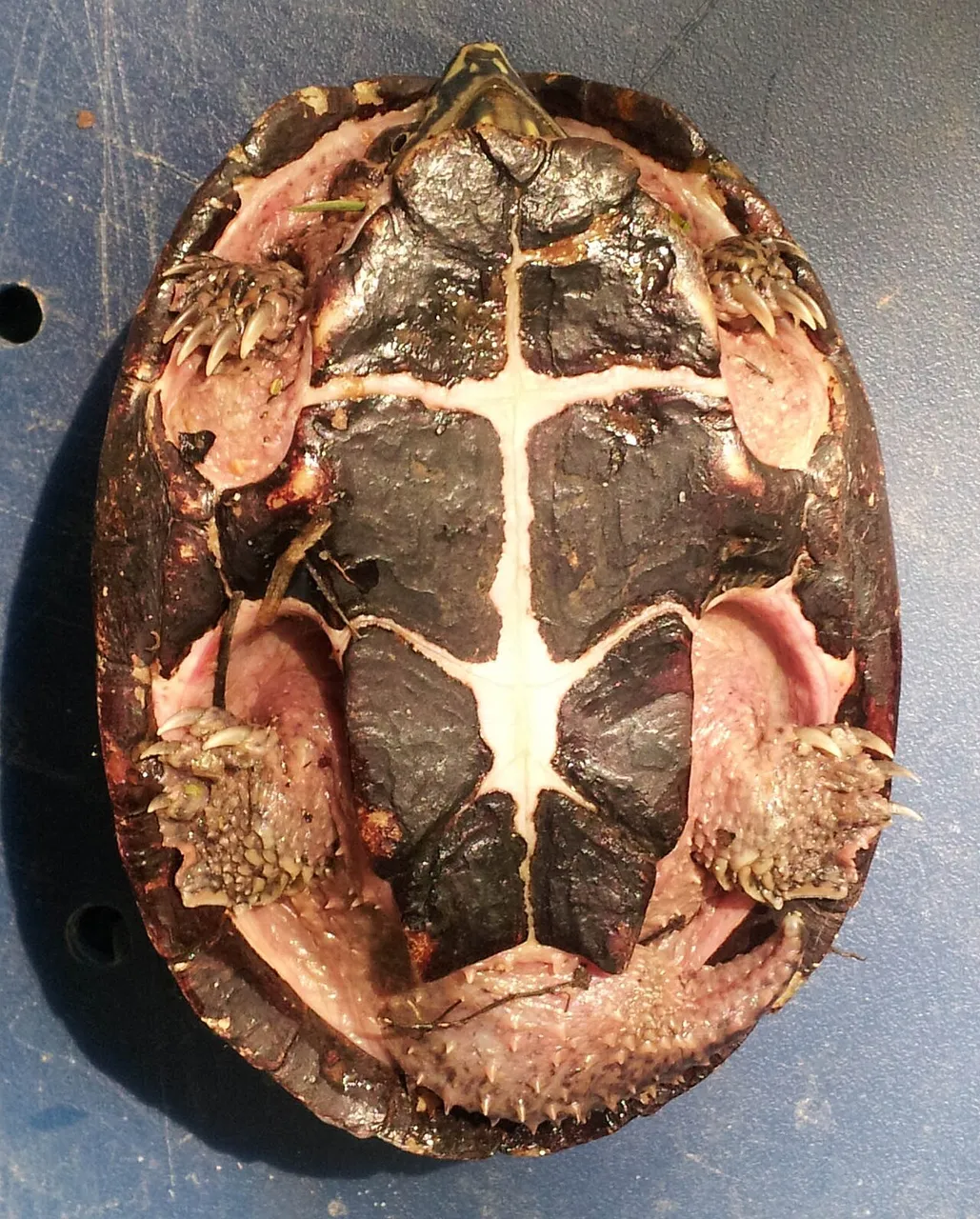
Most illness in aquatic turtles comes back to husbandry. Get temperature, UVB, water quality and diet right and a great deal of disease never appears. The common problems are:
- Metabolic bone disease: weak, soft or deformed shell and jaw from too little UVB and calcium, most often seen in young turtles.
- Hypovitaminosis A: swollen eyelids, eyes kept closed and loss of appetite, typical of turtles fed only lean meat. It also predisposes them to ear abscesses.
- Aural abscess: a firm swelling on one or both sides of the head behind the eye, usually needing surgical drainage.
- Respiratory infection: linked to cold water and chilly air; signs are nasal discharge, open-mouth breathing, wheezing and lopsided floating.
- Shell rot: bacterial or fungal infection under the scutes, encouraged by dirty water and poor basking; look for white or red patches, pits and a foul smell.
- Egg binding: females produce infertile eggs even without a male, and without a suitable nesting area they may retain them dangerously.
- Parasites and impaction: from wild-caught food or swallowed gravel.
See a reptile vet promptly if your turtle stops eating for more than a week outside planned brumation, breathes with its mouth open or bubbles from the nose, keeps its eyes swollen shut, has a cracked, bleeding or soft shell, has tissue protruding from the vent, or is straining without producing eggs. Find an exotic vet before you need one, and avoid home salt baths or human medicines, which can make things worse.
11. Breeding
Aquatic turtles typically mature at three to seven years old. Males court in spring and autumn, and mating takes place in the water. Weeks or months later the female digs a nest on land and lays her clutch, often several clutches a season from a single mating because females can store sperm. Musk turtles lay two to five eggs at a time; cooters lay ten to twenty or more.
Females also produce eggs without any male. If you keep a mature female, give her a nesting box of damp soil and sand 15–20 cm deep whether or not you plan to breed. Restless digging, attempts to escape and loss of appetite in late spring often mean she is ready to lay.
Eggs incubated in damp vermiculite at around 27–30°C usually hatch in two to three months, with temperature influencing the sex ratio.
Think hard before breeding. A single clutch produces several long-lived animals, and finding each a lifelong home is difficult; unwanted hatchlings are a major source of released turtles. Some species cannot legally be bred in some countries, so check the rules first.
12. Costs
Figures below are rough Korean prices from the mid-2020s, given in won; prices in other markets differ. Brand, size and location change them considerably.
| Item | Typical cost | Notes |
|---|---|---|
| Turtle | 30,000–200,000 won | Varies widely by species and size |
| Tank or tub (100–300 L) | 50,000–400,000 won | Plastic tubs are cheapest |
| Canister filter | 70,000–250,000 won | Rated 2–3x volume |
| Heater and guard | 20,000–50,000 won | |
| Basking lamp, socket, stand | 20,000–50,000 won | |
| UVB tube and reflector | 30,000–80,000 won | Replace every 6–12 months |
| Basking dock and decor | 10,000–50,000 won | |
| Thermometers, timer, cleaning gear | 20,000–50,000 won | |
| Setup total | about 250,000–700,000 won | Excluding the turtle |
| Item | Monthly | Notes |
|---|---|---|
| Food | 5,000–20,000 won | More for large species |
| Electricity | 10,000–30,000 won | Higher in winter |
| Consumables | 5,000–10,000 won | Filter media, conditioner |
| Monthly total | about 20,000–50,000 won |
Expect roughly 300,000–700,000 won a year including bulb and filter media replacement. Vet bills vary by clinic: a consultation alone is tens of thousands of won, imaging or blood tests add more, and surgery for an abscess or egg binding can run to several hundred thousand. Over a 30-year life, equipment replacement and tank upgrades cost far more than the turtle itself.
13. Before you get one
Before bringing a turtle home, be honest about these questions.
- Can you house the adult, not the hatchling? Have you measured the space and allowed for weight? Two hundred litres of water weighs over 200 kg.
- Can you commit to 20–40 years, through moves, new jobs, relationships and children?
- Will you really change water and service the filter every week?
- Is there a vet nearby who treats reptiles?
- If your household includes children under five, pregnant women or anyone with weak immunity, can you keep strict Salmonella hygiene?
- Have you checked, by scientific name, that the species is legal where you live?
When choosing an animal, look for clear eyes, no nasal discharge, a hard shell without white patches or smell, level swimming and an interest in food. Ask the seller for the species name, hatch date, whether it was captive-bred and what it eats now. Consider adopting an adult surrendered by another keeper: its adult size is known, and you give a home to a turtle that might otherwise be dumped.
14. Laws
Rules on pet turtles vary enormously between countries, and they change often. Treat the following as orientation and check current official sources where you live.
- Invasive species lists: red-eared and other sliders are restricted in many places. The European Union lists Trachemys scripta as an invasive alien species of Union concern, limiting trade and breeding. Korea has designated sliders and several other turtles as ecosystem-disturbing species, banning import, keeping, transfer and release with limited exceptions for animals already owned.
- Small-turtle sales: in the United States, selling turtles with shells under four inches has been prohibited since 1975, with exceptions such as for education.
- CITES: some aquatic turtles, especially many Asian species, are listed under CITES, which governs international trade and can bring domestic permit duties.
- Native wildlife: collecting wild native turtles is restricted or illegal in many states and countries.
- Release: releasing a pet turtle is harmful everywhere and illegal in many jurisdictions.
If in doubt, ask the national or regional wildlife agency before buying, and keep proof of legal origin.
15. Turtles in culture
Across East Asia the turtle stands for longevity and steadfastness. It appears among the ten symbols of long life in Korean painting, carries memorial stones on its back at palaces and temples, and, entwined with a snake, forms the Black Tortoise that guards the north in the Four Symbols.
- A Korean founding myth of the Gaya kingdom preserves a chant addressed to a turtle, asking it to put out its head.
- In the Korean folktale of the rabbit's liver, the sea king's messenger who lures the rabbit underwater is a softshell turtle.
- The armoured 'turtle ships' of Admiral Yi Sun-sin took their name from their shell-like roofs.
- The Teenage Mutant Ninja Turtles, created as a comic in 1984, are widely described as sliders, and the 1990s cartoon craze is often blamed for a spike in hatchling sales and later dumping.
- In Pokémon, Squirtle and its evolutions are among the best-known turtle characters.
- In the Mario games, the Koopa Troopas who walk upright with shells on their backs became the series' signature foot soldiers.
Popular speech uses 'turtle' for slowness and for shrinking back. Ironically, the modern term 'turtle neck' for a forward-craning posture is the opposite of what an alarmed turtle does.
16. Trivia
- 'Stinkpot', the musk turtle's nickname, refers to its defensive scent. Well-settled pets rarely use it.
- Painted turtles can spend months under ice with almost no oxygen, an ability that has made them a model species for research on low-oxygen tolerance.
- The mata mata looks like a pile of dead leaves and feeds by suddenly expanding its throat, sucking in fish together with a gulp of water.
- Scutes show growth rings rather like tree rings, but growth varies so much with conditions that counting them is an unreliable way to age a turtle.
- Softshells have such long necks that they can reach far back over their own shells, which is why careless handlers get bitten.
- Turtles have no teeth. They cut and crush food with a keratin beak, and musk and mud turtles have broad crushing surfaces in the jaw for cracking snail shells.
- The red-eared slider is named for the red stripe behind its eye, but old males can darken so much that the stripe almost disappears.
- A turtle's shell contains around 50 to 60 bones, which is why vets treat shell fractures as bone injuries and repair them accordingly.
Health notes are general information. If something seems wrong, contact a vet who treats this species.
FAQ
Which aquatic turtle is best for beginners?
Small musk turtles, which stay around 10 cm, are often recommended because they need far less space. Confirm the species is legal where you live first.
I can no longer keep my turtle. What should I do?
Never release it. Contact reptile clubs, specialist shops or local authorities and rescues to find a new home.
My turtle never leaves the water. Is that a problem?
The basking spot is often too cool or hard to climb onto. Check the surface temperature and ramp; if nothing changes, a health issue is possible.
Further reading
- 🗳️ Should sales of non-native aquatic pets be more tightly regulated?
- 🦎 Finding an Exotic Pet Vet and Planning Checkups
Photo credits
Photos are freely licensed images from Wikimedia Commons. Authors and licenses are listed below.
- Stinkpot Turtle (cropped).jpg — Ontley · CC BY-SA 3.0
- Carapaceodoratus.jpg — Uba~itwiki at Italian Wikipedia · CC BY-SA 3.0
- Common Musk Turtle (6762048015) (cropped).jpg — U. S. Fish and Wildlife Service - Northeast Region · Public domain
- Common Musk Turtle - Sternotheus odoratus, McKee Beshers WMA, Poolesville, Maryland (cropped).jpg — Judy Gallagher · CC BY 2.0
- Common Musk Turtle - Sternotheus odoratus, McKee Beshers WMA, Poolesville, Maryland - 9337791213 (cropped).jpg — Judy Gallagher · CC BY 2.0
- DentonNE 14May2013 EMST 01 (16590510995).jpg — Smithsonian Environmental Research Center · CC BY 2.0