TailVille
At a glance
Rough ranges for supplies, food and electricity in Korea (USD is approximate). Purchase or adoption fees are not included.
People who enjoy planted nano tanks and want a quiet, low-maintenance colony to watch.
Anyone wanting a pet to handle or interact with, or who is unwilling to wait weeks for a tank to cycle.
1. Overview
The cherry shrimp is a freshwater dwarf shrimp of 2–3 cm, a red colour form of Neocaridina davidi bred from wild shrimp native to Taiwan and southern China. The name comes from its cherry-red body, and the same species is now sold in yellow, orange, blue, green, black and patterned lines as well.
Cherry shrimp spend their waking hours picking over every surface with tiny fan-tipped claws, harvesting biofilm, soft algae and leftover food. Many people buy them as a clean-up crew for planted tanks, but a colony of red dots busily working across rock and moss is a pleasure to watch in its own right. In the right conditions egg-carrying females and pinhead-sized babies keep appearing until a small tank holds a thriving population.
They are not pets you hold or that swim up to greet you. Once a tank is stable they need only a few minutes of attention a day, take up almost no space and make no noise. The catch is sensitivity: sudden changes in water chemistry and even traces of copper can wipe out a colony, so a well-cycled tank and careful choices about what goes into it make all the difference.
2. Name and classification
TonyZimbinski · CC BY-SA 4.0
2.1. Scientific name and its history
Cherry shrimp belong to the order Decapoda and the family Atyidae, genus Neocaridina. The accepted name is Neocaridina davidi, first described from Chinese material in the early twentieth century. For years the hobby used Neocaridina heteropoda or Neocaridina denticulata sinensis instead, and you will still see those names on older websites and shop labels. Taxonomists have since merged them, though the finer details are still debated.
Atyid shrimp carry fans of fine bristles on the tips of their first two pairs of walking legs, which they use to sweep up microscopic food. Amano shrimp and crystal red or bee shrimp are atyids too, but they belong to a different genus, Caridina, with different needs.
2.2. Common names and native relatives
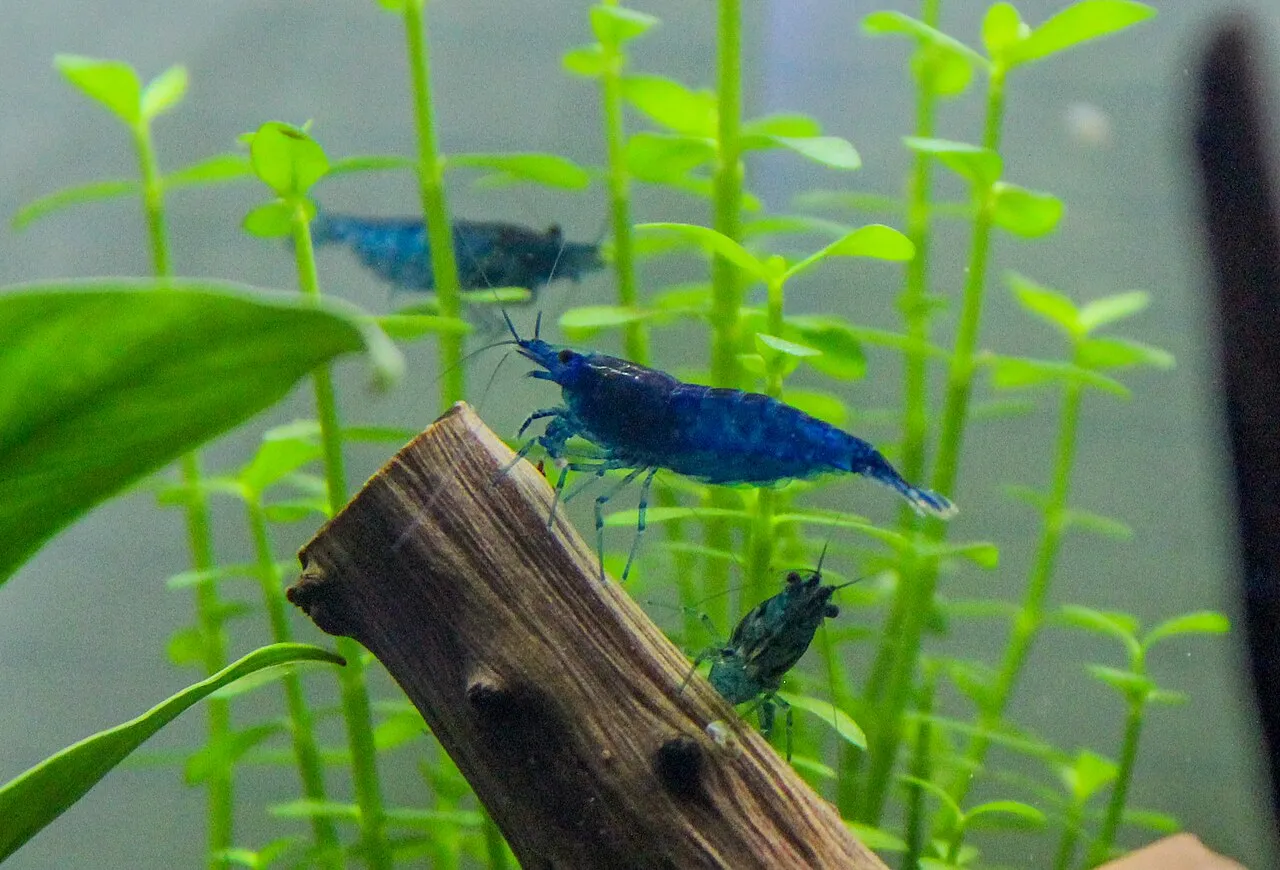
The name cherry shrimp simply describes the colour, and shops also use red cherry or RCS. Higher grades go by names such as sakura and fire red, and other colours of the same species are sold as yellow, blue velvet, green jade and so on.
Neocaridina has wild relatives across East Asia. Korea, for example, has a native species, Neocaridina denticulata, which lives in streams and paddy ditches and is traditionally fermented into a regional shrimp paste. Because the pet and wild species are so closely related, releasing cherry shrimp raises concerns about hybridisation and the genetic integrity of native populations wherever relatives occur.
3. History
Wild Neocaridina davidi is a common shrimp of streams, ponds and paddy ditches in Taiwan and southern China. Most wild individuals are translucent with brown or olive mottling that blends into mud and plants, but now and then one shows a reddish tint.
Taiwanese shrimp keepers selected those red individuals over many generations, and the cherry line is generally said to have been fixed in the late 1990s or early 2000s. The timing was perfect. Nature-style planted aquariums, popularised from Japan, were sweeping the hobby worldwide, and keepers wanted small, algae-eating invertebrates that would not uproot plants. Cherry shrimp were easy, prolific and eye-catching, and they spread rapidly through Europe, North America and Korea.
Breeders in Taiwan, Germany, Japan, the Czech Republic and elsewhere went on to fix yellow, orange, blue, green and black lines, along with rili patterns in which colour is broken by translucent patches. Today many of the shrimp sold in local shops are bred domestically by hobbyists.
4. Body
Atulbhats · CC BY-SA 4.0
4.1. Anatomy
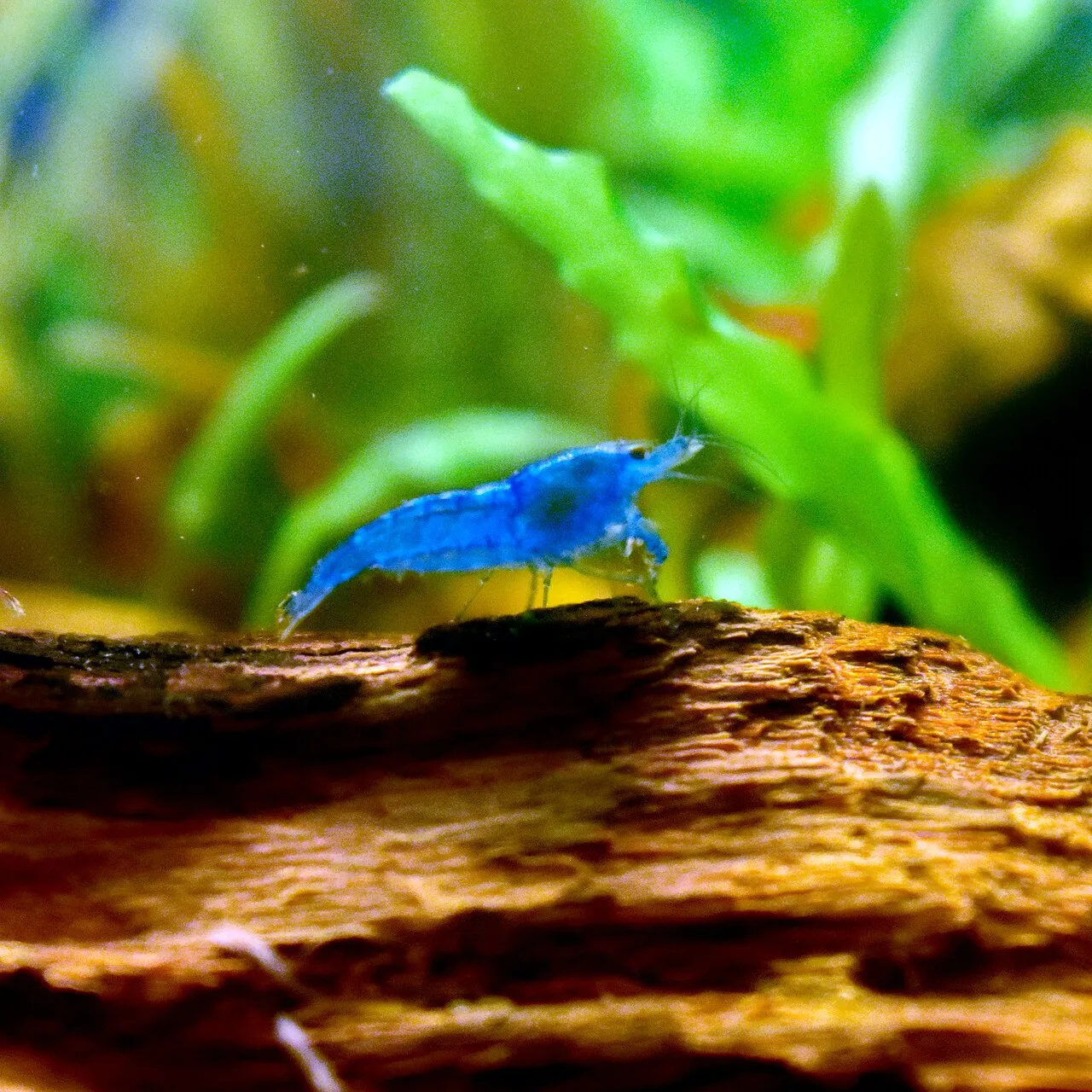
A cherry shrimp’s body has three main parts: a fused head and thorax called the cephalothorax, a segmented abdomen and a tail fan. The cephalothorax sits under a hard carapace that houses the gills, heart, stomach and, in females, the ovaries. At the front is a pointed rostrum, flanked by compound eyes on movable stalks.
There are ten legs in all. The front two pairs are tiny claws tipped with bristle fans for sweeping up food, and the other three pairs are for walking. Under the abdomen are five pairs of swimmerets, used for swimming and, in females, for holding eggs. When startled, a shrimp snaps its tail fan inward and shoots backwards in a fraction of a second.
Two pairs of antennae act as chemical sensors. Drop food into the tank and shrimp start converging within minutes, following the scent through the water.
4.2. Moulting
A hard exoskeleton cannot stretch, so shrimp grow by shedding it. Juveniles moult as often as once a week, adults roughly every three to four weeks. Moults usually happen at night: the shell splits at the joint between the carapace and abdomen, and the shrimp wriggles free in seconds to minutes.
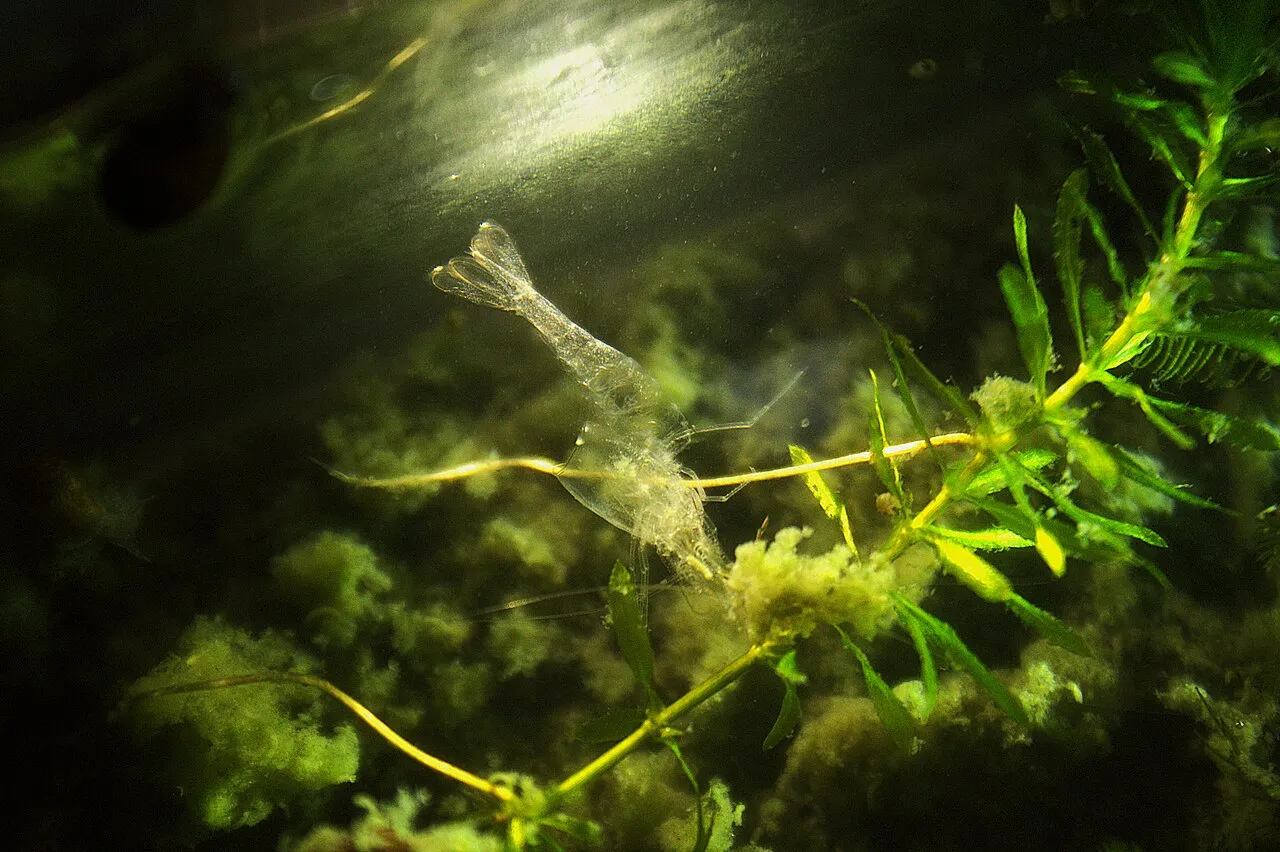
A perfect white shrimp shape on the substrate is usually a cast shell, not a corpse. A freshly moulted shrimp is soft and vulnerable and hides in plants until the new shell hardens, and shrimp often nibble old moults to reclaim calcium and minerals. Leave moults in the tank for a few days.
4.3. Telling males from females
The sexes are fairly easy to tell apart. Females grow to 2.5–3 cm, are more strongly coloured and have a deeper abdomen whose side plates curve down to form a brood chamber. A mature female often shows a yellow or greenish patch through the top of her carapace: her developing ovaries, known as the saddle.
Males are smaller, around 2 cm, slimmer and paler or partly translucent, with a straighter underside and antennae that look relatively long. In high-grade lines males can be deeply coloured too, so body shape is the more reliable guide.
5. Grades and colour lines
Red cherry shrimp are graded by how intense the red is and how evenly it covers the body. The names below are widely used, though sellers apply them a little differently.
| Grade | Description |
|---|---|
| Cherry | Translucent body with red patches; males nearly clear |
| Sakura | Stronger, more widespread red with little translucency |
| Fire red | Solid, even deep red including the legs |
| Painted fire red | Opaque, almost painted red; males strongly coloured too |
| Bloody Mary | Deep wine-red with a glassy look, said to be a separate line |
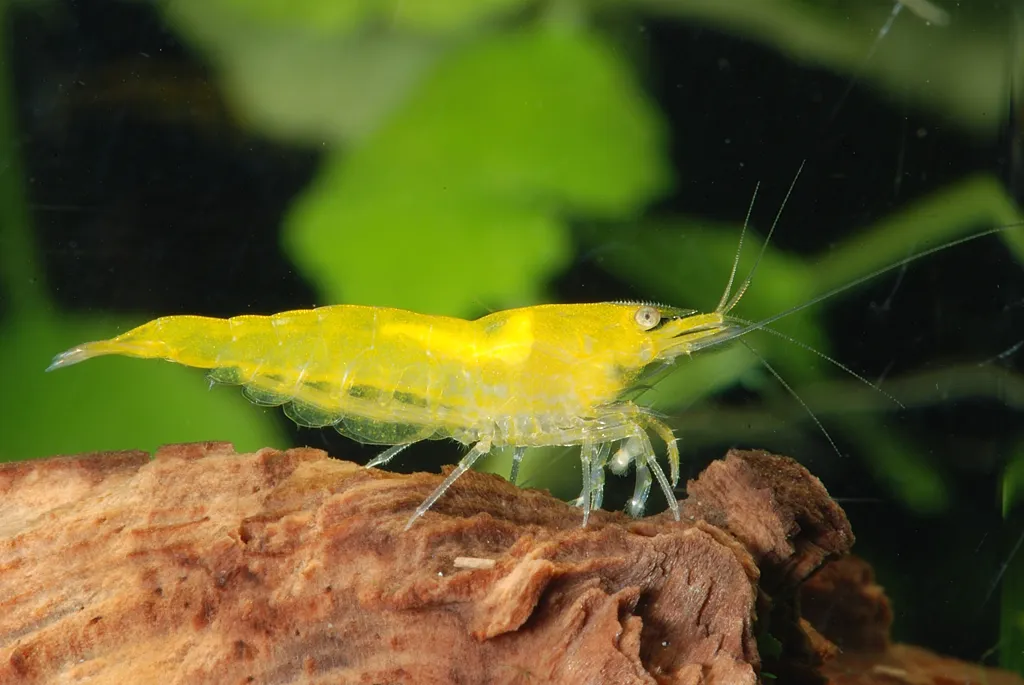
The same species has produced many other colours.
| Line | Description |
|---|---|
| Yellow (golden back) | Yellow body, sometimes a bright dorsal stripe |
| Orange | Orange body |
| Blue dream and blue velvet | Deep navy to translucent blue |
| Green jade | Dark green |
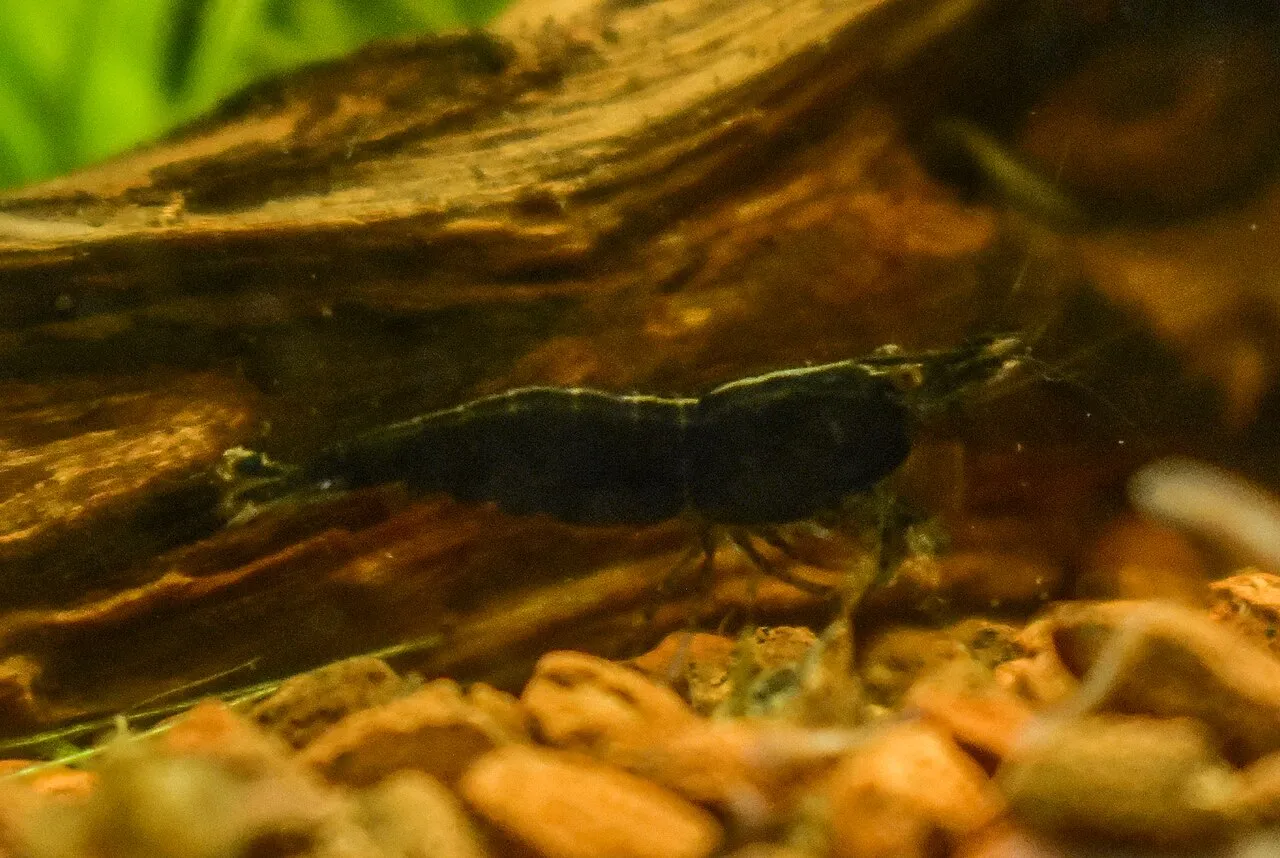
| Black rose and chocolate | Black or dark brown |
| Red rili and blue rili | Coloured head and tail with a clear middle section |
| Snowball | Whitish body carrying white eggs |
Mix colour lines in one tank and within a few generations most offspring revert to brown or clear wild-type shrimp. To keep colours true, give each line its own tank and remove lower-grade shrimp over time. Cherry shrimp do not hybridise with Caridina species such as crystal reds.
6. Behaviour
Atulbhats · CC BY-SA 4.0
6.1. Life in the wild and in the tank
Wild cherry shrimp live in shallow margins thick with plants and leaf litter, picking their way over the bottom and every leaf. They do not school, but they gather wherever food is plentiful, so colonies form naturally. They are almost entirely non-aggressive and simply step around each other.
In a tank they spend most of their time grazing: claws flicking constantly over stone, wood and moss, then a rush towards any pellet that hits the bottom. They are active day and night, though they tend to venture into open areas more boldly once the lights go off. Mostly they walk, but now and then they swim through open water with rapid beats of their swimmerets.
6.2. Reading the signals
Shrimp have no facial expressions, but their behaviour is a surprisingly precise readout of tank conditions.
- Busy claws and steady foraging all over the tank: stable water and healthy shrimp.
- Several males swimming frantically around the tank, often just after a water change: usually a mating frenzy triggered by chemical signals from a freshly moulted female.
- Shrimp of both sexes racing around near the surface or climbing out of the water: suspect a sudden parameter change, low oxygen or contamination, and find the cause quickly.
- Lying on its side with legs moving: about to moult, or in serious trouble.
- Hiding all day: around moulting time, or reacting to predators, bright light or changed water.
- Colour suddenly paler: common after stress, shipping or on a light background; it returns once conditions settle.
7. Life stages
Cherry shrimp usually live one to two years. Warm water speeds growth and breeding but shortens life, and colonies kept a little cooler, around 20–23°C, tend to live somewhat longer.
| Stage | Age | What happens |
|---|---|---|
| Egg | About 3–4 weeks of brooding | Held on the female’s swimmerets; eyes visible just before hatching |
| Shrimplet | 0–1 month after hatching | 1–2 mm, already shaped like an adult and living on the bottom |
| Juvenile | 1–3 months | Frequent moults and rapid growth; colour deepens |
| Adult | From about 3–4 months | Breeding; saddle visible in females |
| Senior | Roughly 1 year on | Longer gaps between moults, less activity |
Neocaridina develop directly: eggs hatch into miniature shrimp, with no free-floating larval stage. Some other shrimp need brackish or salt water for their larvae, but cherry shrimp complete their entire life cycle in a freshwater tank, which is why colonies are so easy to sustain at home.
Older shrimp slow down and are more likely to fail a moult. In a healthy colony old individuals drop out and young ones replace them, so the occasional loss is normal. Several deaths in a single day, however, point to a water problem.
8. Housing
Nafisathallah · CC BY-SA 4.0
8.1. Tank and water parameters
Cherry shrimp can live in a nano tank of around 10 litres, but small volumes swing quickly in temperature and chemistry. Beginners have a much easier time with 20 litres or more; start with ten to twenty shrimp and a stable 20-litre tank will usually hold a colony of dozens within a few months.
Recommended parameters are 20–26°C, pH 6.5–8.0, GH 6–8, KH 2–8 and TDS of roughly 150–250 ppm. Within that range cherry shrimp are forgiving, but they cope poorly with rapid change. Keeping conditions steady matters far more than chasing exact numbers with frequent chemical adjustments.
The most important step is cycling. Run the filter for at least four weeks, confirm that ammonia and nitrite read zero, and only then add shrimp. Biofilm takes even longer to build up on plants, wood and stone, so a tank that has been running for a couple of months is a better home than one that has only just cycled.
8.2. Filtration, substrate and plants
Sponge filters are the standard for shrimp tanks. Babies cannot be sucked in, and the sponge surface grows biofilm that doubles as a feeding station. If you use a hang-on or canister filter, cover the intake with fine foam.
Ordinary sand or gravel is fine. Cherry shrimp do not need the acidic, buffering soils that crystal reds require, though many keepers use aquasoil for the plants. Some soils leach ammonia at first, so cycle thoroughly before adding shrimp.
Plants are central to a good shrimp tank. Java moss and Christmas moss grow biofilm and shelter shrimplets, while hardy plants such as bucephalandra, anubias and Java fern suit the same setup. Driftwood and dried leaves grow edible microbial films on their surfaces.
- A tank of 20 litres or more with a lid, since shrimp sometimes climb out
- A sponge filter and air pump, or a filter with a foam-covered intake
- A thermometer, and if needed a heater and a summer cooling fan
- Water conditioner, a test kit and a TDS meter
- Mosses, hardy plants and driftwood
- Shrimp food and a small feeding dish
- Airline tubing or a drip valve for water changes and acclimation
8.3. Temperature and tankmates
Cherry shrimp do well a little cooler than most tropical fish, and many keepers run unheated tanks as long as the room stays above about 18°C. Summer is the bigger danger: above 28°C, oxygen drops and losses climb. Use a cooling fan, keep the tank in an air-conditioned room if possible and avoid direct sunlight.
Choose tankmates with care. Almost any fish will eat shrimp small enough to fit in its mouth, and baby shrimp fit in nearly every mouth. Guppies, bettas and tetras all hunt shrimplets, so a shrimp-only tank is best if you want the colony to grow. If you do add companions, very peaceful algae grazers such as otocinclus or invertebrates such as nerite snails are the safest choices.
9. Diet
Cherry shrimp are omnivores. In a mature tank much of their diet comes from biofilm on rocks and leaves, soft algae and decaying plant matter. A dedicated shrimp food on top of that improves growth, breeding and colour.
| Type | Examples | How often and tips |
|---|---|---|
| Staple | Shrimp pellets or sticks | Every one or two days, as much as they clear in 2–3 hours |
| Vegetables | Blanched spinach, courgette, cucumber, in small pieces | Once or twice a week; remove after half a day |
| Leaves | Dried mulberry, Indian almond or oak leaves | A few can stay in the tank at all times |
| Supplements | Spirulina, mineral-enriched foods | Once or twice a week |
| For babies | Powdered food and natural biofilm | A light dusting |
Overfeeding is the classic shrimp-keeping mistake. Shrimp eat very little, and leftover food rots fast and fouls the water. A small glass feeding dish lets you see what is left and remove it in one go. Because they can graze biofilm for days, a healthy colony does not need anyone to feed it during a short trip.
Wash vegetables well to remove pesticides and blanch them lightly. Some fish foods and supplements contain copper, so read labels and prefer products marked safe for shrimp.
10. Health
Shrimp are far more likely to be harmed all at once by a tank problem than by an individual disease. When something goes wrong, work through temperature, ammonia, nitrite, nitrate, TDS and anything you have recently added.
| Problem | Cause | Signs | Prevention and response |
|---|---|---|---|
| Shock losses | Big water changes, temperature gaps, chemicals | Many deaths in a short time, shrimp crowding the surface | Small changes, matched temperature and chemistry |
| Failed moult | Low GH, sudden change, poor nutrition | White band between carapace and abdomen, death mid-moult | Keep GH steady, add minerals, avoid swings |
| Copper or pesticide poisoning | Fish medicines, fertilisers, insect sprays | Sudden mass deaths | Check labels, no sprays in the room |
| Muscular necrosis | Stress, possibly bacterial | Patches of opaque white muscle | Isolate affected shrimp, improve water |
| Vorticella | Attached ciliates | White fuzz on body or head | Improve water, reduce feeding |
| Scutariella | Attached flatworms | Tiny white worms on the head | Inspect and quarantine new shrimp |
Planaria and hydra are not diseases but pests that attack baby shrimp. Both explode when food is left lying around, so cutting back feeding comes first. If you use a treatment, confirm it is shrimp-safe.
Very few vets treat shrimp, so specialist shops and experienced hobbyists are usually the best source of help. The best prevention is to observe new shrimp and plants in a separate container for a few days, and to make sure plants are free of pesticide residues before they go in.
11. Breeding
In good conditions cherry shrimp breed with no help at all. When a mature female moults, she releases chemical cues into the water and the males respond by racing around the tank in search of her. Mating takes a few seconds, and shortly afterwards she moves eggs from the ovaries in her back down to the swimmerets under her abdomen.
A typical clutch is around 20–30 eggs, more in a large, well-fed female. For roughly three to four weeks she fans the eggs constantly with her swimmerets to keep them oxygenated and picks off any that turn fungal. Eggs start yellow or greenish and become clearer as they develop, until tiny eyes are visible just before hatching. Warmer water shortens the wait.
First-time mothers and stressed females sometimes drop their eggs. Small, slow water changes and a steady temperature usually solve the problem by the next clutch. Hatchlings need no special food; they graze biofilm in the moss, though a light dusting of powdered food improves survival.
The ease of breeding brings its own problem: a colony can outgrow its tank. Too many shrimp run short of food and oxygen, so plan to pass extras to friends or clubs, or to set up another tank. If you want to keep a strong colour, move paler shrimp to a separate tank over time. Never release surplus shrimp into streams or ponds, where they may interbreed with native relatives and disrupt local ecosystems.
12. Costs
Because they can start in a small tank, cherry shrimp are one of the cheaper setups. The figures below assume a 20-litre tank started with ten to twenty shrimp and are rough examples in Korean won; prices vary by grade, shop and brand.
| Item | Approximate cost (KRW) | Notes |
|---|---|---|
| Ten to twenty shrimp | 10,000–50,000 | Basic grades are cheap; fire red and above cost more each |
| Tank and lid | 20,000–50,000 | Around 20 L |
| Sponge filter and air pump | 10,000–25,000 | |
| Substrate, moss, plants, wood | 10,000–30,000 | |
| Conditioner, test kit, TDS meter | 10,000–30,000 | |
| Thermometer, cooling fan if needed | 5,000–20,000 | |
| Start-up total | About 50,000–150,000 | |
| Monthly food and consumables | 2,000–6,000 | |
| Monthly electricity | 2,000–6,000 | More with a heater or fan |
| Monthly total | About 5,000–12,000 | |
| Yearly | About 60,000–150,000 | Excluding equipment replacement |
There are almost no vet bills, but one water accident can wipe out the whole colony. Money spent on a test kit, a spare sponge filter and drip-acclimation tubing usually saves more in the long run than anything else.
13. Before you get them
Check the following before buying cherry shrimp.
- Can you run a tank for at least four weeks with no animals in it?
- Can you stop the water rising above 28°C in summer?
- If you plan to keep fish too, are you prepared for them to eat baby shrimp?
- Can you avoid insect sprays, mosquito coils and air fresheners in the same room?
- Do you have somewhere to send surplus shrimp when the colony grows?
Healthy shrimp forage actively in the shop tank, have intact legs and antennae and show no white bands or spots. If the shop tank has many dead shrimp on the bottom, skip that batch.
At home, acclimation is critical. Float the bag for 15–20 minutes to match temperature, then move the shrimp and their water into a small container and drip tank water in through airline tubing for an hour or more until the volume has doubled or tripled. Net the shrimp into the tank and discard the shop water. Hiding for the first few days is normal.
14. Laws
Cherry shrimp are not listed by CITES and are not regulated as pets in most countries. They are, however, an introduced species almost everywhere they are kept, and closely related native Neocaridina occur across East Asia, so released shrimp may hybridise with or compete against local species.
Feral populations have been reported in warm, thermally polluted streams in Europe and elsewhere, showing that cherry shrimp can establish wherever water stays warm enough. Some countries regulate the import and release of non-native invertebrates, so check local rules.
Whatever the law says, never release surplus shrimp, and do not pour tank water that might contain shrimplets into drains, streams or ponds.
15. Shrimp in culture
Cherry shrimp themselves rarely appear in popular culture, but small shrimp have a long reach in language and food. Korean has a well-known proverb about a shrimp’s back breaking when whales fight, describing the weak suffering from the quarrels of the strong. English speaks of a shrimp as a small, slight person, and shrimp-sized describes anything tiny.
Freshwater dwarf shrimp are also food in parts of East Asia, fermented into pastes and sauces from wild relatives of the cherry shrimp, which is why newcomers to the hobby sometimes ask whether these are the same shrimp people eat.
In the aquarium world, cherry shrimp are a favourite supporting actor in aquascaping. Photographs from planted-tank contests often use a single red shrimp on green moss as a focal point, and short clips of a colony swarming over a food pellet are reliably popular on social media.
16. Trivia
- Shrimp carry oxygen with haemocyanin, a copper-based blood pigment. The irony is that while they need copper inside their bodies, dissolved copper in the water is lethal to them at tiny concentrations.
- The red colour sits in pigment cells under the shell. Stress or a bright background makes those cells contract, and a shrimp can turn noticeably paler within minutes.
- A cast moult preserves eyes, antennae and even leg bristles, so under a magnifying glass it looks like a perfect ghost of the shrimp.
- Cross a blue line with a yellow line and the next generation is mostly brown, because each colour depends on particular combinations of genes that the cross breaks apart.
- Shrimp rarely leave the water, so a shrimp climbing out up the glass or airline tubing is itself a warning that something in the water has changed.
- Food dropped at one end of a tank brings shrimp from the far end within minutes, guided entirely by scent picked up on their antennae.
Health notes are general information. If something seems wrong, contact a vet who treats this species.
FAQ
My shrimp seem to have disappeared.
Shrimp hide in plants around moulting or after a water change. Check with a torch about half an hour after lights out; they are often all there.
Will cherry shrimp clean all my algae?
They handle biofilm and soft algae well, but they will not fix an established hair algae outbreak or green water.
My berried shrimp dropped her eggs.
It is common with first-time mothers or after a sudden change. Keep water changes small and slow, and the next clutch is usually carried to term.
Further reading
- 🗳️ Bettas: solo tank or a peaceful community tank?
- 🗳️ Cherry shrimp: species-only tank or mixed with guppies?
- 🏢 Choosing a Pet When You Live Alone or Work Full Time
Photo credits
Photos are freely licensed images from Wikimedia Commons. Authors and licenses are listed below.
- Red Cherry Shrimp 1.jpg — TheJammingYam (talk) · CC BY-SA 3.0
- Blue N. Davidi Shrimps.jpg — TonyZimbinski · CC BY-SA 4.0
- Blue Shrimp.jpg — Atulbhats · CC BY-SA 4.0
- Choco Black Shrimp.jpg — Atulbhats · CC BY-SA 4.0
- Freshwater shrimp molted skin.jpg — Nafisathallah · CC BY-SA 4.0
- Neocaridina-heteropoda-var-yellow.jpg — DirkBlankenhaus · CC BY-SA 3.0