TailVille
At a glance
Rough ranges for supplies, food and electricity in Korea (USD is approximate). Purchase or adoption fees are not included.
Anyone wanting a quiet, low-odour insect that lives more than a season, and hobbyists drawn to breeding and rearing large males.
People who want several beetles in one display, or households with very young children who will grab them barehanded.
1. Overview
Stag beetles are beetles whose males carry enormously enlarged mandibles that look like a deer's antlers. Well over a thousand species live in temperate and tropical forests worldwide. Korea alone has several, including Dorcus titanus, Dorcus hopei, Prosopocoilus inclinatus, Dorcus rectus, Lucanus dybowskyi and Dorcus rubrofemoratus, most of them tied to oak woodland.
Alongside the rhinoceros beetle, the stag beetle is one of the most popular pet insects in East Asia, but the two are kept quite differently. Rhinoceros beetle adults live a single summer, whereas several popular stag beetles, particularly in the genus Dorcus, overwinter as adults and live two or three years or more, so one beetle can stay with you through several seasons. On the other hand, stag beetles are aggressive. Males fight each other, and even pairs left together for long often injure one another, so solitary housing is the norm.
The hobby tends to deepen quickly. An adult needs little more than a small container and jelly, but breeding leads to choosing egg-laying logs, rearing larvae in bottles of fungus-colonised sawdust and managing temperature to produce large males. In Japan and Korea, some keepers compete over the length of their males to the millimetre. This article covers the species most often kept, their biology and care, breeding and the relevant laws.
2. Name and classification
KKPCW(Kyu3) · CC BY-SA 4.0
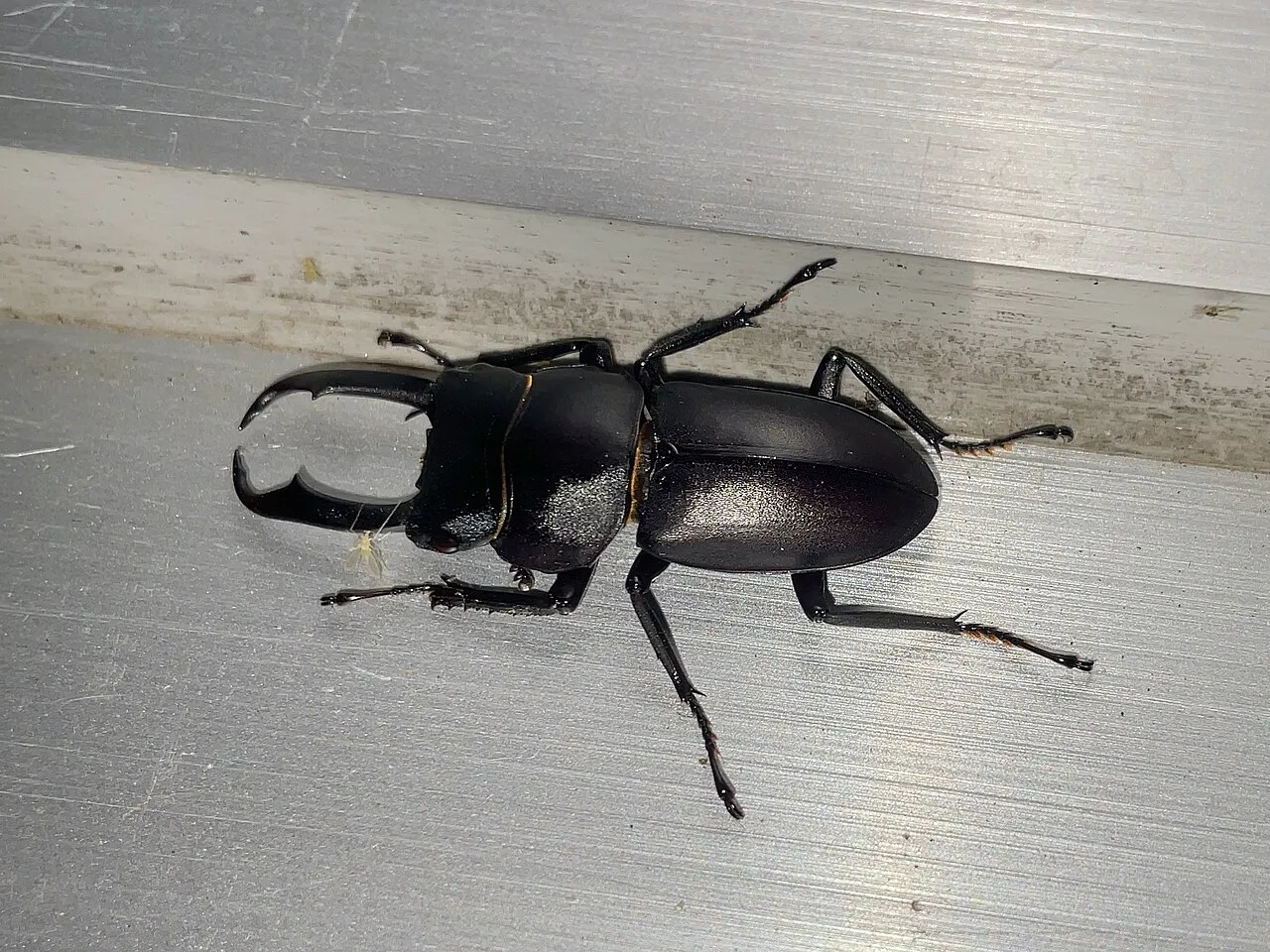
The English 'stag' refers to the antler-like jaws, as does the Korean name, literally 'deer bug'. The Japanese kuwagatamushi is named after the forked crest once mounted on the front of samurai helmets. The family name Lucanidae is said to go back to Pliny the Elder, who linked the beetles to Lucania in southern Italy. Dorcus, the genus most kept in East Asia, comes from the Greek for a gazelle or roe deer.
- Order: Coleoptera
- Superfamily: Scarabaeoidea, shared with scarabs and rhinoceros beetles
- Family: Lucanidae, the stag beetles
- Key genera in the hobby: Dorcus, Prosopocoilus, Lucanus, Phalacrognathus, Cyclommatus and Odontolabis
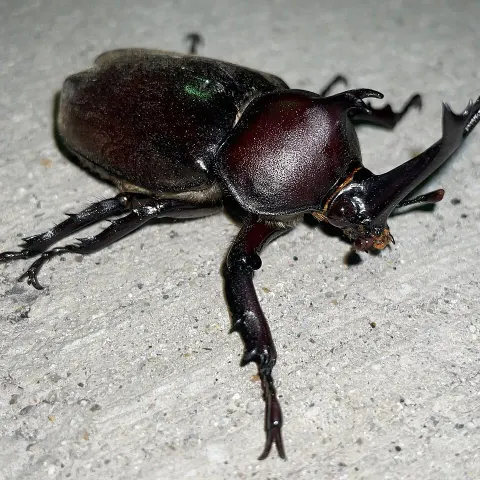
The defining difference from rhinoceros beetles is where the weapons are. Rhinoceros beetles fight with horns growing from the head and thorax; stag beetles fight with their mandibles, which are part of the mouthparts. Stag beetle antennae are elbowed with a comb-like club. Many species are divided into regional subspecies: the Japanese and Korean forms of Dorcus hopei, for example, are often treated as different subspecies of one species.
3. History
Stag beetle keeping developed earliest and furthest in Japan. Catching and keeping them in summer has a long history there, and in the 1980s and 1990s breeders refined techniques for rearing larger larvae. The spread of 'fungus bottles', sawdust colonised by mushroom mycelium, in the 1990s allowed captive breeders to produce males of a size rarely seen in the wild. During that boom, big wild-caught Dorcus hopei males reportedly changed hands for remarkable sums and were nicknamed 'black diamonds'.
Japan relaxed its restrictions on importing many foreign stag beetles around 1999, and species such as the giraffe stag beetle and the rainbow stag became widely available. Concerns about hybridisation with native species and the establishment of exotic beetles have been debated ever since.
In Korea, specialist shops and clubs from the 2000s turned stag beetle keeping into a serious hobby. Native Dorcus titanus and Dorcus hopei are widely captive-bred, and some foreign species are sold within the limits set by quarantine authorities. In Europe, by contrast, the main story is conservation: the European stag beetle, Lucanus cervus, has declined in many areas and is protected under EU nature law.
4. Body and anatomy
KKPCW(Kyu3) · CC BY-SA 4.0
4.1. Mandibles and body
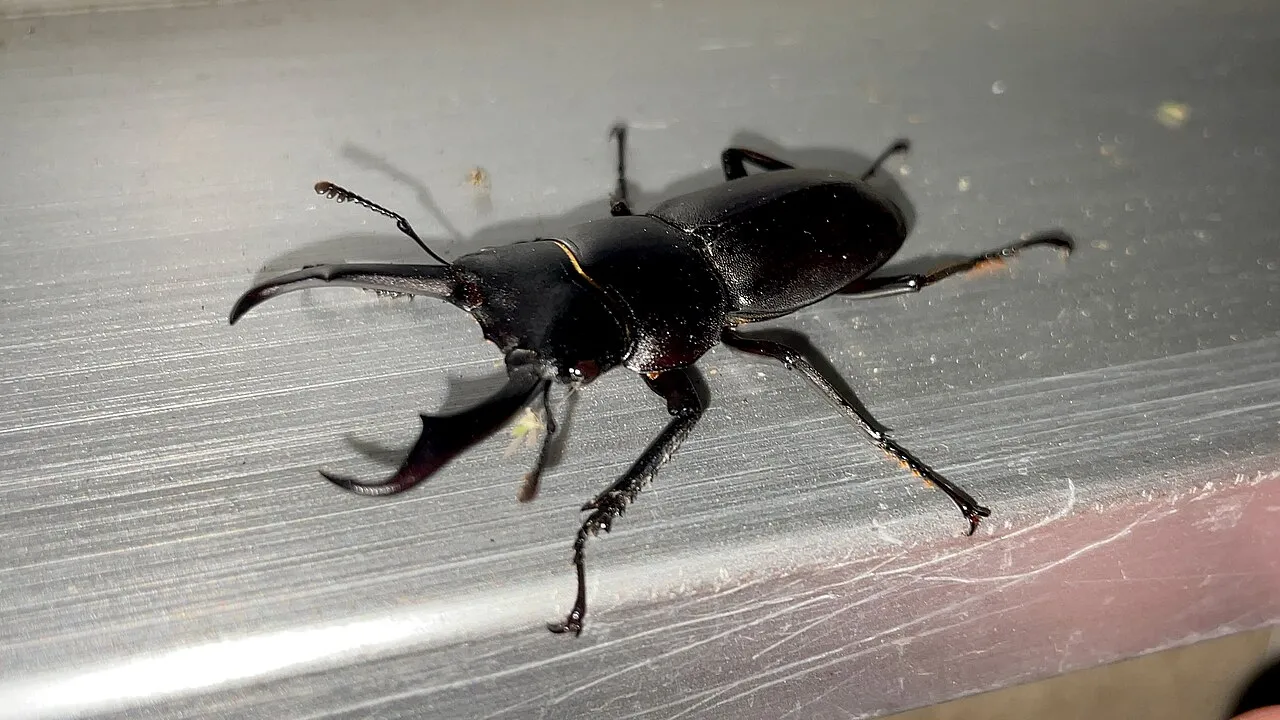
The male's famous 'antlers' are greatly enlarged mandibles. Their shape differs strikingly between species. Dorcus titanus is flat-bodied, with long, fairly straight mandibles lined with small teeth. Dorcus hopei is thick and stocky, with short, heavy, curved mandibles bearing one large inner tooth. Prosopocoilus inclinatus has strongly curved jaws with saw-like teeth along the inner edge.
Within a species, mandible length and shape scale with body size. Large males have disproportionately long mandibles, often with differently placed teeth, while small males have short, simple ones. Large and small males of the same species can look like different species, which regularly confuses beginners.
The body is protected by a hard exoskeleton and elytra, mostly black or dark brown. Legs are slender but end in strong hooked claws for clinging to bark. The mouth has a yellow, brush-like tongue for lapping sap.
4.2. Sexing
- Adults: males have large mandibles; females have small, short ones that can still pinch hard. To tell a small male from a female, compare head size and forelegs. Females have broad, heavily spined front tibiae for digging into wood.
- Larvae: in third-instar larvae, a yellowish patch showing through the skin on the upper side of the abdomen, a few segments from the tail, is the developing ovary and marks a female. This is the standard method for stag beetle larvae, though it is not always visible.
- Pupae: male pupae clearly show the shape of the mandibles.
Sexing larvae early lets you give males bigger fungus bottles and females smaller ones, which saves money.
5. Species
These are the native Korean species most often seen or kept. Sizes are approximate male lengths including mandibles.
| Species | Male size | Adult lifespan | Notes |
|---|---|---|---|
| Dorcus titanus | 30–85 mm | 2–3 years | Korea's largest; flat body, long jaws, aggressive |
| Dorcus hopei | 30–75 mm | 2–3 years | Stocky, relatively calm, lives in tree hollows |
| Prosopocoilus inclinatus | 25–70 mm | Usually one season | Curved, saw-toothed jaws; some reddish |
| Dorcus rectus | 15–50 mm | 1–2 years | Small, common, easy to keep |
| Lucanus dybowskyi | 25–70 mm | One season | Ear-like ridges behind the head, cool uplands |
| Dorcus rubrofemoratus | 25–55 mm | 1–2 years | Red thighs |
| Prismognathus dauricus | 20–35 mm | One season | Small, montane |
| Prosopocoilus astacoides blanchardi | 30–60 mm | n/a | Jeju only; protected, may not be kept |
Well-known exotics include the giraffe stag beetle (Prosopocoilus giraffa), whose males are among the longest stag beetles in the world; the iridescent rainbow stag (Phalacrognathus muelleri) of Australia and New Guinea; the golden stags (Allotopus); and the massive Palawan form of Dorcus titanus. Always check that an exotic species is legal where you live; species closely related to local ones carry a particular risk of hybridisation.
For beginners, Dorcus rectus and Dorcus hopei are good choices. Dorcus hopei is less aggressive and long-lived, and Dorcus rectus is small, hardy and easy to breed. Dorcus titanus produces spectacular males, but bites and attacks on females need careful management.
In Europe, the best-known species is Lucanus cervus, the largest beetle in much of the continent, which is protected and should not be collected.
6. Behaviour
KKPCW(Kyu3) · CC BY-SA 4.0
6.1. In the wild
Stag beetles live in broadleaf woodland rich in oaks. Adults are active mainly at night from late spring through summer, gathering at sap flows on oak trunks. Dorcus hopei tends to hide deep in large tree hollows and is hard to find, while Dorcus titanus is often seen holding a sap site and driving other insects away.
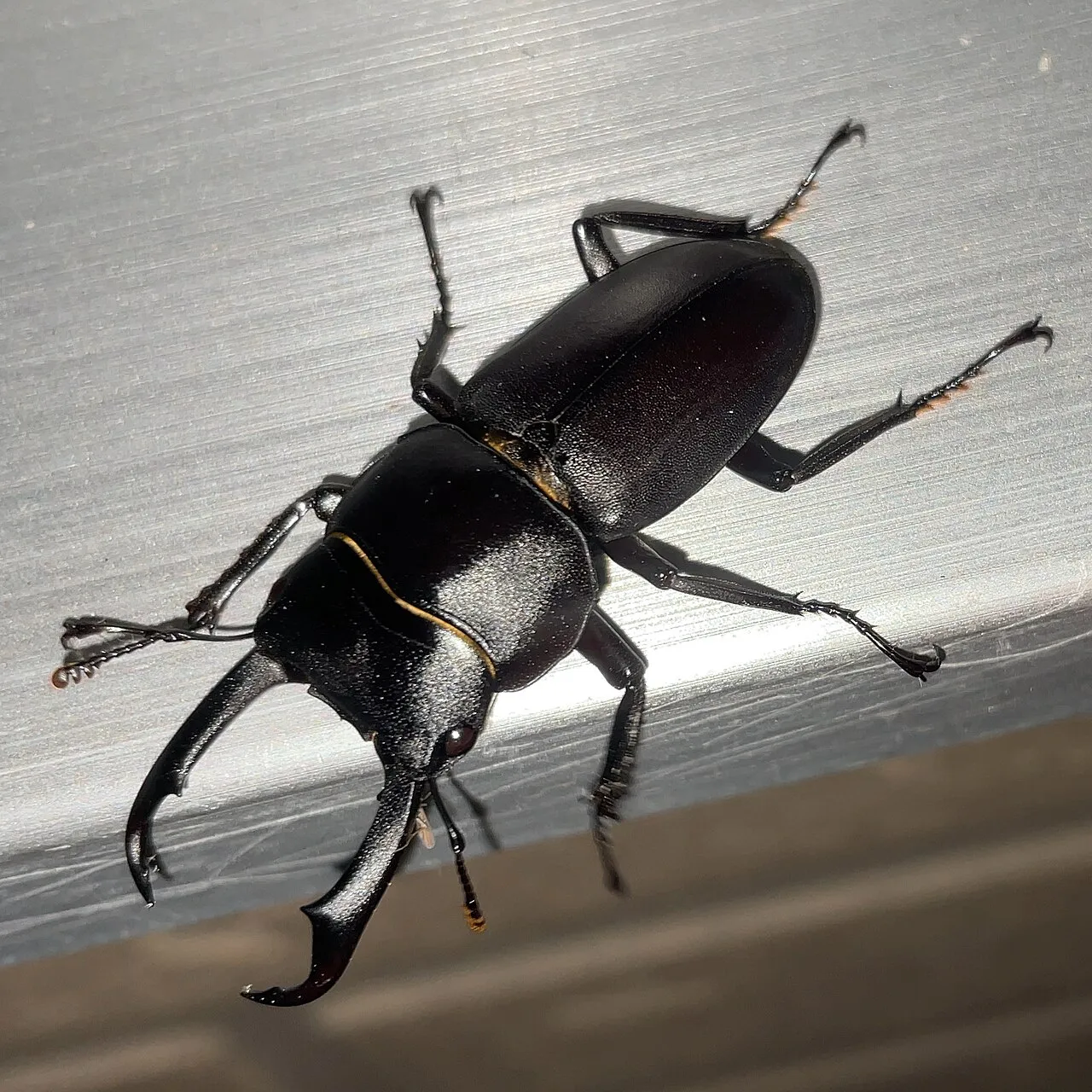
Males fight by gripping a rival in their mandibles and lifting or twisting it off the branch. Bigger males usually win, gaining the sap site and access to females. After mating, females seek out dead oak logs and stumps that have been softened by white-rot fungi, chew into the wood and lay their eggs there. Larvae spend one to two years, sometimes longer, feeding inside the decaying wood.
Dorcus adults such as D. titanus and D. hopei retreat into tree hollows, soil or rotting wood in autumn and overwinter, re-emerging the next spring to feed and breed again. Prosopocoilus inclinatus and Lucanus species, by contrast, live as adults for a single season, overwintering as larvae or as newly transformed adults still inside their pupal cells.
6.2. Behaviour at home
Captive stag beetles hide in substrate or under bark by day and come out at night to feed. They are much quieter than rhinoceros beetles and less inclined to fly.
- Mandibles spread wide and forelegs raised: a threat display; a hand that comes close may be bitten.
- Buried for weeks: in cool weather, preparing to overwinter; in summer, possibly too hot or simply resting. Newly emerged adults also stay buried for weeks or months before they start feeding.
- Not touching jelly: a post-emergence dormancy, overwintering, or old age.
- Constantly scrabbling at the walls: often a female looking for somewhere to lay, or a sign that conditions are wrong.
- Playing dead: when touched or lifted, many tuck their legs in and freeze. Leave them a moment and they recover.
- A male gripping a female in his mandibles: sometimes part of mating, but it can quickly turn lethal; separate them at once if it persists.
7. Life cycle
Stag beetles undergo complete metamorphosis, but life length and adult lifespan vary greatly between species. The outline below is for Dorcus titanus and Dorcus hopei.
| Stage | Duration | Notes |
|---|---|---|
| Egg | About 2–3 weeks | Laid singly in rotting wood |
| First instar | About 1 month | Orange head, translucent white body |
| Second instar | About 1–2 months | Appetite increases |
| Third instar | 6 months to over a year | Most growth happens now; males can reach 20–30 g |
| Pupa | About 3–5 weeks | Lies horizontally in its chamber |
| Post-emergence rest | Weeks to months | New adult stays in the chamber without feeding |
| Active adult | 1–3 years | Overwinters repeatedly |
In captivity these Dorcus take one to two years from egg to adult and then live a further two to three years, for a total of three to five years. Dorcus hopei is noted for particularly long adult life. Prosopocoilus and Lucanus species, by contrast, die within a few weeks to a couple of months of becoming active.
One practical difference from rhinoceros beetles: stag beetle pupal chambers usually lie horizontally, so width and stability matter more than depth. Newly emerged adults are still hardening, so let them dig out in their own time.
As adults age, they lose leg segments, eat less and struggle to right themselves. At this stage, use shallower substrate and plenty of bark to grip, so they waste less energy.
8. Housing
KKPCW(Kyu3) · CC BY-SA 4.0
8.1. Adult set-up
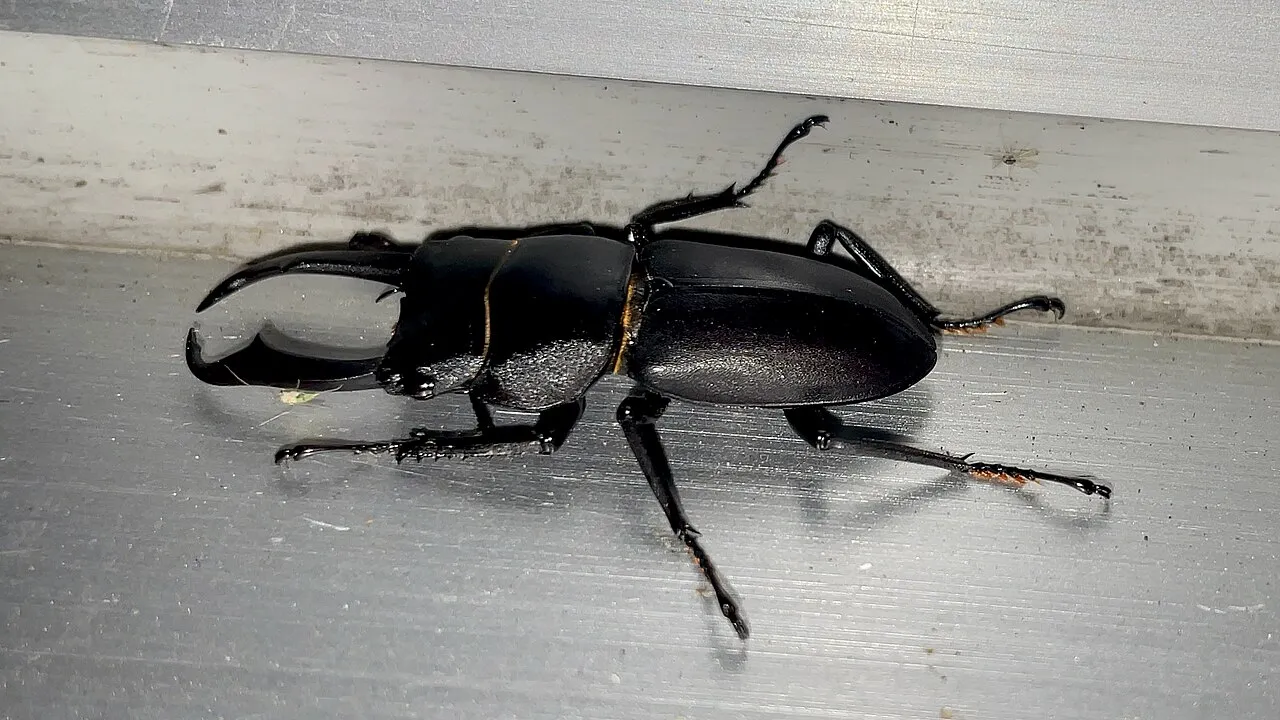
One adult needs only a small container about 20 cm long. Lay 5–10 cm of beetle mat or fermented substrate and press it down lightly to create hiding space and hold moisture. Top it with bark, wood pieces and leaves to grip, and a jelly holder so cups do not tip.
| Factor | Target | Notes |
|---|---|---|
| Temperature | 20–25°C | Prolonged heat above 28°C shortens life |
| Overwintering | 5–15°C | Do not let it freeze |
| Substrate moisture | Clumps lightly when squeezed | Avoid waterlogging |
| Housing | One beetle per container | Pairs together only briefly for mating |
Strong mandibles can chew and enlarge the vents of thin plastic boxes, so use a sturdy container with a secure lid. In summer, rooms without air conditioning easily pass 30°C; keep beetles in the coolest part of the home. Some keepers use a cool box with ice packs to ride out heatwaves.
8.2. Larval set-up
There are three main ways to rear stag beetle larvae.
- Fungus bottles: hardwood sawdust colonised by mycelium, often of oyster-mushroom-type fungi. The fungus breaks down the wood into richer food, and species that take well to it, such as Dorcus titanus and D. hopei, tend to grow larger. Males often go into 800–1,500 ml bottles and females into 500–800 ml, with a fresh bottle every two to four months.
- Fermented substrate: hardwood substrate similar to that used for rhinoceros beetles. It is cheaper and easier to manage and suits species such as Dorcus rectus and Prosopocoilus inclinatus. Pack it firmly into a bottle or tub, one larva each.
- Leaving them in the log: the most natural method, though you cannot easily check progress.
Larvae that meet frequently kill each other, so whichever method you use, keep them individually. Around 18–24°C works well, and keepers aiming for big males often hold a steady 20°C or so. Fungus bottles kept too warm can over-ferment, flooding with liquid or suffocating the larva.
Larval weight largely determines adult size. Recording peak weight late in the third instar gives a fair prediction of how big the adult will be.
8.3. Shopping list
- One small adult container per beetle
- Beetle mat or fermented substrate
- Bark, wood chunks and leaves
- Beetle jelly, including high-protein, and jelly holders
- Mister
- Egg-laying logs, typically oak, often spent shiitake logs
- Fungus bottles or larval bottles
- Spoon and a flat screwdriver for splitting logs
- Scale accurate to 0.1 g, optional
- Thermometer
- Labels recording species, locality and emergence date
9. Diet
Adults lap sap and ripe fruit juice; at home, commercial beetle jelly is the best option. Stag beetles eat less than rhinoceros beetles, often taking two or three days to finish one cup. Replace cups that are empty or dried hard. High-protein jelly is widely reported to boost egg numbers in breeding females.
If you give fruit, offer a little banana or apple and remove it within a day. Watermelon, melon, cucumber and other watery produce cause diarrhoea and turn the substrate soggy. Sugar water or neat honey leaves everything sticky.
Larvae eat their fungus bottle, fermented substrate or rotting wood. When the bottle has browned and feeding tunnels cover more than about half of it, it is time to change. Changing too often stresses larvae and can stall their growth.
Overwintering adults barely eat. As autumn temperatures fall and jelly consumption drops, leave only a small portion, and in deep winter simply check occasionally that the substrate has not dried out. Offer jelly again once the beetle stirs in spring.
10. Health
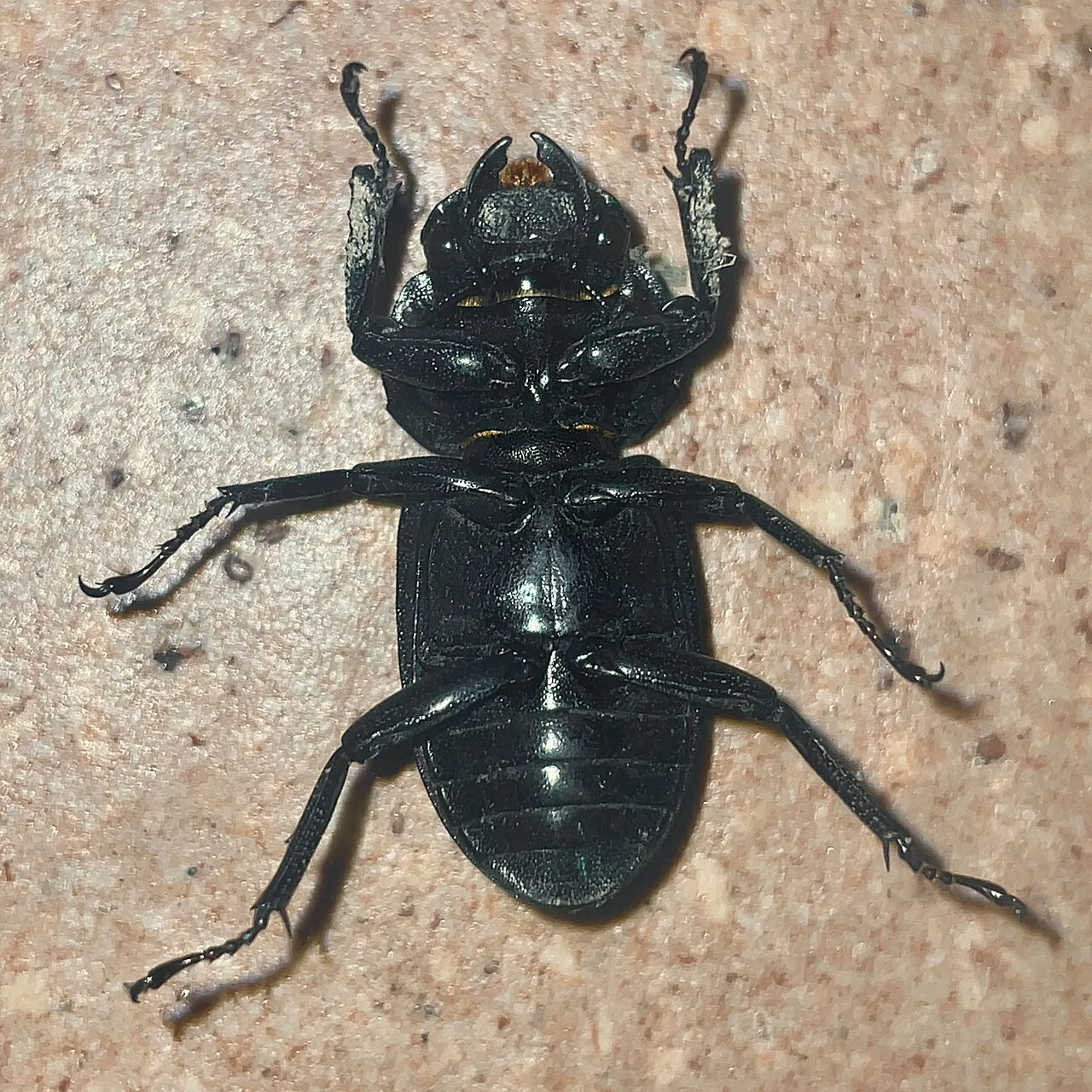
Kyu3 · CC BY-SA 4.0
Most stag beetle health problems come from heat, moisture and housing beetles together. Vets cannot realistically help, so prevention is everything.
- Heat: stag beetles are especially heat-sensitive. Sustained temperatures above 30°C can kill adults and make fungus bottles over-ferment and suffocate larvae.
- Injuries from cohabiting: mandibles can sever legs or puncture wing cases and abdomens. Male Dorcus titanus are notorious for killing females.
- Mites: tiny mites collect between body segments and at leg joints. Brush them off with a soft toothbrush and replace the substrate.
- Damp and mould: soggy substrate and leftover food bring mould and fruit flies.
- Failed emergence: a collapsed or dried-out pupal chamber can leave wings that will not fold or bent mandibles.
- Larval problems: a larva that darkens and shrivels may have an infection or heat damage. One that turns yellow and wrinkled in its bottle is preparing to pupate and should be left alone.
- Lost leg segments: a normal sign of ageing in old adults.
An adult stuck on its back for a long time burns through its reserves, so plenty of bark and twigs to grab is the simplest way to prevent losses. If something looks wrong, share photos and details of your set-up with a specialist shop or experienced club members.
11. Breeding
Breeding stag beetles takes more effort than rhinoceros beetles but is very rewarding. For Dorcus titanus and D. hopei, the process typically runs as follows.
- Maturity: use adults that finished their post-emergence rest and have been feeding well for a month or two. Many keepers breed in the spring after the beetles' first winter.
- Mating: place the pair in a roomy container under supervision and separate them once mating is confirmed. For aggressive species like D. titanus, some keepers gently restrain the male's mandibles with a cable tie during introductions.
- Preparing logs: soak an oak log, often a spent shiitake log, overnight, let it drain in the shade for a few hours and strip the outer bark.
- The laying set-up: pack substrate firmly in the bottom of a large container, half-bury the log and cover it with more substrate. Add the female and high-protein jelly and keep the set-up somewhere dark and quiet.
- Harvesting larvae: after one to two months, remove the female, split the log carefully with a flat screwdriver and move each larva into its own fungus bottle or substrate bottle.
Dorcus rectus and D. titanus lay readily, and one female can produce dozens of larvae. Each needs its own bottle and, later, its own container, so plan space and money in advance. Never release surplus beetles, native or exotic, because of the risks of hybridisation and disease.
12. Costs
These are rough Korean figures for keeping one pair of native stag beetles and raising ten larvae from a single breeding. Large specimens and exotic species cost far more.
| Item | Typical cost | Notes |
|---|---|---|
| Pair of D. titanus or D. hopei | 20,000–80,000 won | Size and locality matter |
| Two adult containers | 10,000–20,000 won | |
| Mat, bark, jelly holders | 10,000–20,000 won | |
| 50 jelly cups | 5,000–15,000 won | |
| Egg-laying log and large tub | 10,000–30,000 won | |
| Setup total | about 30,000–100,000 won | Less without breeding |
| Item | Cost | Notes |
|---|---|---|
| Jelly for one adult | 2,000–5,000 won a month | |
| Fungus bottles for one larva | 5,000–15,000 won each, 2–4 changes | More for big males |
| Substrate bottles for one larva | 2,000–5,000 won each | Cheaper than fungus |
| Ten larvae to adulthood | about 100,000–400,000 won | Depends on method |
Keeping adults alone costs only tens of thousands of won a year, but rearing several larvae in fungus bottles adds up quickly. Air conditioning or small temperature-controlled units in summer also add to the electricity bill.
13. Before you get one
- Do you have room to keep each beetle separately? Group displays do not suit stag beetles.
- Is there somewhere cool in summer? Without air conditioning, decide in advance on the coolest spot in your home.
- Are children ready for bites? A big male can draw blood. Teach them to hold the beetle by the sides of the body.
- Which species suits you? Adult lifespan, size and temperament differ, so choose with your goals in mind.
- Do you know the locality and source? Populations differ by region, and protected or illegal species occasionally turn up for sale.
When choosing an adult, check that all six legs and both antennae are intact, that the wing cases close neatly, and that it grips firmly when placed on your hand. Always ask when it emerged. A recently emerged adult may stay dormant without eating for months, while one that emerged long ago may have little life left. When buying larvae, look for firm, glossy white bodies and a bright orange head. Animals labelled with locality, emergence date and parent size make future breeding plans much easier.
14. Laws
Rules for stag beetles fall into three groups: protected native species, imports of exotic species and release into the wild. Check current rules with your national wildlife, agriculture or plant-protection authority, because lists change.
- Protected species: the European stag beetle, Lucanus cervus, is listed under the EU Habitats Directive, and in Britain it is protected against sale. In Korea, the Jeju population of Prosopocoilus astacoides blanchardi is a designated endangered species that may not be collected, kept or traded without a permit. Other countries protect their own rare species.
- Collecting: national parks and nature reserves generally ban or restrict insect collecting. Breaking open dead logs to search for larvae also destroys habitat that many other species depend on.
- Imports: many countries strictly limit live non-native beetles under plant-health and biosecurity law. In Japan and Korea only certain foreign species may be imported; in Australia, New Zealand and the United States the rules are very tight. Ordering live beetles from abroad yourself can be illegal.
- Release: releasing exotic beetles risks hybridisation and ecological harm, and even releasing natives from another region can blur local genetic differences.
If you live outside East Asia, the most rewarding way to enjoy stag beetles may be conservation: leaving dead wood in your garden and recording sightings for local surveys.
15. Stag beetles in culture
Stag beetles appear in popular culture as armoured warriors of the forest. In East Asia they share top billing with rhinoceros beetles as the stars of summer, and which of the two is stronger is a timeless playground argument.
- In the arcade card battles that swept Japan and Korea in the 2000s, stag beetles were heroes alongside rhinoceros beetles, using their mandibles to seize and hurl opponents.
- In Pokémon, Pinsir is a bug type whose huge pincer horns evoke stag beetle jaws.
- In Kamen Rider Kabuto, the rival rider Gatack is modelled on a stag beetle.
- In Animal Crossing, the giraffe stag and golden stag are among the rarest and most valuable bugs.
- In parts of Europe, old folk beliefs linked stag beetles to thunder and lightning, and they were said to carry burning coals into houses; German folk names connected them with thunder.
In Britain, the stag beetle has become a conservation mascot, with public surveys inviting people to report sightings and to leave dead wood in gardens for the larvae.
16. Trivia
- Males barely use their mandibles to eat. They are weapons for fighting and competing for mates; food is lapped up by the small mouthparts and brush-like tongue beneath them.
- Very long mandibles can actually pinch less hard at the tip, a simple matter of leverage, which is why many keepers say a female's short jaws hurt more.
- Stag beetle larvae look like rhinoceros beetle grubs, but the anal opening differs: a vertical slit in stag beetles, a transverse one in rhinoceros beetles.
- European stag beetle larvae can spend three to seven years underground in rotting wood, yet the adults live only a few weeks.
- In Japanese size-record keeping, captive Dorcus hopei males have been reported at over 90 mm, whereas a wild male in the 70s of millimetres is considered big.
- The rainbow stag of Australia and New Guinea shifts between green, red and gold depending on the viewing angle, and is often called the most beautiful stag beetle in the world.
- Dead and decaying wood, the stag beetle's nursery, also supports fungi, mosses and countless other invertebrates. Leaving it in place is one of the simplest steps in woodland conservation.
Health notes are general information. If something seems wrong, contact a vet who treats this species.
FAQ
Can I keep a stag beetle with a rhinoceros beetle?
It is best not to. They can injure each other, and their ideal temperatures and substrates differ slightly.
Do I have to use fungus bottles for larvae?
No. Fermented substrate works, but species such as Dorcus titanus and Dorcus hopei tend to grow larger on fungus bottles.
My stag beetle hasn’t moved all winter. Is it dead?
It is most likely overwintering. Keep it cool with slightly damp substrate, and it should become active again as spring warms up.
Further reading
Photo credits
Photos are freely licensed images from Wikimedia Commons. Authors and licenses are listed below.
- Dorcushopeibinodulosus.JPG — keusju · CC BY-SA 3.0
- Small stag beetle at convenience store - 1.jpg — KKPCW(Kyu3) · CC BY-SA 4.0
- Small stag beetle at convenience store - 3.jpg — KKPCW(Kyu3) · CC BY-SA 4.0
- Small stag beetle at convenience store - 4.jpg — KKPCW(Kyu3) · CC BY-SA 4.0
- Small stag beetle at convenience store - 2.jpg — KKPCW(Kyu3) · CC BY-SA 4.0
- Female stag beetle on the floor - 3.jpg — Kyu3 · CC BY-SA 4.0