TailVille
At a glance
Rough ranges for supplies, food and electricity in Korea (USD is approximate). Purchase or adoption fees are not included.
People who want a compact dog with a big personality and will commit to back care and weight control.
Homes full of stairs with no way to carry the dog, noise-sensitive housing, or owners unable to budget for disc treatment.
1. Overview
The Dachshund was developed in Germany to go to ground after badgers and foxes. Its body is nearly twice as long as it is tall, its legs are very short, and its deep chest and powerful forelegs are built for digging. That unmistakable outline has earned it nicknames like sausage dog and wiener dog worldwide, and in Korea it has long been a popular small breed.
Dachshunds come in combinations of size (standard, miniature and, in some registries, rabbit) and coat (smooth, long-haired and wire-haired). Small as they are, they carry a hunter's courage and stubbornness and a surprisingly deep bark. Above all, their long back gives them a very high risk of intervertebral disc disease, which is the key to understanding the breed. This article leaves general dog care to the main dog article and focuses on the Dachshund's history, varieties, temperament and the daily habits that protect its spine.
2. Name and origin
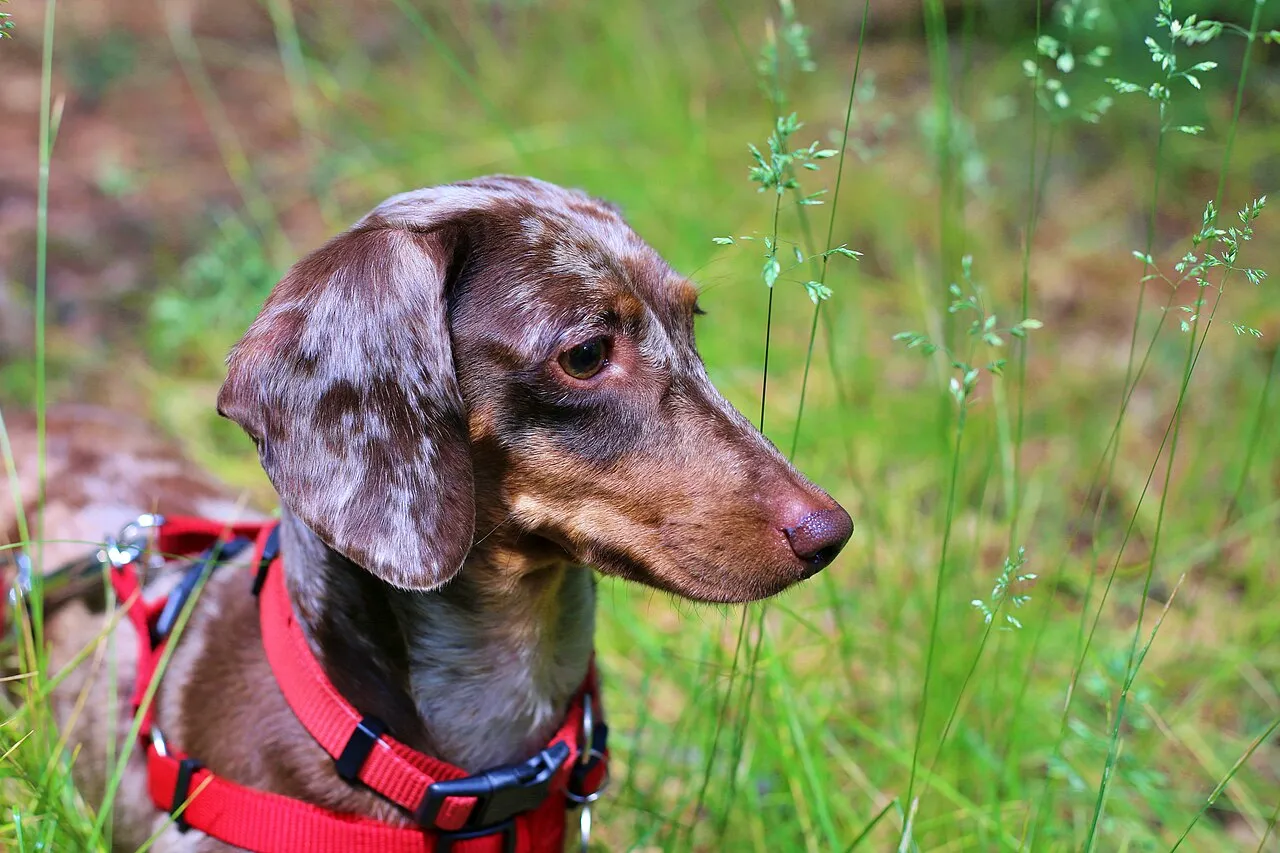
Willydrach · CC BY-SA 4.0
2.1. The badger dog
The name combines the German Dachs (badger) and Hund (dog). In Germany itself the breed is more often called Dackel, or Teckel in hunting circles. English speakers say something like 'daks-hund', and Koreans have settled on dakseuhunteu.
Short-legged hunting dogs appear in medieval European art and writing, but dogs resembling the modern Dachshund are clearly documented in Germany from the seventeenth and eighteenth centuries. Badgers are strong for their size and fight fiercely underground, so a badger dog needed a low, long body to pass through tunnels, powerful forelegs to dig, a loud, deep voice to tell hunters above where it was, and the nerve not to back down. Smaller Dachshunds were later developed for rabbits and other small quarry.
2.2. Coat varieties and recognition
The smooth coat is considered the oldest. The long-haired variety may have come from crossing smooths with spaniel-type dogs or from selecting longer-coated smooths, and the wire-haired variety is said to have been created in the nineteenth century with rough-coated terrier or pinscher-type dogs.
The FCI gives the Dachshund a group of its own, Group 4, a mark of how distinctive it is. The AKC recognised the breed in the late nineteenth century and places it in the Hound Group. Around the First World War, anti-German sentiment in Britain and the United States sent the breed's popularity tumbling, and there were reportedly efforts to rename it.
3. Dachshunds in Korea
The Dachshund was one of the earlier Western breeds to become known in Korea. Its small size and short coat made it seem ideal for apartments, and it remains a regular in small-dog popularity rankings. Most Korean Dachshunds are miniatures, with smooth and long-haired coats far more common than wire.
Popularity has its shadows. Many Dachshunds live in homes full of stairs and sofas without any precautions, and arrive at the clinic only once paralysis has set in; some owners, faced with surgery costs, give up treatment or surrender the dog. Demand for ever-smaller dogs encourages breeding from undersized parents, and the wish for striking dapple coats leads to dapple-to-dapple breedings that produce puppies with eye and ear defects.
4. Appearance and breed standard
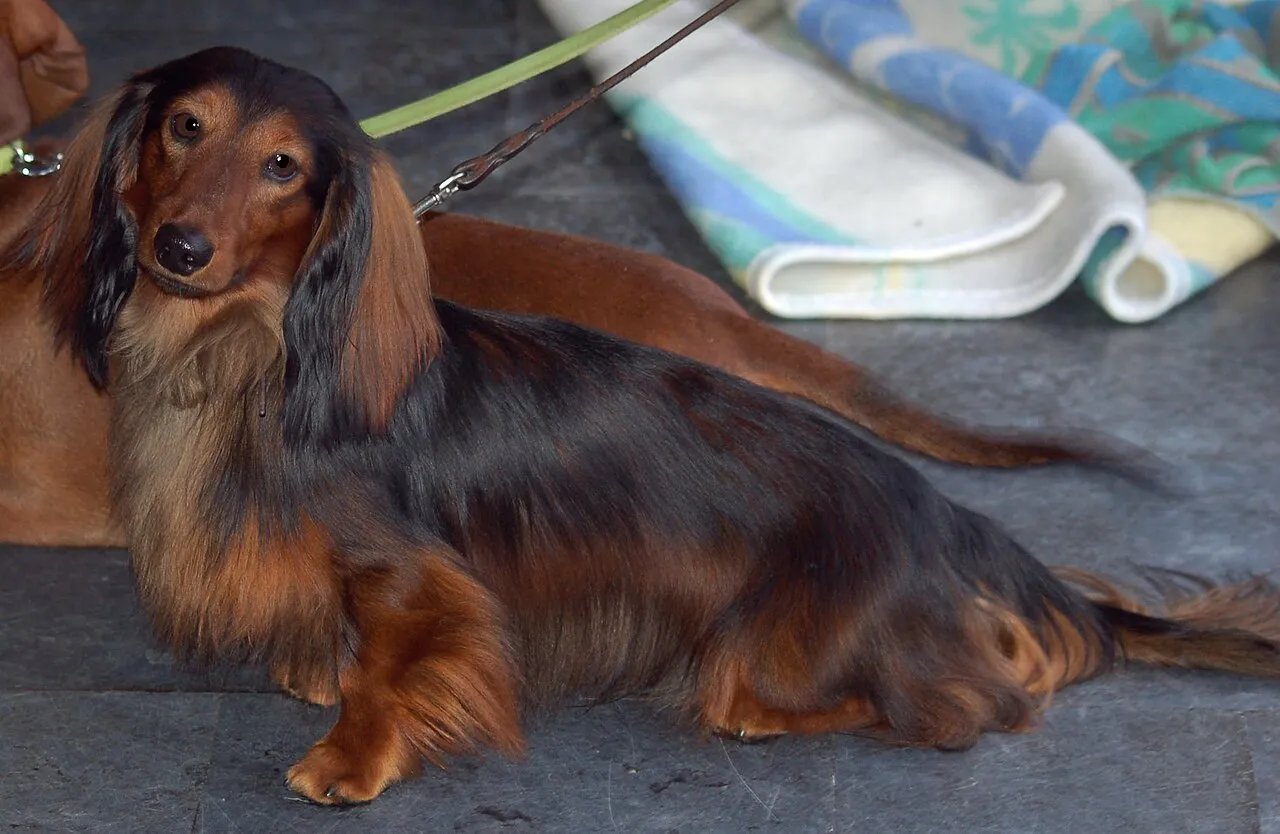
The Dachshund is long and low, with a prominent breastbone and a deep chest. The head is long and tapering, and the ears are set high and hang with rounded tips. The legs are short but muscular, and the front feet are large and strong for digging.
Registries define size differently.
| Size | FCI (adult chest girth) | AKC (weight) |
|---|---|---|
| Standard | Over 35 cm, upper weight about 9 kg | About 7–14.5 kg (16–32 lb) |
| Miniature | 30–35 cm | About 5 kg (11 lb) or less |
| Rabbit (Kaninchen) | Under 30 cm | Not a separate class |
The FCI measures chest girth on dogs at least 15 months old, reflecting the original test of whether a dog could fit down an earth.
There are three coats:
- Smooth: short, glossy and close-lying, the easiest to care for.
- Long-haired: soft, slightly wavy coat with feathering on the ears, chest, legs and tail, often described as the gentlest variety.
- Wire-haired: harsh outer coat with a beard and eyebrows, often described as the most terrier-like and mischievous.
Colours include red, cream, black and tan and chocolate and tan, plus patterns such as dapple (merle), brindle and piebald. Wire-haireds also come in wild boar, a grizzled mix. Accepted colours vary by registry.
5. Temperament
The Dachshund carries big-dog confidence in a small frame. Bred to face badgers, it is fearless, curious and slow to give up once it has decided on something.
- Affection: devoted to family and keen on body contact. Burrowing under duvets and blankets to sleep is a classic Dachshund habit.
- Stubbornness: clever but independent, a Dachshund wants to know why it should bother. House-training is often reported to take longer than with other small breeds.
- Barking: a dog bred to signal its position from underground has a loud, deep voice and tends to bark at doorbells, deliveries and outside noises, so apartment owners need a plan.
- Digging and scent trailing: flowerbeds and pot plants get excavated, and walks become nose-led expeditions.
- Wariness: some are suspicious of strangers, and a child grabbing or handling them roughly may get a defensive nip.
- Possessiveness: some want their person to themselves or guard toys.
People say temperament varies by coat type, but individual differences are far larger. Consistent, enjoyable reward-based training and early socialisation are the surest route to a well-adjusted adult.
6. Who it suits and who it doesn't
- Good fit: people who want a small dog with a big, lively personality
- Good fit: homes with lifts or few stairs
- Good fit: owners who will manage weight and daily habits carefully
- Good fit: people who enjoy 30 to 60 minutes of walking a day
- Poor fit: homes with lots of stairs and no way to carry the dog each time
- Poor fit: noise-sensitive neighbours or thin walls
- Poor fit: homes where young children will often pick up and carry the dog
- Poor fit: anyone unable to prepare for large medical bills such as disc surgery
Its size makes the Dachshund look easy, but it comes with a lifelong assignment: protecting that back.
7. Exercise and play
As a hunting breed, the Dachshund has more stamina than it looks. Adults usually do well on 30 minutes to an hour of walking a day, and steady exercise builds the back and core muscles that help support the spine.
- Walks: level ground is best. Plenty of sniffing makes even short walks satisfying.
- Scent games: ideal for hunting instincts. Hide treats under blankets or in boxes to satisfy the urge to dig at the same time.
- Tug: gentle tugging at ground level is fine, but avoid pulling so hard the dog is lifted or shaken.
- Earthdog: in some countries Dachshunds compete in trials that involve navigating artificial tunnels.
Avoid:
- jumping down from sofas, beds or car seats
- running up and especially down stairs
- standing on hind legs for long periods or leaping for treats
- frantic ball chasing with sudden stops and turns
Teaching a puppy from day one that the sofa is reached by ramp is one of the most effective disc-protection habits there is.
8. Coat and grooming
Grooming depends on coat type.
| Coat | Brushing | Special care |
|---|---|---|
| Smooth | Weekly with a rubber or soft brush | Sheds more than expected; a coat helps in winter |
| Long-haired | Two or three times a week with pin brush and comb | Watch for mats behind ears and in armpits; trim paw hair |
| Wire-haired | Two or three times a week | Hand-stripping of dead coat every few months, or clipping |
- Bathing: every one to two months is plenty; dry the belly and between the legs thoroughly.
- Ears: drop ears are prone to infection, so check weekly for smell and discharge.
- Teeth: Dachshunds are notorious for dental disease. Brush daily and ask your vet about periodic professional cleaning.
- Nails: a long body on short legs puts heavy load on the feet; long nails spoil posture and strain joints. Check every two or three weeks.
- Lifting: one hand under the chest, the other under the hindquarters, keeping the body level. Lifting by the armpits alone lets the back sag and strains the spine. Ask groomers and vet staff to do the same.
9. Diet and weight
For a Dachshund, managing weight is managing the back. The long spine spans the legs like a bridge, and every extra gram increases the load on the discs. Remember that one kilogram on a small dog is a big proportional gain.
- Portions: weigh the food and split it into two meals. For a miniature, a few extra kibbles or one more treat really adds up.
- Body check: from above you should see a waist behind the ribs; from the side the belly should tuck up. A belly hanging low or bulging flanks mean overweight.
- Treats: keep under 10% of daily calories. Dachshunds are expert beggars, and one family member breaking the rules can undo everyone else's efforts.
- Human food: fatty food causes obesity and can trigger pancreatitis.
- Dieting: aim to lose about 1–2% of body weight a month, with a target weight and any prescription diet set by your vet.
During crate rest or recovery from disc surgery, activity drops and weight creeps up, so portions need adjusting then too.
10. Inherited conditions and health
Any discussion of Dachshund health starts with disc disease, but other conditions are linked to particular coat types and sizes. This is background only; diagnosis and treatment are for your vet.
10.1. Intervertebral disc disease (IVDD)
Cause: in chondrodystrophic breeds like the Dachshund, the soft centre of each disc hardens early in life. Research links an extra copy of the FGF4 gene to both short legs and early disc degeneration, and the variant is extremely common in Dachshunds. A hardened disc can rupture or bulge under modest stress and compress the spinal cord. A substantial share of Dachshunds, roughly one in five or more depending on the study, show disc signs during their lives, most often between three and seven years old.
| Grade | Signs | Typical approach |
|---|---|---|
| 1 | Pain only (hunched back, trembling, yelping when lifted) | Strict crate rest and medication may be tried |
| 2 | Walking but wobbly | Rest and medication, or surgery considered |
| 3 | Moves hind legs but cannot walk | Surgery often recommended |
| 4 | Hind-leg paralysis, deep pain sensation present | Prompt surgery advised |
| 5 | Paralysis with loss of deep pain | Surgery as soon as possible; recovery odds fall sharply |
Tests: neurological exam, X-rays, and MRI or CT to confirm and plan surgery.
Management: mild cases may be prescribed four to six weeks of strict crate rest; letting the dog out early because it seems better invites relapse. After surgery, rehabilitation helps recovery enormously.
The golden rule: weak or odd-moving hind legs mean a vet today, not tomorrow. Once paralysis develops, every hour of delay reduces the chance of recovery.
10.2. Dapple and double dapple
Dapple is the pattern called merle in other breeds: patches of diluted colour across the coat. Dogs with one dapple gene are usually healthy, but double dapples, from dapple-to-dapple matings, carry a much higher risk of microphthalmia (small or absent eyes), deafness and blindness. Responsible breeders never mate two dapples. Be wary of mostly white dapple puppies advertised as rare colours, as they may be double dapples. Some dogs carry a dapple pattern so faint it's hard to see, which is why colour DNA testing of parents helps.
10.3. Other conditions
| Condition | What happens | Most associated with |
|---|---|---|
| Dental disease | Tartar, gum inflammation, tooth loss | All types, especially miniatures |
| Progressive retinal atrophy (cord1 and others) | Retinal degeneration and vision loss | Miniature long-haireds; DNA test available |
| Lafora disease | Progressive myoclonic epilepsy starting in later life | Miniature wire-haireds; DNA test available |
| Osteogenesis imperfecta | Fragile bones that fracture easily | Reported in wire-haireds; DNA test available |
| Acanthosis nigricans | Darkened, thickened skin in armpits and elsewhere | Mostly smooths |
| Pattern baldness | Gradual thinning on ears, neck and thighs | Smooths |
| Cushing's disease | Heavy drinking, pot belly, hair loss | Middle age onward |
| Luxating patella | Kneecap slips, causing skipping | Miniatures |
| Diabetes | Increased thirst and urination, weight loss | Linked to obesity |
When choosing a puppy, check that the parents had the DNA tests relevant to their coat and size, such as PRA for miniature long-haireds and Lafora disease for miniature wire-haireds.
11. Life stages and lifespan
Like most small dogs, Dachshunds are long-lived, typically 12 to 16 years. A wire-haired Dachshund was once reported by Guinness as the world's oldest living dog at over 20.
| Stage | Age | Focus |
|---|---|---|
| Puppy | 0–6 months | Ramp habits, correct lifting, socialisation and house-training |
| Adolescent | 6 months–2 years | Stubbornness and barking peak; stop the jumping habit |
| Adult | 2–8 years | Peak disc risk, especially 3–7; weight control and muscle tone |
| Senior | 9+ years | Dental, eye and endocrine checks; watch for joint and back pain |
Many senior Dachshunds lose several teeth to periodontal disease; a brushing habit started young makes a big difference to quality of life later. A dog that has had one disc episode can have another at a different site, so keep up the protective routine after recovery.
12. Costs
Rough 2026 ranges in Korean won.
| Item | Approximate cost | Notes |
|---|---|---|
| Initial supplies, vaccines, registration | 600,000–1,300,000 | Excluding purchase; ramps and non-slip rugs |
| Food | 30,000–60,000 a month | |
| Treats and supplies | 20,000–40,000 a month | |
| Parasite prevention | 10,000–20,000 a month | |
| Bathing and grooming | 30,000–70,000 per visit | Hand-stripping wires may cost more |
| Pet insurance | 20,000–50,000 a month | Check that disc disease is covered |
| Dental cleaning | Hundreds of thousands per session | Including pre-anaesthetic tests |
| Disc diagnosis (MRI) | Hundreds of thousands to over 1,000,000 | |
| Disc surgery and hospitalisation | Several million or more | Rehabilitation extra |
Basic monthly costs run about 100,000–180,000 won. When choosing insurance, read the policy carefully for spinal and joint exclusions or breed-specific clauses.
13. Before you get one
- Back history: ask whether the parents or close relatives have had disc surgery. Some countries use spinal X-ray screening of disc calcification to guide breeding.
- DNA tests: request the tests relevant to coat and size, such as PRA, Lafora disease and osteogenesis imperfecta, plus dapple status.
- Double dapple: check whether both parents are dapples and whether the puppy's eyes and ears are normal.
- Teacup claims: ads promising a dog will stay under 3 kg may involve extreme miniaturisation.
- Pet shops and puppy farms: selling puppies under two months is illegal in Korea; avoid sellers who can't show the parents.
- Shelters: Dachshunds are surrendered over barking or disc treatment costs. If adopting one with a disc history, get full details on recovery and care from the shelter and a vet.
- Home layout: in a walk-up building, can you carry the dog up and down for life? Is there room for ramps to the sofa and bed?
- Medical fund: disc surgery can cost several million won, so arrange insurance or an emergency fund in advance.
14. Dachshunds in popular culture
The Dachshund has long served as a symbol of Germany. Waldi, a striped Dachshund, was the mascot of the 1972 Munich Olympics and is generally regarded as the first official Olympic mascot. Queen Victoria was fond of Dachshunds, and Picasso's Lump, Andy Warhol's Archie and David Hockney's Dachshunds all found their way into art.
Slinky Dog in Toy Story is a Dachshund toy with a spring for a body. Some say the hot dog got its name from jokes comparing sausages to Dachshunds, though the true origin is uncertain. Wiener dog races are popular events in the United States, Australia and elsewhere, and in Korea clips of Dachshunds sprinting on tiny legs are perennial favourites on social media.
15. Trivia
- A Dachshund's tail was supposedly meant to be sturdy enough for a hunter to haul the dog out of a burrow by it.
- Hearing that deep bark through a door, many visitors expect a much bigger dog.
- In Germany Dachshunds are still used in hunting, notably for tracking wounded deer by blood trail.
- They are famous sun-seekers, moving around the house to follow patches of sunlight.
- Their long bodies don't fit standard dog clothes, so Dachshund-specific coats and harnesses are sold.
- A museum devoted to Dachshunds opened in Bavaria and drew international attention.
Health notes are general information. If something seems wrong, contact a vet who treats this species.
🍽️ Can my dog or cat eat this? →
FAQ
How are miniature and standard Dachshunds defined?
The AKC defines miniatures by weight, about 11 lb (5 kg) or less at maturity. The FCI uses chest circumference to define three sizes: standard, miniature and rabbit (Kaninchen).
Should Dachshunds never use stairs?
Reducing them is more realistic than banning them. Let your dog take short flights slowly, carry it on long or downward flights, and use gentle ramps for furniture.
Does disc disease always need surgery?
It depends on severity. Mild, pain-only cases are sometimes managed with strict crate rest and medication, but dogs that can't walk or have lost deep pain sensation usually need prompt surgery. Get a veterinary, ideally neurology, assessment quickly.
Photo credits
Photos are freely licensed images from Wikimedia Commons. Authors and licenses are listed below.
- 닥스훈트(단모종) (Dachshund (Short)).jpg — Katemil94 · CC BY-SA 4.0
- Dapple-Dachshund.jpg — Willydrach · CC BY-SA 4.0
- Jamnik długowłosy standardowy LM 671.jpg — Lilly M · CC BY-SA 2.5