TailVille
At a glance
Rough ranges for supplies, food and electricity in Korea (USD is approximate). Purchase or adoption fees are not included.
Calm, detail-minded owners who keep late hours and are happy to manage temperature carefully year-round.
Families wanting a hands-on pet for young children, or anyone unable to keep a room reliably warm in winter.
1. Overview
The hedgehogs sold as pets almost all descend from the four-toed hedgehog (Atelerix albiventris) of central and eastern Africa's savannas and scrublands. Pet shops call them African pygmy hedgehogs, or APHs, but that is a trade name for the captive population rather than a true species. They are famous for the several thousand spines on their back and for a defence that turns the whole animal into a prickly ball.
At roughly 250–600 g they fit in a cupped pair of hands, and they make almost no noise, which is why they are often pitched as apartment pets. The reality is a little more demanding. They come from a warm climate and need steady heat, they are nocturnal, and they live alone in the wild, so they rarely seek out affection the way a dog or a rat might. What you earn instead is a quieter kind of trust: a hedgehog that relaxes its spines, unrolls and potters across your lap because it recognises your scent.
Captive hedgehogs usually live four to six years, and from about age three cancers and neurological problems become common. Think of a hedgehog not as an easy starter pet but as an exotic animal whose temperature, weight and ageing signs need regular attention. This article covers classification, history, anatomy, behaviour, housing, diet, health, breeding, costs, law and the hedgehog's place in culture.
2. Name and classification
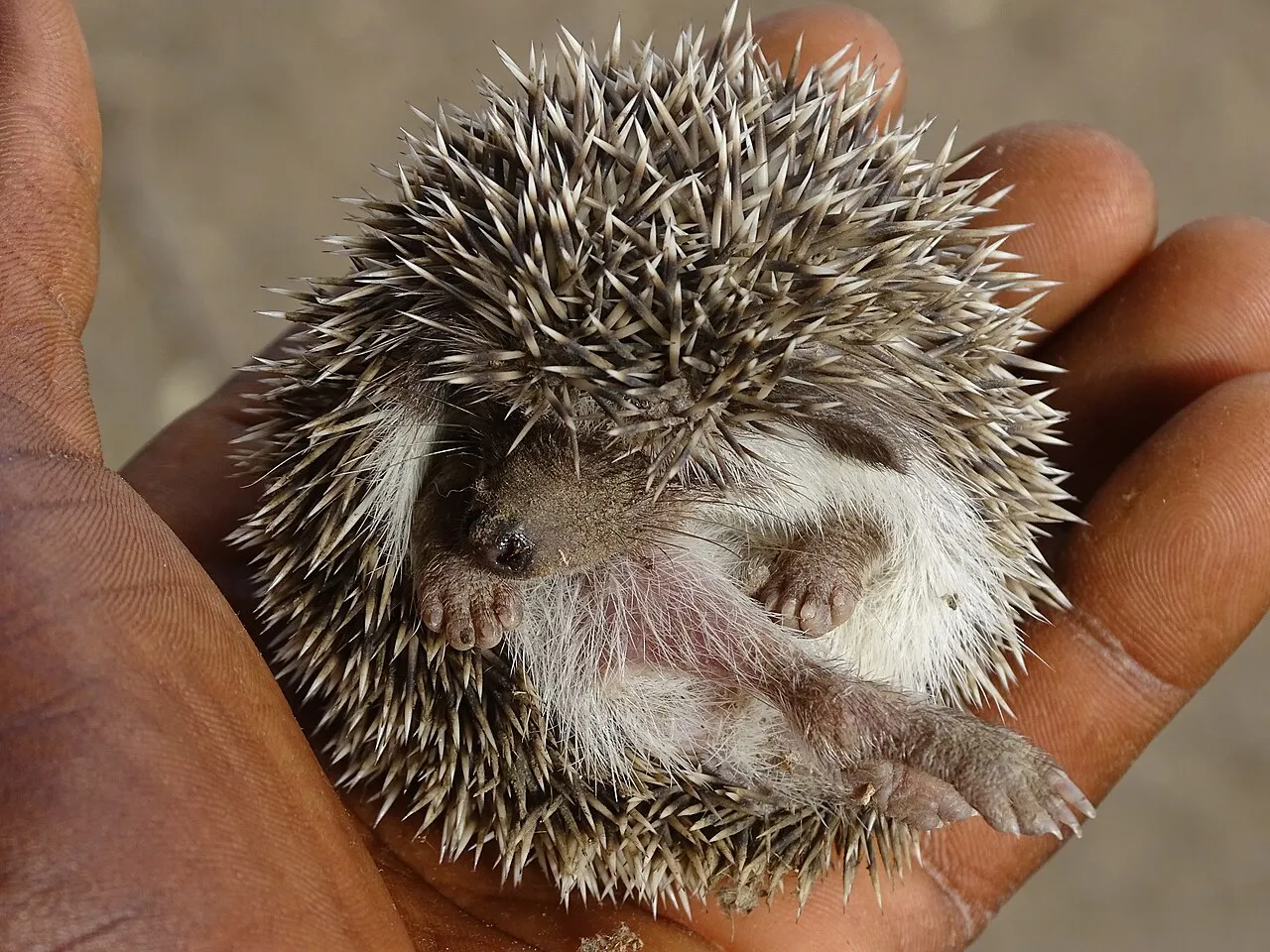
GANSO Rockis Gérovenso Sèdodjitché · CC BY-SA 4.0
2.1. Scientific name and taxonomy
Hedgehogs are mammals in the order Eulipotyphla and the family Erinaceidae. They were once lumped with moles and shrews in an order called Insectivora, a grouping that modern genetics has reshuffled. The family has two branches: the spiny hedgehogs, and the furry, spineless gymnures or moonrats of Southeast Asia.
| Rank | Name |
|---|---|
| Order | Eulipotyphla |
| Family | Erinaceidae |
| Genus | Atelerix (African hedgehogs) |
| Main pet species | Four-toed hedgehog, Atelerix albiventris |
| Close relatives | North African hedgehog (A. algirus), Amur hedgehog (Erinaceus amurensis) |
The pet population is built mainly on the four-toed hedgehog, but early imports may have mixed in North African hedgehogs, so some keepers describe pet APHs as a blend. The exact ancestry has never been fully worked out.
2.2. Where the names come from
The English word is easy to unpack: the animal snuffles along hedgerows and grunts like a small pig, hence hedge plus hog. Older English used urchin, which is why the spiny sea creature is called a sea urchin. The Korean name, goseumdochi, traces back to older forms ending in a syllable that meant pig, so Korean speakers reached the same piggy comparison independently.
The genus name Atelerix is usually read as Greek for incomplete or imperfect spine, and albiventris is Latin for white belly, a fair description of the pale underside. The common name four-toed hedgehog comes from the hind feet, which often lack the inner toe.
2.3. Related species
Korea has its own wild hedgehog, the Amur hedgehog, which is noticeably larger than a pet APH, can approach 1 kg and truly hibernates through winter. The European hedgehog is the garden visitor of Britain and western Europe and the model for most storybook hedgehogs. Long-eared hedgehogs of Egypt and the Middle East have strikingly large ears, and desert hedgehogs are kept as pets in a few countries. Porcupines, despite the spines, are rodents and not closely related at all.
3. History
3.1. From the wild to the living room
People and hedgehogs go back a long way. Roman writers mention hedgehog skins used for carding wool, and European gardeners sometimes welcomed wild hedgehogs as slug hunters. None of that was pet keeping in the modern sense, though. Breeding hedgehogs indoors, generation after generation, only took off in the late twentieth century.
Large numbers of four-toed hedgehogs were exported from West Africa to North America and Europe in the 1980s, and the American pet craze peaked in the early 1990s. Concern about livestock disease led the United States to restrict imports of African hedgehogs in the early 2000s, so today's pet population is overwhelmingly captive-bred, several generations removed from the wild.
3.2. Hedgehogs in Korea
In Korea hedgehogs appeared in exotic small-pet shops and online clubs during the 2000s. They hit a sweet spot in the public imagination, more unusual than a hamster but less of a commitment than a dog, and became very popular from the late 2000s into the 2010s. Local breeders multiplied and new colours arrived. Hedgehog cafés also opened, drawing criticism from welfare advocates because they asked a shy, nocturnal animal to be handled by strangers in daylight.
As the boom faded, keepers became more aware of problems caused by poor husbandry, especially winter chilling, obesity and tumours. Thermostats and under-tank heaters went from optional extras to standard kit.
4. Body
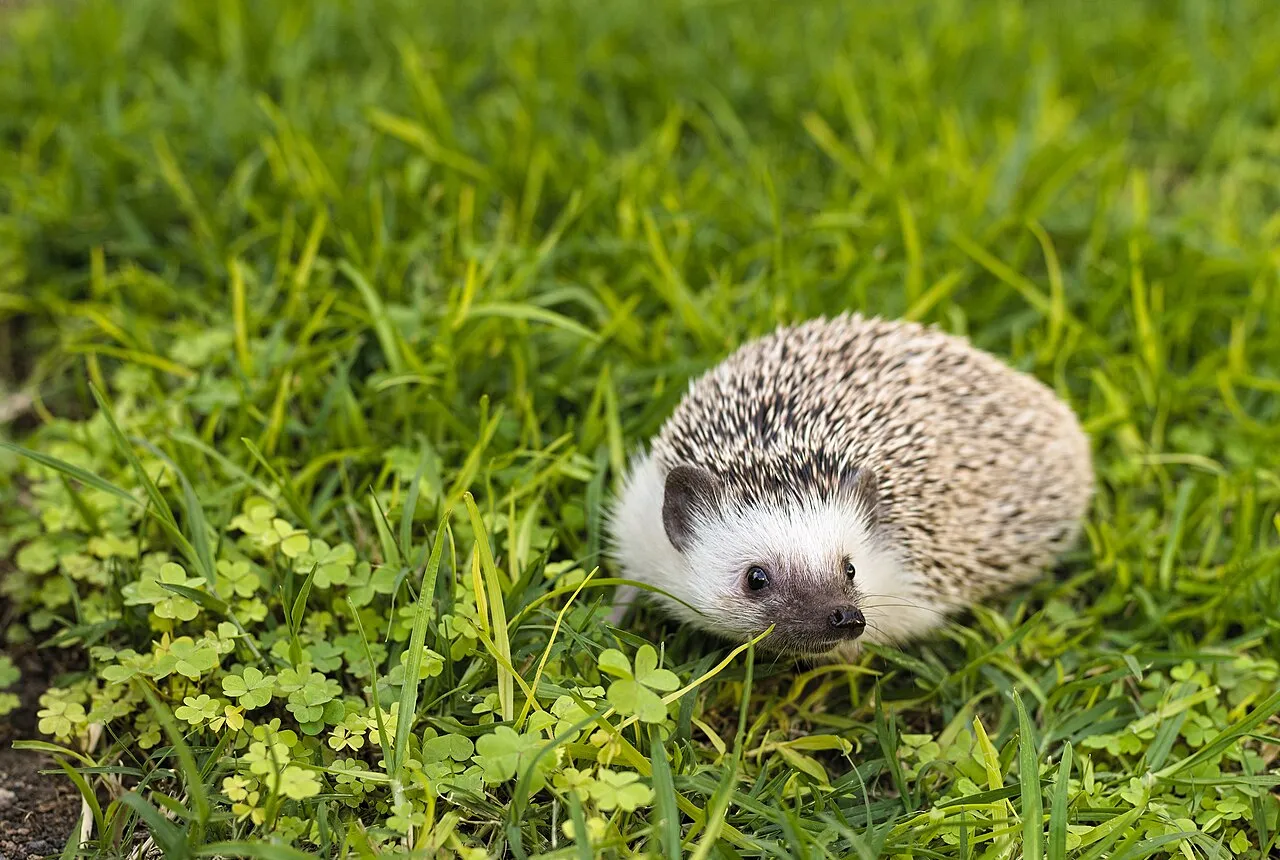
Cvmontuy · CC BY 4.0
4.1. Size and build
Adults measure about 15–22 cm and weigh roughly 250–600 g, with a lot of individual variation. Males tend to be slightly heavier but the overlap is large. The tail is a stub of 1–2 cm, hidden in the fur. The legs look tiny, yet hedgehogs are quick and can cover several kilometres a night on a wheel.
The best way to judge condition is from above. A fit hedgehog has a smooth teardrop outline. An overweight one develops bulging fat pads in the armpits and flanks that spill out past the spines, and it can no longer roll into a complete ball.
4.2. Quills and fur
Quills are modified hairs: hollow keratin tubes braced inside by thin walls, which makes them light but stiff. An adult carries something like five thousand of them, though counts vary. They carry no venom and no barbs, and hedgehogs cannot shoot them. The trick is a powerful ring of muscle under the skin that tightens like a drawstring, pulling the spines upright as the body curls.
The face, belly and legs are covered in soft fur. Spines are replaced gradually throughout life, but young hedgehogs go through quilling, a heavy shed of baby spines, at around 6–8 weeks and again at around 4–6 months. A quilling hedgehog is itchy and grumpy, which is normal. Patchy loss with bare skin in an adult is not normal and usually points to mites or fungal infection.
4.3. Senses and skeleton
Eyesight is poor and mainly useful for picking up movement in dim light. Smell and hearing do the heavy lifting: a hedgehog can hear a beetle shifting under leaf litter and track it by scent. That is also how it recognises you, so a strongly perfumed hand cream can make a familiar keeper smell like a stranger.
The mouth holds around 36–44 small pointed teeth designed for crunching insect shells. Unlike rodent teeth they do not keep growing, so tartar and gum disease build up over time. Body temperature sits around 35–37 °C, and their ability to stay warm runs out quickly once the room cools.
4.4. Telling males from females
Sexing is fairly easy once you see the belly. In males the penile sheath sits in the middle of the abdomen, roughly where you would expect a belly button, well away from the anus. In females the genital opening sits right next to the anus near the tail. Sex can be checked reliably at 6–8 weeks, and littermates should be separated by then.
5. Colours and types
There are no body-type breeds of pet hedgehog. Instead, keepers sort them by colour, combining quill banding, skin tone and eye colour. Naming differs between registries and breeders, so one animal may be sold under two or three labels. The common ones are below.
| Colour | What it looks like |
|---|---|
| Salt and pepper (standard) | Dark brown-black banded quills mixed with white, dark mask, close to wild type |
| Grey | Greyish banding, dark nose and skin |
| Cinnamon | Light brown quills, pink nose |
| Chocolate | Chocolate-brown banding, ranging to very pale |
| Champagne and apricot | Very pale beige or peach, often ruby or red eyes |
| Albino | No pigment at all, white quills and red eyes |
| Pinto | Patches of unbanded white quills and pink skin |
| Snowflake | A high proportion of solid white quills scattered through banded ones |
Colour has no known link to health or temperament. Red-eyed and albino animals may find bright light uncomfortable, so keep them out of direct sun. Rare colours sometimes carry inflated prices, but the health history of the parents and the conditions at the breeder matter far more than the shade of the spines.
6. Behaviour
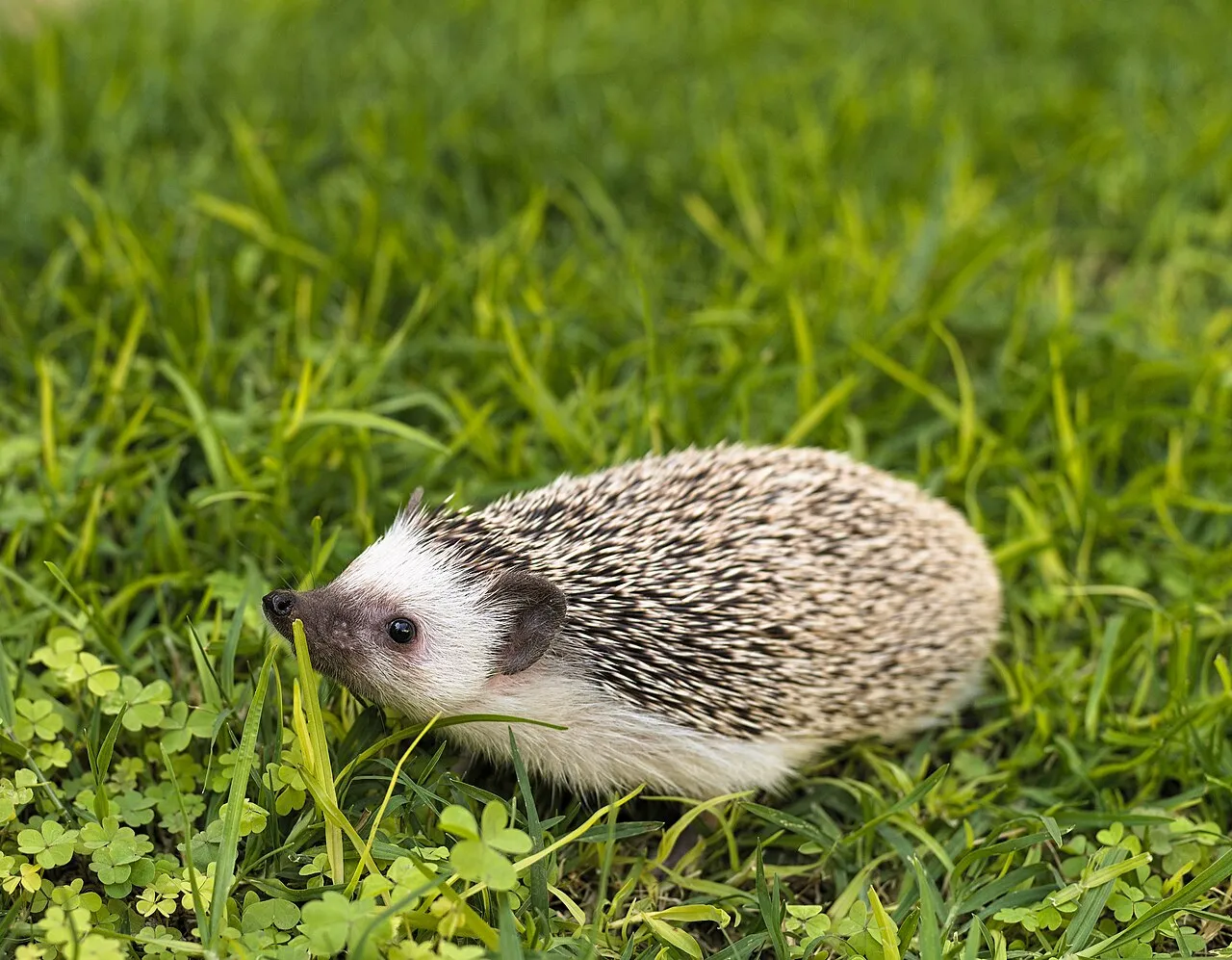
Cvmontuy · CC BY 4.0
6.1. Life in the wild
Wild four-toed hedgehogs sleep through the day in rock crevices, under thick bushes or in abandoned burrows, and come out after dark to forage. A night's wandering can stretch from a few hundred metres to several kilometres, and the menu is opportunistic: beetles, caterpillars, earthworms, snails and now and then a small frog or an egg. Outside the breeding season they keep to themselves.
During cool or dry spells they can drop into a state of torpor for days at a time. Pet hedgehogs do not have the fat reserves or the conditions to come through that safely, so a pet that starts to go torpid is in danger, not taking a nap.
6.2. Behaviour at home
At home a hedgehog wakes around dusk and stays busy until dawn. It patrols every corner of the enclosure, runs on its wheel for hours and drags bedding into its hide. Many hedgehogs also poop while running, so scrubbing the wheel becomes a morning ritual for most owners.
The oddest habit is self-anointing. When a hedgehog meets a new smell or taste it licks and chews the source until it produces frothy saliva, then twists around and spreads the foam over its spines with its tongue. Nobody knows for certain why. Ideas include scent camouflage and coating the spines with irritants for extra defence. It can look like a seizure the first time you see it, but it is normal and harmless.
6.3. Reading the signals
Spines and sounds tell you most of what a hedgehog is feeling.
- Forehead spines pulled down over the eyes, with huffing and clicking: wary, give it a moment.
- Sudden jumps or pops upward: a strong threat response meant to jab whatever is touching it.
- Fully rolled into a ball: frightened, or simply refusing to wake up.
- Spines flat, nose twitching, walking around: relaxed and curious.
- Soft chirps or a quiet whistling: usually contentment, or a male courting.
- A loud scream: serious pain or terror. Check immediately.
Hedgehogs do bite sometimes, usually because a hand smells of food or because they are investigating a new scent with their teeth. Most bites are exploratory rather than aggressive, and washing your hands with unscented soap before handling cuts them down a lot.
7. Life stages
Hedgehogs grow up fast and start to age surprisingly early. Knowing the stages helps you judge whether a change in behaviour is normal or a warning sign.
| Stage | Age | What happens |
|---|---|---|
| Newborn | 0–2 weeks | Born with soft white spines under a fluid-filled skin layer, eyes closed |
| Hoglet | 2–4 weeks | Eyes open, spines darken, first trips out of the nest |
| Weaning | 4–6 weeks | Starts eating solid food alongside milk, first quilling |
| Juvenile | 2–6 months | Usual age to go to new homes, sexual maturity, second quilling, touchy mood |
| Adult | 6 months–3 years | Weight and personality settle, peak activity |
| Senior | 3 years on | Slows down, higher risk of tumours, dental disease and neurological problems |
Captive hedgehogs usually live four to six years, and well-kept individuals sometimes reach seven or eight. Ageing shows up as less time on the wheel, slow weight loss, thinner and duller quills and longer sleep. Wobbling hind legs or a persistent lean to one side are not ordinary old age and can indicate wobbly hedgehog syndrome, so get a vet check. Seniors appreciate a hide with a low entrance, softened food and flooring that is not slippery.
8. Housing
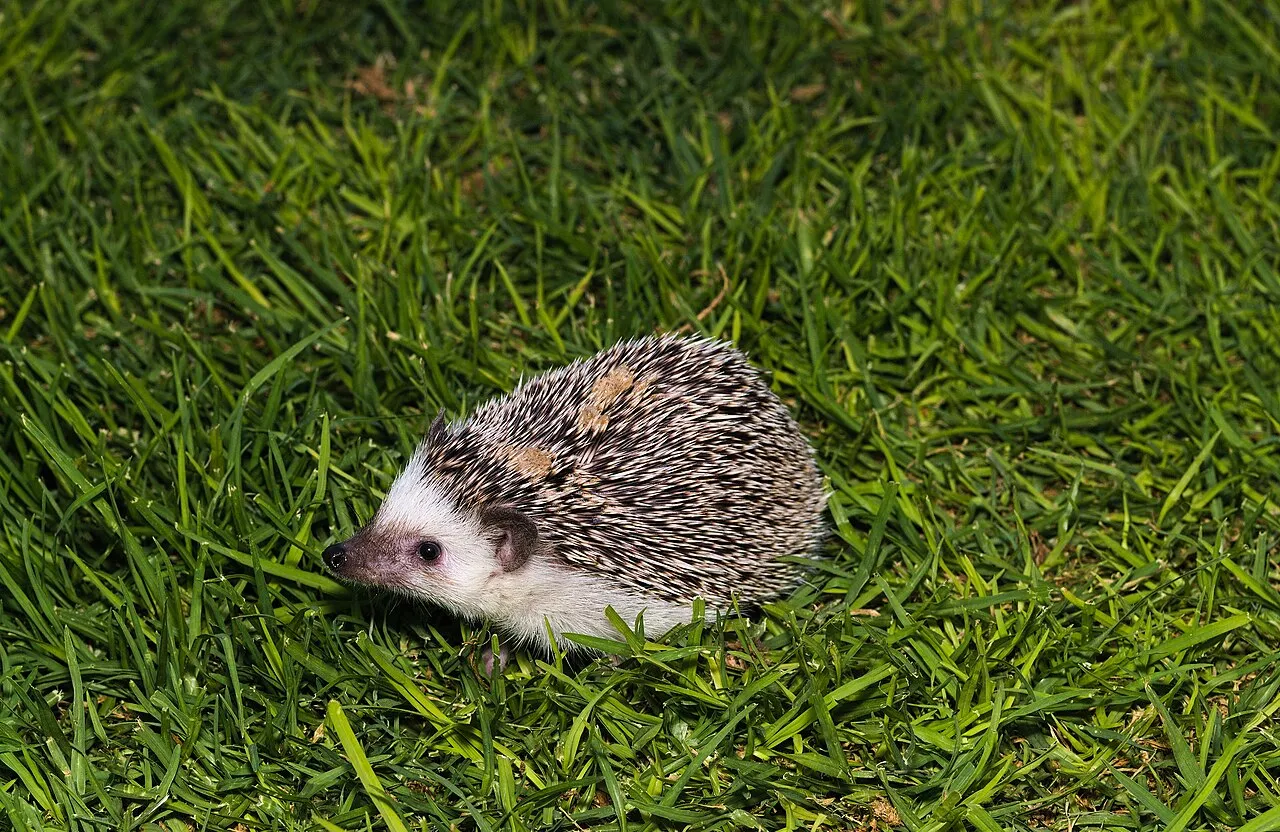
Cvmontuy · CC BY 4.0
8.1. Enclosure size and layout
Hedgehogs roam at night, so floor area matters far more than height. Aim for at least 90 × 60 cm, and bigger is better: a 120 cm storage-box conversion or a purpose-built enclosure is ideal. They climb better than you might expect but fall badly, so avoid multi-level cages and high shelves. If you use a wire cage, pick one with a solid plastic base; wire floors trap feet and toes. Smooth-sided plastic tubs are escape-proof, but they need plenty of ventilation holes or condensation will build up.
8.2. Temperature, humidity and light
Temperature is the single most important part of hedgehog care. Keep the enclosure at 24–28 °C and never let it drop below 20 °C. In the cold a hedgehog lets its body cool and tries to enter torpor, and a pet often cannot pull itself out again. Use a ceramic heat emitter or an under-tank heat pad, always on a thermostat, and place digital thermometers both near the hide and at the far end. Above about 30 °C hedgehogs become sluggish and heat-stressed, so keep them out of direct summer sun and stuffy closed rooms.
Humidity of 40–60% suits them. Very dry air leads to flaky skin, and very damp air invites fungal problems. Natural daylight is best; in a windowless room, give 12–14 hours of light a day, which helps stop the shortening days of autumn from triggering torpor. At night, keep the room properly dark.
8.3. Equipment checklist
- Wheel: at least 28–30 cm across, solid running surface. Wire or rung wheels break toes.
- Hide: an igloo, a wooden house or a fleece sleeping bag. Check fleece regularly for loose threads.
- Bedding: paper bedding, aspen shavings or fleece liners. Avoid cedar and strongly scented pine.
- Food bowl: heavy, low ceramic. Light bowls get flipped.
- Water: many hedgehogs prefer a bowl to a bottle, so offer both at first.
- Heater plus thermostat, and at least two digital thermo-hygrometers.
- Kitchen scale accurate to 1 g for weekly weigh-ins.
- Tunnels, cardboard tubes and a digging box for snuffling enrichment.
Frequent baths are unnecessary. A shallow foot bath in lukewarm water takes care of wheel mess, and full baths should be monthly at most, followed by thorough drying in a warm room.
9. Diet
9.1. Staple food and portions
Hedgehogs are insectivores, so the goal is a diet rich in protein and moderate in fat. Commercial hedgehog foods exist but vary widely in quality, and many keepers rely on, or mix in, a good-quality dry cat food with roughly 30–35% protein and 10–15% fat. A typical adult eats about 15–25 g a day, one to two tablespoons, offered in the evening as it wakes up.
Weight is the best guide. Weigh weekly at the same time of day, and if weight shifts by more than about 10% in a month, rethink portions and check health. Choose small kibble, since large pieces are hard for a hedgehog to crunch, and soak food in warm water for seniors or animals with dental trouble.
9.2. Treats and insects
Live insects are both nutrition and entertainment. Crickets, dubia roaches, mealworms and black soldier fly larvae, three to five at a time, two to four times a week, let a hedgehog hunt the way it would in the wild. Mealworms and superworms are fatty, so keep them a small part of the mix. Use only feeder insects bred for the purpose; bugs from parks and gardens may carry pesticides or parasites.
Small bits of plain cooked chicken or boiled egg white are fine too. Fruit and vegetables are not a dietary need for hedgehogs, so a fingernail-sized piece of apple, banana or cooked squash now and then is plenty. Keep all treats under about 10% of daily intake.
9.3. Foods and items to avoid
- Grapes and raisins: linked to kidney damage.
- Avocado, chocolate, onion and garlic: contain compounds toxic to many mammals.
- Milk and cheese: adult hedgehogs are lactose intolerant and get diarrhoea.
- Nuts, seeds and dried corn: hard fragments lodge in the roof of the mouth or the throat.
- Seasoned human food, processed meat and fried food: far too much salt and fat.
- Raw meat and raw egg: bacterial risk.
Hazards are not only edible. Wire wheels, frayed fabric and long strands of hair can wrap around a leg and cut off circulation, and scented candles, air fresheners and insect sprays are hard on such a small body.
10. Health
Hedgehogs hide illness well. Leaving food or skipping a night on the wheel is often the first visible sign of a problem that has been building for a while. Few clinics see hedgehogs, so find an exotic-animal vet before you bring one home and book a check-up soon after, which also gives you baseline weight and health notes. The information below is for understanding only; diagnosis and treatment belong to a vet.
10.1. Common conditions
| Condition | Cause | Signs | Prevention or response |
|---|---|---|---|
| Mites | Usually Caparinia species | Heavy quill loss, dandruff, intense itching | Quarantine newcomers, clean bedding, vet-prescribed treatment |
| Ringworm | Fungal infection | Quill loss, crusts, scaling | Control humidity, antifungal treatment after diagnosis |
| Wobbly hedgehog syndrome | Progressive neurological disease of unknown cause, likely inherited | Wobbly hind legs, falling over, gradual paralysis | No cure; supportive care and adaptations |
| Oral tumours | Often squamous cell carcinoma | Facial swelling, drooling, bad breath, eating less | Regular mouth checks, early detection |
| Uterine disease | Tumours, endometrial hyperplasia | Blood in urine, swollen belly, weight loss | See a vet at the first sign of blood, discuss spaying |
| Obesity and fatty liver | Overfeeding, low exercise, fatty treats | Cannot roll up, fat pads, lethargy | Measured portions, a good wheel, weight records |
| Dental disease | Tartar, soft diets | Bad breath, red gums, lost teeth | Crunchy food, dental checks |
| Dilated cardiomyopathy | Weakened heart muscle | Laboured breathing, coughing, tiring easily | Senior health checks |
| Chilling and torpor | Room below about 20 °C | Cold to touch, limp, slow to respond | Warm slowly against your body and call a vet at once |
Wobbly hedgehog syndrome is the condition keepers fear most. Signs usually start in the hind legs around two years of age and progress over months to a year or two. There is currently no cure, and responsible breeders remove any line with a history of the disease from their programme.
10.2. When to see a vet
- Eating little or nothing for more than a day, or not drinking
- Cold to the touch, limp or slow to react
- Green or watery droppings lasting more than two days
- Blood in the urine or on the bedding
- Swelling on one side of the face, or constant drooling
- Spines falling out in clumps with bare skin showing
- Stumbling, wobbling or leaning to one side
- Wheezing, clicking breaths or nasal discharge
Salmonella and some skin fungi can pass to people. Wash your hands after handling, and take extra care with young children and anyone whose immune system is weakened.
11. Breeding
Hedgehogs reach sexual maturity at roughly two to six months, and a short meeting between a male and a female is enough for a pregnancy. Gestation lasts about 35 days, and litters range from one to seven hoglets, usually three or four. The babies are born with soft spines buried under a swollen layer of skin; within hours the spines push through. Eyes open at around two weeks, weaning starts between four and six weeks, and the young are independent at six to eight weeks.
The hard part is the mother's nerves. If people peer into the enclosure, if the smell of the nest changes or if the room is noisy, a new mother may abandon or even kill her litter. The usual rule is to leave the enclosure alone for at least ten to fourteen days after the birth, apart from quietly topping up food and water. The male must be removed well before the birth because he may harm the babies.
Home breeding deserves serious thought. Breeders report that a female bred for the first time when much older is more likely to have a difficult birth, but very young females are not ideal either. Above all, breeding animals from lines with wobbly hedgehog syndrome or early tumours passes those problems on. Before pairing, ask yourself whether you can sex and separate the young correctly, find good homes for every one of them and reach an exotic vet in an emergency. If the answer is unsure, not breeding is the kindest choice.
12. Costs
These are rough figures based on Korean prices and can vary widely by region, brand and clinic. Purchase price is left out because it depends heavily on colour and breeder. US and European readers should expect similar proportions in local currency.
| Item | Approximate cost (KRW) | Notes |
|---|---|---|
| Enclosure | 50,000–150,000 | At least 90 × 60 cm of floor |
| Wheel | 30,000–80,000 | Solid, 28 cm or larger |
| Heater and thermostat | 60,000–120,000 | Essential in winter; a spare is wise |
| Hide, bowls, thermometers, scale | 40,000–80,000 | Includes basics |
| First vet check | 30,000–70,000 | More with a faecal test |
| Starting total | about 250,000–450,000 | |
| Monthly food, insects and bedding | 30,000–60,000 | Depends on how many insects you feed |
| Extra winter electricity | a few thousand to around 10,000 a month | Depends on heater use |
| Annual check-ups | 50,000–150,000 | More often for seniors |
Veterinary bills can be the surprise. Skin problems are often resolved for a modest sum, but surgery for an oral or uterine tumour can run into the hundreds of thousands of won, and anaesthesia carries real risk in such a small animal. Because old age arrives early, many keepers set aside a fixed amount each month. Pet insurance for hedgehogs is still rare.
13. Before you get one
- Schedule: hedgehogs come alive after about 9 p.m. Make sure you have half an hour or more in the evening to spend with one.
- Temperature: if you are often away in the coldest or hottest months, plan for a thermostat and a way to check room temperature remotely.
- Vet access: find an exotic vet that treats hedgehogs within reasonable travelling distance before you commit.
- One per enclosure: hedgehogs do not need company and usually fight if housed together. More hedgehogs means more enclosures.
- Household: small children find the spines hard to manage, and a dropped hedgehog can be badly hurt.
- Seller checks: ask to see the parents, get a birth date and the sex, ask about any history of wobbly hedgehog syndrome or tumours, and find out whether the breeder offers advice afterwards.
- Choosing an animal: look for bright, round eyes, a slightly damp nose, even quill cover and a clean rear end. A hedgehog that balls up but then peeks out to sniff your hand usually settles in faster.
For the first week, set up the enclosure in its permanent spot and handle very little. A scrap of a worn T-shirt near the hide helps it learn your smell. After that, short daily sessions at the same time each evening slowly build confidence.
14. Laws
Rules vary a great deal from place to place, so always check with your local authority. In South Korea, where this site is based, African pygmy hedgehogs are not covered by the animal registration requirement, which mainly applies to dogs, and no separate licence is known to be needed to keep one. Cruelty and abandonment are still offences under animal protection law regardless of species, and releasing a pet hedgehog outdoors is both illegal and dangerous for the animal. Korea tightened licensing for businesses that sell or import wild animals from December 2025, so buyers there should confirm that a seller holds the right permit.
In the United States, several states and some cities ban hedgehogs or require a permit; California and Hawaii are the examples most often cited, and others have changed their rules over time. Australia and New Zealand strictly limit imports of exotic mammals, which in practice rules hedgehogs out. Several European countries have no specific restrictions on African hedgehogs, while wild native hedgehogs are protected. Whatever your location, never take a wild hedgehog home. Native hedgehogs belong in the wild, and in many countries disturbing them is against the law.
15. Hedgehogs in culture
Korea has a proverb that even a hedgehog finds its own babies silky soft, meaning that parents see their children as lovely no matter how they look to others. The old adjective in the saying describes smooth, glossy fur, which makes the image of a mother cooing over a prickly baby especially apt.
In games, the most famous hedgehog by far is Sonic the Hedgehog, Sega's blue speedster from 1991, whose spin attack borrows the hedgehog's habit of rolling into a ball. The character has since starred in cartoons and live-action films. Beatrix Potter's Mrs. Tiggy-Winkle, a hedgehog washerwoman, has charmed readers for more than a century, and the 1975 Soviet short Hedgehog in the Fog is regularly named among the finest animated films ever made.
Philosophy contributed the hedgehog's dilemma, Schopenhauer's image of hedgehogs that huddle together for warmth but prick each other when they get too close. Psychologists and the anime Neon Genesis Evangelion have both borrowed the idea. There is also the ancient Greek line, popularised by Isaiah Berlin, that the fox knows many things but the hedgehog knows one big thing. In Britain the wild hedgehog is a garden mascot, and campaigners encourage neighbours to cut small holes in fences to create hedgehog highways.
16. Trivia
- Hedgehogs have a notable resistance to some snake venoms and will tackle small vipers in the wild, though they are not fully immune.
- A newborn's spines sit beneath a fluid-filled layer of skin, sparing the mother injury during birth.
- A fully rolled hedgehog tucks its face, legs and belly entirely inside the spines. Most predators give up, though in Africa some owls, eagles and honey badgers have learned to get past the defence.
- A resting hedgehog's heart beats roughly 180–280 times a minute, slowing dramatically during torpor.
- Pet hedgehogs fitted with wheel counters have logged several kilometres in a single night.
- Owners often say a hedgehog knows its name. More likely it links the tone of your voice with your scent.
- Belly-up cuddle photos are popular online, but most hedgehogs find being held on their back unsettling, so keep it brief.
Health notes are general information. If something seems wrong, contact a vet who treats this species.
FAQ
Do hedgehog quills hurt?
Raised quills prickle quite a bit, but they carry no venom and do not detach like a porcupine's. A relaxed hedgehog lays them flat, and handling becomes surprisingly comfortable.
My hedgehog is cold and barely moving. What do I do?
It may be attempting hibernation, which is an emergency. Warm it gradually against your body inside a shirt or blanket and contact an exotic-animal vet straight away.
Do hedgehogs need baths?
Only occasionally, usually when feet or belly get dirty. Use shallow lukewarm water, then dry thoroughly and keep your hedgehog warm afterwards so it does not get chilled.
Further reading
Photo credits
Photos are freely licensed images from Wikimedia Commons. Authors and licenses are listed below.
- Atelerix albiventris young.jpg — Pueri Michał Klimont · CC BY-SA 3.0
- Hérisson 1.jpg — GANSO Rockis Gérovenso Sèdodjitché · CC BY-SA 4.0
- Atelerix albiventris, Coacalco, Mexico 250917P2.jpg — Cvmontuy · CC BY 4.0
- Atelerix albiventris, Coacalco, Mexico 250917P1.jpg — Cvmontuy · CC BY 4.0
- Atelerix albiventris, Coacalco, Mexico, self-annointing 202510p5.jpg — Cvmontuy · CC BY 4.0