TailVille
1. Overview
The Chinese giant salamander is one of the largest amphibians alive today. With a broad, flattened head, tiny eyes and baggy, wrinkled brown skin, it commonly exceeds a metre in length, and historical records mention animals around 1.8 metres. Its body plan has changed little over tens of millions of years, earning it the label 'living fossil'.
It lives in cold, clear mountain streams in central and southern China, hiding in rock crevices by day and emerging at night to ambush fish, crabs and frogs. Although it has lungs, it relies largely on its skin to absorb oxygen from the water, so clean, well-oxygenated streams are essential.
Sadly, it is also one of the most threatened amphibians on Earth. Prized as a luxury food and traditional medicine, it has been heavily overharvested. A huge farming industry then created a new problem: farmed animals, often of mixed genetic origin, have been released into rivers, blurring distinct wild lineages. A nationwide survey published in 2018 concluded that wild populations had all but vanished.
2. Name and classification
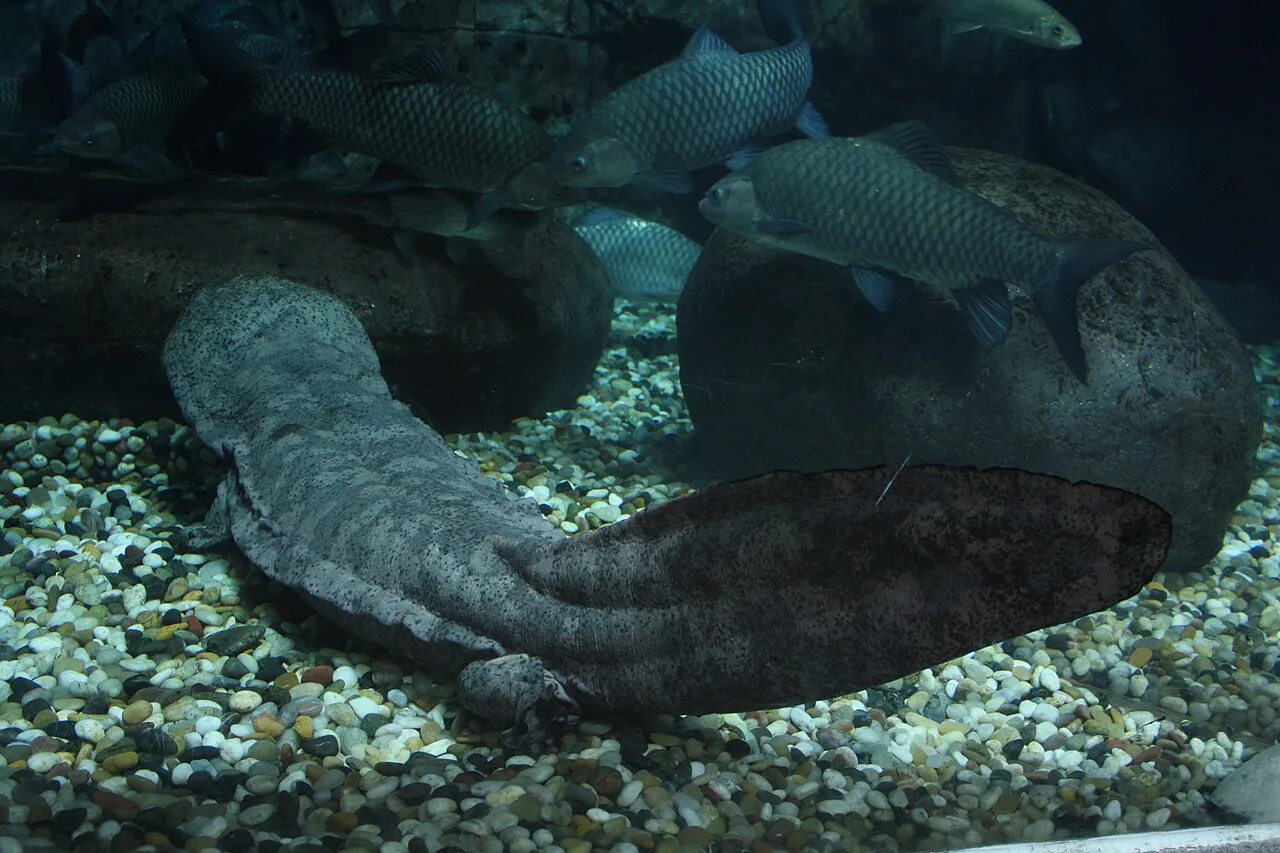
J. Patrick Fischer · CC BY-SA 3.0
The genus name Andrias comes from Greek for 'image of a man', a nod to an eighteenth-century episode in which a giant salamander fossil was mistaken for a human drowned in the biblical flood. The species name honours Armand David, the French missionary-naturalist who introduced many Chinese animals and plants to Western science, including the giant panda.
In Chinese it is commonly called wawayu, 'baby fish', because its distress call is said to sound like a crying infant.
It belongs to the family Cryptobranchidae, the giant salamanders, together with the Japanese giant salamander and the North American hellbender. Cryptobranchidae means 'hidden gills': larvae have external gills that disappear as they mature, though adults never fully leave the water.
2.1. One species or several?
For a long time this was treated as a single species. Genetic studies of museum specimens and wild and farmed animals, published in 2018 and 2019, revealed at least five deeply divergent lineages in different river basins. In 2019 the southern lineage was recognised as a separate species, the South China giant salamander (Andrias sligoi), and in 2022 a lineage from Jiangxi Province was described as Andrias jiangxiensis.
This matters enormously for conservation, because breeding and releasing a mix of lineages as if they were one species can erase each lineage's unique genetic heritage. The 2019 study also suggested that the South China giant salamander may be the largest amphibian in the world. Taxonomy is still being worked out, so naming may differ between sources.
3. Evolution
Giant salamanders belong to an ancient lineage. Chunerpeton, a fossil salamander from Middle Jurassic rocks in Inner Mongolia, about 160 million years old, is regarded as an early relative of the family and already looked much like its living descendants. Giant salamanders have kept essentially the same body plan since the age of dinosaurs.
During the Cenozoic, giant Andrias salamanders also lived in Europe and North America. The most famous is Andrias scheuchzeri from Germany and Switzerland. In 1726 the Swiss naturalist Johann Jakob Scheuchzer described a skeleton as Homo diluvii testis, 'man, witness of the Flood'. Georges Cuvier later showed it was a giant salamander. European giant salamanders apparently disappeared as the climate cooled a few million years ago.
Molecular studies suggest the Asian Andrias and the North American hellbender lineages split tens of millions of years ago, with the Chinese and Japanese giants diverging much more recently. Within China, the separate lineages likely arose over millions of years as mountain ranges and river basins isolated populations.
4. Range and habitat
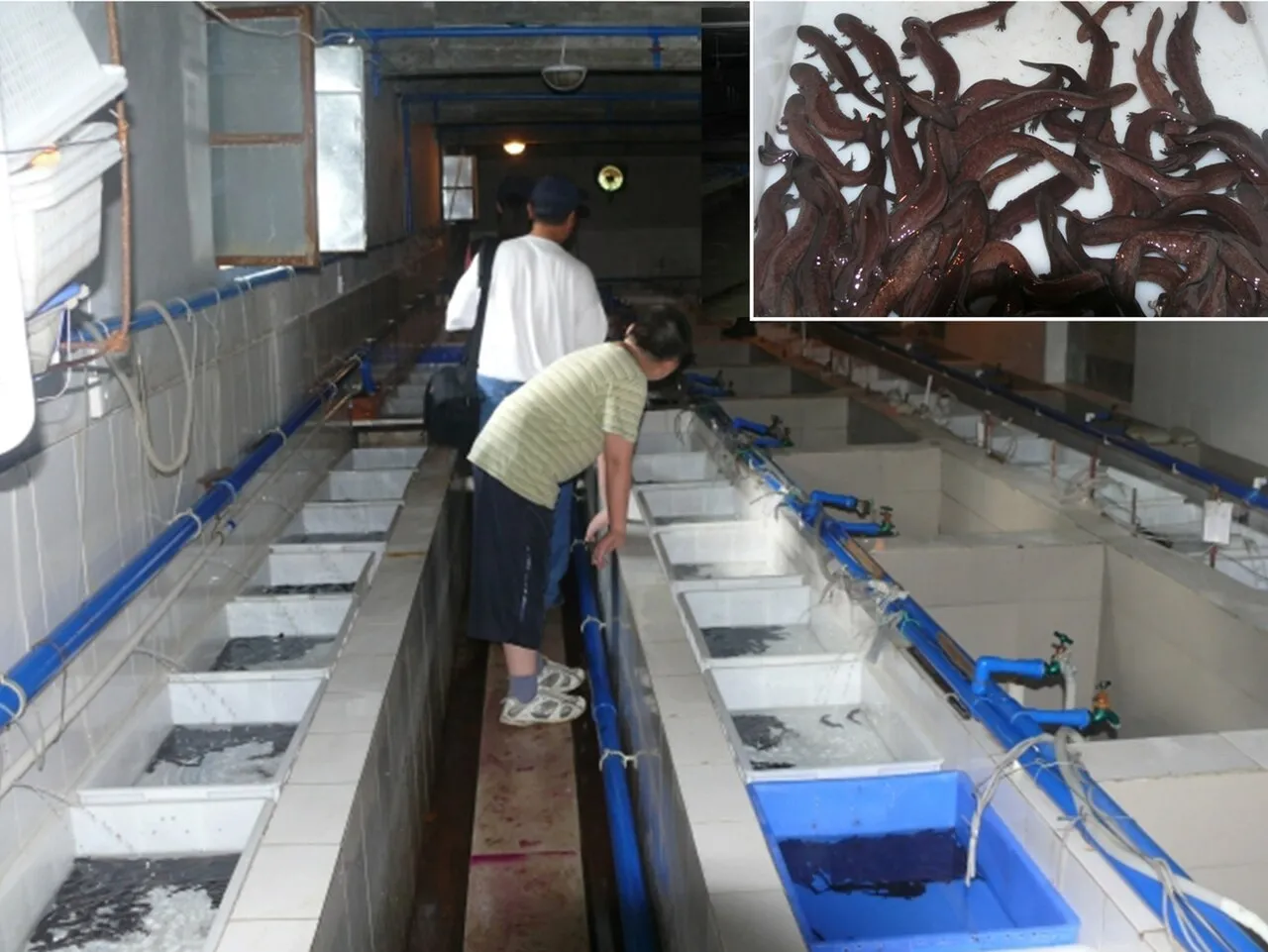
Andrew A. Cunningham, Samuel T. Turvey, Feng Zhou, Helen M. R. Meredith, Wei Guan, Xinglian Liu, Changming Sun, Zhongqia · CC BY-SA 4.0
In the broad sense, the Chinese giant salamander complex once ranged across much of central, southern and southwestern China, in tributaries of the Yangtze, Yellow and Pearl Rivers, with records from around seventeen provinces from Qinghai to Guangdong and Sichuan to Zhejiang.
Its ideal habitat is a mountain stream at elevations from a few hundred to around 1,500 metres: cold (typically 10–20 °C), clear and well-oxygenated, with plenty of crevices and burrows in rocky beds and banks. Individuals often use the same den for long periods. Some live in underground rivers in limestone karst caves.
Today's reality is far removed from range maps. Surveys covering nearly a hundred areas across China between 2013 and 2016 found wild salamanders at only a handful of locations, and many of those animals appeared to be of farm origin. Across much of its former range, the species is considered functionally or nearly extinct in the wild.
5. Body
The head and body are flattened top to bottom, while the tail is flattened side to side like a paddle.
| Feature | Typical range | Records and notes |
|---|---|---|
| Length | Adults about 0.8–1.2 m | Historical reports up to about 1.8 m |
| Weight | About 10–30 kg | Large individuals around 50 kg |
| Hatchling | About 3 cm | Has external gills |
The head is broad and rounded with a very wide mouth. The eyes are tiny and lidless, and eyesight is poor. The skin is slimy and hangs in wrinkled folds along the flanks, greatly increasing surface area for absorbing oxygen. Mottled brown, grey and black colouring blends with rocks and mud; albino or pale yellow individuals turn up occasionally.
The legs are short and stout, with four toes in front and five behind. On the stream bed the salamander walks slowly; to swim, it sweeps its tail. Rather than sight, it relies on sensory organs on the head and body that detect water movements, much like a fish's lateral line, along with smell and touch. The sexes look similar, though breeding males develop a swollen cloaca.
6. Behaviour and ecology
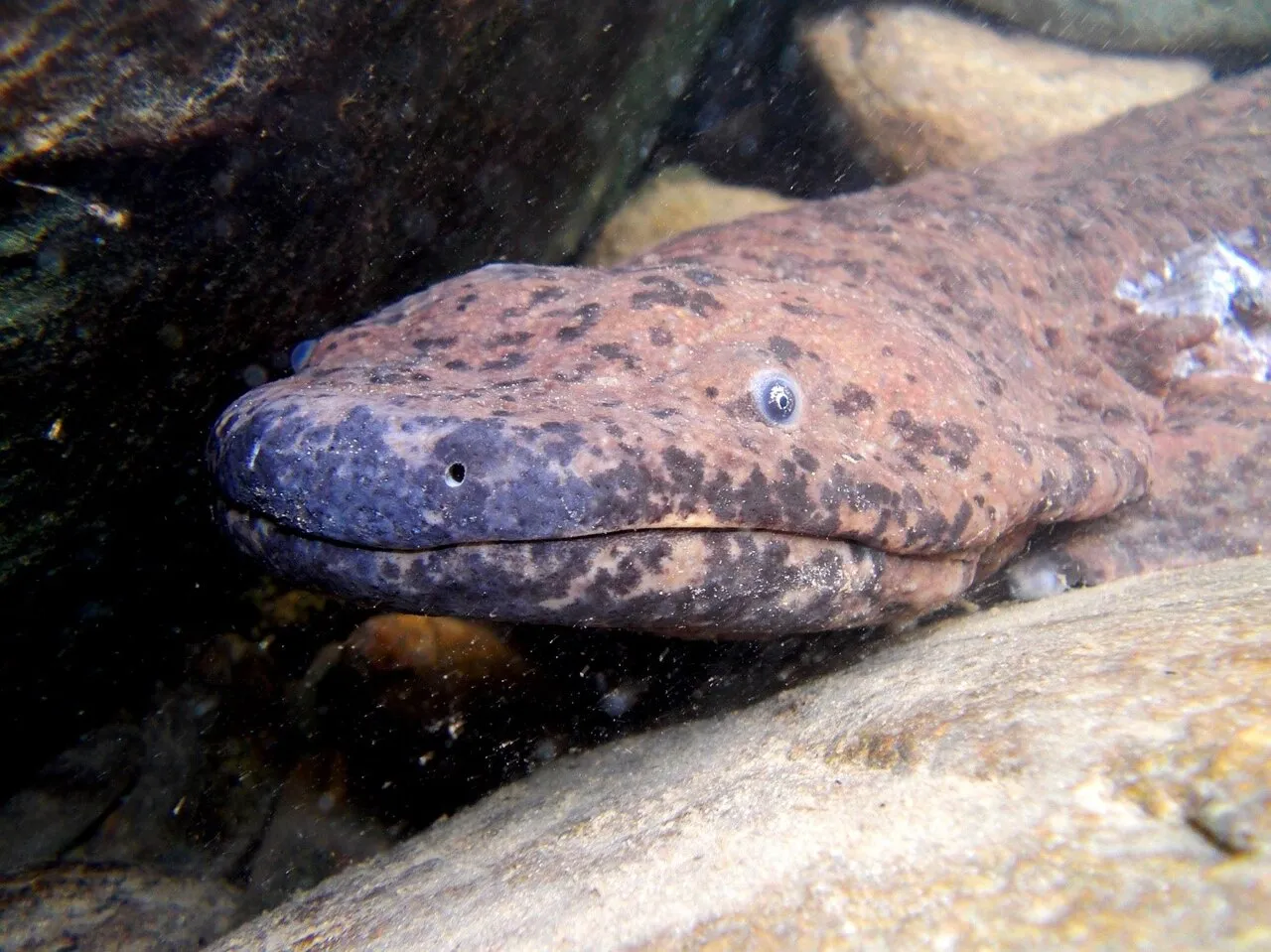
Shu Chen Andrew A. Cunningham Gang Wei Jian Yang Zhiqiang Liang Jie Wang Minyao Wu Fang Yan Hanbin Xiao Xavier A. Harris · CC BY-SA 4.0
Chinese giant salamanders are strictly nocturnal. By day they rest in dens or under rocks, sometimes with only the head poking out; after dark they emerge to prowl slowly over the stream bed. Much of their time is spent nearly motionless, which keeps energy needs very low.
Adults are solitary and tend to defend their den and its surroundings. Home ranges are small, often a few hundred metres of stream for life. Intruders may be bitten, and many adults bear scars from such fights.
They are sensitive to temperature. In warmer water, skin breathing may not supply enough oxygen and they surface to gulp air with their lungs. In very cold winter water they become largely inactive. They have also been seen rocking their bodies from side to side, which is thought to move fresh, oxygenated water over the skin.
7. Diet and feeding
The Chinese giant salamander is carnivorous and eats almost any aquatic animal that fits in its mouth: fish, freshwater crabs, crayfish, shrimp, frogs and tadpoles, aquatic insects and snails. Small mammals and snakes that venture into the water are sometimes taken, and cannibalism of smaller salamanders occurs when food is scarce.
It hunts by ambush and suction. Waiting motionless beside a rock or at a den entrance, it detects prey approaching and snaps its huge mouth open in a fraction of a second. The sudden expansion lowers pressure inside the mouth, sucking in water and prey together. Studies show giant salamanders can also perform an asymmetrical strike, opening one side of the jaw more than the other to grab prey passing beside the head.
Rows of small teeth help grip slippery fish, which are swallowed whole. Thanks to its slow metabolism, a well-fed salamander can go weeks between meals.
8. Reproduction and life cycle
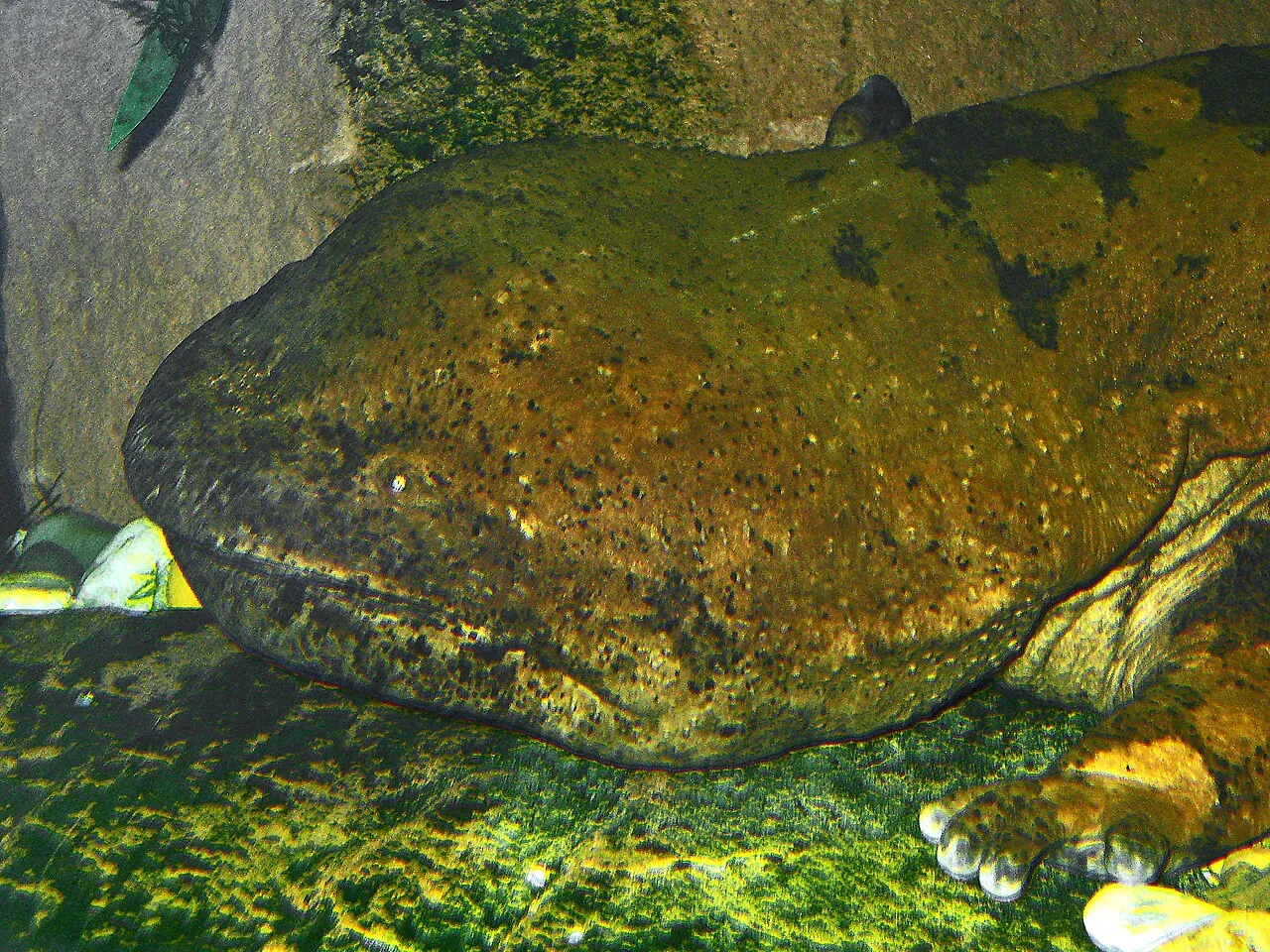
Breeding usually takes place in late summer and early autumn, roughly July to September. A male selects a burrow in a bank or under the stream bed, cleans it out and drives off rivals. Females enter to lay, and the male releases sperm over the eggs, so fertilisation is external — a trait that sets giant salamanders apart from most other salamanders.
The eggs are laid in long, bead-like strings, typically several hundred per female (often around 400–500), and several females may use the same den. The females then leave, and the male stays behind as guardian. He fans the eggs with his tail and body to keep fresh water flowing, chases away intruders and may eat eggs that go bad.
| Stage | Duration or age | Notes |
|---|---|---|
| Egg | About 40–60 days | Depends on temperature; guarded by the male |
| Larva | Hatching to about 3 years | External gills; starts around 3 cm |
| Juvenile | About 3–5 years | Gills lost; lung and skin breathing |
| Adult | Breeding from about 5–7 years | Keeps growing slowly |
Longevity is believed to be great, but wild data are scarce. A captive Japanese giant salamander lived more than 50 years, and Chinese giant salamanders have lived for decades in captivity. Claims of 60 or more years in the wild are plausible but unconfirmed.
9. Communication and special abilities
When threatened or grabbed, Chinese giant salamanders can produce barks, hisses and wailing sounds — the 'baby cry' behind their Chinese name. Whether they use sounds to communicate with each other in everyday life is not well understood; scent, skin secretions and touch probably matter more.
Their most remarkable feature is skin breathing. Much of their oxygen is absorbed through the skin, made possible by the extensive folds and a dense network of blood vessels just beneath the surface. This makes them highly vulnerable when water becomes warm, muddy or polluted and oxygen levels drop, which is why giant salamanders are seen as indicators of stream health.
When stressed, they secrete a sticky white mucus. Research suggests it contains antimicrobial compounds that may help prevent infection, and the animals generally recover well from wounds. Their sensitivity to tiny vibrations in the water lets them pinpoint prey in the dark, even with poor eyesight.
10. Predators and survival
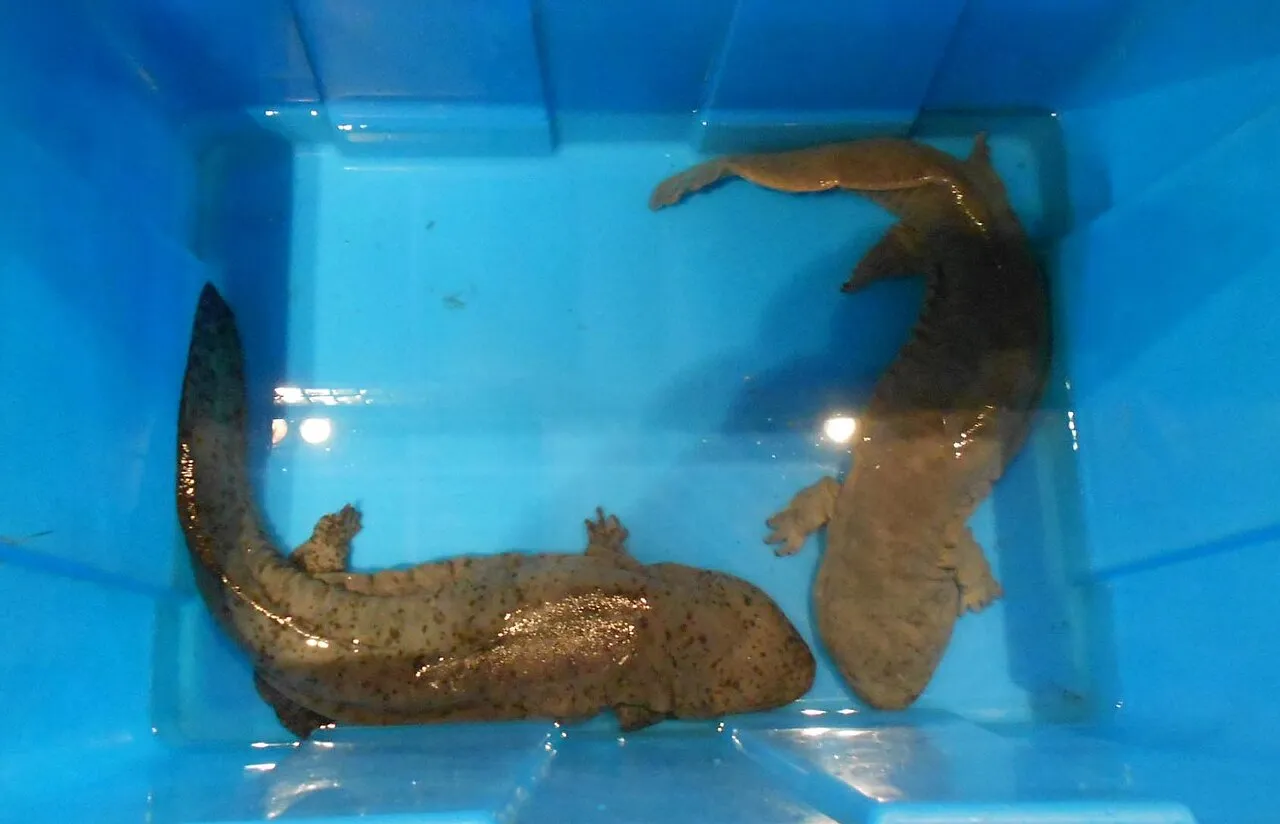
Adult giant salamanders have very few natural predators; their size, slippery skin and secure dens protect them. Otters may take younger animals, and eggs and larvae are eaten by fish, aquatic insects and other salamanders.
Their natural survival strategy is to live long and breed steadily. With low adult mortality and long lives, a population can persist even if successful breeding happens only occasionally. That same strategy leaves them defenceless against human harvesting: each adult removed takes decades to replace.
Today their real predator is us. Illegal capture with traps, hooks, electrofishing and poison has been widespread in mountain streams, while dams, hydropower stations, river engineering, mining runoff and pesticides have degraded habitat. Ranavirus outbreaks have caused mass deaths in farms, raising fears of spread to the wild.
11. Relationship with humans
Giant salamanders have long been known in China. Old texts describe a mountain-stream 'fish' that cries like a person, and some communities reportedly regarded the animal as sacred or taboo to catch, while others valued it as nourishing food or medicine.
As China's economy boomed in the late twentieth century, demand for giant salamander as a luxury dish soared. Wild numbers crashed, and from the 1980s artificial breeding began. By the 2000s a vast farming industry, centred in provinces such as Shaanxi and Guizhou, held millions of animals. Farming was meant to relieve pressure on wild populations, but the results have been mixed.
First, farms continued to take breeding stock from the wild. Second, large numbers of farmed salamanders were released into rivers in the name of conservation, often far from their lineage's home basin or as genetic mixtures, threatening the integrity of distinct wild lineages. Third, high densities in farms increased disease risk.
There is little direct connection with Korea: no giant salamanders live there, and Korea's native salamanders are small species around 10–20 cm. As a CITES Appendix I species, it is strictly regulated in Korean trade law.
12. Conservation
The Chinese giant salamander is listed as Critically Endangered by the IUCN. Wild populations are estimated to have fallen by more than 80 percent since the 1980s, and the true decline may be greater. The study published in 2018 surveyed 97 sites across 16 provinces between 2013 and 2016 and confirmed wild salamanders at only four, where it was difficult to tell whether the animals were of farm origin. Nobody knows exactly how many truly wild animals remain, but researchers agree the number is very small.
Main threats:
- Illegal capture for food and medicine
- Genetic mixing caused by releases of farmed animals
- Dams, hydropower and river development
- Pollution from mining, agriculture and sewage
- Disease, especially ranavirus
- Rising water temperatures with climate change
The species is protected under Chinese national law, with its protection level revised over time, occurs in a number of nature reserves, and is listed on CITES Appendix I. Scientists urge that future releases use only genetically screened animals returned to their home basins, that any remaining pure wild populations be located and strictly protected, and that farms be kept separate from wild populations. Newly recognised species such as the South China giant salamander may need their own conservation plans.
13. In zoos and aquariums
A number of zoos and aquariums in China and abroad keep Chinese giant salamanders. They need cold, clean water with powerful filtration and aeration, plus dens to hide in. Warm water quickly causes health problems, so chillers are important. Being nocturnal, they often stay tucked in their dens during visiting hours.
Captive animals have provided crucial scientific material. The studies that revealed multiple species analysed DNA from captive and farmed animals alongside museum specimens. Some salamanders that arrived in European zoos decades ago turned out to belong to rare lineages, underlining the importance of managing captive animals by lineage.
Ethical debate centres on the boundary between conservation breeding and food farming. With millions of animals in farms, questions remain about how much zoos can add, and how to explain to the public that releasing farmed salamanders can harm rather than help.
14. In culture
In Chinese folklore the giant salamander's infant-like cry gave it an eerie, mysterious reputation; strange wails heard from mountain gorges at night were attributed to it. Some scholars suggest certain water monsters in Chinese mythology may have been inspired by the animal. A popular claim that the yin-yang symbol derives from two coiled salamanders is often repeated but lacks solid evidence.
Karel Čapek's 1936 novel War with the Newts imagines intelligent giant salamanders exploited by humans until they turn the tables. The book draws on the story of Scheuchzer's fossil and on the Asian giant salamanders, and it is regarded as a classic satire of greed and exploitation.
More recently, online videos and documentaries have made it famous as 'the world's largest amphibian'. Its bulk, wrinkles and deadpan face draw reactions ranging from 'adorable' to 'nightmarish', and some Chinese regions use cartoon salamanders in tourism promotion.
15. Trivia
- A 2019 study of old museum specimens showed that an animal from around the 1920s belonged to the southern lineage, helping justify its recognition as a separate species.
- The South China giant salamander's name sligoi honours the Marquess of Sligo, connected with a specimen kept at London Zoo in the 1920s.
- In rivers around Kyoto, Japan, introduced Chinese giant salamanders have hybridised with native Japanese giant salamanders, a case of an alien giant threatening a native one.
- Giant salamanders have small hearts relative to body size and modest oxygen-carrying capacity, so they are built for stillness, not speed.
- In very clear streams, a salamander may rest with its head at the den entrance by day, but it vanishes inside the moment a shadow falls across the water.
- Farmed salamanders vary hugely in colour, and unusual golden or spotted individuals have sometimes been sold at high prices, adding another commercial pressure.
Wild animals are not pets. Catching, trading or keeping them is illegal in most places. If you find an injured wild animal, call your local wildlife rescue centre.
FAQ
If millions live on farms, why is it Critically Endangered?
Farmed animals are raised for food and often mix distinct lineages. Red List status is based on wild populations, and surveys have found wild animals to be extremely rare.
Is it dangerous to people?
It does not hunt people, though it can bite hard if handled. The real danger runs the other way — from people to the salamander.
Does it live in Korea?
No. Korea has no giant salamanders; its native salamanders are small species mostly 10–20 cm long.
Photo credits
Photos are freely licensed images from Wikimedia Commons. Authors and licenses are listed below.
- Velemlok čínský zoo praha 1.jpg — Petr Hamerník · CC BY-SA 4.0
- 2009 Andrias davidianus.JPG — J. Patrick Fischer · CC BY-SA 3.0
- A. davidianus farms.jpg — Andrew A. Cunningham, Samuel T. Turvey, Feng Zhou, Helen M. R. Meredith, Wei Guan, Xinglian Liu, Changming Sun, Zhongqia · CC BY-SA 4.0
- A. davidianus head.jpg — Shu Chen Andrew A. Cunningham Gang Wei Jian Yang Zhiqiang Liang Jie Wang Minyao Wu Fang Yan Hanbin Xiao Xavier A. Harris · CC BY-SA 4.0
- Andrias davidianus 01.JPG — H. Zell · CC BY-SA 3.0
- Andrias davidianus Hongqiaozhen.jpg — Micromesistius · CC BY-SA 3.0