TailVille
1. Overview
If you see a frog no bigger than a thumbnail, painted electric yellow, cobalt blue or fire-engine red, it very likely belongs to the family Dendrobatidae, the poison dart frogs. Around 200 species live in the rainforests of Central and South America.
Those colours are not decoration but warning. They tell predators that the frog is distasteful or dangerous. The golden poison frog, Phyllobates terribilis, from Colombia's Pacific coast, ranks among the most toxic animals on Earth. Yet many dart frogs are only mildly toxic or barely toxic at all, so the family name fits some members far better than others.
Dart frogs are as famous for devoted parenting as for poison. Parents guard eggs, carry newly hatched tadpoles on their backs to tiny pools, and in some species mothers return to feed their tadpoles with unfertilised eggs. This article covers the family as a whole, using the dyeing poison frog (Dendrobates tinctorius) and the golden poison frog as main examples.
2. Name and classification
The name comes from the use of frog toxins on blowgun darts by Indigenous peoples of western Colombia. In English they are called poison dart frogs, poison arrow frogs or simply poison frogs; many herpetologists prefer the last, since only three species are documented as dart poisons.
The family name Dendrobatidae means 'tree walkers' in Greek, after species that climb into bromeliads, though many actually live in the leaf litter on the forest floor.
Taxonomy has been reshuffled since the 2000s. Genetic studies split the old genus Dendrobates into several genera and moved many drab, non-toxic species into a separate family, Aromobatidae. Some major genera:
| Genus | Example | Notes |
|---|---|---|
| Dendrobates | Dyeing poison frog, green-and-black poison frog | Fairly large, bold patterns |
| Phyllobates | Golden poison frog | Carries batrachotoxins, the most potent |
| Oophaga | Strawberry poison frog | Mothers feed tadpoles with eggs |
| Ranitomeya | Many small species | Often around 2 cm long |
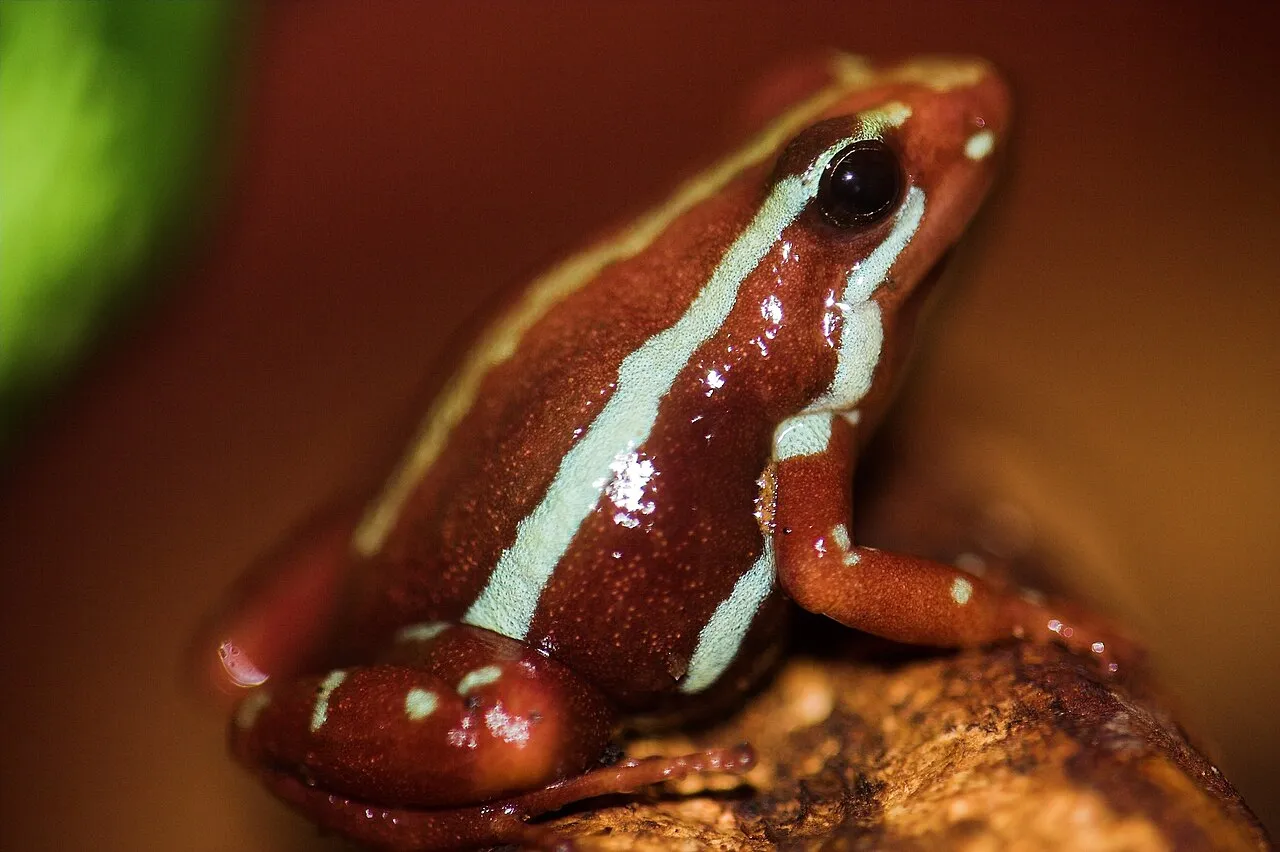
| Epipedobates | Phantasmal poison frog | Source of the painkiller lead epibatidine |
3. Evolution
Molecular studies suggest the family arose in South America roughly 40 million years ago. Small tropical frogs rarely fossilise, so almost everything known about dart frog history has been reconstructed from the DNA of living species.
A striking finding is that toxicity and warning coloration evolved several times independently within the family. Toxic lineages repeatedly shifted toward diets dominated by ants and mites, whose alkaloids they sequester. Bright colours then tended to evolve alongside chemical defence.
Mimicry adds another layer. In Peru, several Ranitomeya species share similar patterns, a case of Müllerian mimicry in which toxic species reinforce one another's warning. There are also suspected cases of Batesian mimicry, where a weakly defended frog copies a highly toxic one. Many species vary enormously in colour from valley to valley, making them ideal subjects for studying how colour evolves.
4. Range and habitat
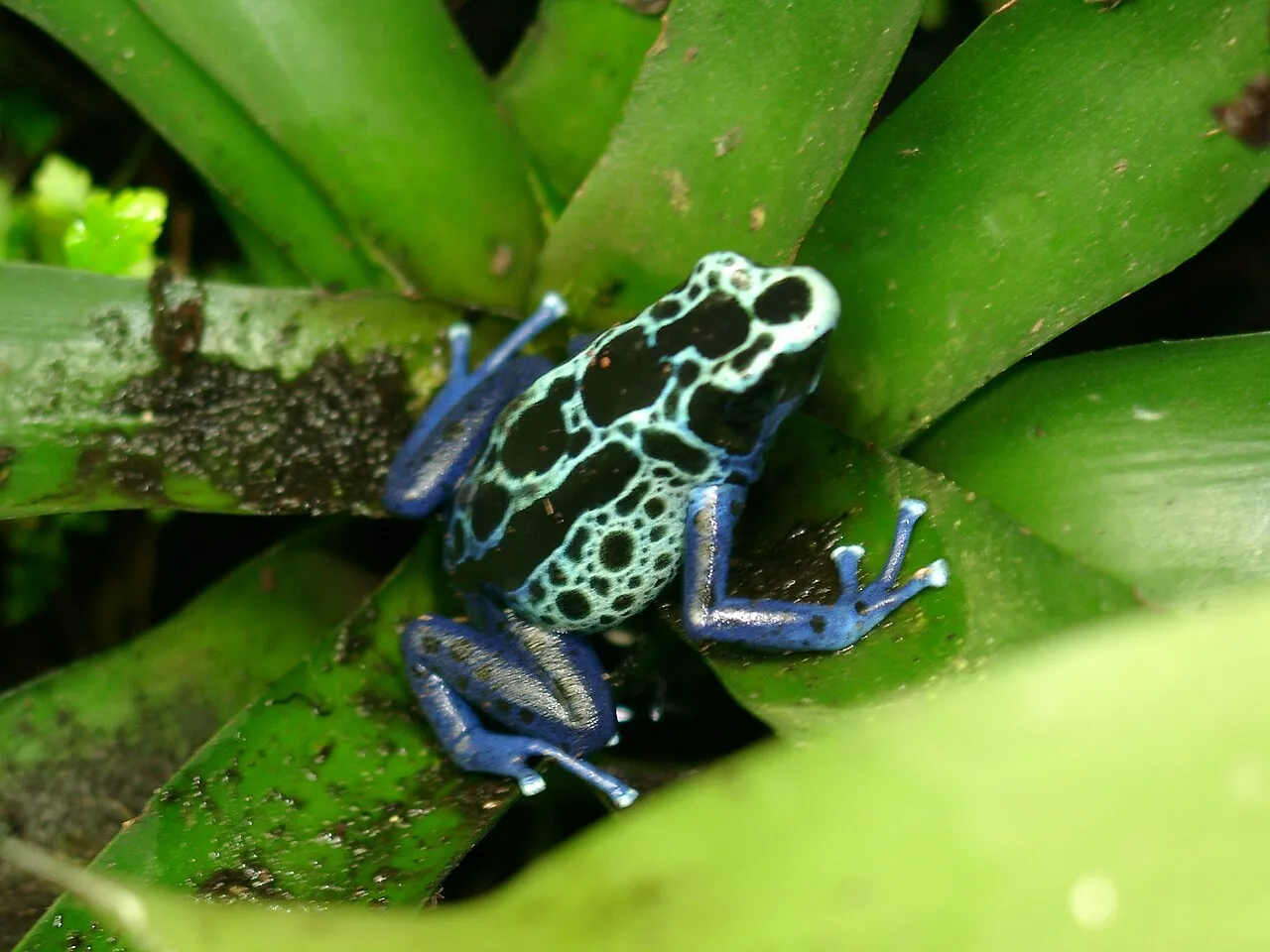
The family ranges from Nicaragua through Costa Rica and Panama into Colombia, Ecuador, Venezuela, the Guianas, Peru, Bolivia and Brazil, including Amazonia and the Atlantic Forest. The green-and-black poison frog was introduced to Hawaii in the 1930s, supposedly for mosquito control, and still lives on Oahu.
Most species inhabit warm, humid lowland and montane rainforests. Leaf litter, tangles of roots and fallen logs, and rocky stream banks are typical homes. Some small species centre their lives on bromeliads, using the pools of water trapped between their leaves. Elevations range from sea level to cloud forests above 2,000 metres.
Many species have tiny ranges, sometimes a single valley or hillside. The golden poison frog is known only from a small area of Pacific coastal rainforest in Colombia's Cauca region. Such narrow distributions mean that clearing a single patch of forest can endanger an entire species.
5. Body
Most dart frogs measure 1.5 to 6 cm. A few examples:
| Species | Length | Typical colours |
|---|---|---|
| Dyeing poison frog | About 4–6 cm | Highly variable: yellow, blue, black, white |
| Golden poison frog | About 4.5–5.5 cm | Golden yellow, orange or mint green |
| Strawberry poison frog | Around 2 cm | Often red with blue legs; many colour morphs |
| Small Ranitomeya | About 1.5–2 cm | Stripes of yellow or red, blue speckles |
The skin is smooth and moist, packed with granular glands that store and release toxins. Toe tips are expanded into discs for gripping slick leaves. Most species have little or no webbing on their feet, reflecting a life spent walking and hopping rather than swimming.
Sex differences vary. Females are often slightly larger and plumper, while in some species males have broader toe discs on the front feet. Colour variation within a species can be extraordinary: different populations of the dyeing poison frog can look like entirely different animals.
6. Behaviour and ecology
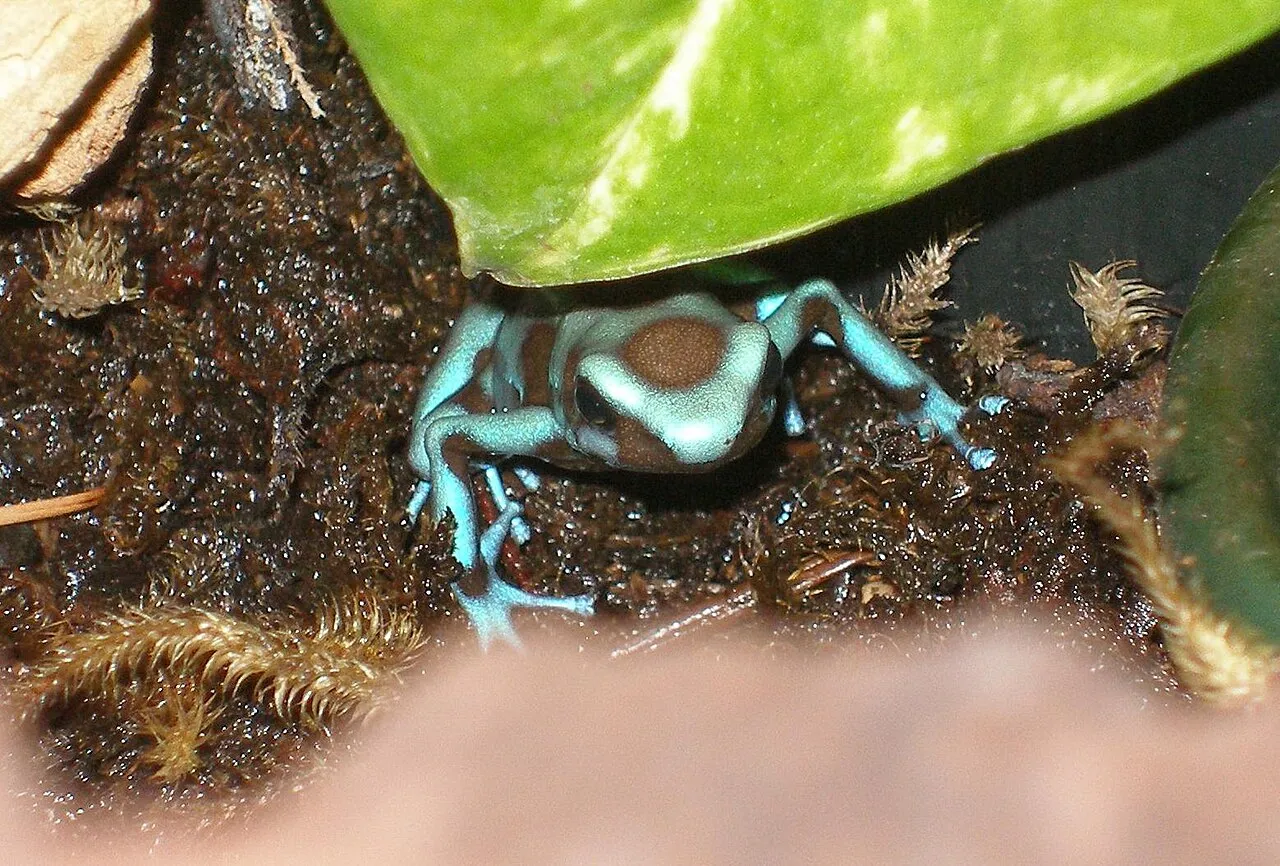
The Lord of the Allosaurs (talk) · CC BY-SA 3.0
Unlike most frogs, dart frogs are active by day. Many frogs are nocturnal to avoid predators, but a toxic frog with warning colours has less need to hide, so dart frogs hop openly across the leaf litter in daylight, especially in humid mornings and after rain.
Many species are strongly territorial. Males call from raised perches such as logs and rocks to advertise their patch and wrestle intruders, grappling belly to belly. In some species females also fight, competing for mates or attacking other females' eggs.
Calls are distinctive: buzzes, trills, chirps and bird-like whistles. Researchers often identify species by sound, since a frog hidden in the litter may be heard long before it is seen.
Dart frogs are significant predators of tiny forest-floor invertebrates and, despite their toxins, still part of the food web for certain snakes, spiders and birds.
7. Diet and the source of the poison
Dart frogs eat tiny arthropods: ants, mites, springtails, small beetles, termites and fruit-fly-sized insects. They pick them off with a quick flick of the tongue, and some species eat hundreds a day.
That menu is the source of their poison. The toxins are alkaloids, which the frogs cannot make from scratch. Instead they eat alkaloid-bearing ants, mites and beetles and store the chemicals, largely unchanged, in skin glands. Hundreds of different alkaloids have been identified from dart frog skin.
Captivity proves the point. Frogs raised on crickets and fruit flies are essentially non-toxic, and wild-caught frogs lose potency over time. The dietary source of the golden poison frog's batrachotoxins is not fully pinned down, but toxic birds in New Guinea carry the same class of toxin, apparently obtained from small melyrid beetles, suggesting a similar route.
How do the frogs avoid poisoning themselves? Research points to small changes in the target proteins that make them less sensitive, and to special binding proteins that may sequester toxins safely.
8. Reproduction and life cycle
Dart frogs breed very differently from frogs that dump masses of eggs in ponds. Most lay small clutches, from one to around forty eggs depending on species, on land under damp leaves or on foliage, and one or both parents care for them.
The guarding parent keeps the eggs moist, sometimes by sitting on them, and may remove eggs that become infected with fungus. After about 10 to 18 days the tadpoles hatch and wriggle onto a parent's back, held by mucus. The parent then carries them, sometimes considerable distances and up into trees, to tree holes, bromeliad pools or small streams, depositing them singly or in small groups.
The strawberry poison frog and its Oophaga relatives go further. The mother places each tadpole in a separate bromeliad pool, then returns every few days to lay unfertilised 'trophic' eggs for it to eat, allowing tadpoles to grow in pools with almost no other food. Studies suggest these eggs contain some of the mother's alkaloids, giving the tadpoles an early chemical defence.
| Stage | Duration | Notes |
|---|---|---|
| Egg | About 10–18 days | On land, guarded by a parent |
| Tadpole | About 6–12 weeks | Carried to water on a parent's back |
| Froglet | Just after metamorphosis | About 1 cm; colours intensify |
| Adult | From about 1–2 years | Begins breeding |
Wild lifespans are poorly known but probably around three to ten years; captive frogs sometimes exceed a decade.
9. Toxicity and special abilities
Toxicity varies enormously. The most potent are the batrachotoxins of the genus Phyllobates. These lock sodium channels in nerve and muscle cells in the open position, so signals cannot switch off, leading to paralysis and cardiac failure.
A single golden poison frog is estimated to carry on the order of a milligram of toxin, often said to be enough to kill around ten adult humans, though such figures are extrapolated from animal studies and vary between sources. Handling one with bare hands, especially with cuts, is considered genuinely dangerous.
Many other species, including the dyeing and strawberry poison frogs, carry weaker toxins. They are not considered lethal to people but are distasteful and nauseating to predators.
Dart frog chemistry has inspired medicine. Epibatidine, found in an Ecuadorian frog, proved a far more powerful painkiller than morphine in lab tests. It was too toxic for use as a drug but launched research into related compounds.
Dart frogs also navigate impressively. Experiments show that some can find their way home after being moved hundreds of metres from their territory, and parents remember the locations of the pools where they leave tadpoles.
10. Predators and survival
Toxicity does not guarantee safety. At least one South American snake, long known as Leimadophis epinephelus, is resistant to batrachotoxins and can eat golden poison frogs. Large spiders, some birds and other frogs also take less toxic species or tadpoles.
Tadpoles are especially vulnerable to dragonfly larvae, other tadpoles and even larger tadpoles of their own species, which is one reason parents spread their offspring among multiple pools.
Warning colours exploit predator learning. A young bird that pecks a dart frog and experiences a bitter taste and nausea will remember the pattern and avoid it in future. For this to work, signals must be conspicuous and consistent locally, which helps explain why each region tends to have its own colour form that local predators have learned.
11. Relationship with humans
The Emberá and Noanamá peoples of Colombia's Chocó region traditionally used Phyllobates toxins on hunting darts. Accounts describe frogs being stressed, for example held near a fire or pierced with a stick, so that toxin oozed from the skin, and darts being rubbed in the secretion. With the golden poison frog, simply wiping a dart across the frog's back was reportedly enough. The darts were used for birds, monkeys and other small game.
Today dart frogs intersect with people in three main ways: biomedical research, as described above; ecotourism, where they are among the most sought-after sights on rainforest walks; and the pet trade.
Their colours make them highly prized in the international amphibian trade. Large numbers were once exported from the wild, and poaching and smuggling of rare colour forms remain problems in Colombia, Peru, Ecuador and elsewhere. We do not recommend keeping them. Collecting can wipe out small local populations, and trade risks spreading disease. All dart frogs are listed on CITES Appendix II, so international trade requires permits, and Korea regulates them as internationally endangered species.
12. Conservation
Because the IUCN assesses species individually, there is no single category for the family. The 'NE' shown in this site's info box means 'not assessed as a family'. Species-level categories vary widely and may change with reassessment:
| Species | Approximate IUCN category | Notes |
|---|---|---|
| Dyeing poison frog | Least Concern | Widespread in the Guianas |
| Strawberry poison frog | Least Concern | Common on the Caribbean side of Central America |
| Golden poison frog | Endangered | Tiny range |
| Some Ranitomeya and Oophaga species | Endangered to Critically Endangered | Poaching and habitat loss |
Key threats:
- Rainforest loss to farming, cattle ranching, illegal coca cultivation, mining and logging
- Poaching and smuggling of rare colour forms
- Infectious disease, especially chytrid fungus
- Climate change altering rainfall
- Pesticide and mercury pollution of soils and streams
Chytrid fungus has driven amphibian declines worldwide and devastated frog communities in Central American highlands. Responses include habitat protection with Indigenous and local communities and, in Colombia, licensed captive-breeding operations intended to undercut poaching. Critics worry that legal supply may also stimulate demand, so the approach remains debated.
13. In zoos and aquariums
Dart frogs are common in the tropical exhibits of zoos and aquariums: they are small, colourful and active by day, so visitors can actually see them. Captive frogs fed ordinary insects are essentially non-toxic and safe for keepers to handle with basic precautions.
Zoos also play a real role in amphibian conservation. Programmes around the world rescue threatened species from chytrid-hit areas, maintain 'ark' populations and plan reintroductions once conditions improve. Dart frogs, whose breeding is well understood, serve as models for these efforts.
There are concerns to manage: displays should use captive-bred frogs so as not to fuel wild collection, strict quarantine is needed to stop disease spreading between facilities, and visitors should be told that captive frogs, having lost their toxins, are not quite the animals they are in the wild.
14. In culture
Dart frogs are pop culture's shorthand for 'small but deadly'. They feature on nearly every 'most dangerous animals' list, and children's science books use them as the textbook example of warning colours.
The animated film Rio 2 gave a poison dart frog a comic supporting role, and adventure films and video games often use them as jungle hazards. Many poison-type frog characters in games and anime borrow their vivid colours; Pokémon's poison-and-fighting frog is widely seen as dart-frog-inspired.
In Colombia, Costa Rica and elsewhere, dart frogs are emblems of biodiversity, appearing on murals, stamps and souvenirs. Their name, tied to Indigenous hunting traditions, also makes them a symbol of how traditional knowledge of nature has informed science.
15. Trivia
- The golden poison frog's species name terribilis means 'terrible' or 'frightful' in Latin; it was formally described in 1978.
- The dyeing poison frog's name tinctorius refers to a story that Indigenous people rubbed its secretions onto parrot feathers to change their colour. Whether this really worked is uncertain.
- Strawberry poison frogs in Panama's Bocas del Toro archipelago vary from island to island in red, blue, green, yellow, orange and more, with dozens of colour forms described.
- Some dart frog fathers climb several metres up trees with tadpoles on their backs to reach bromeliad pools.
- Weight for weight, batrachotoxin is far more potent than most snake venoms.
- Experiments show that captive, non-toxic frogs fed alkaloid-laced food begin accumulating toxins again, confirming the dietary origin of their poison.
- Some species are so small and well hidden that new ones are still being described from remote forests.
Wild animals are not pets. Catching, trading or keeping them is illegal in most places. If you find an injured wild animal, call your local wildlife rescue centre.
FAQ
Were they really used on darts?
Yes, but only a few species. Indigenous peoples in western Colombia tipped blowgun darts with toxins from three Phyllobates species, including the golden poison frog — not the whole family.
Why is the IUCN status listed as 'NE'?
The IUCN assesses species, not families. Dart frogs range from Least Concern to Critically Endangered, so there is no single family-level category; NE here means 'not assessed as a group'.
Are captive-bred dart frogs poisonous?
Frogs raised on ordinary feeder insects have little or no toxin, because the poison is not made by the frog itself but acquired from particular wild prey.
Photo credits
Photos are freely licensed images from Wikimedia Commons. Authors and licenses are listed below.
- Blue-poison.dart.frog.and.Yellow-banded.dart.frog.arp.jpg — Pixeltoo · Public domain
- Epipedobates tricolor close.jpg — Unknown · CC BY 2.0
- Färberfrosch Dendrobates tinctorius.jpg — Unknown · CC BY-SA 3.0
- Pet Auratus.jpg — The Lord of the Allosaurs (talk) · CC BY-SA 3.0