TailVille
1. Overview
When dusk settles over a rocky gorge, a deep, booming 'oo-hu' sometimes rolls down the valley. It belongs to the Eurasian eagle-owl, one of the two or three largest owls in the world. Some females exceed 70 centimetres in length and four kilograms in weight, and with wings spanning up to nearly two metres they are formidable hunters.
The bird is unmistakable: huge orange eyes, tall ear tufts and tawny-brown plumage streaked with black. It ranges from Spain and Portugal across Europe, the Middle East, Russia and Central Asia to China and Korea.
Eagle-owls eat almost anything they can overpower, from voles and rats to hares, hedgehogs, ducks and pheasants, and they regularly kill other birds of prey, including smaller owls, buzzards and falcons. In Korea it is a scarce resident of cliffs, gorges and old quarries, protected as a Natural Monument and a Class II endangered species.
2. Name and classification
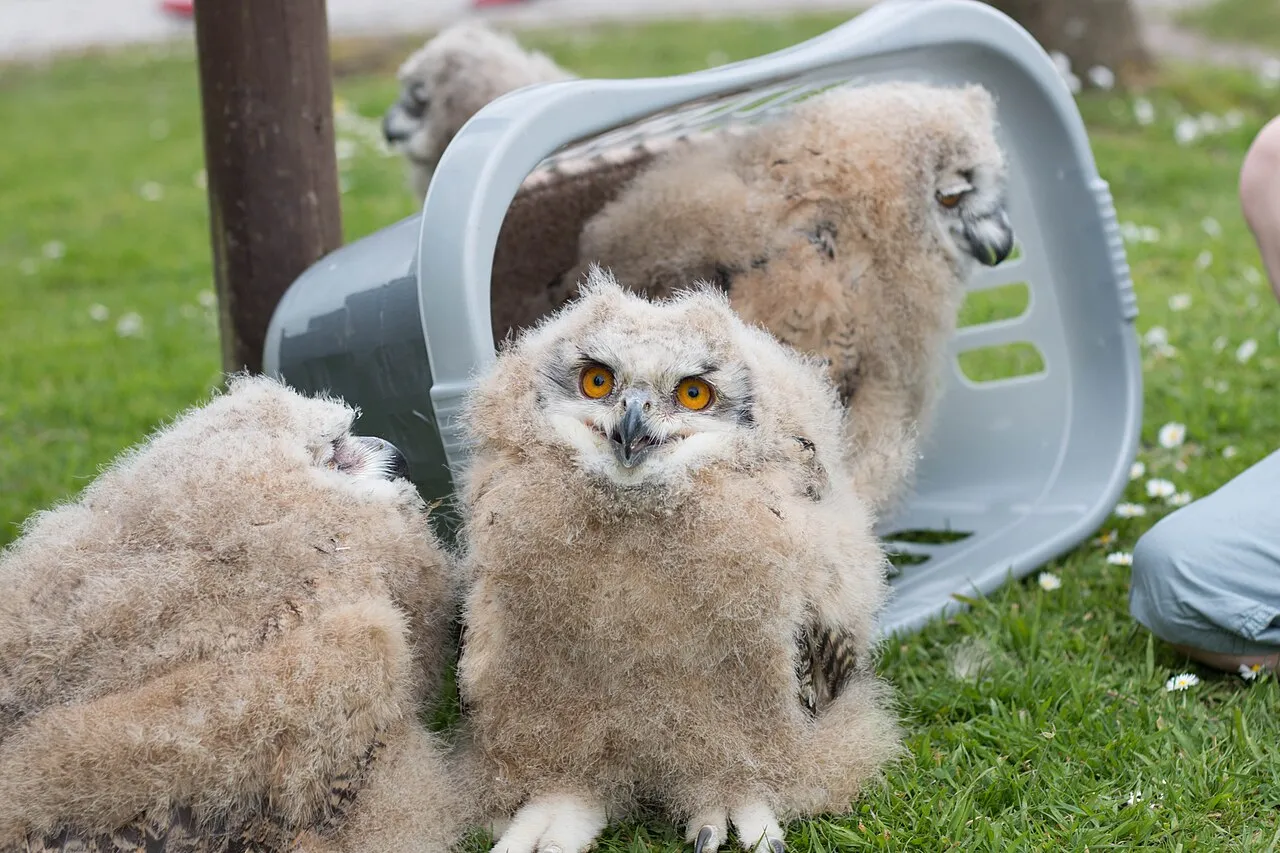
p.d. johnson · CC BY 2.0
The scientific name Bubo bubo repeats itself, a so-called tautonym often given to the type species of a genus. Bubo is the Latin word for an eagle-owl, probably imitating its call.
The Korean name, suri-bueongi, means eagle-sized horned owl. Korean folk usage calls tufted owls bueongi and owls without tufts olppaemi, giving names like long-eared owl (chik-bueongi) and short-eared owl (soe-bueongi). The rule is not strict, since the tuftless brown hawk-owl is also called a bueongi, but it is a handy everyday distinction.
The genus Bubo includes the great horned owl of the Americas, the Indian eagle-owl, several African eagle-owls and, according to genetic studies, the snowy owl. The fish owls of Asia, including Blakiston's fish owl, are close relatives.
2.1. Subspecies
More than a dozen subspecies have been described. Generally, northern and eastern birds are larger and paler, while those from southern deserts are smaller and sandier.
| Subspecies | Range | Notes |
|---|---|---|
| B. b. bubo | Central and northern Europe | Nominate, dark brown |
| B. b. hispanus | Iberia | Smaller, paler |
| B. b. sibiricus | Western Siberia, Urals | Very pale, large |
| B. b. yenisseensis | Central Siberia | Large, greyish |
| B. b. turcomanus | Central Asian steppes | Pale, sandy |
| B. b. kiautschensis | Eastern China, Korea | Smaller, darker |
| B. b. ussuriensis | Russian Far East | Medium-sized |
The Pharaoh eagle-owl of North Africa and the Indian eagle-owl, once lumped with this species, are now usually treated as separate species.
3. Evolution
Owls are an ancient lineage. Owl-like fossils appear in the Paleocene, soon after the dinosaurs vanished, so they have hunted the night for some sixty million years. Genetic studies place owls closer to mousebirds, trogons and woodpeckers than to hawks and falcons, implying that nocturnal and diurnal raptors evolved their weaponry separately.
The genus Bubo is thought to have arisen in the Old World a few million years ago and later spread to Africa, Asia and the Americas. The great horned owl of the Americas is so similar to the Eurasian eagle-owl in looks and lifestyle that the two are often described as ecological counterparts.
Eagle-owl bones are common in European Pleistocene cave deposits, sometimes alongside traces of Ice Age people, and the Chauvet Cave in France contains an owl engraving believed to be more than thirty thousand years old.
4. Range and habitat
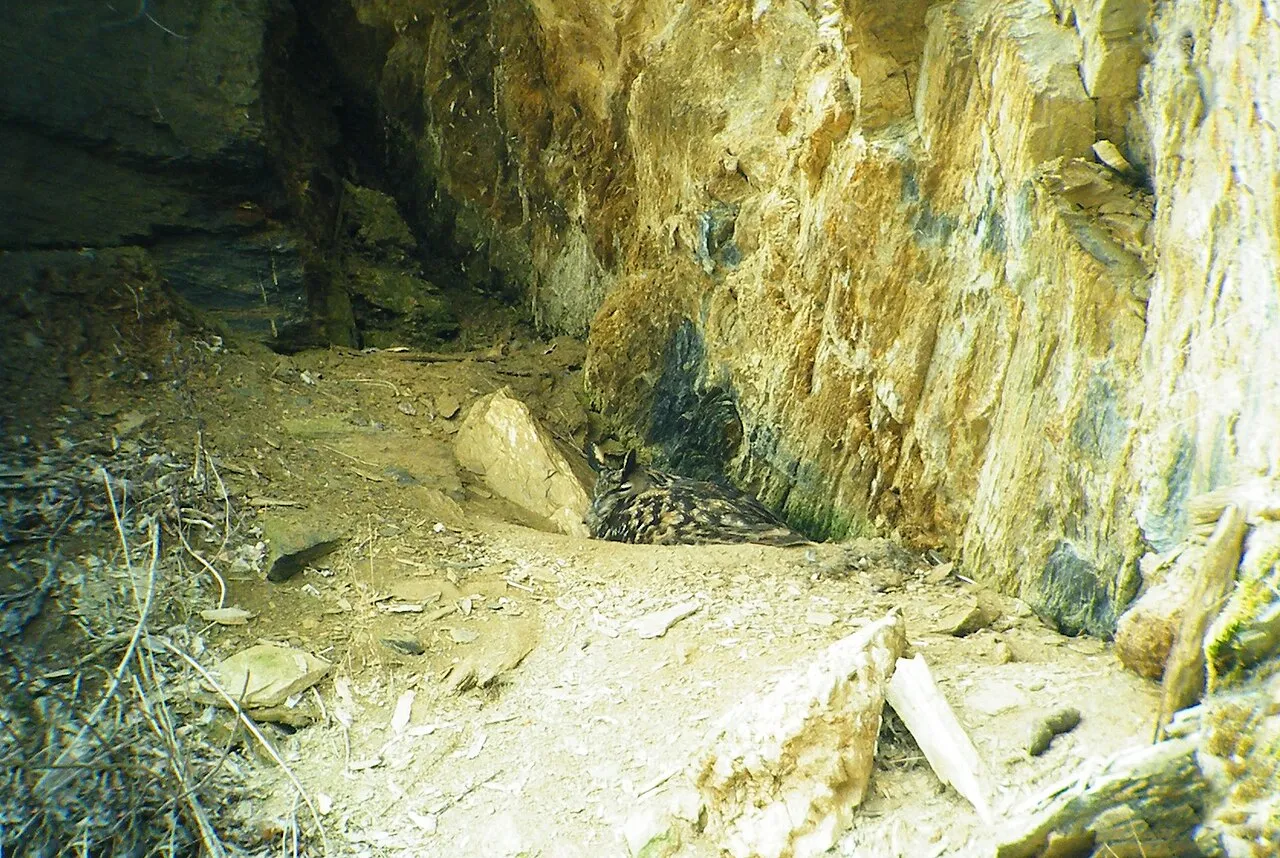
Eagle-owls inhabit most of Eurasia: west to Iberia and France, north into Scandinavia and the Siberian taiga, south to the Mediterranean, the Middle East and the northern edge of the Himalaya, and east to China, the Russian Far East and Korea. They are very rare in Japan.
Rock is the key ingredient. The ideal territory has cliffs, crags, gorges or riverside bluffs with ledges for nesting, surrounded by a mosaic of woodland edge, grassland, farmland and wetland for hunting. Where there are no rocks, they nest at the foot of large trees, in old raptor nests or on the ground. In Europe they increasingly use quarries, old buildings and even urban sites.
In Korea they are thinly scattered across the country wherever there are cliffs, including along the major rivers, on sea cliffs and on islands. They are often closer to towns and farmland than people expect.
Persecution eliminated eagle-owls from much of western Europe by the mid-twentieth century, but reintroduction programmes in Germany, Sweden and elsewhere helped them return.
5. Body
Females are larger than males, and size varies greatly across the range, with northern birds the biggest.
| Measurement | Male | Female |
|---|---|---|
| Length | about 56–65 cm | about 60–75 cm |
| Wingspan | about 1.4–1.7 m | about 1.6–1.9 m |
| Weight | about 1.5–2.8 kg | about 1.8–4.2 kg |
The dense plumage makes them look bulkier than they really are; underneath, the body is surprisingly slim.
5.1. Eyes and ears
The eyes are so large relative to the skull that they are tube-shaped rather than spherical and cannot move in their sockets. Instead, the owl turns its whole head, up to about 270 degrees, thanks to fourteen neck vertebrae (twice our number) and specialised blood vessels that keep the brain supplied.
The ear tufts are not ears. The real ear openings lie hidden at the sides of the face, slightly asymmetrical in position, so the owl can triangulate sounds by comparing their timing and loudness. The facial disc funnels sound towards them like a satellite dish. The tufts probably serve for signalling mood and for camouflage, breaking up the outline of the head.
5.2. Feathers and feet
The leading edges of the flight feathers bear comb-like serrations, and the feather surfaces are velvety. Together they break up turbulence and muffle the sound of the wings, so even this big bird can approach prey almost silently.
Legs and toes are densely feathered. One outer toe can swivel backwards, giving a two-forward, two-back grip, and the black talons close with enough force to dispatch a hare.
6. Behaviour and ecology
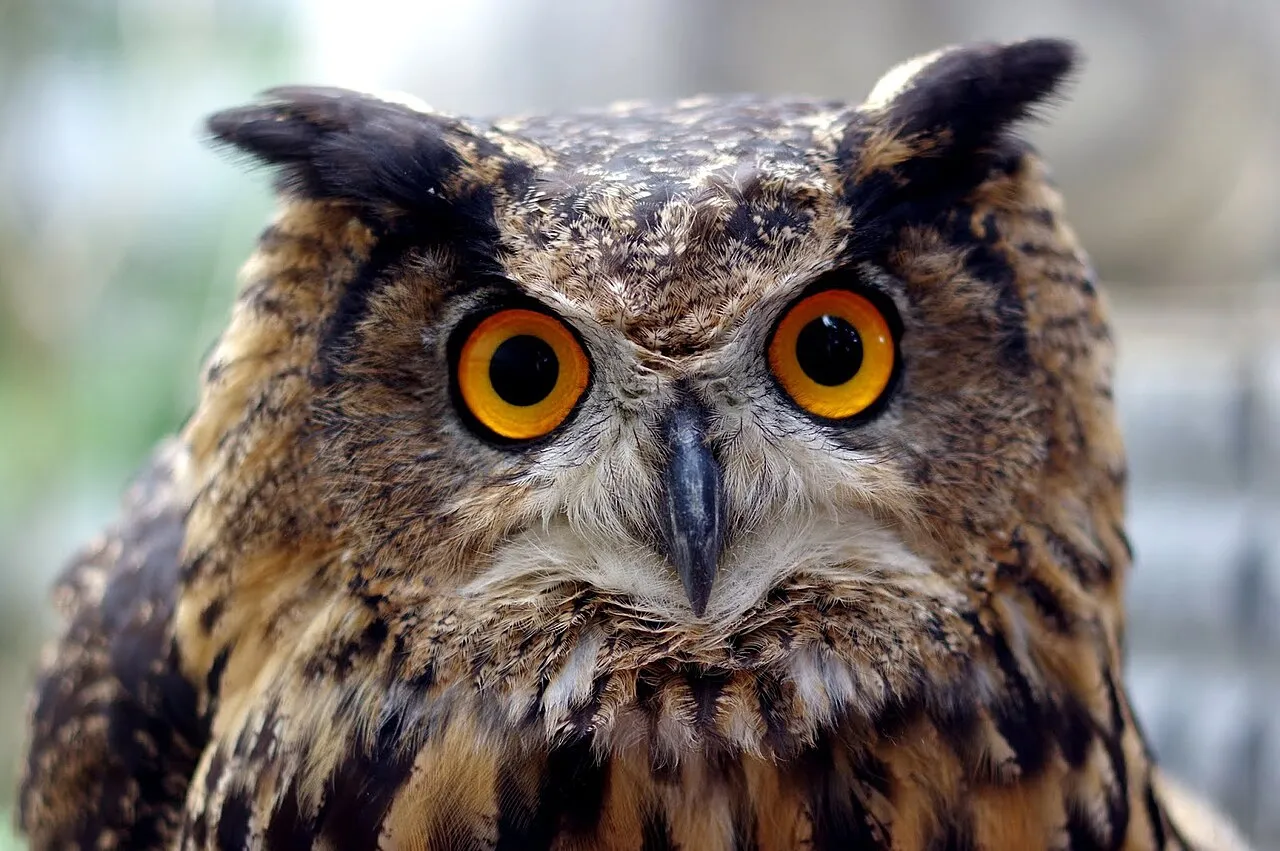
Johnsonwang6688 · CC BY-SA 4.0
Eagle-owls are mainly active from dusk to dawn. By day they sit motionless against rock faces or in thick foliage, their mottled plumage blending perfectly with stone and bark. If crows or magpies discover a roosting owl, however, they mob it noisily until it moves.
Pairs are long-term and usually faithful to the same territory for years. Territories range from a few to several tens of square kilometres. From late autumn into winter, males hoot to advertise ownership, and females often answer in a duet.
Most populations are sedentary, though some northern birds move south in hard winters. Juveniles disperse in autumn, travelling tens to hundreds of kilometres before settling.
7. Diet and feeding
The eagle-owl is an opportunist with one of the broadest diets of any raptor. Studies list several hundred prey species: mammals, birds, reptiles, amphibians, fish and even large insects. The staples are rodents such as voles and rats, and hares and rabbits. Hedgehogs, weasels, fox cubs, ducks, pheasants, pigeons, gulls, frogs, snakes and fish all appear on the menu.
It is notorious as a killer of other raptors. Scops owls, long-eared and tawny owls, buzzards, kestrels and even peregrines can fall prey, and other raptors may shift their nests or decline where eagle-owls settle.
The usual technique is to wait on a high perch, listen and watch, then glide down silently. It also walks on the ground hunting for prey. Small items are swallowed whole; larger ones are torn apart. Indigestible bones and fur are coughed up as pellets, which researchers collect beneath roosts to reconstruct the diet in detail.
8. Reproduction and life cycle
Eagle-owls breed remarkably early. In Korea eggs are usually laid between January and March, often with snow still on the ground. No nest is built; the female simply scrapes a shallow hollow on a ledge or in a rock crevice.
The clutch is typically two to four eggs, laid a day or more apart. The female incubates for about 34 to 36 days while the male hunts and delivers food every night. Chicks hatch in white down and are brooded and fed torn-up meat by the female for the first weeks.
| Stage | Timing | Notes |
|---|---|---|
| Egg | 0–36 days | Female incubates, male provisions |
| Downy chick | 0–3 weeks | Fed by the female |
| Walking out | about 5 weeks | Leaves the nest on foot before it can fly |
| First flight | about 7–9 weeks | Short flights begin |
| Dependence | 2–3 months after flying | Fed by parents while learning to hunt |
| Dispersal | Autumn | Leaves the parental territory |
| First breeding | usually 2–3 years | After securing a territory |
Because young owls clamber out of the nest well before they can fly, people sometimes 'rescue' them as orphans. In almost every case the parents are nearby, and the chick should be left alone.
Wild eagle-owls typically live 15 to 20 years. Captive birds have reportedly lived 50 to 60 years, though the oldest claims are hard to verify.
9. Intelligence, communication, special abilities
The territorial call is a deep, resonant 'oo-hu' that can carry for kilometres on a still night. Males are lower-pitched; females sound higher and hoarser. While calling, the owl puffs out its white throat patch, which studies suggest acts as a visual signal in the dark. Other sounds include bill-snapping when threatened, hoarse begging calls from chicks and barking alarm notes.
When cornered, an eagle-owl spreads its wings, fluffs its feathers to double its apparent size, hisses and clacks its bill, a display intimidating enough to make foxes and dogs back off.
Its senses are its great gift. Combining excellent low-light vision with directional hearing, it can hunt accurately in darkness where we would see nothing. The silent-flight adaptations of owl feathers have inspired engineers trying to make aircraft, fans and wind turbines quieter.
10. Predators and survival
Adult eagle-owls sit at the top of the food chain. Occasional fatal encounters with golden eagles or goshawks occur, and foxes, martens and badgers may raid ground-level nests.
The greatest dangers are man-made. With their broad wings, eagle-owls are prone to electrocution when they perch on power poles and touch two conductors; in several European countries this is a leading cause of death, and electrocuted owls are found beneath poles in Korea too. Road collisions, barbed-wire and glass collisions, and secondary poisoning from eating rodents killed with anticoagulant rat poison are other major threats.
11. Relationship with humans
In Europe eagle-owls were long persecuted as competitors for game birds and hares. Shooting, poisoning and nest destruction from the nineteenth to the mid-twentieth century wiped them out across much of the west, including large parts of Germany, the Netherlands and Belgium. Hunters also tethered captive eagle-owls as decoys to lure other raptors within gunshot. Protection and reintroduction from the 1960s onwards allowed a widespread comeback.
The recovery has created new dilemmas: in some areas eagle-owls prey on peregrines and other rare birds, complicating conservation. Farmers, on the other hand, often appreciate them as rat-catchers.
In Korea, owls have traditionally been linked with wealth. Because they cache surplus food at the nest, the phrase bueongi gotgan, an owl's storehouse, describes riches that pile up unnoticed, and owl ornaments are still sold as good-luck charms. At the same time, their night calls gave them an ominous reputation. In the late twentieth century they also suffered from poaching driven by baseless folk-medicine beliefs.
12. Conservation
The IUCN lists the Eurasian eagle-owl as Least Concern because of its huge range and a global population believed to number in the hundreds of thousands. Europe holds perhaps tens of thousands of pairs, though estimates differ. Numbers have risen in much of western Europe thanks to reintroduction, but declines are reported in parts of eastern Europe and Asia.
Main threats:
- Electrocution and collisions with power lines and wind turbines
- Road traffic
- Secondary poisoning from rodenticides and pesticides
- Destruction of nesting cliffs by quarrying and development
- Disturbance by climbers and photographers in the breeding season
- Poaching and illegal trade
In Korea it is a Natural Monument and a Class II endangered species under the Wildlife Protection and Management Act; internationally it is on CITES Appendix II. The Korean breeding population has not been precisely counted; some estimate it at several hundred pairs.
Power companies in many countries now fit insulating covers and safe perches on dangerous poles. During the breeding season, the best thing people can do is keep away from known nest sites and never use flash or approach for photographs.
13. In zoos
Eagle-owls are among the most commonly kept large owls in zoos. They adapt fairly well and breed readily, and many birds released in European reintroduction programmes were captive-bred. Being nocturnal, they spend most of the day sitting still.
Owl cafés and photo attractions in several countries, where large owls are handled by visitors under bright lights, have been widely criticised: noise, light and constant contact are highly stressful for nocturnal raptors, and tethering harms their health and flight. Films and fantasy stories have fuelled interest in owls as pets, but an eagle-owl is a powerful wild predator that eats whole animals daily. In Korea, keeping one without a permit is illegal.
14. In culture
Owls everywhere carry a double reputation for wisdom and ill omen. In ancient Greece the owl was the bird of Athena, though that bird was the little owl rather than the eagle-owl. The Romans, by contrast, believed an owl's hoot foretold death.
Korean has the expression bueongi sallim, an owl's household, for possessions that quietly accumulate, inspired by the owl's habit of stockpiling prey. Owl figurines are sold as charms to attract wealth. In Japan, the word for owl sounds like phrases meaning 'no hardship' and 'good fortune will come', so owls are popular lucky symbols. In eastern and northern European folklore they appear as forest spirits and witches' companions.
In modern pop culture, fantasy films about wizarding schools made owls hugely fashionable, and an eagle-owl appeared among the on-screen mail birds. Animal charities in several countries later warned about a spike in owls bought as pets and then abandoned.
15. Trivia
- Eagle-owls are among the few predators that regularly eat hedgehogs, peeling them from the belly side and leaving the spiny skin.
- Leftover prey and pellets pile up around nests, giving researchers useful clues when searching for breeding sites.
- In 2007 an eagle-owl landed on the pitch during a Finland national team match in Helsinki and briefly stopped play; the team has been nicknamed Huuhkajat, the Eagle-owls, ever since.
- Some ornithologists link bright orange eyes with owls that hunt at dusk and dawn, while strictly nocturnal owls tend to have dark eyes.
- With its tufts raised, a perched eagle-owl looks oddly cat-like, and in several languages its names allude to a cat's head.
Wild animals are not pets. Catching, trading or keeping them is illegal in most places. If you find an injured wild animal, call your local wildlife rescue centre.
FAQ
What's the difference between 부엉이 and 올빼미?
In Korean, owls with ear tufts are called 부엉이 and those without are 올빼미. It's a folk distinction rather than a scientific one; all are members of the same owl order.
Where does it live in Korea?
It lives sparsely across the peninsula wherever there are cliffs, river gorges or old quarries. It nests very early, around January to March, so that is when disturbance does the most harm.
What should I do if I find an injured eagle-owl?
Don't handle it bare-handed; its talons are powerful. Call a local wildlife rescue centre. In Korea it is a protected natural monument, and keeping one without a permit is illegal.
Photo credits
Photos are freely licensed images from Wikimedia Commons. Authors and licenses are listed below.
- Bubo bubo 3 (Martin Mecnarowski).jpg — Martin Mecnarowski (http://www.photomecan.eu/) · CC BY-SA 3.0
- Baby Siberian eagle-owls, Screech Owl Sanctuary.jpg — p.d. johnson · CC BY 2.0
- Brütendes Weibchen.JPG — Martin Lindner · CC BY-SA 3.0
- Bubo bubo02.jpg — Johnsonwang6688 · CC BY-SA 4.0