TailVille
1. Overview
The golden eagle is one of the largest and most powerful birds of prey in the Northern Hemisphere, and also one of the most widespread. It hunts over the Rocky Mountains and the Mojave Desert, the Scottish Highlands and the Alps, the Tibetan Plateau, the Mongolian steppe and the Siberian taiga. Wherever there is open country with cliffs or tall trees for nesting and plenty of mid-sized prey, there is a good chance a pair of golden eagles holds the skies.
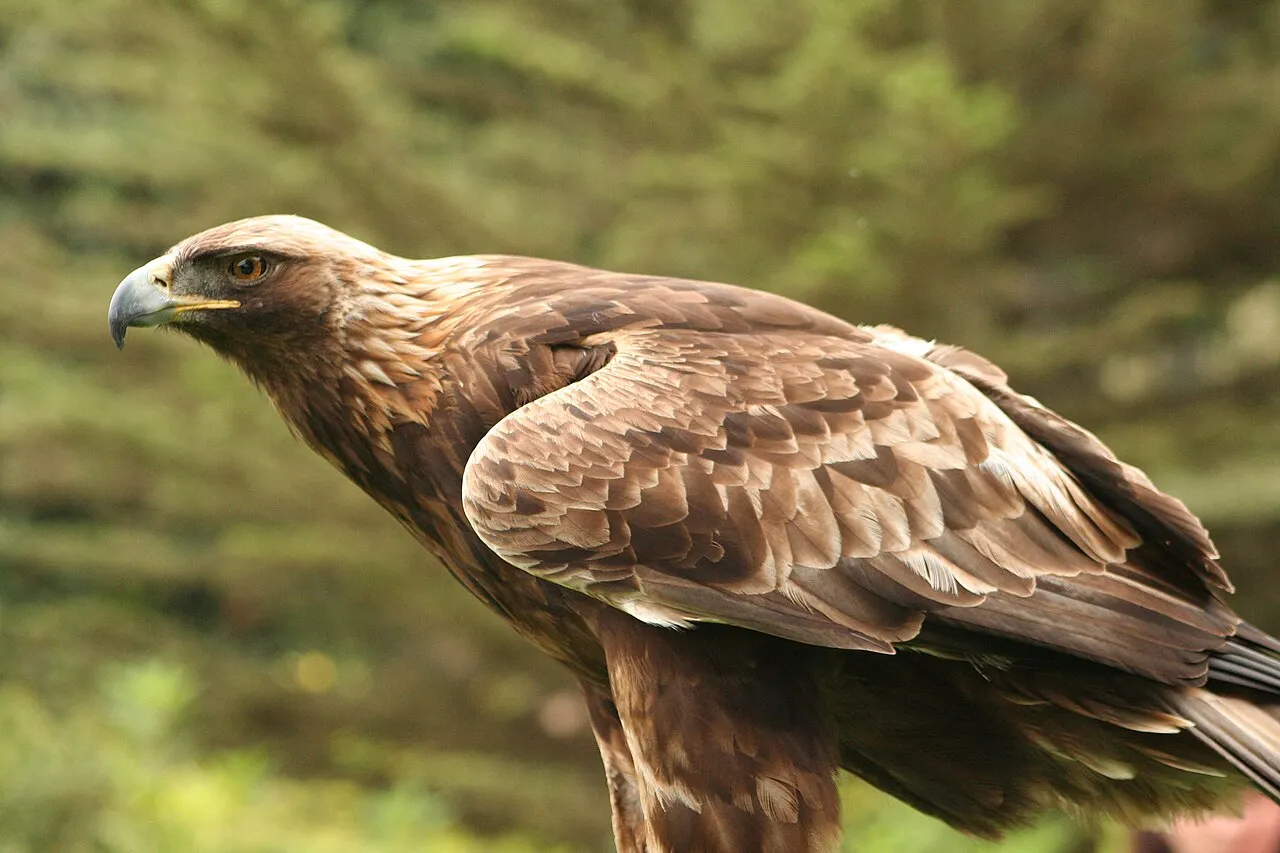
At a distance the bird looks uniformly dark brown, but in good light the crown and nape shine tawny gold, which gives the species both its English name and its scientific name, chrysaetos, Greek for golden eagle. Its wings span more than two metres, and it can soar for hours on rising air with barely a wingbeat.
Golden eagles mostly take hares, rabbits, marmots, ground squirrels and grouse, but they are strong enough to tackle foxes, young deer and mountain goat kids. That combination of power and grace has made the species an emblem of kings and nations for thousands of years. In Korea it is a rare winter visitor and is protected as both a Class I endangered species and a natural monument.
2. Name and classification
Rocky · CC BY 2.0
The scientific name Aquila chrysaetos was given by Linnaeus in 1758. Aquila is simply Latin for eagle, and chrysaetos combines the Greek chrysos, gold, and aetos, eagle.
The Korean name, geom-doksuri, literally means black doksuri, after the bird's dark plumage. This causes endless confusion, because plain doksuri in Korean refers to the cinereous vulture, a huge scavenger whose name comes from a character meaning bald. English speakers translating eagle as doksuri have muddied the water further. In short: the golden eagle is a true eagle that kills its own food, while the doksuri of Korean winter fields is an Old World vulture.
2.1. Subspecies
Six subspecies are usually recognised, though the differences are mostly subtle variations in size and shade, and authorities disagree on the boundaries.
| Subspecies | Range | Notes |
|---|---|---|
| A. c. chrysaetos | Europe, western Asia | Nominate form, medium-sized |
| A. c. homeyeri | Iberia, North Africa, Middle East | Smaller and darker |
| A. c. daphanea | Central Asia, Himalaya, Tibet | Often the largest |
| A. c. kamtschatica | Eastern Siberia, Kamchatka | Large and dark |
| A. c. japonica | Japan and Korea | Small, with a rich golden nape |
| A. c. canadensis | North America | Widespread, variable |
Which subspecies the few eagles reaching Korea belong to is not well documented.
2.2. Close relatives
Genetic studies place the golden eagle closest to Verreaux's eagle of Africa, the wedge-tailed eagle of Australia and Gurney's eagle of New Guinea. The white-tailed and Steller's sea eagles that also winter in Korea belong to a separate genus, Haliaeetus, while the eastern imperial eagle is a fellow Aquila.
3. Evolution
Eagles, hawks and kites form the family Accipitridae. For a long time falcons were lumped in with them, but DNA studies show falcons are actually closer to parrots and songbirds. The hooked beak and grasping talons of raptors evolved more than once, a textbook case of convergent evolution.
The Aquila eagles are thought to have diversified in the Old World over the last few million years, though dates vary widely between studies. Fossil bones almost identical to modern golden eagles turn up in Pleistocene deposits across Europe and North America. The La Brea tar pits in Los Angeles alone have yielded remains of hundreds of golden eagles, birds that were trapped while trying to feed on mammals already stuck in the tar. They show that the species has hunted the same landscapes for tens of thousands of years.
4. Range and habitat
Juan Lacruz · CC BY-SA 3.0
Golden eagles occur right across the Northern Hemisphere, roughly between 20 and 70 degrees north. In North America they are commonest in Alaska, western Canada, the western United States and northern Mexico, and scarce in the east. In Eurasia they inhabit Scandinavia, Scotland, the Alps, Pyrenees and Balkans, the Atlas Mountains of North Africa, the dry uplands of the Middle East, the Central Asian steppes and the Himalaya, Siberia, the Russian Far East and Japan.
The ideal home combines open hunting ground with cliffs or large trees for nesting: alpine meadows, tundra, semi-desert scrub and rolling country with a patchwork of woods and pasture. They avoid dense unbroken forest and built-up areas.
Northern populations migrate south in winter, but most birds at mid-latitudes stay on their territories all year. Those reaching Korea are winter visitors from the north and are recorded only sporadically in the mountains of Gangwon, northern Gyeonggi and inland Gyeongbuk.
The range used to be larger. Persecution wiped golden eagles out of most of England, Wales and Ireland by the early twentieth century; today the British population is concentrated in the Scottish Highlands, and a reintroduction project brought Scottish birds to Ireland in the early 2000s.
5. Body
Golden eagles are big even by eagle standards, and as in most raptors the female is noticeably larger, often 30 to 40 percent heavier than her mate.
| Measurement | Male | Female |
|---|---|---|
| Length | about 66–90 cm | about 75–100 cm |
| Wingspan | about 1.8–2.1 m | about 1.9–2.3 m |
| Weight | about 3–4.5 kg | about 4–6.5 kg |
Size varies with region: birds from the Himalaya and Central Asia tend to be the largest, those from Iberia and Japan the smallest.
5.1. Plumage and age
Adults are dark brown with a golden crown and nape, and their legs are feathered down to the toes, a useful insulation in cold mountains. Juveniles show bold white patches at the base of the flight feathers and a white tail with a dark band, very conspicuous from below. These patches shrink with each moult, and full adult plumage takes around five or six years, so experienced watchers can roughly age a bird by how much white remains.
5.2. Eyes, feet and beak
Golden eagle eyesight is several times sharper than ours. The retina is packed with receptor cells and has two foveae, one for forward vision and one for sideways scanning, allowing an eagle to pick out a moving hare from a great height. A bony ridge above each eye shades it from glare and gives the famous fierce expression.
The real weapons are the feet. The hind talon can exceed five centimetres, and the grip is crushing enough to kill most prey on impact. The hooked beak is used mainly for tearing meat, not for killing.
6. Behaviour and ecology
Golden eagles are diurnal. As the morning sun warms the slopes and thermals begin to rise, they launch from their roosts and glide along ridges scanning for prey. Much of the day, though, is spent perched on a crag or snag, watching; actual flying time is surprisingly short.
A breeding pair defends a large home range year-round. Depending on prey density it can cover anything from a few tens to several hundred square kilometres. Along the boundaries the birds perform undulating sky-dances, climbing steeply, folding their wings to plunge, then swooping up again, a display that advertises ownership to neighbours.
Pairs usually stay together for life and keep several nests within their range, using different ones in different years. Northern birds migrate hundreds or thousands of kilometres each autumn; in North America, streams of eagles follow the Rocky Mountain ridges south. Young birds wander widely for several years before settling on territories of their own.
7. Diet and feeding
The menu varies with region. In the western United States, jackrabbits and ground squirrels dominate; in the Alps it is marmots; in Scotland, mountain hares and red grouse; in Mongolia and Kazakhstan, hares, marmots and foxes. Studies have recorded several hundred prey species in total, but most kills weigh between half a kilogram and four kilograms.
Hunting techniques include:
- High soaring followed by a long, angled glide-attack
- Contour-hugging flight just above a ridge to surprise animals on the far side
- A near-vertical stoop with wings folded, used to catch birds in flight
- Still-hunting from a high perch
Stoop speeds are often quoted at over 200 km/h, with some estimates approaching 300 km/h, though measurements vary.
Rarer behaviours include knocking chamois or young deer off cliffs and tandem hunting by pairs, one bird distracting the prey while the other strikes. In lean winters, carrion becomes important, which exposes eagles to lead fragments left in hunters' gut piles and carcasses.
8. Reproduction and life cycle
Breeding begins in late winter or spring depending on latitude. Nests are built of sticks on cliff ledges or in large trees and are refurbished every year with fresh branches and greenery. Used for decades, a nest can grow to more than two metres deep.
The usual clutch is two eggs, sometimes one or three, laid several days apart. The female does most of the incubating while the male brings food, and the eggs hatch after about 41 to 45 days. Because the first chick hatches earlier and is bigger, it often attacks and kills its younger sibling when food is short. Parents do not intervene; raising two chicks is normally possible only in years of plenty.
| Stage | Timing | Notes |
|---|---|---|
| Egg | 0–45 days | Mostly incubated by the female |
| Downy chick | 0–3 weeks | White down, fed torn-up meat |
| Feathering | 3–8 weeks | Brown feathers emerge, begins self-feeding |
| Fledging | about 65–80 days | First flight from the nest |
| Independence | months later | Learns to hunt near the parents' range |
| Immature | 1–5 years | Nomadic wandering |
| First breeding | usually 4–5 years+ | Claims a territory and mate |
Wild birds can live 20 to 30 years, and ringing records show some wild individuals passing 30. Captive birds have exceeded 40. Mortality among first-year birds, however, is high.
9. Intelligence, communication, special abilities
Golden eagles are surprisingly quiet. They give high whistles and yelping notes around the nest and between mates, but the piercing scream that accompanies every movie eagle is usually a dubbed red-tailed hawk. Most golden eagle communication happens through flight displays and posture rather than voice.
They learn well. In the Mediterranean, eagles have been seen dropping tortoises onto rocks to crack their shells, and local hunting specialities seem to be passed on. Their trainability in falconry is another sign of flexible intelligence.
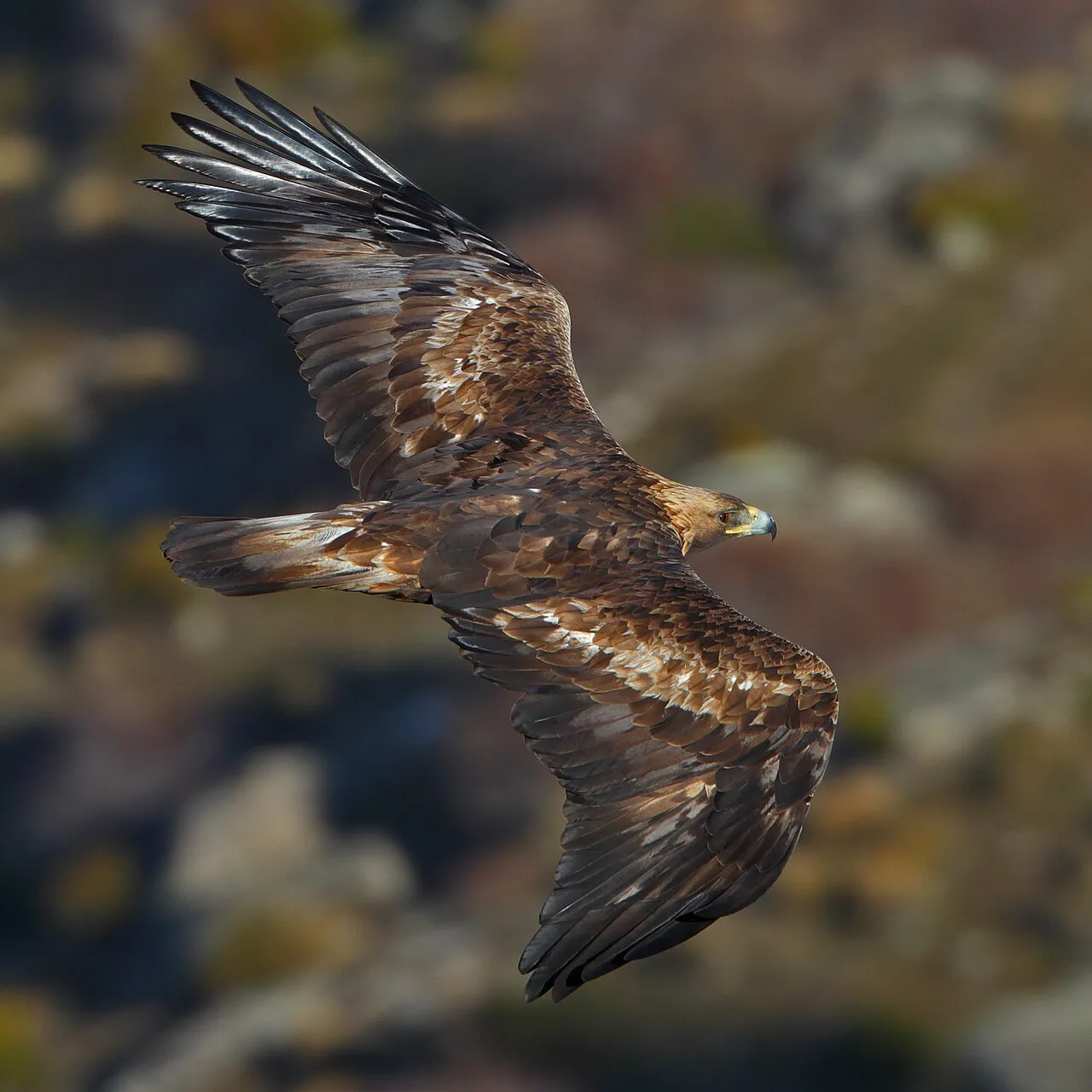
Flight is their great talent. The broad, long wings end in slotted primary feathers that spread like fingers, reducing drag and turbulence. By riding thermals and ridge lift, an eagle can travel hundreds of kilometres with little effort; satellite-tagged birds have covered more than 100 km in a single day.
10. Predators and survival
Adult golden eagles have almost no natural predators. Fights with wolves or bears over carcasses, or territorial clashes with other large raptors, occasionally prove fatal. In Eurasia, eagle-owls sometimes raid nests at night, and wolverines, foxes and ravens may take eggs or small chicks.
The main threats today are human-related: electrocution on power poles, collisions with wind turbines, being hit by vehicles while feeding on roadkill, lead poisoning from shot game, and illegal poisoning and shooting. In the western United States, eagle deaths at wind farms have become a long-running policy debate.
11. Relationship with humans
The deepest bond between people and golden eagles is falconry. Kazakh and Kyrgyz hunters of Central Asia have flown eagles at foxes, hares and even wolves for centuries, perhaps much longer. Known as berkutchi, these eagle hunters still gather each autumn at festivals in western Mongolia's Bayan-Ölgii province and in Kazakhstan. Falconry as a whole was inscribed by UNESCO as an Intangible Cultural Heritage of Humanity in 2010.
In ranching country, by contrast, eagles were long treated as vermin. Accused of killing lambs and kids, they were shot and poisoned across Europe and North America well into the twentieth century; in the American West, ranchers even hunted them from aircraft until the early 1960s. Research later showed that livestock losses were real but often overstated, and many 'kills' were scavenged stillborn lambs. In 1962 the United States extended its Bald Eagle Protection Act to cover golden eagles.
For many Native American nations, golden eagle feathers are sacred. The US government runs a National Eagle Repository that collects eagles found dead and distributes feathers to enrolled tribal members for religious use.
In Korea the species never had a big cultural role. It was too rare to be distinguished clearly from other eagles in old texts, and Korean falconers favoured goshawks and peregrines. Today it is one of the most prized sightings for Korean birdwatchers.
12. Conservation
The IUCN Red List classifies the golden eagle as Least Concern, thanks to its vast range and a global population estimated in the hundreds of thousands of individuals. Estimates vary considerably; a common figure is somewhere around 100,000 to 200,000 pairs, with tens of thousands of pairs in North America.
The overall picture hides big regional differences. Protection has allowed partial recoveries in parts of Europe after decades of persecution. In the western United States, wind energy, electrocution, lead poisoning and habitat development raise concern in some regions. In Japan, the resident population has declined as abandoned forestry plantations closed over and eliminated open hunting ground, leading to poor breeding success.
Key threats:
- Electrocution on power poles and collision with lines
- Collision with wind turbines
- Lead poisoning from ammunition in carcasses
- Illegal poisoning, shooting and nest destruction
- Loss of open hunting habitat
- Disturbance at nests from hikers, drones and photographers
In Korea it is listed as a Class I endangered species under the Wildlife Protection and Management Act and designated a Natural Monument; capturing, keeping or trading one without a permit is illegal. Internationally it is on CITES Appendix II, which regulates trade.
13. In captivity and falconry
Golden eagles are wide-ranging fliers, and satisfying their needs in a zoo is difficult. They require tall, spacious aviaries with perches at many heights and places to retreat; birds kept in cramped enclosures can develop feather-plucking and repetitive behaviours. Many facilities therefore focus on non-releasable rescued birds, such as those with permanent wing or eye injuries, and use them for education.
Falconry eagles remain wild animals. The grip of their talons can cause serious injuries, and training takes years of experience. In Korea keeping one privately is illegal, and elsewhere it is tightly licensed. A growing welfare concern is the use of eagles taken as chicks for tourist photo opportunities in parts of Central Asia and beyond.
14. In culture
Golden eagles have symbolised power since antiquity. The eagle standards carried by Roman legions, the aquilae, are generally thought to depict this species, and losing one was the ultimate disgrace. In Greek myth the eagle was the bird of Zeus.
The species is still a national emblem:
- The eagle on Mexico's flag, perched on a cactus devouring a snake, comes from the Aztec founding legend of Tenochtitlan and is officially identified as a golden eagle.
- Germany, Albania and Kazakhstan use eagles based on this species in their arms or flags; Kazakhstan's flag shows a steppe eagle soaring beneath a golden sun.
- In Scotland the golden eagle is an icon of the wild Highlands.
In fiction, Tolkien never named the species of his giant Eagles, but many readers picture golden eagles. Nature documentaries regularly feature eagles hunting mountain goat kids on cliffs, and a documentary about a teenage Kazakh eagle huntress in Mongolia became an international hit. Countless sports teams and corporate logos borrow the bird's silhouette.
15. Trivia
- Some golden eagle nests have been used by successive generations for many decades, and historic eyries in Scotland and the American West have records stretching back a century.
- Eagles often line their nests with fresh green sprigs and aromatic plants, possibly to deter parasites.
- They have attacked prey as large as young reindeer and pronghorn, but such kills are far too heavy to lift and are eaten on the spot.
- Much of what Korean translates as doksuri is actually an eagle, which is why the bald eagle is often wrongly called a 'bald vulture' in Korean.
- Satellite tracking shows some North American eagles commute thousands of kilometres each year yet return precisely to the same wintering and breeding sites.
- In Korea, a golden eagle sighting is checked carefully against the eastern imperial and steppe eagles, using juvenile wing patches, tail shape and wing proportions.
Wild animals are not pets. Catching, trading or keeping them is illegal in most places. If you find an injured wild animal, call your local wildlife rescue centre.
FAQ
Is the golden eagle the same as the black vulture Koreans call 독수리?
No. In Korean, plain 독수리 usually means the cinereous vulture, a scavenger with a bare-looking head. The golden eagle is a true eagle that kills live prey; it is smaller than that vulture but far more agile.
Can a golden eagle carry off a child?
No. An eagle can usually lift only around 2–3 kg in flight. There are records of attacks on lambs and young deer, but stories and viral videos of eagles snatching babies are myths or fakes.
Where can you see one in Korea?
Only rarely: a handful winter in Korea each year, mostly in the northern inland and mountains. It is a protected species, so watch from a distance and never approach roosts.
Photo credits
Photos are freely licensed images from Wikimedia Commons. Authors and licenses are listed below.