TailVille
1. Overview
The giant panda is a black-and-white bear with dark eye patches, ears and limbs, found only in the bamboo forests of mountainous central China. A bear that lives almost entirely on bamboo, with a round face and an unhurried manner, it has become one of the most beloved wild animals on the planet.
For decades the panda was the very symbol of an animal on the brink. Its forests were being cleared, it breeds slowly, and the periodic mass flowering and die-off of bamboo made things worse. After decades of work by the Chinese government and international partners to expand reserves, restore forest and master captive breeding, wild numbers began to recover. In 2016 the IUCN moved the giant panda from Endangered to Vulnerable.
The panda is the face of conservation, chosen as the logo of WWF, and a star of diplomacy through China's practice of lending pandas to other countries. This article looks at how a bear came to live on bamboo, how its body and habits work, and the efforts and debates surrounding its protection.
2. Name and classification
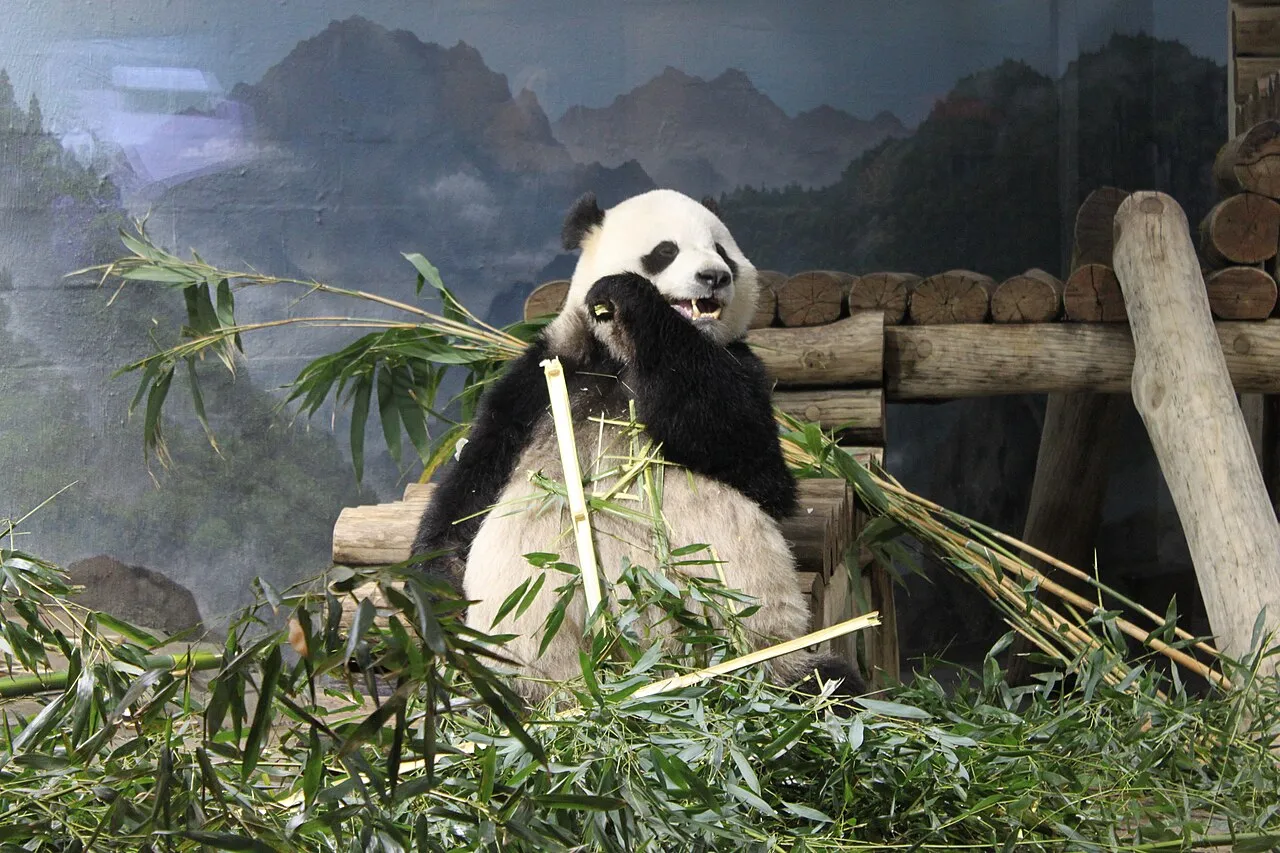
Melina Kolburn · CC BY-SA 4.0
The scientific name Ailuropoda melanoleuca combines Greek words meaning cat-foot and black-and-white: literally, the black-and-white cat-footed animal.
Its classification was argued over for a long time. It looks like a bear but eats bamboo, and it shares a name and some habits with the red panda, so some experts placed it with raccoons or in a family of its own. Molecular studies from the late twentieth century settled the question: the giant panda is a true bear, family Ursidae, and the earliest-diverging branch of the living bears, placed in its own subfamily, Ailuropodinae.
2.1. Where 'panda' comes from
Curiously, panda was originally the red panda's name. The red panda of the Himalayas reached European science first, and its name is thought to derive from a Himalayan word. When the large black-and-white animal from China became known, it was called the giant panda, and the original panda gained the prefixes lesser or red. Despite the shared name, the two are not close relatives.
In Mandarin the giant panda is daxiongmao, the big bear-cat, while in Taiwan the order is often reversed to maoxiong, cat-bear. Several names in ancient Chinese texts may refer to the panda, but scholars disagree about which animals they really meant.
2.2. Subspecies
Two subspecies are usually recognised.
| Subspecies | Scientific name | Range | Features |
|---|---|---|---|
| Sichuan panda | A. m. melanoleuca | Sichuan and Gansu | The classic black-and-white panda |
| Qinling panda | A. m. qinlingensis | Qinling Mountains, Shaanxi | Smaller, rounder skull; some individuals dark brown instead of black |
The Qinling panda was proposed as a subspecies in the mid-2000s, based on evidence that pandas in the Qinling range have been isolated long enough to diverge genetically. The rare brown-and-white pandas found there have drawn particular attention, though not all experts accept the subspecies split.
3. Evolution
The panda lineage split from the ancestors of other bears a very long time ago; molecular estimates commonly fall somewhere around fifteen to twenty million years. That makes it the oldest surviving branch of the bear family.
Fossils linked to panda ancestry have been found in Europe and Asia. Some Miocene bears from Europe are discussed as distant relatives, and fossils roughly seven to eight million years old from Yunnan in China are regarded as early members of the panda line. Even then, their teeth showed features suited to chewing tough plants.
Around two million years ago, a much smaller species, the dwarf panda Ailuropoda microta, lived in southern China. Its teeth already show signs of bamboo feeding, suggesting pandas have relied on bamboo for at least two million years. During the Pleistocene, pandas larger than today's ranged across southern and eastern China and into northern Myanmar and Vietnam. Their fossils so often turn up in caves alongside the ancient elephant relative Stegodon that palaeontologists speak of an Ailuropoda–Stegodon fauna.
Why a bear switched to bamboo is a fascinating question. The panda genome revealed that one of the genes needed to taste umami, the savoury flavour of meat, has become non-functional. One idea is that, as meat tasted less rewarding, pandas turned to an abundant food with little competition. Whether the gene loss was a cause or a consequence of the diet shift is still uncertain.
4. Range and habitat
Wild giant pandas now live only in mountainous parts of three Chinese provinces: Sichuan, Shaanxi and Gansu. Their range is split among several mountain ranges, including the Minshan, Qionglai, Qinling, Liangshan, Xiangling and Daxiangling, with the Minshan and Qionglai holding the most pandas.
They live at roughly 1,200 to 3,500 metres in cool, damp mixed forest with a dense bamboo understorey. Rain and mist are frequent and winters bring snow, but bamboo stays green all year, so pandas never hibernate. Instead they move up and down the slopes with the seasons, descending in spring to feast on new shoots, climbing higher in summer to stay cool, and moving down again in autumn and winter.
Pandas prefer gentle slopes and old-growth forest with large trees, whose hollows and nearby rock crevices serve as dens for giving birth. Logging that removes big trees therefore also removes nursery sites.
| Period | Range |
|---|---|
| Pleistocene | Much of southern and eastern China, northern Myanmar and Vietnam |
| Early historical times | Many parts of central and southern China |
| From the mid-twentieth century | Restricted to mountains of Sichuan, Shaanxi and Gansu |
| Today | Split across about six mountain ranges, with some isolated populations |
Fragmentation is the big problem. Roads, villages and farmland have cut panda habitat into dozens of patches, and small isolated groups are vulnerable to inbreeding, disease and bamboo die-offs. Building wildlife corridors to reconnect them has become a conservation priority.
5. Body
Giant pandas are mid-sized bears with stocky bodies, large round heads and short tails almost hidden in fur.
| Measure | Value |
|---|---|
| Body length | About 1.2 to 1.9 m |
| Shoulder height | About 60 to 90 cm |
| Tail | About 10 to 15 cm |
| Weight (males) | Usually 85 to 125 kg, large individuals more |
| Weight (females) | Usually 70 to 100 kg |
| Newborn | About 90 to 130 g |
Males are around 10 to 20 percent larger than females. That famously round face is largely muscle: powerful jaw muscles attach to a broad skull, and huge flat molars crush tough bamboo.
5.1. The false thumb
Besides its five digits, each front paw carries what looks like a sixth finger. It is not a true finger but an enlarged wrist bone, the radial sesamoid, known as the panda's thumb. Pandas grip bamboo stems between this pseudo-thumb and their other digits, rather like holding chopsticks.
The structure became a famous example of evolution as a tinkerer that reworks existing parts rather than designing from scratch, and it even lent its name to a well-known collection of essays on evolution.
5.2. Why black and white?
Several explanations have been offered for the panda's colours. A 2017 comparative study of carnivore coat patterns concluded that the white face, neck and belly help it blend into snowy backgrounds, while the black limbs and shoulders help it hide in shade. Because bamboo keeps pandas active all year rather than hibernating, they need camouflage for both snowy slopes and dark forest, and the pattern is a compromise.
The same study suggested that the black ears and eye patches serve as signals, the ears perhaps conveying ferocity and the patches helping pandas recognise each other or intimidate rivals. Nothing is settled, but it is a neat reminder that one pattern can do several jobs.
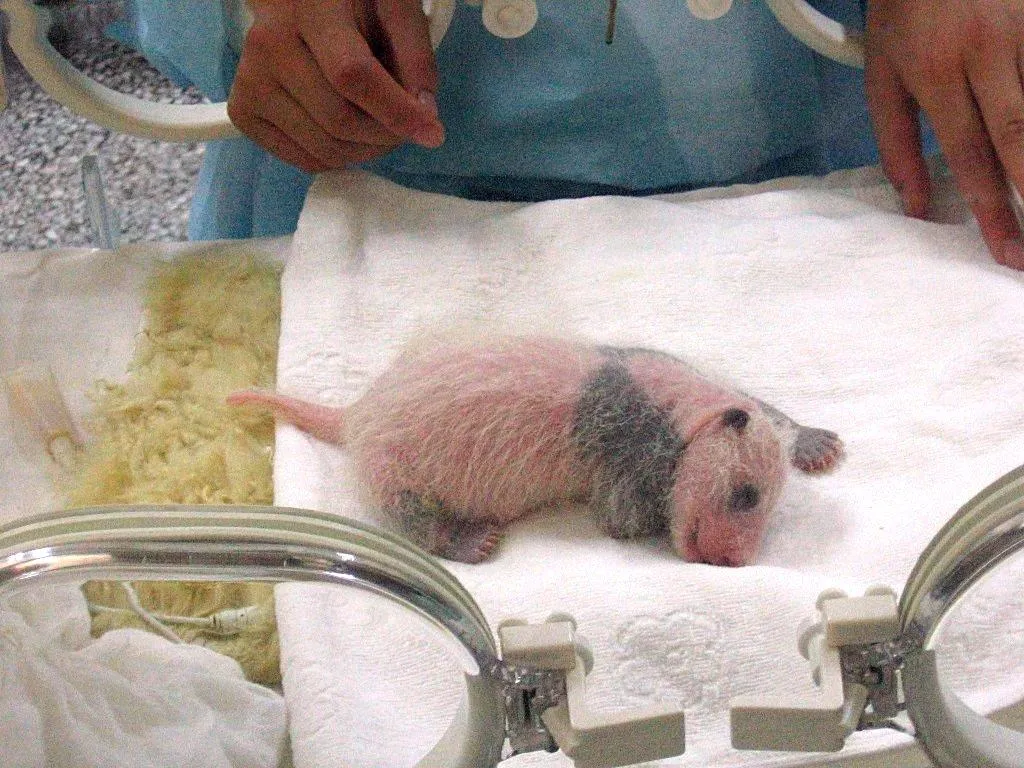
The coat is thick and oily, keeping pandas warm and dry in cold, wet mountains. Newborns are pink with sparse white fuzz; the black markings begin to appear around the eyes, ears and legs after a few weeks.
5.3. Senses and other features
Pandas have an excellent sense of smell, used to detect other pandas and their breeding condition and to choose the best bamboo. Their eyesight is thought to be relatively modest. Unlike other bears, they are often noted for having vertically elongated, somewhat cat-like pupils.
Despite its diet, the panda's gut remains carnivore-like: no multi-chambered stomach, no large caecum, and a relatively short intestine. As a result it digests only about a fifth or less of the bamboo it eats. To compensate, it picks the most nutritious parts, spends much of the day eating, and has evolved to save energy. Studies show its daily energy expenditure is remarkably low for a mammal its size, with low thyroid hormone levels, and some organs such as the brain, liver and kidneys are relatively small for its body.
Tough linings in the oesophagus and stomach protect against bamboo splinters, and gut microbes help break down some fibre, though research suggests the panda's microbiome still resembles a carnivore's more than a herbivore's.
6. Behaviour and ecology
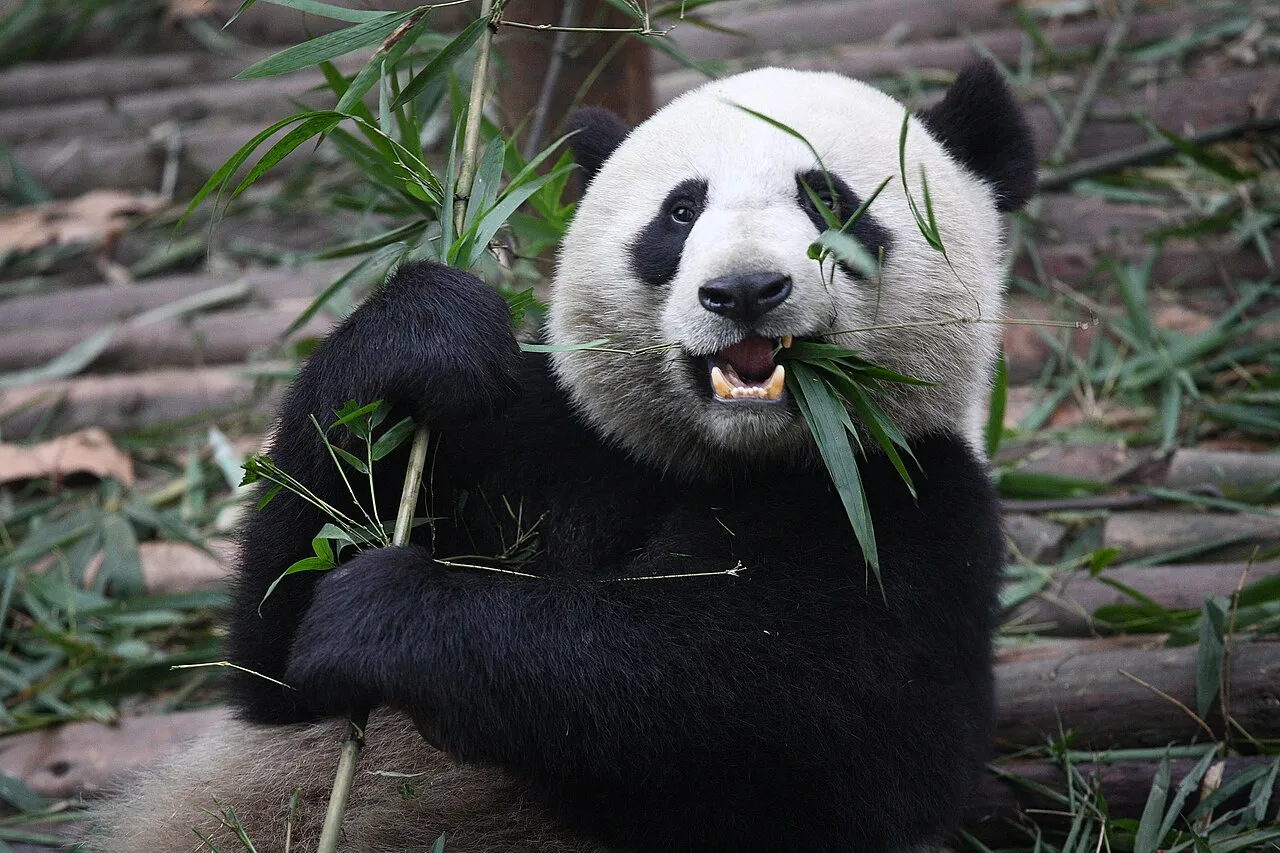
Chen Wu from Shanghai, China · CC BY 2.0
Giant pandas are basically solitary. Adults keep their own home ranges and rarely meet outside the breeding season. Range size depends on bamboo supply, commonly reported at a few to a few dozen square kilometres. Females tend to use a compact core area, while males roam more widely, overlapping several females.
Eating dominates the day. Estimates vary, but pandas spend roughly ten to sixteen hours a day finding and eating bamboo, and most of the rest resting or sleeping. It looks like a lazy routine, but it is an efficient strategy for surviving on low-energy food. Pandas are active both by day and by night, with peaks around dawn and dusk.
They are much better climbers than they look. Youngsters often play and rest in trees, and adults climb to escape danger or bask. They can also swim and cross mountain streams.
Pandas usually move slowly but can break into a fair run when needed. Their pigeon-toed gait comes from inward-turned forepaws.
Communication is mostly by scent. Pandas rub secretions from glands around the tail on tree trunks and rocks, leaving information about sex, age and reproductive state. Males sometimes do a handstand to spray urine high up a tree, perhaps because a higher mark suggests a bigger animal.
7. Diet and feeding
Bamboo makes up around 99 percent of the panda's diet. Dozens of bamboo species grow in panda country, and pandas in each area rely on a few. They eat leaves, stems and the shoots that sprout in spring, shifting with the seasons: juicy shoots in spring and early summer, leaves in summer and autumn, stems in winter. Research suggests the shifts track whichever part offers the most protein, calcium and phosphorus at the time.
The quantities are staggering, roughly 12 to 38 kg a day, more during shoot season because shoots are so watery. Much of it passes through undigested, so pandas defecate dozens of times a day. Their droppings are packed with neatly chewed bamboo fragments, and researchers analyse them to study diet and even extract DNA from their surface to identify individuals.
A feeding panda sits upright, holds bamboo with its paws and pseudo-thumb, strips the outer layer with its teeth and bites off sections. With leaves, it gathers a bundle, rolls it up and eats it in one go. Powerful jaws make short work of hard stems.
Very occasionally pandas eat other plants, small animals or carrion, a reminder of their carnivorous ancestry. In captivity they are fed bamboo plus specially formulated biscuits, apples and carrots.
One of the gravest dangers is bamboo flowering. Many bamboo species flower simultaneously across a region at intervals of decades, set seed, then die. When bamboo flowered and died across large parts of the Minshan and Qionglai mountains in the 1970s and 1980s, many pandas are believed to have starved. That is why large, connected forests with several bamboo species matter so much: when one species dies, pandas need another to switch to.
8. Reproduction and life cycle
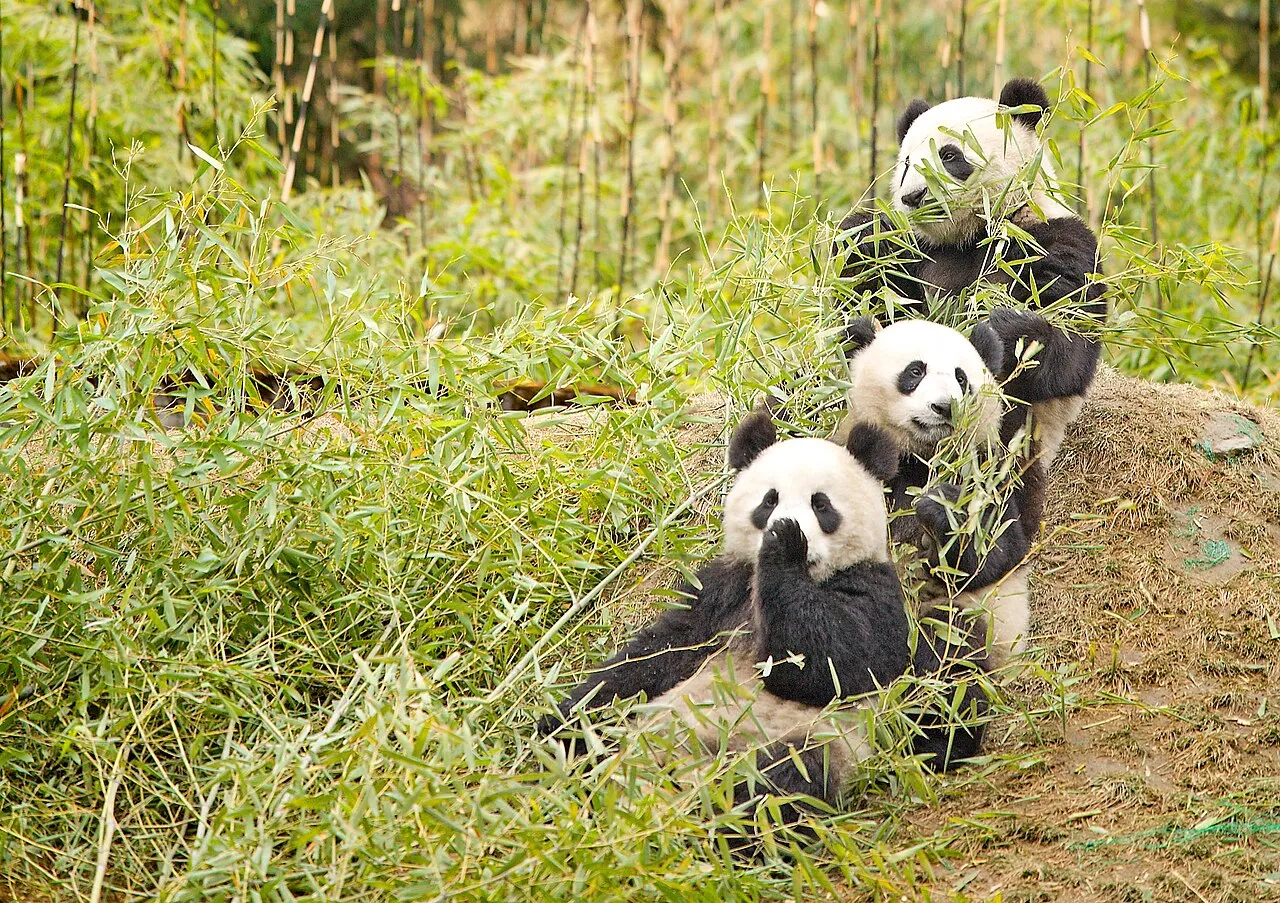
Chi King · CC BY 2.0
Panda breeding is notoriously tricky. Females come into heat once a year, usually between March and May, and are fertile for only one to three days. Miss that window and there is no second chance until the following year.
A female advertises her condition with scent marks and distinctive calls, drawing males from around her range. Males may fight for access, and several sometimes gather around one female. Females may mate with more than one male.
Pandas have delayed implantation: the fertilised egg floats free for a variable period before attaching to the uterus. As a result, the time from mating to birth ranges widely, roughly three to five months, while actual foetal development takes only the final month or two. Births typically happen in late summer or early autumn.
A newborn weighs around 90 to 130 g, about one nine-hundredth of its mother's weight, one of the most extreme mother-to-baby size ratios among mammals. It is blind, pink, nearly hairless and unable to keep itself warm. For the first days the mother barely moves, cradling it against her body to nurse.
Twins occur in close to half of births. In the wild a mother can usually raise only one, so the second often dies. In captivity keepers swap twins between the mother and an incubator so both can survive.
| Stage | Age | What happens |
|---|---|---|
| Newborn | 0 to 1 month | About 100 g, eyes closed, almost hairless, stays in mother's arms |
| Markings | 1 to 2 months | Black-and-white pattern develops; eyes open at about 6 to 8 weeks |
| First steps | 3 to 5 months | Starts walking and exploring |
| First bamboo | 6 to 12 months | Begins eating bamboo while still nursing |
| Independence | 1.5 to 2 years | Fully weaned and leaves its mother |
| Maturity | Females about 4 to 6, males about 6 to 8 | Starts breeding |
| Lifespan | About 15 to 20 years in the wild | Captive pandas may pass 30 |
Because mothers care for each cub for up to two years, females usually give birth only every two or three years, and populations recover slowly.
9. Intelligence, communication, special abilities
Pandas may look sleepy, but they are reasonably clever. Captive pandas quickly learn to solve food puzzles and perform well on spatial memory tests. In the wild they remember where and when the best bamboo shoots appear and return each season.
For a solitary animal, the panda has a surprisingly varied voice; researchers have described more than ten distinct calls. Cubs squawk when hungry or uncomfortable and whine for their mothers. Adults bark and growl as threats, and during the breeding season they bleat like sheep and make chirping, bird-like sounds. Studies suggest a female's calls carry information about her ovulation timing, helping males judge when to approach.
Scent remains central. From another panda's scent mark, a panda can tell its sex, approximate age and readiness to breed. Marking trees work like shared bulletin boards.
One quietly special ability is the panda's sitting posture. It sits back on its rump like a person, leaning against something, leaving its forepaws free to handle bamboo. That relaxed position lets it feed for hours while spending very little energy.
10. Predators and survival
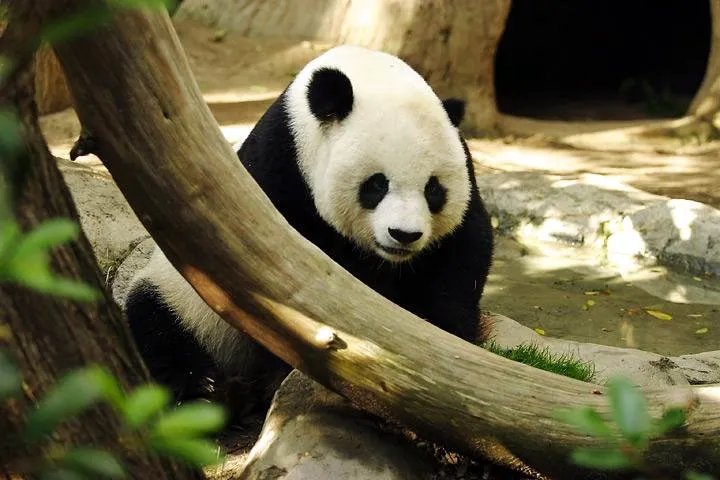
Aaron Logan · CC BY 1.0
Adult pandas, big and armed with strong teeth and claws, have few predators. Cubs, however, can fall prey to leopards, dholes and yellow-throated martens, especially when mothers leave the den to feed. Young pandas escape danger by scrambling up trees.
For all their cuddly image, pandas are bears: strong, and capable of a serious bite when threatened. Their bite force is very high for their body size.
Naturally, the biggest threat is mass bamboo flowering and die-off. Pandas are also vulnerable to parasites and some viral diseases; canine distemper can be deadly, so preventing transmission from village dogs near panda habitat has become a conservation concern.
Historically, the greatest threat has been people: logging, land clearance for farming, snares set for other animals, and in the past, direct poaching.
11. Relationship with humans
For a long time the panda was known only to people in China's mountain regions. Animals that may be pandas appear in ancient texts, and panda bones have turned up in old tombs, but the panda held no special symbolic status.
The West learned of it in 1869, when the French missionary and naturalist Armand David obtained a panda skin in Sichuan and sent it to Paris. Western hunters and explorers soon arrived seeking pandas, and in the 1930s the first live cub was taken to the United States, causing a sensation. Zoos around the world were soon eager to acquire pandas.
11.1. Panda diplomacy
The People's Republic of China began giving pandas as goodwill gifts, a practice nicknamed panda diplomacy. The pair sent to the United States during the thaw in relations in the early 1970s is the best-known example, and pandas also went to Japan, the United Kingdom, France and other countries.
From the 1980s, China switched from gifts to loans. Receiving countries typically sign ten-year agreements and pay substantial annual fees that fund panda conservation and research in China. Cubs born abroad also belong to China and return there at a set age. Because the arrival or departure of pandas often tracks the state of diplomatic relations, panda loans are watched as political signals.
11.2. Pandas and Korea
Korea first received pandas in 1994, two years after establishing diplomatic relations with China. The pair was hugely popular, but after the 1997 Asian financial crisis the high loan and care costs became a burden, and they returned to China in 1999.
Another pair arrived in 2016, and in 2020 the first panda cub conceived naturally in Korea was born, followed by the country's first panda twins in 2023. When a Korea-born panda departed for China under the loan terms, crowds turned out to say goodbye, showing how attached Koreans had become. Panda videos, broadcasts and merchandise became so popular that the media spoke of panda fever.
12. Conservation
The giant panda is listed as Vulnerable on the IUCN Red List. It had been Endangered since the 1990s and was downlisted in 2016 because wild numbers and habitat had increased. Chinese authorities announced a similar downgrade in their national assessment around 2021.
China has run nationwide wild panda surveys roughly once a decade. The fourth survey, published in the mid-2010s, counted around 1,860 wild pandas, and officials later cited a figure of about 1,900, a clear rise from the 1980s. Critics note that survey methods changed between rounds, making direct comparisons tricky. Several hundred more pandas live in captivity, mostly in Chinese breeding centres.
| Period | Wild pandas (approximate, Chinese national surveys) |
|---|---|
| 1970s | About 2,400 |
| 1980s | About 1,100 |
| Early 2000s | About 1,600 |
| Mid-2010s | About 1,860 |
12.1. Protection efforts
Efforts to save the panda fall into three broad areas.
- Habitat protection: China designated dozens of nature reserves in panda country and in 2021 formally launched a vast Giant Panda National Park uniting many of them. Part of the Sichuan panda sanctuaries is also a UNESCO World Heritage Site.
- Forest restoration and corridors: logging of natural forest was banned and steep farmland returned to forest. Projects plant bamboo and build underpasses to reconnect fragmented habitat.
- Captive breeding and reintroduction: breeding pandas in captivity was once extremely difficult, but advances in artificial insemination and cub care have greatly increased captive numbers. Programmes now prepare captive-born pandas for release, with keepers famously wearing panda costumes scented with panda smells so cubs do not become used to people.
Threats remain: fragmentation, climate change shifting bamboo ranges, tourism and road building, and loss of genetic diversity in small populations. Researchers stress that the downlisting recognises real progress but is no reason to relax.
The giant panda is listed on CITES Appendix I.
12.2. The panda as an umbrella species
Protecting pandas protects much more than pandas. Their forests are home to golden snub-nosed monkeys, takins, red pandas, rare pheasants, amphibians and many other species. Because safeguarding a wide-ranging animal shelters everything living within its range, the panda is called an umbrella species. Panda forests also protect the headwaters of the Yangtze and prevent soil erosion, benefiting people downstream.
Critics, however, point out that charismatic animals like the panda attract a disproportionate share of conservation money and attention, leaving less glamorous endangered species neglected.
13. In zoos
Pandas are among the biggest zoo attractions in the world. Zoos invest heavily to host them, and visitor numbers typically jump when they arrive.
Keeping pandas is demanding. Above all they need large amounts of fresh bamboo every day, and they are picky: intake can drop sharply if the species or condition is not right. Zoos therefore grow several bamboo species themselves or ship it in from afar. Pandas also struggle in heat, so summer requires air-conditioned indoor areas and cooling enrichment such as ice treats.
Captive breeding was a headache for decades. Pairs often showed no interest in each other or did not seem to know how to mate; stories of pandas being shown videos of other pandas mating made headlines. Today, hormone monitoring pinpoints the brief fertile window, and advances in artificial insemination and cub rearing have greatly improved success.
Zoo pandas are controversial too. Some argue the huge loan fees would do more good spent on other endangered species, and question how much captive breeding helps wild pandas. Others counter that zoo pandas build public support and that loan fees fund field conservation in China.
No private individual can keep a panda. Essentially every panda in the world is under Chinese government management, international trade is banned, and despite their looks adult pandas are strong bears with sharp teeth and claws. Even experienced keepers are careful around them.
14. In culture
The panda is one of the most beloved animal characters in modern culture. When WWF was founded in 1961, it chose a panda as its logo, reportedly because the black-and-white design was cheap to print and because the panda was a widely loved endangered animal. The panda has symbolised the conservation movement ever since.
The Kung Fu Panda films, about a clumsy panda who becomes a martial-arts hero, were a global hit. A panda was one of the mascots of the 2008 Beijing Summer Olympics, and the mascot of the 2022 Beijing Winter Olympics was a panda wearing a shell of ice.
In China the panda is regarded as a national treasure and appears on commemorative coins, stamps and tourism campaigns; the annual panda bullion coins are prized by collectors.
In Korea, devotion to pandas grew so intense that the media spoke of panda fever, with hugely popular videos, documentaries and merchandise and a dedicated fan community. Dark circles under tired eyes are jokingly called panda eyes in both Korean and English.
Thanks to its friendly image, the word panda turns up in brand names, apps and software. A popular data-analysis library for Python is often associated with the animal, although its name is said to derive from an unrelated technical term.
15. Trivia
- Pandas are bears that do not hibernate; bamboo stays green all winter, so food never runs out.
- Panda dung smells mostly of bamboo and is less pungent than you might expect. In China people have even experimented with turning it into paper and fertiliser.
- Pandas can be very playful, especially youngsters, which tumble, roll and slide down snowy slopes.
- Their human-like way of holding bamboo depends entirely on the pseudo-thumb.
- A newborn panda is about the size of a stick of butter, and people seeing one for the first time sometimes mistake it for a mouse or a baby rodent.
- Jokes about pandas being lazy miss the point: their low-energy lifestyle is a finely tuned survival strategy.
- Captive pandas sometimes live beyond thirty, and the oldest on record reportedly reached their late thirties.
- Many pandas love sweet treats like apples and carrots, which keepers use as rewards in training for health checks.
Wild animals are not pets. Catching, trading or keeping them is illegal in most places. If you find an injured wild animal, call your local wildlife rescue centre.
FAQ
Is the giant panda really a bear?
Yes. Genetic studies confirmed it is a true bear, the earliest-diverging branch of the living bear family.
Why do pandas eat only bamboo?
It seems they adapted to an abundant food with little competition. Research also found that one gene for tasting umami has stopped working, which may be linked.
Why do zoo pandas abroad return to China?
Most pandas abroad are on loan from China, and cubs born overseas also belong to China, returning at an agreed age under the loan terms.
Photo credits
Photos are freely licensed images from Wikimedia Commons. Authors and licenses are listed below.
- Grosser Panda.JPG — J. Patrick Fischer · CC BY-SA 3.0
- Bao Li.jpg — Melina Kolburn · CC BY-SA 4.0
- Chengdu-pandas-d18.jpg — User:Colegota and post-processed with The GIMP · CC BY-SA 2.5 es
- Giant Panda Eating.jpg — Chen Wu from Shanghai, China · CC BY 2.0
- Giant Pandas having a snack.jpg — Chi King · CC BY 2.0
- Lightmatter panda.jpg — Aaron Logan · CC BY 1.0