TailVille
1. Overview
For centuries, sailors told of a monster in the deep that could wrap its arms around a ship and drag it under: the kraken of Nordic legend. Today scientists believe much of that legend was inspired by a real animal, the giant squid, Architeuthis dux.
Including its two long feeding tentacles, a giant squid can exceed ten metres in length. It has some of the largest eyes in the animal kingdom and lives hundreds of metres down in the dark. Yet it remained so elusive that the first photographs of a live one were taken only in 2004, and the first video in its natural habitat in 2012.
Most of what we know comes from indirect evidence: carcasses washed ashore, individuals caught in fishing nets, and beaks recovered from the stomachs of sperm whales, its main predator. Basic questions, such as how long it lives, how many there are and how mates find each other, still lack firm answers.
The giant squid has become a symbol of how much of our planet remains unexplored. That humans first saw the largest squid alive only around two decades ago says a great deal about how little of the deep sea we know.
2. Name and classification

NASA · Public domain
The giant squid belongs to the phylum Mollusca, class Cephalopoda, order Oegopsida and family Architeuthidae. Cephalopod means head-foot, and the class includes squids, octopuses, cuttlefish and nautiluses.
Architeuthis means chief squid in Greek. Danish zoologist Japetus Steenstrup described the genus in 1857 from a beak and remains washed ashore. The Korean name, daewang-ojingeo, means great king squid.
Over the years, nearly twenty species names were given to giant squids from different oceans, because their proportions and localities varied slightly. A 2013 study comparing DNA from more than forty specimens worldwide found remarkably little genetic difference, and today most researchers recognise a single global species, Architeuthis dux, though a few keep the door open to more.
The giant squid's great rival for the title of largest squid is the colossal squid (Mesonychoteuthis hamiltoni) of the Southern Ocean. The giant squid is longer and slimmer; the colossal squid is similar or slightly shorter in length but far bulkier and heavier.
3. Evolution
Cephalopod history reaches back some 500 million years to the Cambrian. Early cephalopods had hard, cone-shaped shells with gas-filled chambers for buoyancy. The nautiloids and ammonites that dominated Palaeozoic and Mesozoic seas were their descendants.
The coleoids, the group containing squids and octopuses, evolved by internalising or losing the shell. The transparent, plastic-like pen inside a squid, called the gladius, is a remnant of that ancestral shell. Giving up armour, coleoids became fast, colour-changing, big-brained hunters. Squid-like belemnites swarmed Mesozoic seas, and their bullet-shaped fossils are still common finds.
When the giant squid family split off is unclear, because soft bodies rarely fossilise; only beaks and statoliths occasionally survive.
Its great size is often discussed under the heading of deep-sea gigantism: in cold, high-pressure, food-poor waters, a large body may be more energy-efficient and better at enduring lean times. One study proposed that the giant squid's huge eyes evolved specifically to spot approaching sperm whales from a distance.
4. Range and habitat
SSR2000 · CC BY-SA 3.0
Giant squid have been found in all the world's oceans except the polar seas. Specimens have been especially frequent in:
- Waters off New Zealand and southern Australia
- Around Japan, including the Ogasawara Islands and the Sea of Japan coast
- The North Atlantic: Norway, Ireland, northern Spain and Newfoundland
- Off southern Africa
- The Gulf of Mexico
They are most often associated with continental slopes, shelf edges and seamounts where the seafloor drops into deep water. Their usual depth is thought to be roughly 300 to 1,000 metres, the dimly lit twilight zone, where water is cold and stable.
Giant squid sometimes wash up on Japan's Sea of Japan coast in winter or turn up in set nets. In the winter of 2014 to 2015, an unusual number appeared in Toyama Bay and nearby areas. Changes in water temperature were suggested but not confirmed. One hypothesis is that in warm surface water, the squid's blood carries oxygen less effectively, leaving it weak.
Confirmed records from Korean waters are very rare, and whether giant squid regularly inhabit the deep East Sea is unknown.
5. Body
Giant squid sizes are easily exaggerated. Carcasses stretch as muscles relax, and many historical records are poorly supported. Approximate figures based on reliable data are:
| Measure | Female | Male |
|---|---|---|
| Total length with tentacles | up to about 12 to 13 m | up to about 10 m |
| Mantle length | up to about 2 to 2.5 m | smaller |
| Weight | up to about 250 to 275 kg | up to around 150 kg |
| Eye diameter | about 25 to 27 cm |
Females are generally larger and heavier than males. Old tales of animals near twenty metres have never been scientifically confirmed.
The body consists of the mantle, the head, eight arms and two feeding tentacles. The tentacles are far longer than the arms and make up most of the total length; their broad tips, called clubs, bear clusters of suckers. Each sucker is ringed with a hard, toothed rim that grips prey.
Eyes over 25 centimetres across, close to the size of a basketball, rank with the colossal squid's as the largest in the animal kingdom, ideal for gathering the faintest light in the deep.
The tissues are rich in ammonium chloride, which is lighter than seawater and keeps the squid neutrally buoyant without effort. The same chemical makes its flesh bitter and ammonia-scented, so it is reportedly poor eating. Its blood uses copper-based haemocyanin to carry oxygen, giving it a bluish tint, and it has three hearts.
6. Behaviour and ecology
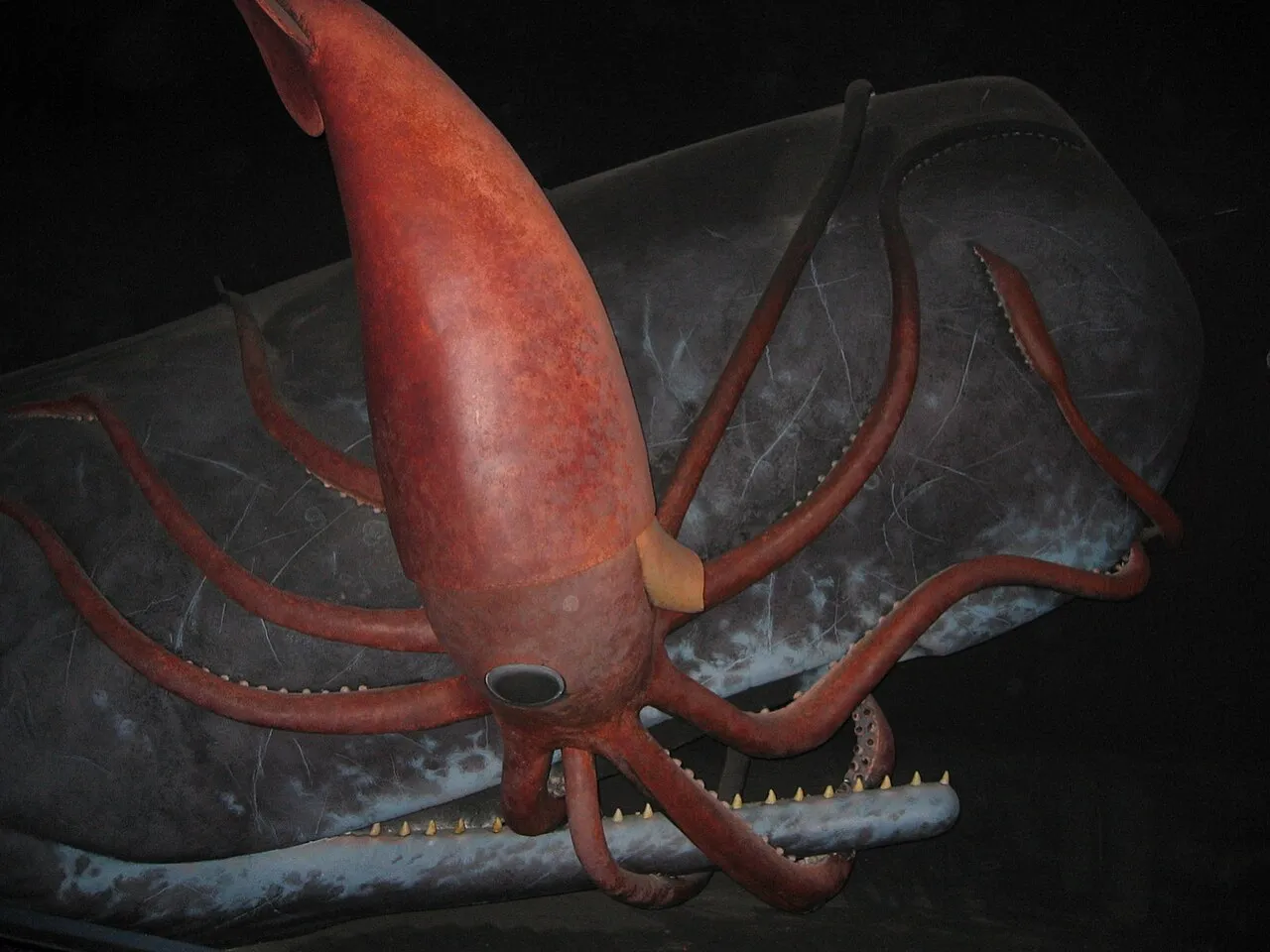
Mike Goren from New York · CC BY 2.0
Almost nothing is known about the giant squid's daily life; what we have comes from a handful of observations and carcass studies.
In 2004, Tsunemi Kubodera of Japan's National Museum of Nature and Science and Kyoichi Mori of the Ogasawara Whale Watching Association lowered bait and a camera to about 900 metres near the Ogasawara Islands and took the first series of photographs of a living giant squid. It wrapped its tentacles around the bait, struggled for hours and finally broke free, leaving a severed tentacle behind. This showed the giant squid to be an active predator rather than a sluggish drifter.
In 2012, a Japanese and American team filming from a submersible in the same region captured video of a giant squid in its natural habitat, broadcast to worldwide fascination in 2013. In 2019, an American team in the Gulf of Mexico filmed a young giant squid using a camera with a lure that imitates a glowing jellyfish.
Taken together, these records suggest the giant squid is solitary and may hang head-down in mid-water with arms trailing, shooting out its tentacles when prey comes near. Its range of movement, daily vertical migrations and social life remain largely unknown.
7. Diet and feeding
Stomach contents show that giant squid eat mainly deep-sea fish and other squid. Specimens from New Zealand contained hoki and orange roughy, as well as pieces of other giant squid, hinting at cannibalism.
To hunt, the squid shoots out its two long tentacles and snatches prey. The toothed sucker rings on the clubs grip slippery victims, then the eight shorter arms pull the prey towards the mouth, where a hard, parrot-like beak slices it up.
Inside the mouth, a ribbon-like radula pushes pieces down the throat. In squids, the oesophagus passes through the brain, so food must be cut into small pieces; a large chunk could press on the brain.
How much a giant squid eats in a day, or how often it hunts, is not known.
8. Reproduction and life cycle
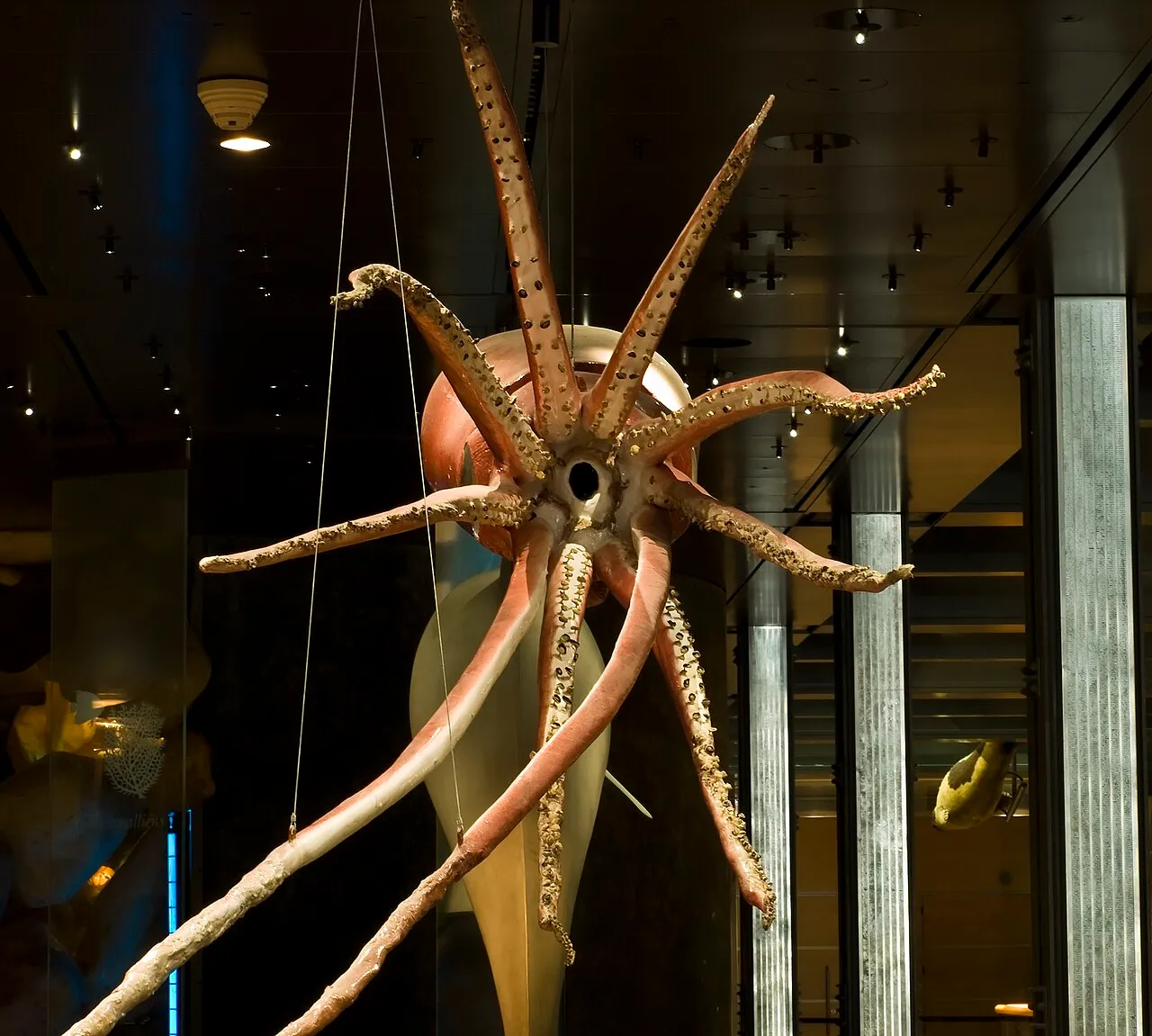
Giant squid reproduction has almost never been observed, so most knowledge comes from dissections.
Males have an extremely long penis, in some specimens rivalling the mantle in length. They appear to inject sperm packets, spermatophores, directly into the skin of the female's arms; females have been found with spermatophores embedded there. How the female then uses the sperm is unclear. One idea is that the sperm work their way out; another is that she tears the skin open with her beak.
Females produce enormous numbers of tiny eggs, with millions recorded in a single ovary. Like other oegopsid squids, they probably release eggs in large, drifting gelatinous masses, but giant squid egg masses have hardly ever been identified. A few tiny paralarvae caught at sea have been confirmed as giant squid.
| Topic | What is known |
|---|---|
| Maturity | Age unknown; thought to grow fast and mature within a few years |
| Eggs | Very small and numerous, likely in the millions |
| Young | Begin as planktonic paralarvae a few mm long |
| Lifespan | Many studies suggest under five years, based on statoliths |
Squid age is estimated by counting growth rings in statoliths, tiny stones in the balance organs. Giant squid statoliths suggested surprisingly young ages, implying the animals grow from centimetres to nearly ten metres in just a few years. Like many squids, giant squid may breed once and die, but this is not certain.
9. Intelligence, senses and special abilities
Cephalopods have the largest brains among invertebrates. Octopus problem-solving is well documented, but there has been almost no way to study giant squid intelligence, so nothing is known about it.
Its most remarkable sense organ is its enormous eye. A 2012 study calculated that such large eyes offer little extra benefit for spotting prey but a big advantage for detecting approaching sperm whales. When a large animal moves through the deep, it triggers glowing plankton, and a huge eye can detect that faint, spread-out light at distances over 120 metres, buying time to escape.
Like other squid, the giant squid has pigment cells in its skin and can change colour; the squid filmed in 2012 shimmered silver and gold like polished metal. It also has an ink sac and can presumably release ink when threatened.
It moves by jet propulsion, drawing water into the mantle and expelling it through the funnel, assisted by fins at the mantle tip. Given its ammonium-based buoyancy, many researchers think it is suited to hovering with bursts of movement rather than sustained fast swimming.
10. Predators and survival
The sperm whale is virtually the only predator of adult giant squid. Sperm whales dive deeper than 1,000 metres to hunt squid, and giant squid beaks are frequently found in their stomachs. Because beaks are hard and indigestible, they accumulate, and scientists count them to learn which squid whales eat and how many.
Sperm whales often bear round sucker scars several centimetres across on their heads and bodies, thought to be left by struggling squid. The image of a deep-sea duel between whale and squid is a museum favourite, yet no actual hunt has ever been filmed. In most encounters, a whale weighing tens of tonnes presumably holds the upper hand.
Young giant squid are likely eaten by many fish, sharks, other squid and seabirds. Some toothed whales and deep-sea sharks such as sleeper sharks have also been recorded eating giant squid.
11. Relationship with humans
11.1. From legend to science
Tales of the kraken circulated in Scandinavia from the Middle Ages. In the eighteenth century, the Norwegian bishop Erik Pontoppidan described it as a creature as large as an island. Scientists today believe sightings of dying giant squid at the surface, or their carcasses, fed the legend.
In 1861, the French warship Alecton encountered a huge squid near the Canary Islands and tried to harpoon it, hauling aboard only part of the body. The incident was an important step in convincing scientists the animal was real. In the 1870s, a series of giant squid washed ashore in Newfoundland, and naturalists' photographs and specimens put the matter beyond doubt.
For over a century afterwards, the giant squid was known only from dead specimens. The first photographs in 2004, footage of a live animal brought to the surface in 2006 and natural-habitat video in 2012 became milestones in deep-sea exploration.
11.2. Fisheries and people
There is no fishery for giant squid. As noted, its ammonium-laden flesh is reportedly bitter and unappealing. Occasionally individuals are caught by accident in deep trawls or set nets off New Zealand, Japan and northern Spain, and these become valuable research specimens.
Squid products sold in Korea under names translating as giant squid are almost always made from the Humboldt squid (Dosidicus gigas), caught off South America. The Humboldt squid grows to around 1.5 to 2 metres and is a major raw material for dried shredded squid and grilled squid products. Despite the confusing name, it is a different species.
12. Conservation
The giant squid is listed as Least Concern on the IUCN Red List. It is widespread in the world's oceans, and the quantity eaten by sperm whales implies a substantial population. Direct counts are impossible, however, so its numbers and trend are unknown.
With no targeted fishery, it is not considered seriously threatened, but several indirect pressures are discussed:
- Bycatch and habitat disturbance from deep-sea trawling
- Ocean warming and expanding low-oxygen zones
- Intense underwater noise such as seismic surveys; a study linked strandings on Spain's northern coast in 2001 and 2003 to nearby airgun surveys
- New activities such as deep-sea mining
The giant squid has no special legal status in Korea.
13. In museums and aquariums
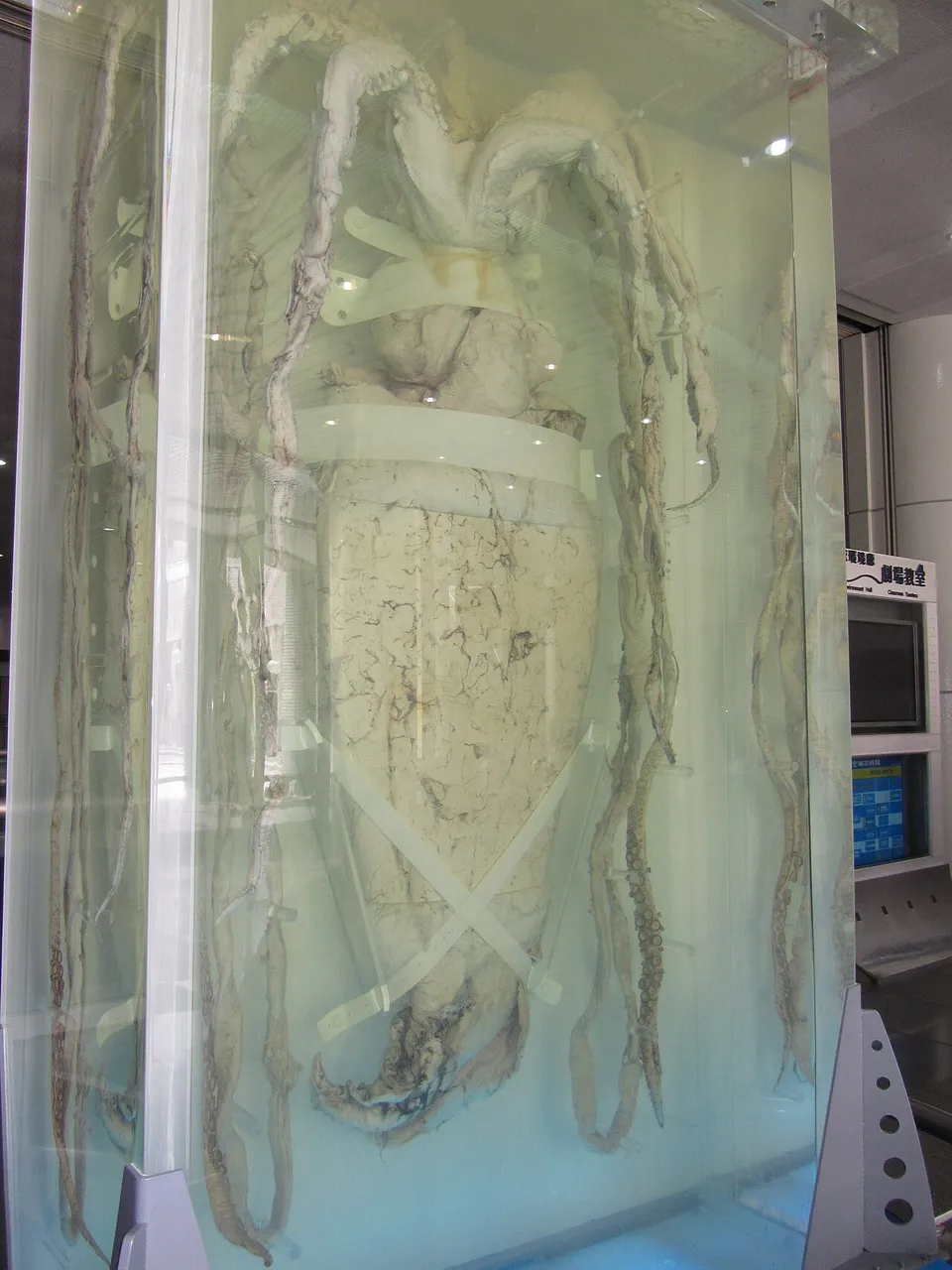
No aquarium has ever kept a living giant squid. Recreating deep-sea cold, pressure and darkness is extremely hard, and captured animals are usually dead or dying. A few that surfaced alive were briefly placed in tanks, but none survived long.
Instead, many natural history museums display giant squid preserved in formalin or other fluids. London's Natural History Museum, the Smithsonian in Washington, Te Papa in New Zealand, Japan's National Museum of Nature and Science and a squid museum in northern Spain are well known for their specimens. A giant squid in a glass tank remains one of the most popular windows onto the deep.
Preservation is itself a challenge. The huge, soft bodies are hard to infuse evenly, and specimens fade and distort over time. Increasingly, museums pair real specimens with life-size models and 3D scans.
14. Giant squid in culture
The giant squid is the archetypal sea monster. In Jules Verne's Twenty Thousand Leagues Under the Seas (1870), the crew of the Nautilus battles giant squid in one of literature's most famous scenes, memorably filmed by Disney in 1954. In Herman Melville's Moby-Dick, sailors who glimpse a huge squid at the surface take it as an ill omen.
The kraken has appeared in the Pirates of the Caribbean films and Clash of the Titans, and is a staple boss in games and fantasy novels. The National Hockey League's Seattle Kraken carries the name on ice.
In Korea and Japan, the giant squid is a favourite topic for documentaries and science books. The 2013 broadcast of Japanese footage caused a sensation, and picture books and animations have featured it as a hero.
Kraken has become shorthand for vast, unknown power, lending its name to software, beers and roller coasters.
15. Trivia
- The giant squid's brain is shaped like a doughnut around its oesophagus, so swallowing large pieces could injure it.
- In 2025, a juvenile colossal squid was reported filmed alive in its natural habitat in the Southern Ocean for the first time, about two decades after the first images of a living giant squid.
- Giant squid sucker scars are a few centimetres across. Reports of much larger scars on sperm whales may reflect scars stretching as the whale grows.
- Squid have blue blood and three hearts: two pump blood through the gills and one through the body.
- In Japan, a folk belief holds that stranded deep-sea animals foretell earthquakes, but there is no scientific evidence for it.
- Because the tentacles are several times longer than the body, total length says little about bulk, so scientists prefer mantle length for comparing size.
Wild animals are not pets. Catching, trading or keeping them is illegal in most places. If you find an injured wild animal, call your local wildlife rescue centre.
FAQ
Is the 'giant squid' sold in Korean shops this animal?
No. Those products are almost always Humboldt squid from South America. True giant squid taste bitter from ammonium and are not fished for food.
Which is bigger, the giant squid or the colossal squid?
The giant squid can be as long or longer, but the bulkier colossal squid is heavier.
Do giant squid attack ships?
There is no confirmed case. The kraken legend probably grew from sightings of dying giant squid at the surface.
Photo credits
Photos are freely licensed images from Wikimedia Commons. Authors and licenses are listed below.
- Giant squid Ranheim.jpg — NTNU Vitenskapsmuseet · CC BY 2.0
- A piece of sperm whale skin with Giant Squid sucker scars.JPG — NASA · Public domain
- Architeuthis sanctipauli in National Museum of Natural Science, Taichung, Taiwan.JPG — SSR2000 · CC BY-SA 3.0
- Display of sperm whale and giant squid battling in the Museum of Natural History.jpg — Mike Goren from New York · CC BY 2.0
- Giant squid (Architeuthis sanctipauli) replica in Muséum national d'histoire naturelle (France).jpg — Stephanemartin · CC BY-SA 3.0