TailVille
1. Overview
Every autumn, hundreds of millions of orange-and-black butterflies stream south across North America. Starting in southern Canada and the eastern United States, they travel to fir forests in the mountains of central Mexico, a journey that can exceed 4,000 kilometres. This is the monarch butterfly, Danaus plexippus.
The monarch is the most celebrated long-distance traveller among insects. Remarkably, none of the butterflies making the trip has ever done it before. Several generations pass during the spring and summer push north, so the autumn migrants are the great-grandchildren or great-great-grandchildren of last year's travellers, yet they reach the same mountains and sometimes the same groves.
Monarch caterpillars feed only on toxic milkweeds and store the plants' poisons, making both larvae and adults distasteful to birds. The vivid orange is a warning.
Because overwintering numbers have fallen sharply over recent decades, the monarch has become a flagship for insect conservation in North America. It does not live in Korea, but Korea has its own sea-crossing migrant, the chestnut tiger, which this article also mentions.
2. Name and classification
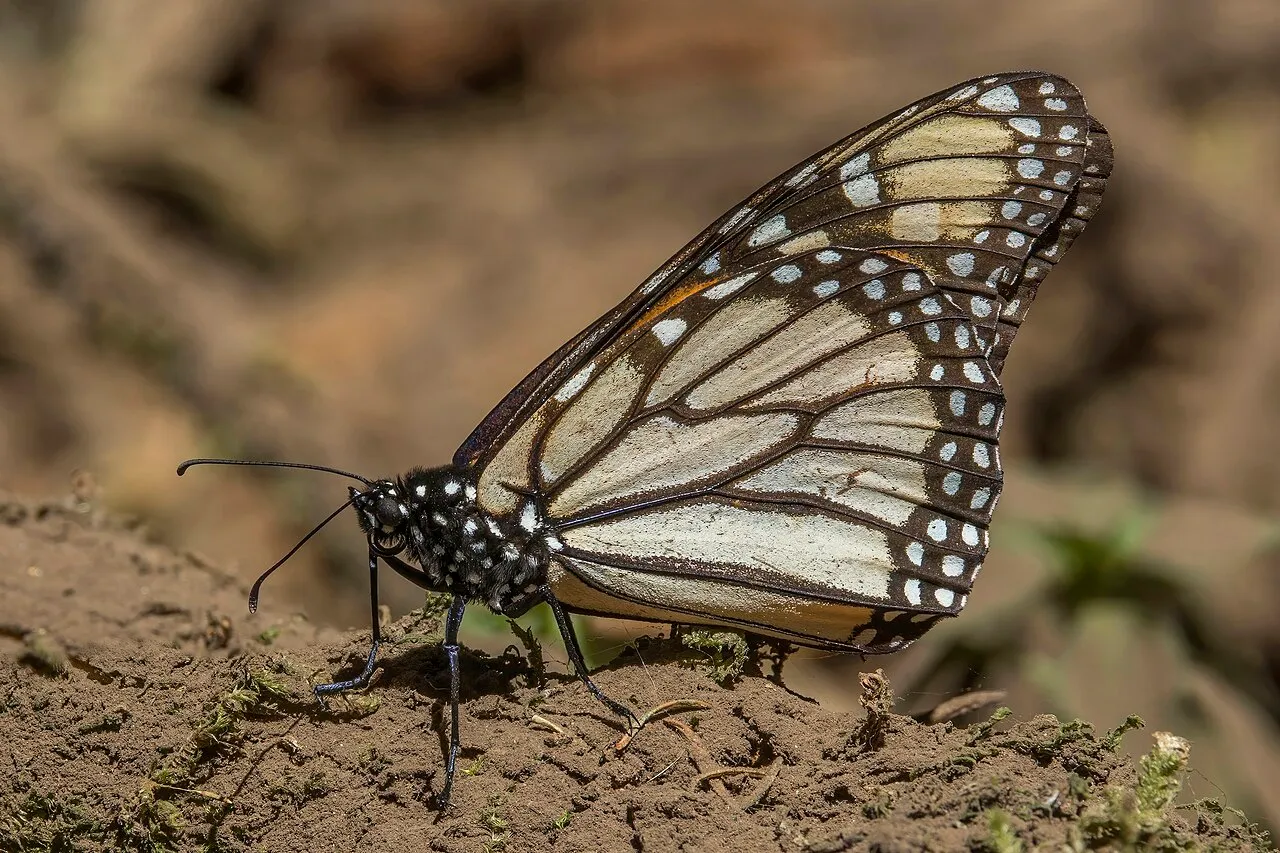
Charles J. Sharp · CC BY-SA 4.0
The monarch belongs to the order Lepidoptera, family Nymphalidae and subfamily Danainae, the milkweed butterflies. Relatives include the tropical Asian tigers and crows, and the chestnut tiger (Parantica sita) found in Korea.
Linnaeus named it in 1758. Danaus refers to Danaus, a king in Greek myth, and plexippus to one of the sons of his twin brother Aegyptus. Borrowing names from mythology was common practice at the time.
The origin of the English name is uncertain. It may simply reflect the butterfly's size and stately look, or it may honour King William III of England, Prince of Orange, whose house colour was orange. The Korean name, jewang-nabi, translates the English.
The migratory North American form, D. p. plexippus, is the best known subspecies; non-migratory populations in the Caribbean and Central and South America are sometimes treated separately. South America also hosts a close look-alike, the southern monarch (Danaus erippus).
3. Evolution
The order Lepidoptera first appears in the fossil record as wing scales about 200 million years old, and true butterflies probably arose during the Cretaceous after flowering plants spread. Butterfly fossils are rare because the insects are so delicate, but sites such as Florissant in Colorado have yielded beautifully preserved specimens tens of millions of years old.
The milkweed butterflies are mostly tropical and share a strategy of feeding on toxic plants and recycling the poisons for defence. A genome study published in 2014 suggested that monarchs originated from migratory ancestors in North America and later spread into Central and South America and the Caribbean, where some populations lost the migratory habit. The same work linked variation in a gene involved in flight muscle function to migratory behaviour.
During the nineteenth century, monarchs crossed the Pacific to Hawaii, New Zealand and Australia, and the Atlantic to the Canary Islands, southern Spain and Portugal, establishing small populations helped by milkweeds that people had planted.
4. Range and habitat
The monarch's heartland is North America, where two populations are usually distinguished.
| Population | Breeding range | Wintering grounds | Notes |
|---|---|---|---|
| Eastern | US and southern Canada east of the Rockies | High-elevation fir forests on the Michoacán and State of Mexico border | The vast majority of monarchs |
| Western | West of the Rockies | Coastal groves of eucalyptus, pine and cypress in California | Much smaller and highly variable |
In summer, monarchs live in sunny open places where milkweed grows: fields, prairies, roadsides, farm margins and gardens. The Mexican wintering forests sit around 3,000 metres above sea level among oyamel firs. The air there is cool and moist but rarely freezing, letting the butterflies conserve energy through the winter.
Populations in southern Florida, the Caribbean, Central and South America and the overseas colonies in Australia, Hawaii and Iberia generally do not migrate long distances.
Monarchs do not occur naturally in Korea. Korea's chestnut tiger plays a similar role, arriving from the south in spring and heading south again in autumn; tagged individuals have been recorded travelling between Korea, Japan and Taiwan.
5. Body
With a wingspan of about 9 to 10 centimetres, the monarch is a large butterfly, though it weighs only around half a gram, roughly a paper clip.
| Feature | Value |
|---|---|
| Wingspan | about 8.9 to 10.2 cm |
| Weight | about 0.3 to 0.75 g |
| Caterpillar length | up to about 4.5 to 5 cm |
| Chrysalis length | about 2.5 cm |
The wings are orange with bold black veins and a black border dotted with two rows of white spots. The colours come from tiny overlapping scales arranged like roof tiles, the powder that rubs off on fingers.
Males and females are easy to tell apart from the hindwings. Males have a small black spot of scent scales on a vein of each hindwing and thinner veins; females lack the spots and have thicker, darker veins.
Like other brush-footed butterflies, the monarch's front pair of legs is reduced and held against the body, so it stands on four legs. Taste receptors on the feet let a female drum on a leaf to confirm it is milkweed before laying an egg.
The caterpillar is banded in white, yellow and black, with a pair of black filaments at each end. The chrysalis is jade green studded with gold dots, a shine produced by light reflection rather than pigment.
6. Behaviour and ecology
6.1. A multigenerational migration
The eastern population's year runs roughly like this:
| Period | Generation | What happens |
|---|---|---|
| Feb to Mar | Overwintering | Wake in Mexico, mate and head north |
| Mar to Apr | Overwintering | Reach the southern US, lay eggs and die |
| Apr to Jun | First | Move further north and breed |
| Jun to Aug | Second and third | Spread across the northern US and southern Canada |
| Aug to Oct | Migratory super generation | Delay breeding and fly south |
| Nov to Feb | Overwintering | Cluster in Mexican forests |
Summer adults live only two to six weeks, while the late-summer migratory generation can live six to nine months. Cues such as shortening days, cooling temperatures and ageing milkweed switch this generation into reproductive diapause: they stop developing eggs and sperm, store fat and prepare to travel.
Migrants cover tens of kilometres a day, sometimes over a hundred. They save energy by soaring on thermals rather than flapping constantly, roosting communally in trees at night. Feeding on nectar along the way, they may even gain fat during the journey.
6.2. The winter spectacle
At the Mexican sites, tens of millions of monarchs coat fir branches and trunks so densely that whole trees turn orange, and branches can bend or snap under the weight. On cold mornings they barely move; when sunlight arrives they take off together to drink, and the sound of their wings is often compared to light rain.
Clustering helps conserve warmth and moisture and dilutes the risk from predators. The forest canopy acts as both blanket and umbrella, so when trees are cut, storms and frost can kill butterflies in huge numbers.
7. Diet and feeding
Monarch caterpillars feed almost exclusively on milkweeds of the genus Asclepias, of which North America has over a hundred species. Broken leaves bleed a milky latex containing cardenolides, toxins that affect the heart. Caterpillars often cut leaf veins first to drain the sticky latex before eating.
By the time it pupates, a caterpillar may weigh some 2,000 to 3,000 times its hatching weight. The toxins it stores pass through the pupa into the adult's body and wings.
Adults sip nectar from milkweed flowers and a wide range of others, including goldenrod, asters, blazing star and thistles. Late-blooming flowers are vital fuel stations during the autumn migration. Males also sip minerals from damp soil.
In the southern United States, tropical milkweed (Asclepias curassavica) planted in gardens stays green through winter. Researchers worry this encourages some monarchs to stop migrating and keep breeding, raising parasite loads, so planting native milkweeds is generally recommended.
8. Reproduction and life cycle
Monarchs undergo complete metamorphosis. A male grabs a female in flight and brings her down to the ground or vegetation to mate, and pairs may stay coupled for hours. Along with sperm, he transfers a nutrient-rich spermatophore that she uses to help produce eggs.
Females glue eggs singly to the undersides of milkweed leaves, spreading them across many plants to reduce competition and predation. A female may lay several hundred eggs in her life, with figures around 700 sometimes reported.
| Stage | Duration in summer | Notes |
|---|---|---|
| Egg | 3 to 5 days | Cream-coloured, ridged, about 1 mm |
| Caterpillar, five instars | about 9 to 14 days | Moults four times |
| Chrysalis | about 8 to 15 days | Green with gold dots, turns clear before emergence |
| Adult, summer generation | 2 to 6 weeks | Feeds and breeds |
| Adult, migratory generation | 6 to 9 months | Delays breeding, migrates and overwinters |
A full-grown caterpillar spins a silk pad, hangs head-down in a J shape and sheds its skin a final time to reveal the chrysalis. The emerging butterfly pumps fluid into its crumpled wings and hangs for hours while they harden.
Survival from egg to adult is very low. Field studies show that most eggs and young caterpillars are lost to spiders, ants, predatory bugs and weather.
9. Intelligence, communication and special abilities
How monarchs find mountains they have never seen was a long-standing puzzle. A key part of the answer is a time-compensated sun compass. Monarchs read the sun's position and the sky's polarisation pattern with their compound eyes, and an internal clock corrects for the sun's movement through the day, letting them hold a south-westerly heading. Surprisingly, part of this clock lives in the antennae: monarchs whose antennae were painted to block light lost their bearings.
Because they stay on course under overcast skies, monarchs also appear to use a magnetic compass. Laboratory experiments have shown them responding to the inclination of the Earth's magnetic field.
Monarchs do not carry a detailed map. A widely accepted idea is that as they hold their heading, mountain ranges and coastlines funnel them towards central Mexico. Exactly how they pinpoint the final sites is still not fully understood.
Their toxins also act as a signal. A bird that vomits after eating one learns to avoid orange-and-black butterflies. The viceroy looks remarkably similar; it was long cited as a tasty Batesian mimic, but studies showing viceroys are also unpalatable shifted many researchers to see the pair as Müllerian mimics reinforcing a shared warning.
10. Predators and survival
Toxins do not make monarchs safe. Eggs and caterpillars fall prey to ants, spiders, lady beetles, stink bugs and wasps, while parasitoid flies and wasps lay eggs inside caterpillars that are eaten from within.
At the Mexican wintering sites, black-backed orioles and black-headed grosbeaks eat monarchs in large numbers. Orioles pick out the less toxic muscle and abdominal contents, while grosbeaks are thought to tolerate the toxins. Some estimates suggest these birds take a substantial share of a winter colony. Certain mice also eat fallen butterflies.
Invisible enemies matter too. The protozoan parasite Ophryocystis elektroscirrha, known as OE, passes to the next generation through spores on adults' bodies and can cause deformed wings and weakness. Research suggests long migration helps weed out heavily infected individuals.
Weather is a major factor. A sudden storm and frost at the wintering grounds can kill millions in a night, drought along the flyway reduces nectar, and extreme heat lowers caterpillar survival.
11. Relationship with humans
Local people had long known the Mexican wintering sites, but science learned of them only in the 1970s. Canadian zoologist Fred Urquhart spent decades tagging monarchs with the help of volunteers, and in 1975 people working with his project found an enormous colony in the Mexican mountains. The discovery was announced to a wide audience in a magazine article in 1976.
Today the monarch is a model of citizen science. Students and volunteers across North America tag butterflies, count caterpillars and report sightings, and these records are essential for tracking population trends.
In Mexico, monarchs arrive around the Day of the Dead in early November, and they are traditionally associated with returning souls of ancestors. Villages near the reserves earn income from butterfly tourism, but there has also been friction between protection and communities that depended on logging, so conservation programmes have tried to create alternative livelihoods.
Planting milkweed for monarchs is now a popular movement, and pollinator gardens have sprung up along highways and in schools and parks across the United States and Canada.
12. Conservation
In 2022 the IUCN assessed the migratory North American monarch subspecies as Endangered, making headlines; a 2023 reassessment moved it to Vulnerable. This does not mean the species is about to vanish, but it signals that the migration itself is at risk. In the United States, the Fish and Wildlife Service proposed listing the monarch as threatened under the Endangered Species Act in late 2024; readers should check the current status of that decision.
The eastern population is measured by the area of forest occupied in Mexico. In the mid-1990s it reached around 18 hectares, but in the winter of 2013 to 2014 it fell below one hectare, and it has fluctuated widely since, with another low of around a hectare reported for 2023 to 2024. Since a hectare may hold tens of millions of butterflies, the long-term decline is clear.
The western population's fall has been even steeper. Millions are thought to have wintered on the California coast in the 1980s, yet counts around 2020 found fewer than 2,000. Numbers rebounded to the low hundreds of thousands for a few years before reportedly dropping again, so year-to-year swings are huge.
The main threats are:
- Loss of milkweed to herbicides and land conversion
- Logging and degradation of wintering forests
- Drought, heat waves and unusual cold linked to climate change
- Pesticide exposure
- Flyways stripped of nectar plants
The Mexican wintering area is protected as the Monarch Butterfly Biosphere Reserve and was inscribed as a UNESCO World Heritage Site in 2008.
13. Butterfly houses and captive rearing
Monarchs are more often seen in butterfly houses, museums and classrooms than in zoos, and rearing caterpillars to watch them emerge is a common school activity in North America.
Captive rearing is not without controversy:
- Releasing commercially bred butterflies at weddings and events is criticised for spreading disease and mixing genetically distinct stock.
- Some studies found indoor-reared monarchs orient less well than wild ones, raising doubts about whether mass rearing and release truly helps.
- Crowded rearing can spread parasites such as OE quickly.
Conservation groups therefore stress that planting milkweed and nectar flowers does far more good than raising and releasing butterflies. Importing live monarchs into countries where they are not native risks introducing an alien species and is generally restricted by quarantine rules.
14. Monarchs in culture
The monarch is among North America's most beloved insects. Several US states have named it their state insect, and because its migration links Canada, the United States and Mexico, it has become a symbol of North American cooperation; the leaders of the three countries have publicly committed to protecting it.
In Michoacán, festivals welcome the butterflies' arrival, and monarchs appear on murals, crafts and souvenirs. Linked with the Day of the Dead, they stand for life, return and transformation.
In literature and film, butterflies often represent metamorphosis and the soul, and the monarch in particular stands for the long journey. Its migration has inspired documentaries, giant-screen films and picture books, including dramatised accounts of the scientists who solved its mystery.
In the English-speaking world, monarch imagery decorates school mascots, sports logos and environmental groups' emblems, and plant-milkweed campaigns have made it part of everyday gardening culture.
15. Trivia
- Migratory monarchs pack much of their body weight as fat for the winter, and by the time they leave Mexico in spring that fuel is nearly spent.
- On rare occasions, strong winds carry North American monarchs across the Atlantic to Britain and Ireland.
- A mature caterpillar can strip several milkweed leaves a day; labs rearing many larvae report being able to hear them chewing.
- Toxicity varies with the milkweed species eaten; monarchs raised on low-toxin plants are less repellent to birds.
- Around 2010, monarch caterpillars were reared aboard the International Space Station to observe metamorphosis in microgravity.
- Males of some milkweed butterflies gather chemicals from certain plants to make courtship pheromones, which may explain why Korea's chestnut tiger males crowd particular flowers such as thoroughworts.
- Tags are small round stickers; each one recovered in Mexico reveals where its butterfly began the journey.
Wild animals are not pets. Catching, trading or keeping them is illegal in most places. If you find an injured wild animal, call your local wildlife rescue centre.
FAQ
Do monarchs live in Korea?
No. Korea's relative, the chestnut tiger, makes a similar seasonal migration, arriving from the south in spring and leaving in autumn.
Is the monarch endangered?
The IUCN listed the migratory North American subspecies as Endangered in 2022 and revised it to Vulnerable in 2023. The species is not about to vanish, but the migration itself is at risk.
What is the best way to help monarchs?
Planting native milkweed and nectar flowers and cutting pesticide use helps far more than rearing and releasing butterflies.
Photo credits
Photos are freely licensed images from Wikimedia Commons. Authors and licenses are listed below.
- Danaus plexippus on flowers (48483505276).jpg — Mike's Birds from Riverside, CA, US · CC BY-SA 2.0
- Monarch (Danaus plexippus plexippus) underside Piedra Herrada.jpg — Charles J. Sharp · CC BY-SA 4.0