TailVille
1. Overview
A transparent bell with four horseshoe rings glowing like a four-leaf clover, pulsing slowly in an aquarium spotlight: that is the moon jellyfish. One of the most widespread jellyfish in the world's oceans, it was long known by the single name Aurelia aurita.
It has no brain, no heart and no bones. More than 95 percent of its body is water, and it swims by gently contracting and relaxing its bell. Yet it represents a lineage that has drifted through the seas for over half a billion years, and under the right conditions its numbers can explode almost overnight.
Moon jellyfish are very familiar in Korean waters. In summer they gather in huge numbers in sheltered bays on the south and west coasts and in places such as Sihwa Lake and Saemangeum, clogging fishing nets and power-plant cooling intakes. Their sting is mild and rarely harms people, but why jellyfish seem to be multiplying is an important question about the changing ocean.
This article centres on the moon jellyfish while also covering jellyfish in general and Korea's jellyfish problem.
2. Name and classification
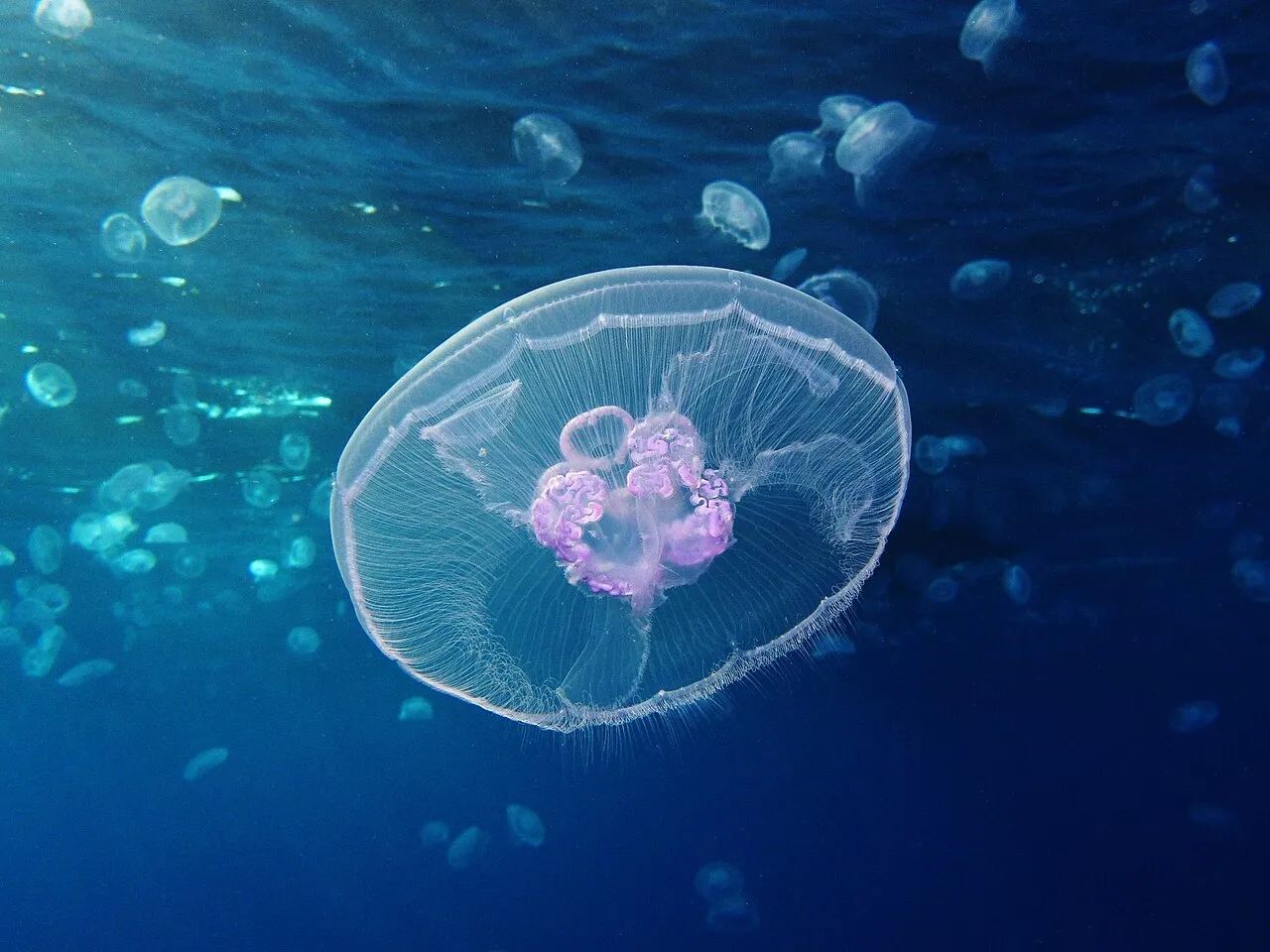
Alexander Vasenin · CC BY-SA 3.0
The moon jellyfish belongs to the phylum Cnidaria, class Scyphozoa (the true jellyfish), order Semaeostomeae, family Ulmaridae and genus Aurelia. Cnidarians are animals armed with stinging cells, a group that also includes corals, sea anemones and hydras.
Aurelia is thought to come from the Latin aureus, golden. The Korean name, boreumdal-mul-haepari, means full-moon water jellyfish, after the round, translucent bell, and the English name has the same inspiration.
All moon jellyfish were once lumped into Aurelia aurita. Genetic studies have since revealed several species that look almost identical but differ genetically, so scientists now speak of an Aurelia species complex. Many studies assign the species that blooms along Korean, Japanese and Chinese coasts to Aurelia coerulea, though A. aurita remains the name in everyday use.
Jellyfish is not a strict taxonomic term. It loosely covers the true jellyfish, box jellyfish, stalked jellyfish and some hydrozoans. Comb jellies, despite the name, belong to a completely separate phylum, Ctenophora.
3. Evolution
Cnidarians are among the oldest animal lineages on Earth. Molecular estimates suggest they split from the bilaterians, the group that includes most animals and ourselves, more than 600 million years ago.
Soft-bodied jellyfish rarely fossilise, but exceptional traces survive. Jellyfish fossils around 500 million years old have been reported from Cambrian rocks in Utah, and in 2023 researchers described a swimming jellyfish about 505 million years old from the Burgess Shale in Canada, evidence that free-swimming medusae already existed in the Cambrian.
The jellyfish life cycle is intriguing from an evolutionary viewpoint. Many alternate between an attached polyp and a free-swimming medusa, and many researchers think the polyp is the older form, with the medusa added later. Corals and anemones remain polyps all their lives.
The cnidocyte, or stinging cell, is one of the fastest cellular mechanisms in the animal kingdom, and it has stayed essentially the same for hundreds of millions of years as the jellyfish's tool for both feeding and defence.
4. Range and habitat
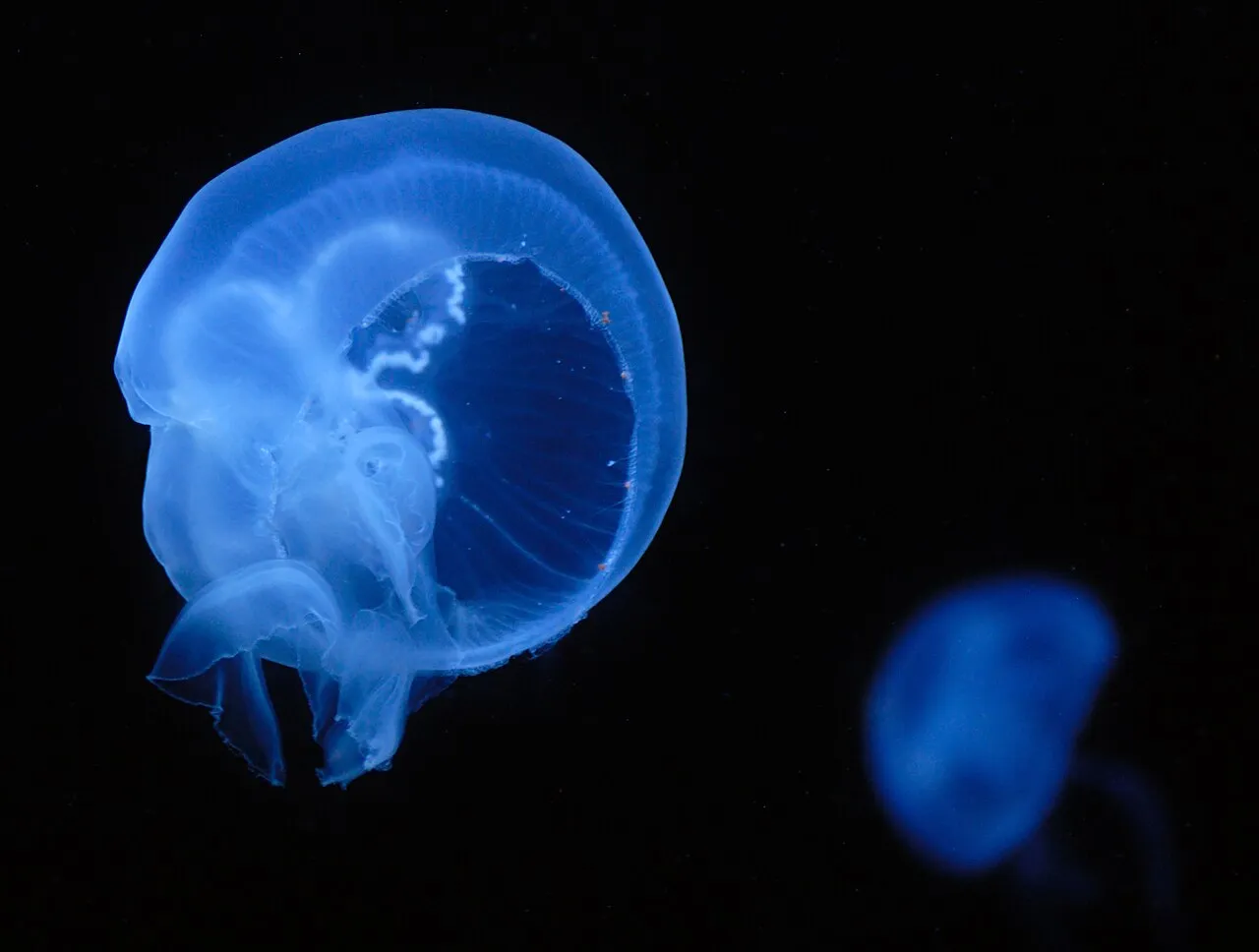
André Karwath aka Aka · CC BY-SA 2.5
Moon jellyfish occur along coasts in almost every sea from the tropics to temperate zones, roughly between 70 degrees north and 40 degrees south. They favour calm, enclosed waters such as bays, harbours, estuaries and lagoons.
They are remarkably hardy, tolerating temperatures from a few degrees to around 30 degrees Celsius and salinities well below that of open seawater. They also cope with low-oxygen water better than many animals, which helps them thrive in polluted, nutrient-rich coastal waters where competitors struggle.
In Korea they are common along the entire south coast, in west-coast bays and in the southern East Sea. Frequently cited bloom sites include:
- Sihwa Lake and Gyeonggi Bay
- Inside and around the Saemangeum seawall
- Southern bays such as Jinhae, Masan and the Yeosu to Gwangyang coast
- Waters around some coastal power plants
Polyps prefer hard, shaded surfaces, crowding onto the undersides of breakwaters, harbour concrete, pier pilings and aquaculture floats. That is why the growth of coastal infrastructure is suspected as one driver of jellyfish increases.
5. Body
The bell typically measures 25 to 40 centimetres across, occasionally more. It is clear or milky, sometimes tinged pink, lavender or bluish depending on diet and location.
| Feature | Detail |
|---|---|
| Bell diameter | usually 25 to 40 cm |
| Water content | about 95 to 98 percent |
| Tentacles | hundreds of short, fine tentacles around the margin |
| Oral arms | four long, frilled arms around the mouth |
| Gonads | four ring or horseshoe shapes in the centre |
| Sense organs | eight rhopalia on the bell margin |
The four rings are the gonads. Females are often said to have pinkish or purplish gonads and males whitish or yellowish ones, though individuals vary. Occasionally a jellyfish has three, five or six rings.
Between the outer skin and the inner gut lining lies a thick jelly called mesoglea, which makes up most of the body. Being mostly water, it lets the animal maintain a large body cheaply. There is only one opening, serving as both mouth and anus, and radial canals carry nutrients across the bell.
Instead of a brain, a diffuse nerve net spreads through the body. The rhopalia contain statocysts that sense tilt and simple eyespots that sense light, so the jellyfish can tell up from down and respond to brightness.
6. Behaviour and ecology
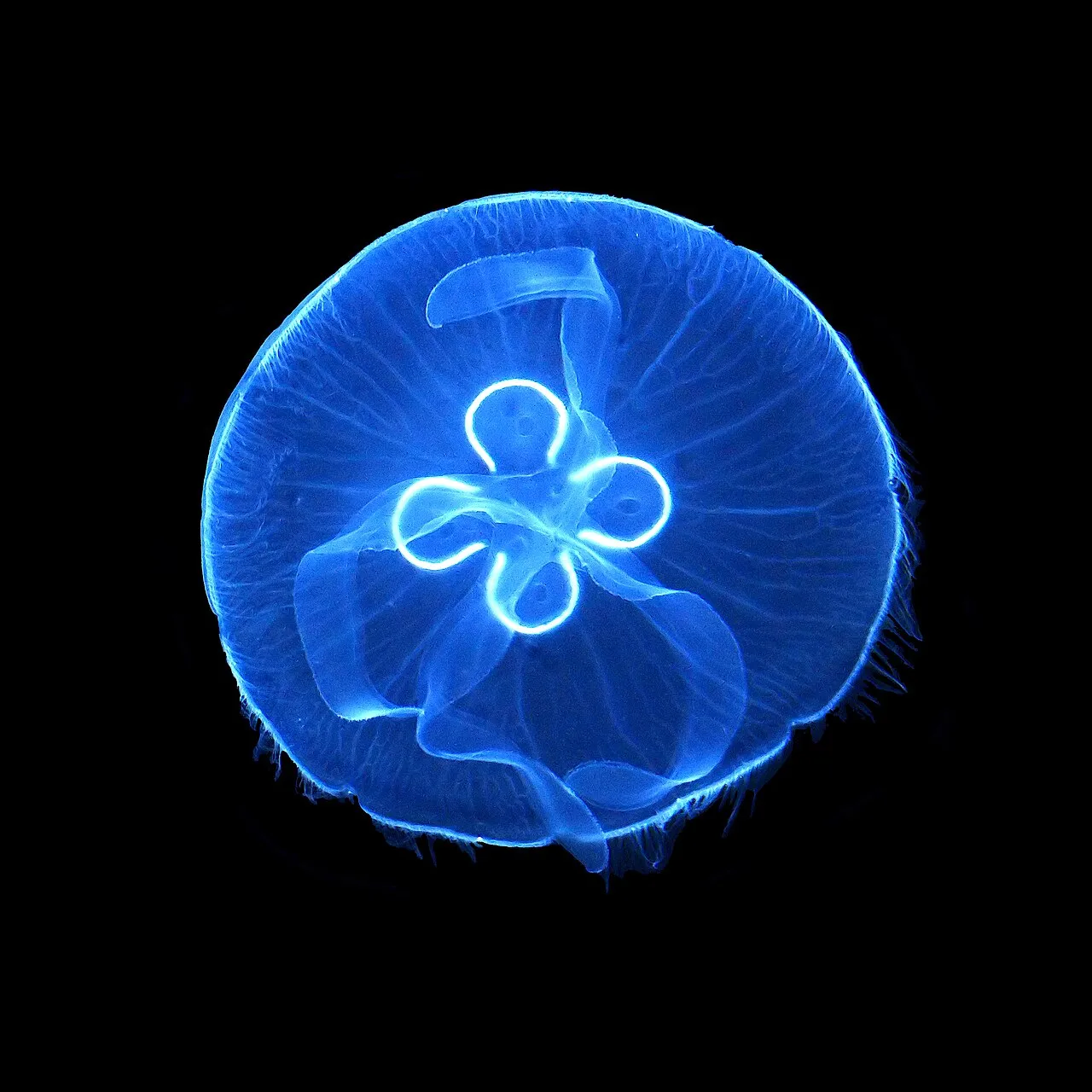
Moon jellyfish swim, but weakly, mostly drifting with currents and tides, which is why they count as plankton. Contracting the bell pushes water out and propels the animal forward, and as the bell relaxes, a vortex forms at its rim that gives a second push. Researchers have found that this makes jellyfish among the most energy-efficient swimmers relative to distance travelled.
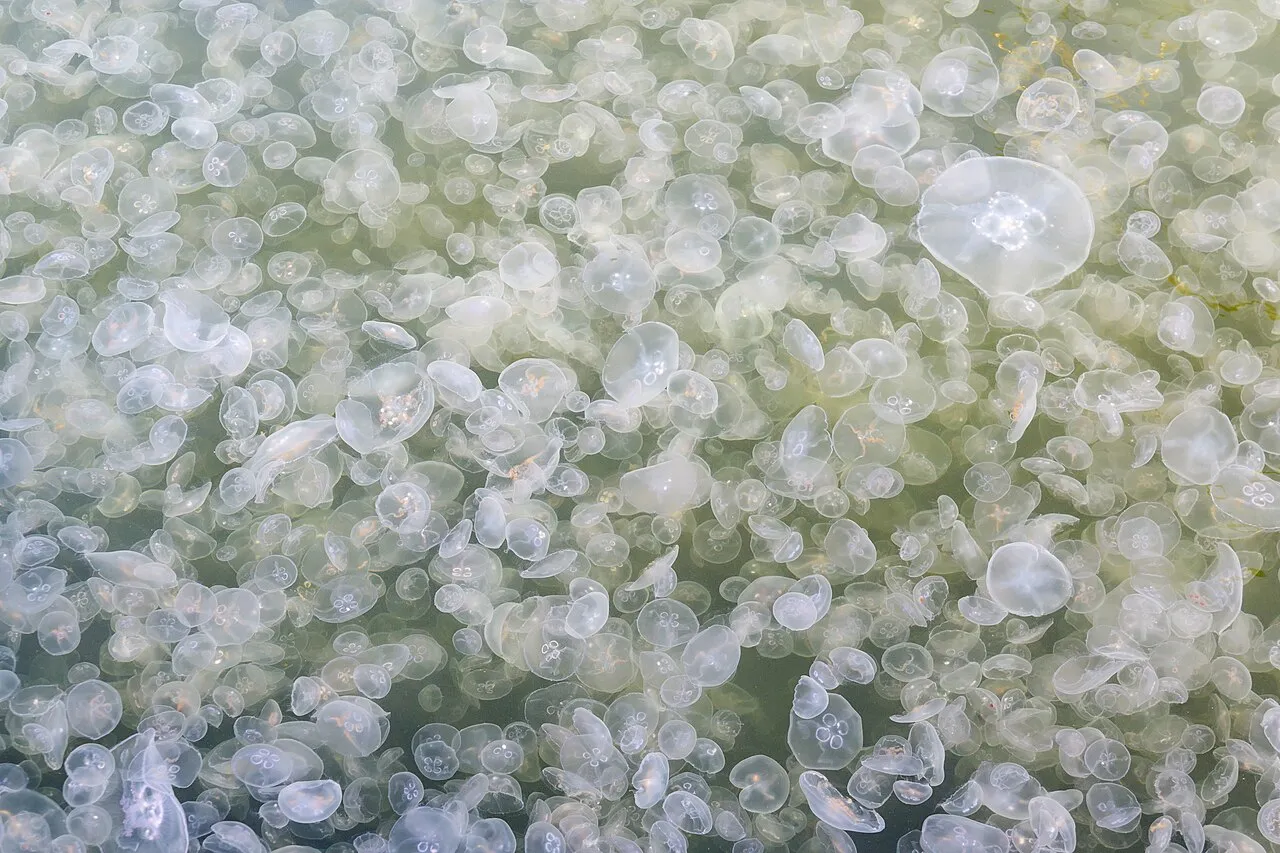
Wind, currents and tides often concentrate jellyfish, forming bands of thousands where surface waters converge or at the heads of bays. They also move up and down in the water column in response to light and time of day.
A mass occurrence is called a jellyfish bloom. Typically, polyps release young jellyfish en masse between winter and spring, the young grow rapidly in warm, food-rich water, and numbers peak in summer. By autumn, spent adults die off.
7. Diet and feeding
Moon jellyfish feed on small zooplankton: copepods, fish eggs and larvae, mollusc and crab larvae, small crustaceans, rotifers and tiny jellyfish.
Their method is less hunting than flypaper. The bell surface and marginal tentacles are coated with sticky mucus, and plankton swept in by the swimming current gets stuck. Stinging cells subdue small prey, and cilia move the mucus-bound food to the bell margin, where the oral arms carry it to the mouth.
When food is abundant, moon jellyfish grow fast; when it is scarce, they can shrink and wait. This ability to shrink during famine and regrow later is part of their resilience.
Dense blooms can deplete zooplankton, starving fish eggs and larvae, and jellyfish also eat fish eggs and larvae directly. This raises fears of a vicious circle in which more jellyfish mean fewer fish, and fewer fish leave more room for jellyfish.
8. Reproduction and life cycle
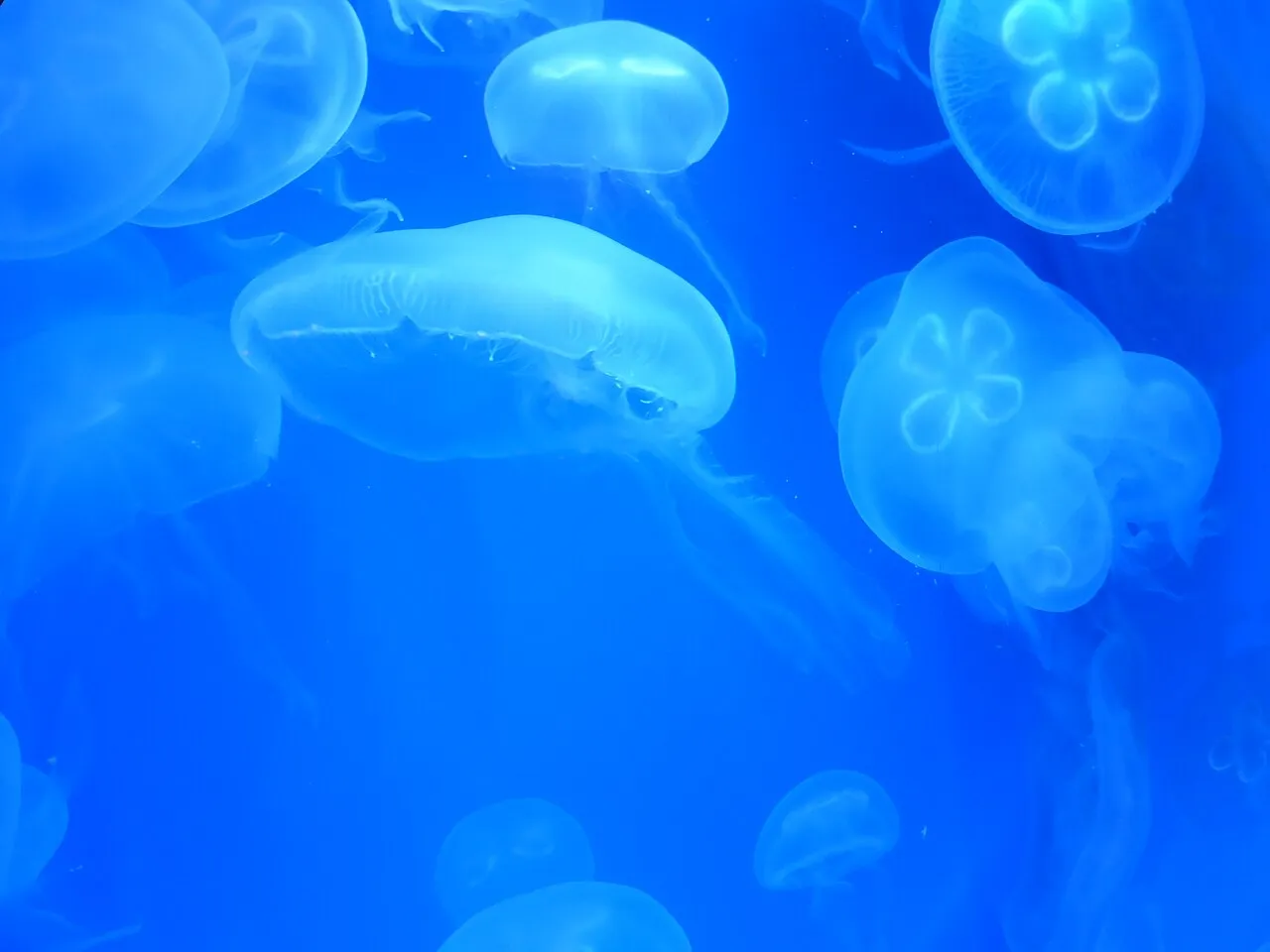
MartinThoma · CC0
Moon jellyfish alternate between sexual reproduction in the medusa stage and asexual reproduction in the polyp stage.
Males release sperm into the water and females take it in to fertilise eggs internally. The embryos develop in brood pouches on the female's oral arms and are released as ciliated larvae called planulae. After swimming for a few days, a planula settles on a shaded hard surface and becomes a polyp.
| Stage | Size | Notes |
|---|---|---|
| Planula | about 0.1 to 0.3 mm | Swims with cilia, then settles |
| Polyp (scyphistoma) | a few mm | Feeds with tentacles, clones by budding |
| Strobila | a few mm | Body divides into a stack of discs |
| Ephyra | a few mm | Star-shaped juvenile that breaks away |
| Medusa | up to tens of cm | Grows and reproduces |
The polyp is the key stage. It multiplies by budding off new polyps and, in poor conditions, can form resistant cysts that last a long time. In late autumn or winter, when water cools, a polyp undergoes strobilation, dividing into segments that peel off one after another as ephyrae.
Medusae usually live from a few months to about a year, but polyps persist far longer and can produce new jellyfish every year. Colonies of polyps on the seabed therefore act as seed banks for blooms.
9. Abilities without a brain
A brainless animal can do more than you might expect. Using its rhopalia, a jellyfish senses gravity and light, and its nerve net adjusts the pulsing rhythm to right itself when tilted. Some studies show activity changing with day-night cycles. In 2023, researchers reported that a box jellyfish, with no central brain, could learn to avoid obstacles, a result that attracted wide attention.
The stinging cell is a marvel. Coiled inside is a thread tipped with a barb; on contact it fires in a tiny fraction of a millisecond, piercing prey and injecting venom, with accelerations ranking among the fastest in biology.
Moon jellyfish venom is weak for humans and usually causes only mild stinging or itching. Other jellyfish are far more dangerous: the Australian box jellyfish Chironex fleckeri can kill a person within minutes, and tiny Irukandji jellyfish cause severe symptoms.
Some jellyfish are famous for apparent immortality. Turritopsis dohrnii can revert to a polyp when injured or aged, earning the nickname immortal jellyfish. Experiments have also reported fragments of damaged moon jellyfish transforming back into polyps.
10. Predators and survival
A.Savin · CC BY-SA 3.0
Jellyfish seem low in nutrition, yet many animals eat them. The leatherback turtle is the classic predator, feeding almost entirely on jellyfish and using backward-pointing spines in its throat to swallow the slippery prey. Other sea turtles, ocean sunfish, filefish and some penguins and seabirds also eat them, and larger jellyfish such as the lion's mane prey on moon jellyfish.
Recent studies show jellyfish feed more fish and marine animals than once thought; they digest so quickly that they leave little trace in stomachs and were long underestimated.
Plastic bags are dangerous for sea turtles, which may mistake drifting bags for jellyfish and die from blocked guts.
The loss of predators and competitors is thought to contribute to blooms. When fishing removes fish that eat jellyfish or compete with them for plankton, jellyfish can fill the gap.
11. Relationship with humans
11.1. Jellyfish trouble in Korean waters
Jellyfish damage became a major issue in Korea from the 2000s. Two species cause most of the trouble:
| Species | Size | When | Damage |
|---|---|---|---|
| Moon jellyfish | bell 25 to 40 cm | spring to autumn, blooming in bays | clogged nets and power-plant intakes, mild stings |
| Nomura's jellyfish | bell over 1 m, sometimes over 100 kg | summer to autumn, carried in from the East China Sea | torn nets, spoiled catches, stings |
Each summer, beachgoers are stung by venomous species such as Nomura's jellyfish, the Pacific sea nettle Chrysaora pacifica and the Portuguese man o' war. The Ministry of Oceans and Fisheries and the National Institute of Fisheries Science monitor jellyfish and issue advisories and warnings when numbers pass set thresholds, while local governments remove polyps and collect jellyfish.
Suspected drivers of the increase include:
- Warming seas lengthening the growth season and boosting polyp reproduction
- Eutrophication increasing plankton
- Overfishing removing competitors and predators
- More coastal structures providing polyp habitat
- Enclosed bays where seawalls restrict water flow
11.2. Eating and using jellyfish
Jellyfish have long been eaten in East Asia. The jellyfish in Korean cold jellyfish salad and Chinese jellyfish dishes is usually not the moon jellyfish but rhizostome species such as Rhopilema. They are cured with salt and alum for a crunchy texture.
Researchers are also looking for uses for bloom jellyfish: collagen for cosmetics and medical materials, fertiliser and feed, and even jellyfish mucus as a filter for microplastics.
Jellyfish have advanced science as well. Green fluorescent protein, discovered in the hydromedusa Aequorea victoria, became a glowing tag for proteins inside cells and transformed biology; its pioneers shared the 2008 Nobel Prize in Chemistry. In 1991, moon jellyfish polyps flew aboard a US space shuttle in an experiment on how microgravity affects the development of jellyfish gravity sensing.
11.3. If you are stung
If stung, leave the water and carefully remove any clinging tentacles with gloves, a card or tweezers rather than bare hands. Rinsing with seawater is the usual advice; fresh water can trigger remaining stinging cells. Vinegar helps with some species such as box jellyfish but can worsen others, so avoid it when the species is unknown. Seek emergency help immediately for breathing difficulty, chest pain or confusion, and pay attention to lifeguards and jellyfish warning signs at beaches.
12. Conservation
The moon jellyfish has not been evaluated by the IUCN. It is abundant worldwide, and in many places the concern is that it is increasing. Its conservation story is less about protecting it than about understanding and managing the conditions that favour it.
Whether jellyfish are increasing globally is actually debated. Clear increases have been documented in some regions, but other research shows jellyfish naturally rise and fall over cycles of a decade or two, so longer records are needed. Along Korea's coasts, many reports describe more frequent blooms of moon and Nomura's jellyfish since the 1990s.
Management efforts include:
- Locating and removing polyps from harbour structures and aquaculture gear
- Jellyfish information systems and advisory warnings
- Devices that separate jellyfish from fishing catches
- Research on breaking down and using jellyfish biomass
- Improving coastal water quality and curbing overfishing
In Korea, the moon jellyfish is not protected; it is a target of monitoring and bloom warnings.
13. In aquariums
The moon jellyfish is the most commonly displayed jellyfish in aquariums worldwide, and its slow drifting under soft lighting has made jellyfish galleries a favourite space in many facilities.
Jellyfish cannot live in ordinary fish tanks, where they get caught in corners or sucked into intakes. Instead, aquariums use specially designed kreisel tanks with circular flow that keeps the animals suspended. Many aquariums now culture polyps and raise their own jellyfish, reducing the need to collect from the wild.
With such a simple nervous system, jellyfish welfare cannot be discussed in the same terms as for vertebrates, yet questions remain about display conditions, lifespan and casual sales. Some companies market pet jellyfish and home tanks, but feeding and water quality are demanding and the animals often die quickly. Jellyfish collected from the sea should not be kept at home, and captive jellyfish or polyps must never be released into the sea or rivers.
14. Jellyfish in culture
Jellyfish evoke both mystery and danger. The term medusa comes from the snake-haired Gorgon of Greek myth, whose writhing locks the trailing tentacles resemble.
East Asian folktales explain why jellyfish have no bones. In one Japanese tale, a jellyfish loses all its bones as punishment for revealing the Dragon King's secret to a monkey, a story whose structure parallels Korea's tale of the rabbit and the turtle.
Jellyfish are popular in animation. Finding Nemo features a perilous swim through a jellyfish swarm, SpongeBob SquarePants returns again and again to jellyfishing and Jellyfish Fields, and the Japanese manga Princess Jellyfish, about a young woman obsessed with jellyfish, became an anime and live-action drama.
In Korea, a slang term for zoning out while watching jellyfish has caught on, and jellyfish lamps and videos are marketed as relaxation content. Engineers are also building underwater robots inspired by the jellyfish's efficient swimming.
15. Trivia
- A group of jellyfish may be called a smack, bloom or swarm.
- Stranded jellyfish dry into thin films, but their stinging cells can still fire for some time, so do not touch them barehanded.
- Moon jellyfish with more or fewer than four rings occasionally appear and are sometimes showcased in aquariums as lucky jellyfish.
- Lion's mane jellyfish with tentacles reportedly tens of metres long are candidates for the longest animal on Earth.
- Jellyfish have no heart or blood; oxygen diffuses directly through their thin tissues.
- Jellyfish swarms clogging cooling-water intakes have forced power plants to shut down in Japan, Israel, Sweden and elsewhere.
- Being mostly water, jellyfish carry far fewer calories than fish of the same weight, so leatherback turtles are estimated to eat roughly their own body weight in jellyfish each day.
Wild animals are not pets. Catching, trading or keeping them is illegal in most places. If you find an injured wild animal, call your local wildlife rescue centre.
FAQ
Is a moon jellyfish sting dangerous?
Usually it causes only mild stinging or itching, though sensitive skin may swell. More venomous species such as Nomura's jellyfish may share the same waters, so check local warnings.
Why are jellyfish increasing?
Warming seas, nutrient pollution, overfishing of competitors and more coastal structures for polyps are all suspected. Whether jellyfish are increasing globally is still debated.
Is this the jellyfish used in jellyfish salad?
No. Edible jellyfish are mainly other species, such as rhizostomes, cured with salt and alum.
Photo credits
Photos are freely licensed images from Wikimedia Commons. Authors and licenses are listed below.
- Aurelia aurita (Cnidaria) Luc Viatour.jpg — Luc Viatour · CC BY-SA 3.0
- Moon jellyfish at Gota Sagher.JPG — Alexander Vasenin · CC BY-SA 3.0
- Aurelia aurita (aka).jpg — André Karwath aka Aka · CC BY-SA 2.5
- Aurelia aurita 2.jpg — Hans Hillewaert · CC BY-SA 4.0
- Aurelia-aurita-3.jpg — MartinThoma · CC0
- Flensburg 2015-08 img13 jellyfish in bay water.jpg — A.Savin · CC BY-SA 3.0