TailVille
At a glance
Rough ranges for supplies, food and electricity in Korea (USD is approximate). Purchase or adoption fees are not included.
Keepers planning a large planted tank who want a long-lived showpiece fish, and anyone curious to watch fish parents raise their young.
Anyone limited to a small tank, or who wants to keep neon tetras or shrimp in the same aquarium.
1. Overview
The freshwater angelfish is a cichlid from the Amazon basin with a flat, disc-like body and long, sweeping fins. Adults reach 12–15 cm in length and 18–25 cm in height including fins, giving them real presence in an aquarium. The name is shared with unrelated marine angelfish on coral reefs, so the freshwater species is sometimes specified to avoid confusion.
It is one of the longest-loved aquarium fish, and decades of selective breeding have produced varieties from the silver wild type to marble, koi, gold, black and veil-finned forms. Like other cichlids, angelfish show personality, recognising their keeper and begging for food, and bonded pairs guard their eggs and fry together.
Because they are sold at coin size, many end up in tanks that are soon too small, or quietly eat the neon tetras they were housed with. This article covers classification, history, anatomy, varieties, behaviour, housing and tankmates, diet, disease, breeding, costs and what to check before buying.
2. Name and classification
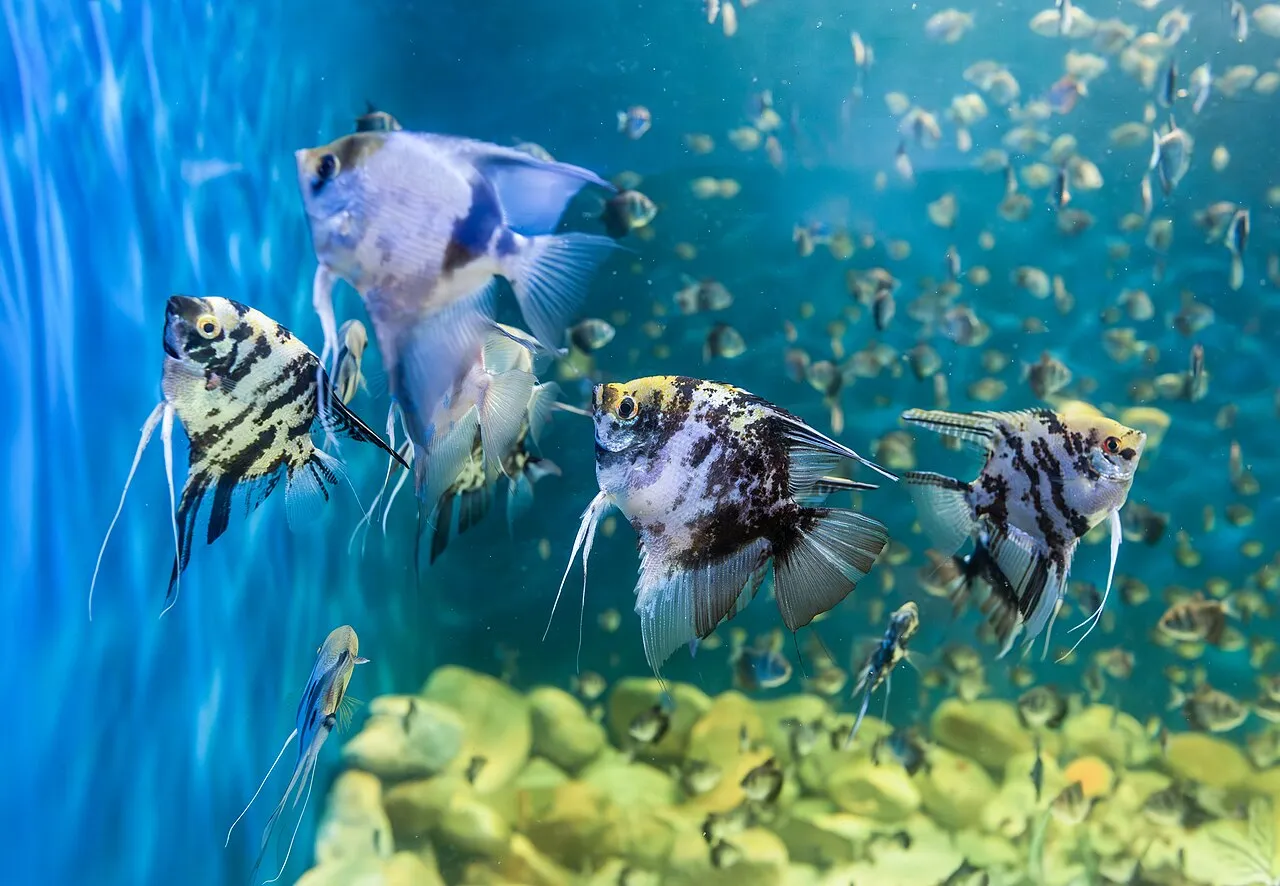
Rjcastillo · CC BY 4.0
2.1. Scientific name
The angelfish's scientific name is Pterophyllum scalare, a member of the cichlid family. Cichlids include many famous aquarium fish, from discus and oscars to the colourful species of Africa's Lake Malawi. Angelfish are South American cichlids and, like discus, come from the Amazon and enjoy similar water.
Pterophyllum combines the Greek pteron, wing, and phyllon, leaf. The species name scalare is usually linked to a Latin word for steps or a ladder, possibly referring to the fin shape or the body bars. In German-speaking countries the fish is still commonly called Skalar.
2.2. Related species
| Species | Notes | Difficulty |
|---|---|---|
| Angelfish (P. scalare) | Most common, farmed for generations, adaptable | Moderate |
| Altum angelfish (P. altum) | From the Orinoco, much taller with a steep forehead, needs very soft acidic water | Hard |
| Leopold's angelfish (P. leopoldi) | Smaller, black spot ahead of the dorsal fin, rarely available | Fairly hard |
Altums can exceed 30 cm in height including fins and need tanks at least 60 cm tall; wild-caught fish are tricky to acclimatise. Beginners should start with farmed P. scalare.
3. History
Angelfish were described by European naturalists in the early nineteenth century, and live fish began arriving, mostly in Germany, in the early twentieth century. With breeding conditions unknown, they were very expensive at first, but hobbyists in the United States and Europe succeeded in spawning them in the 1920s and 1930s, and prices fell. Angelfish were among the first cichlids bred routinely in aquariums and became an emblem of the tropical fish hobby.
From the mid-twentieth century onward, mutations were fixed through farm breeding. Black, veil-finned and marbled angelfish appeared first, followed by gold, koi, platinum and blue varieties. American breeders carefully mapped how angelfish colour genes are inherited, so today the colours of offspring can be predicted fairly accurately from the parents.
In Korea, angelfish have been sold since the 1970s and 1980s and became one of the most familiar tropical fish after goldfish. Many people remember them in classroom tanks or clinic waiting rooms. Most fish now come from Southeast Asian and domestic farms, and some hobbyists specialise in particular varieties.
4. Body
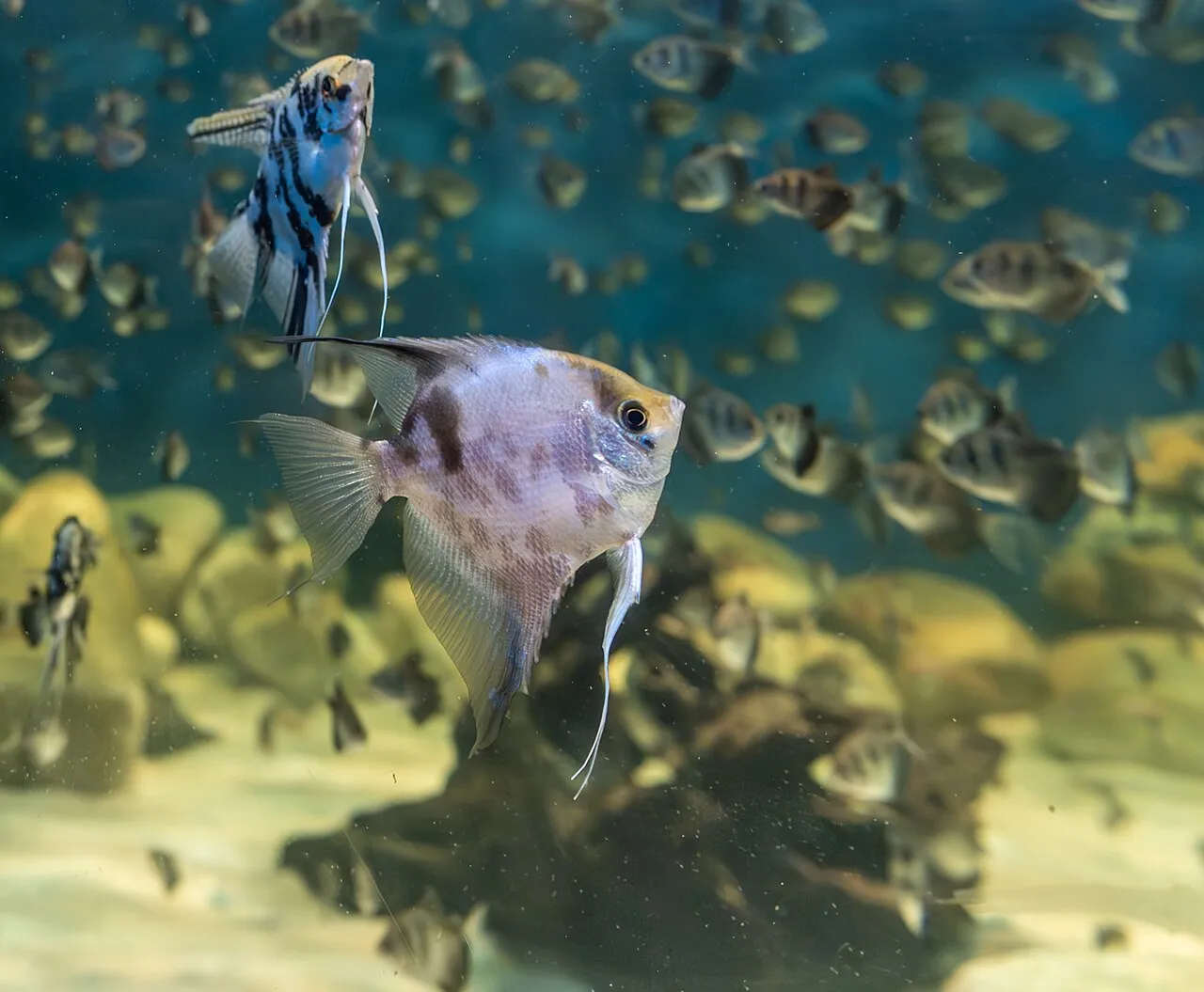
Rjcastillo · CC BY 4.0
4.1. Shape and fins
Seen from the side, an angelfish is almost round or diamond-shaped; from above, it is paper-thin. This flat body slips between plant stems and roots and is hard for predators to spot. The dorsal and anal fins stretch far above and below, the pelvic fins are long, thread-like feelers, and the tail often has trailing tips.
The wild-type silver angel has a silvery body crossed by about four vertical black bars. The bars darken and fade with mood and become especially bold during fright or fights. The bar through the eye is thought to help hide the eye from predators.
4.2. Size and growth
Shops usually sell angelfish with bodies the size of a coin, two to three centimetres. With good food and space they reach half a palm in six months and over 10 cm in body length within a year. Their height with fins is far greater, and in short tanks the fins can scrape the substrate or surface. Growth depends heavily on temperature, food, tank size and how often you change water.
4.3. Sexing
Angelfish are notoriously hard to sex. Mature males are said to develop a slight forehead bump and females a rounder belly, but there are many exceptions. The reliable sign is the breeding tube that appears just before spawning: thick and blunt in females, thin and pointed in males. That is why breeders usually raise around six juveniles together and let pairs form naturally.
5. Varieties
Angelfish varieties come from combinations of colour and pattern genes plus a gene that controls fin length. Trade names vary somewhat between sellers.
| Variety | Description |
|---|---|
| Silver (wild type) | Silver with black bars, the hardiest |
| Zebra | Extra, narrower bars |
| Marble | Black and white marbled pattern |
| Black (including black lace) | Solid deep black |
| Gold | Golden body, orange crown |
| Koi | White with orange and black patches like a koi carp |
| Platinum | Nearly pure silvery white |
| Blue (e.g. Philippine blue) | Blue sheen under light |
| Leopard and smokey | Spots or smoky patterning |
| Veil (longfin) | Greatly elongated fins, combined with any colour |
Veil angels are graceful but their fins tear easily and they swim slowly, so they need gentle currents and peaceful tankmates. For a first angelfish, a sturdy standard-finned silver or marble is a safe choice.
6. Behaviour
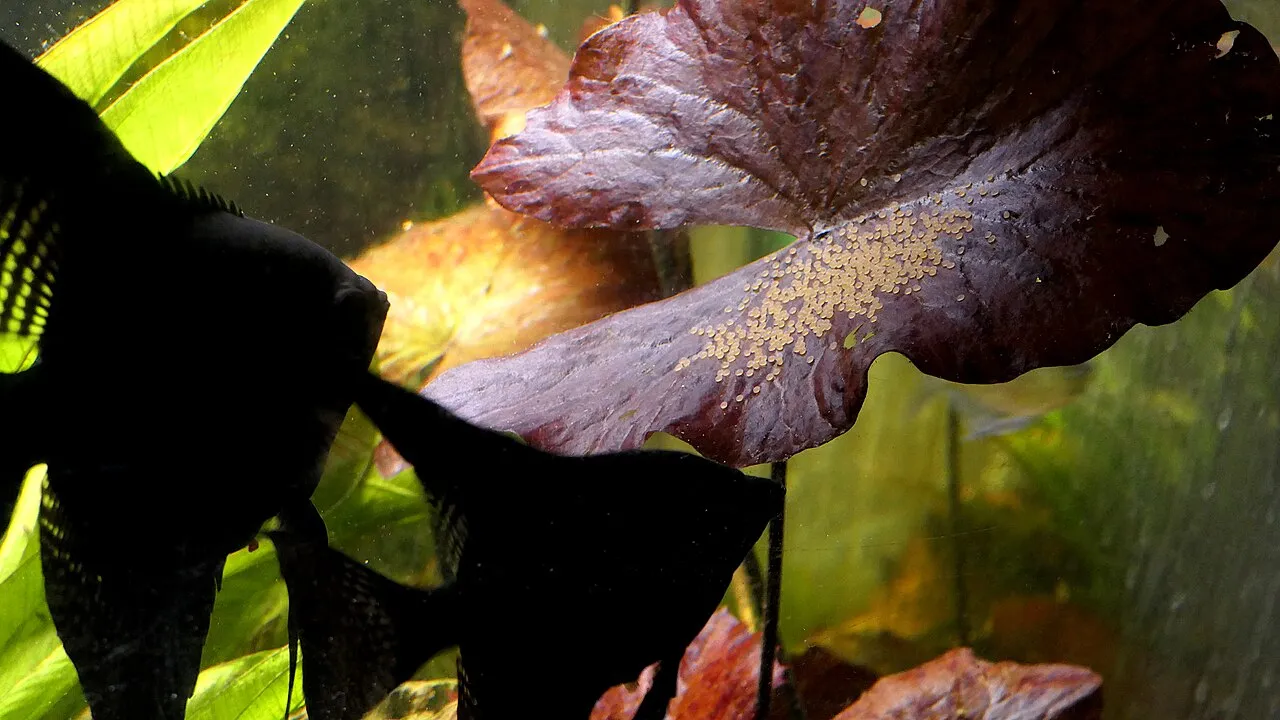
5snake5 · CC0
6.1. In the wild
Wild angelfish live in slow riverbanks, lake-like channels and seasonally flooded forest. They gather among submerged branches and tall plants, ambushing small fish, insect larvae and crustaceans. They hover motionless, then snap up prey that drifts close. In the breeding season, pairs leave the group and defend a chosen leaf or branch as their spawning site.
6.2. Tank behaviour and signals
Young angelfish move as a group, but as they grow a hierarchy forms and dominant fish claim the best spots and food. Once a pair forms, the two guard part of the tank and chase other angels away, sometimes locking lips in shoving matches.
| Behaviour | Meaning |
|---|---|
| Approaching and following you at the glass | Expecting food or recognising you |
| Two fish together chasing others | Pair formation, territory defence |
| Cleaning a leaf or the glass with the mouth | Preparing to spawn |
| Darker bars and fins held erect | Excitement, alarm or fighting |
| Clamped fins, hiding in a corner | Stress, illness or bullying |
| Tilting or floating upside down | Swim bladder trouble or serious illness |
| Rapid gill movement | Low oxygen, poor water or gill disease |
Sudden movements can send angelfish bolting into the glass or décor. Fade the lights on and off and avoid waving your hands in front of the tank.
7. Life stages
Angelfish live around ten years in good conditions, and some pass twelve. Water quality and diet make a big difference.
| Stage | Age | Notes |
|---|---|---|
| Egg | 0–3 days | Laid on a leaf or slate, hatch in about 2–3 days at 27–28°C |
| Wriggler | 3–7 days | Attached by the head, wriggling, living on yolk |
| Fry | 1 week–1 month | Free-swimming, eating brine shrimp, not yet angel-shaped |
| Juvenile | 1–4 months | Fins lengthen into the angel shape, group living |
| Sub-adult | 4–8 months | Hierarchy and pairing begin |
| Adult | From 8 months–1 year | Able to breed, over 18 cm tall |
| Old age | After 7–8 years | Faded colour, ragged fin edges, less active |
Older angels become more sensitive to water changes and may lose out to younger fish at feeding time. Target-feeding them or moving them to a quieter tank can help.
8. Housing
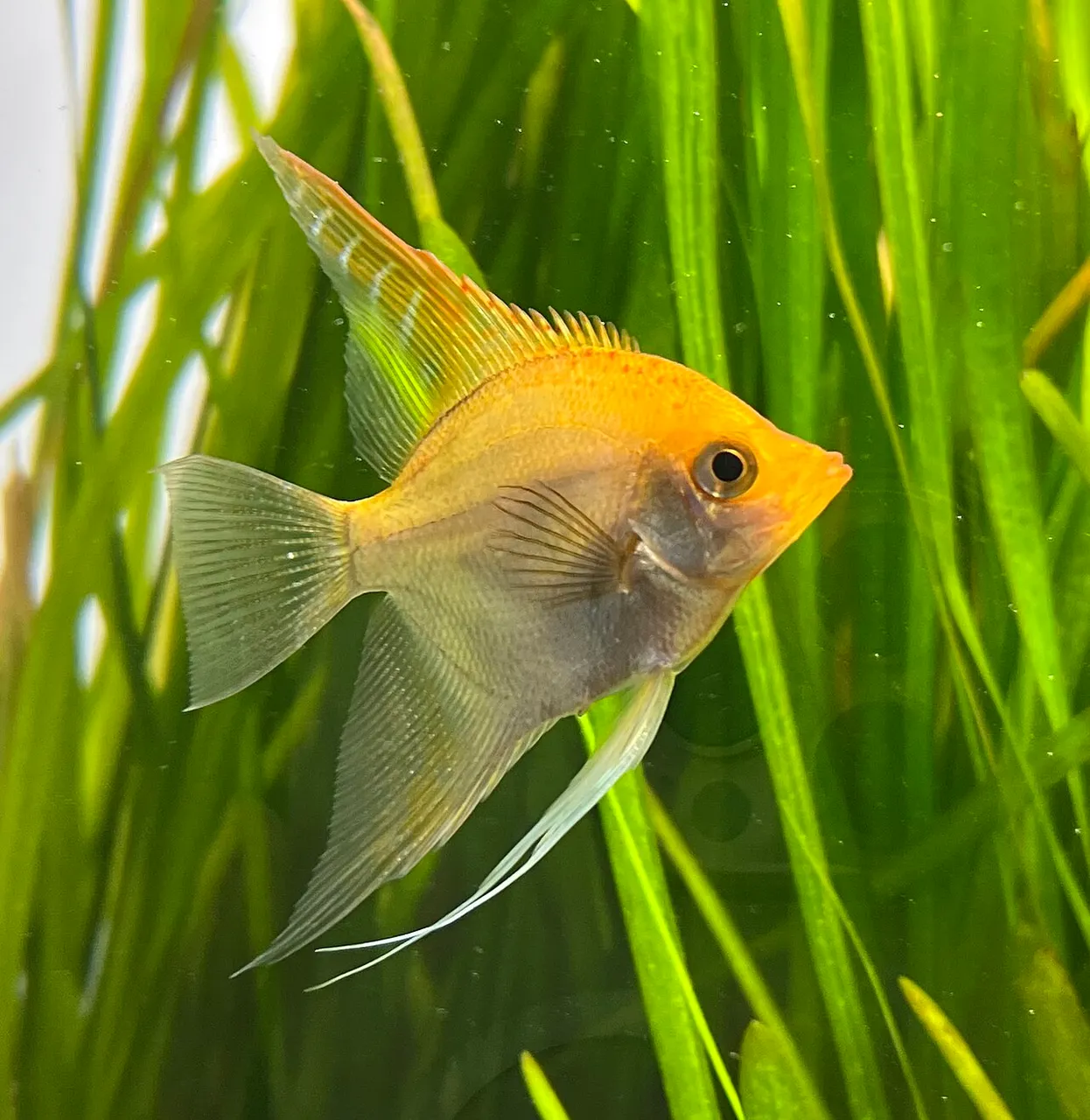
Versions111 · CC BY 4.0
8.1. Tank size
For angelfish, height matters as much as length. A pair needs a tank at least 45 cm tall and 100 L or more; a group of four to six needs around 200 L and at least 50 cm of height. A standard 60 × 30 × 36 cm tank is fine for juveniles for a while but too short for adults.
| Fish | Recommended tank | Notes |
|---|---|---|
| 4–6 juveniles | 60 cm, at least 36 cm tall | Temporary, up to about six months |
| 1 adult pair | 90 cm, at least 45 cm tall, 100–150 L | |
| 4–6 adults | 120 cm, at least 50 cm tall, 200 L+ | Be ready to separate pairs |
| Community tank | 120 cm or more | Larger depending on tankmates |
8.2. Water and filtration
| Parameter | Target |
|---|---|
| Temperature | 24–29°C (27–28°C for breeding) |
| pH | 6.0–7.5 |
| Hardness | Soft to moderate |
| Ammonia and nitrite | 0 |
| Nitrate | Below 20–40 mg/L |
Farm-bred angelfish adapt well and do fine in most dechlorinated tap water. They are large, greedy fish that produce plenty of waste, so oversize the filter and keep up weekly 25–30% water changes. Their long fins dislike strong flow; aim the outlet at a wall or use a spray bar to spread the current.
8.3. Layout and tankmates
Tall plants such as Amazon swords, vallisneria and cryptocorynes, plus upright driftwood, recreate their flooded-forest home and break up sight lines to reduce fights. Leave open water in the middle and avoid sharp ornaments that can tear fins.
Tankmate choice is the trickiest part of keeping angelfish. Anything small enough to fit in an adult angel's mouth may become food.
| Category | Examples |
|---|---|
| Good | Corydoras, small plecos, larger tetras (black phantom, lemon, Congo), gouramis, larger rasboras, mollies |
| Use caution | Neon and cardinal tetras (adults may eat them), guppies (male tails get nipped), discus (different temperature and disease risks) |
| Avoid | Tiger barbs and other fin nippers, aggressive large cichlids, shrimp and tiny fish |
- Equipment: tall tank and lid, two heaters or one large one, thermometer, oversized filter, substrate, tall plants, driftwood, dechlorinator, test kits, siphon
9. Diet
In the wild, angelfish are omnivores leaning strongly toward meat, eating small fish, insect larvae and crustaceans. In the aquarium, cichlid flakes or small pellets as a staple plus frozen foods give a balanced diet.
| Food | How often | Notes |
|---|---|---|
| Cichlid or angelfish flakes, small pellets | Once or twice daily | Amount eaten in 2–3 minutes |
| Frozen bloodworms | Twice a week | Very popular, don't overdo it |
| Frozen brine shrimp or mysis | 2–3 times a week | Maintains colour and condition |
| Spirulina-based food | 1–2 times a week | Helps digestion and colour |
| Live worms or daphnia | Occasionally | Parasite and bacteria risk; reliable sources only |
Angelfish will eat as much as you offer, which leads to bloated bellies and dirty water. A weekly fasting day helps digestion. Frozen foods are safer than live worms, and feeder fish are not recommended because of disease risk. Fry grow fastest on newly hatched brine shrimp three or four times a day.
10. Health
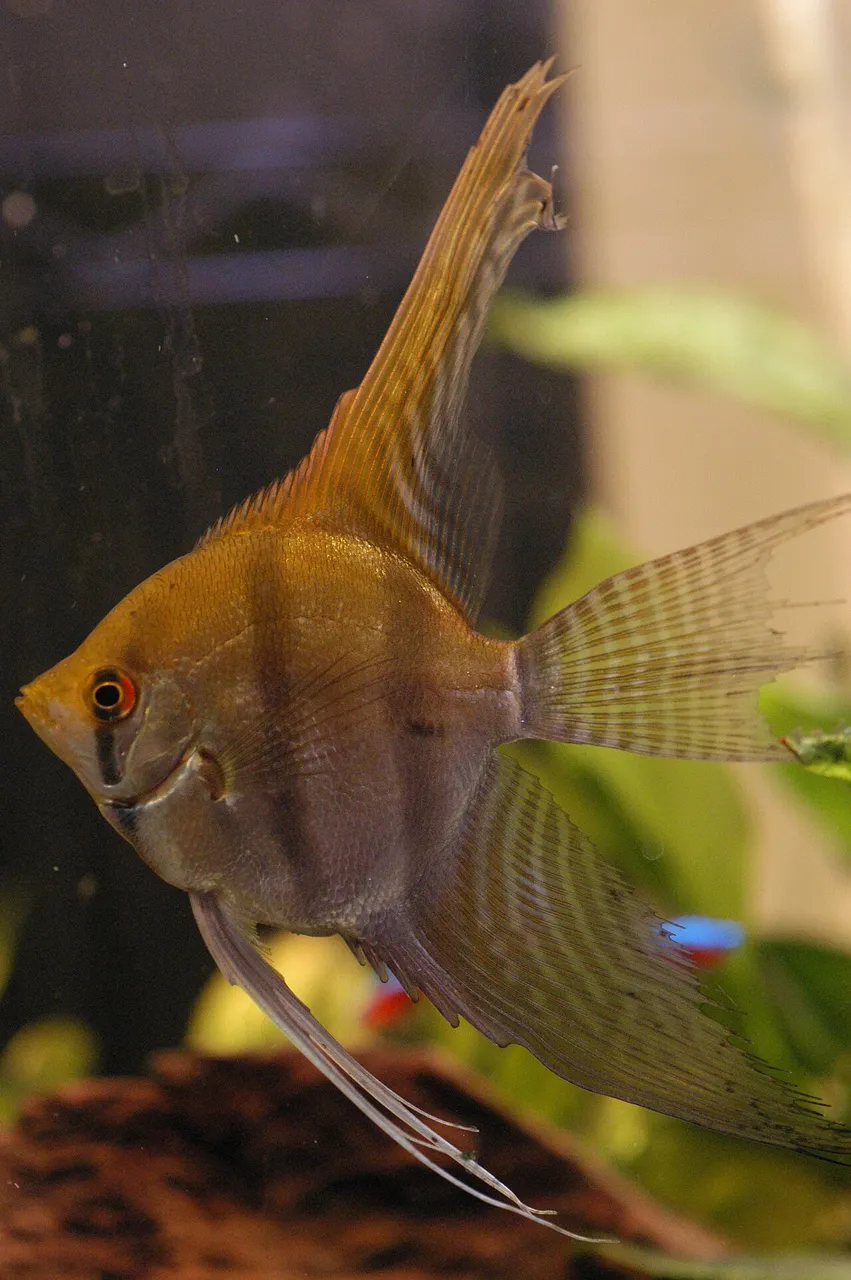
The original uploader was M7 at Italian Wikipedia. · CC BY-SA 3.0
Angelfish are robust in stable water, but trouble follows rising nitrate or a newcomer carrying disease.
| Disease | Cause | Signs | Response |
|---|---|---|---|
| Hexamita / hole-in-the-head | Intestinal flagellates, poor water, poor diet | White stringy faeces, poor appetite, pits on head and lateral line | Improve water; metronidazole-type treatment with vet advice |
| Ich | Ciliate parasite | White spots, flashing | Raise temperature slowly, medicate |
| Fin rot | Bacteria | Whitening, fraying fin edges | Water changes, antibacterials |
| Gill disease | Gill flukes, bacteria | Rapid breathing, one gill held shut | Treatment by cause, isolate |
| Angelfish viral disease | Presumed virus | Excess slime, lethargy, mass deaths | Limited treatment; quarantine and prevention |
| Swim bladder problems | Overfeeding, constipation, bacteria | Tilting, floating or sinking | Fast, adjust temperature, vet if persistent |
A fast-spreading viral illness among angelfish has been reported from some farms, so quarantine new angels in a separate tank for three to four weeks. If fish clamp their fins, pass stringy white droppings or stop eating for days, test the water first. Treatment works best when the cause is known, so consult a fish vet if things do not improve.
11. Breeding
Angelfish are among the easier cichlids to breed in captivity. Raise several juveniles together and pairs usually form between eight months and a year. When two fish stick together, chase others away and start cleaning a broad leaf, the glass or a slanted piece of slate, spawning is near.
The female lays rows of eggs on the cleaned surface and the male follows to fertilise them, often 200 to 1,000 eggs at a time. The parents fan the eggs with their fins and pick off any that turn fungal. At 27–28°C the eggs hatch in two to three days; the young wriggle on the spawning surface for several days and swim freely after four or five, ready for newly hatched brine shrimp.
Young pairs often eat their first few clutches, especially in busy or noisy tanks. Many settle down with practice, so be patient. If they keep eating the eggs, you can move the spawning surface to a separate tank with gentle aeration and hatch them artificially, though watching parents raise their own fry is the real joy of angelfish breeding.
One spawning can produce hundreds of young, and a pair may spawn again every two weeks. Without space and homes for the fry, it is better not to encourage breeding, and surplus fish must never be released.
12. Costs
With angelfish, the tall tank and equipment cost far more than the fish. The figures below are rough examples for a 90–120 cm tank with an adult pair and a few tankmates.
| Item | Estimated cost (KRW) | Notes |
|---|---|---|
| 4–6 juvenile angelfish | 20,000–100,000 | Common varieties; rare ones cost tens of thousands each |
| Tank at least 45 cm tall, with stand | 100,000–300,000 | Depends on size and glass thickness |
| Heater and thermometer | 20,000–50,000 | |
| Filter (e.g. canister) | 40,000–150,000 | |
| Substrate, plants, driftwood | 30,000–100,000 | |
| Dechlorinator, test kits, siphon | 15,000–30,000 | |
| Total setup | About 200,000–500,000 | |
| Monthly food (flakes, frozen) | 5,000–15,000 | |
| Monthly electricity | 10,000–20,000 | Large tank, winter heating |
| Monthly total | About 15,000–35,000 | |
| Yearly | About 200,000–400,000 | Equipment replacement extra |
A filled large tank can weigh several hundred kilograms, so use a proper stand and consider floor loading. Budget for a quarantine tank and basic medications too.
13. Before you get one
- Do you have room and a stand for a tank at least 45 cm tall?
- Does your current tank hold neon tetras, shrimp or anything else an angel might eat?
- If a pair forms and fights escalate, do you have a spare tank or a rehoming plan?
- Can you keep up weekly water changes for close to ten years?
In the shop, choose fish with rounded bodies and no sunken backs, intact, upright fins and a good appetite. Fish with eyes that look too big for their bodies may be stunted. Avoid tanks where several fish trail white stringy faeces or hang listlessly in corners.
Buying four to six similar-sized juveniles spreads aggression so no single fish takes the brunt. Ideally, quarantine them for three to four weeks before adding them to your display tank.
14. Laws
Pterophyllum scalare is not listed under CITES, and keeping it requires no permit in Korea or most countries. Never release angelfish into local waters; besides the ecological risk, tropical fish cannot survive cold winters.
Wild-caught species such as the altum must be exported legally from their countries of origin. Anyone importing or selling fish commercially should check current regulations.
15. Angelfish in culture
When people draw a tropical fish, the angelfish shape is often what comes out: a triangle with stripes and long trailing fins, seen in children's books, aquarium icons and emoji-style graphics. For many Koreans, angelfish recall living rooms, tea houses and clinic waiting rooms of the 1970s to 1990s.
Fish resembling angelfish turn up in aquarium scenes in films and cartoons, and the name lends itself to associations with grace and peace, appearing in shop and product names. Variety names that borrow from other animals, such as the koi angel, add to the fish's charm.
16. Trivia
- Angelfish and discus are both flat, rounded Amazon cichlids, but discus need warmer, softer water and more demanding care, so mixing them takes thought.
- Because both parents guard the young, angelfish often appear in educational material about parental care in animals.
- Marine angelfish such as the queen angel belong to an entirely different family and share only the name and the flamboyance.
- Many keepers report that angelfish seem to tell their owner from strangers, coming forward for one and backing off from the other.
- The vertical bars can darken or fade within seconds, a handy clue to mood.
- Angelfish colour genetics mix dominant, recessive and co-dominant genes, and breeders use charts to predict the colours of offspring.
Health notes are general information. If something seems wrong, contact a vet who treats this species.
FAQ
Can angelfish live with neon tetras?
It often works while the angels are young, but many adults start eating neons. A very large tank, fully grown tetras and dense plants reduce the risk without removing it.
How can I tell males from females?
Most of the time you can't. Just before spawning a breeding tube appears: thick and blunt in females, thin and pointed in males.
My pair ate their eggs.
Very common with young pairs, especially if the tank is busy or noisy. Many pairs improve after a few attempts, so keep things calm.
Photo credits
Photos are freely licensed images from Wikimedia Commons. Authors and licenses are listed below.
- Pterophyllum scalare Natural History Museum University of Pisa.jpg — Mattia Nocciola · CC BY-SA 4.0
- Pterophyllum scalare A742578.jpg — Rjcastillo · CC BY 4.0
- Pterophyllum scalare A742576.jpg — Rjcastillo · CC BY 4.0
- Pterophyllum scalare couple with eggs.JPG — 5snake5 · CC0
- Pterophyllum scalare 03.jpg — Versions111 · CC BY 4.0
- Pterophyllum scalare 7.jpg — The original uploader was M7 at Italian Wikipedia. · CC BY-SA 3.0