TailVille
At a glance
Rough ranges for supplies, food and electricity in Korea (USD is approximate). Purchase or adoption fees are not included.
Households that can commit to a weekly water change and want a calm, long-lived companion that children can help look after.
Anyone hoping for a no-maintenance bowl pet, or unprepared for a fish that may live well over a decade.
1. Overview
The goldfish is a domesticated member of the carp family, created when people in China began keeping and selecting the odd red, orange and yellow individuals that turned up among wild crucian-type carp. It is one of the oldest domesticated fish on Earth, and roughly a millennium of selective breeding has produced a remarkable range of shapes: round-bodied fish with no dorsal fin, fish with raspberry-like head growths, fish whose eyes point permanently at the sky.
For many people the goldfish is the first pet they ever owned, often won at a fair and carried home in a plastic bag. That history has saddled it with a reputation as a disposable, bowl-sized fish. In reality a healthy goldfish grows to the size of a hand or larger, lives ten to fifteen years and sometimes much longer, and produces enough waste that a filter and regular water changes are the heart of its care. Get those basics right and it is a hardy, unheated, genuinely engaging pet.
This article covers where goldfish came from, how they are classified, the major varieties, behaviour, life stages, housing, diet, health, breeding, costs, legal points and the goldfish in culture. If you are about to buy your first fish, the Housing and Before You Get One sections are the place to start.
2. Name and classification
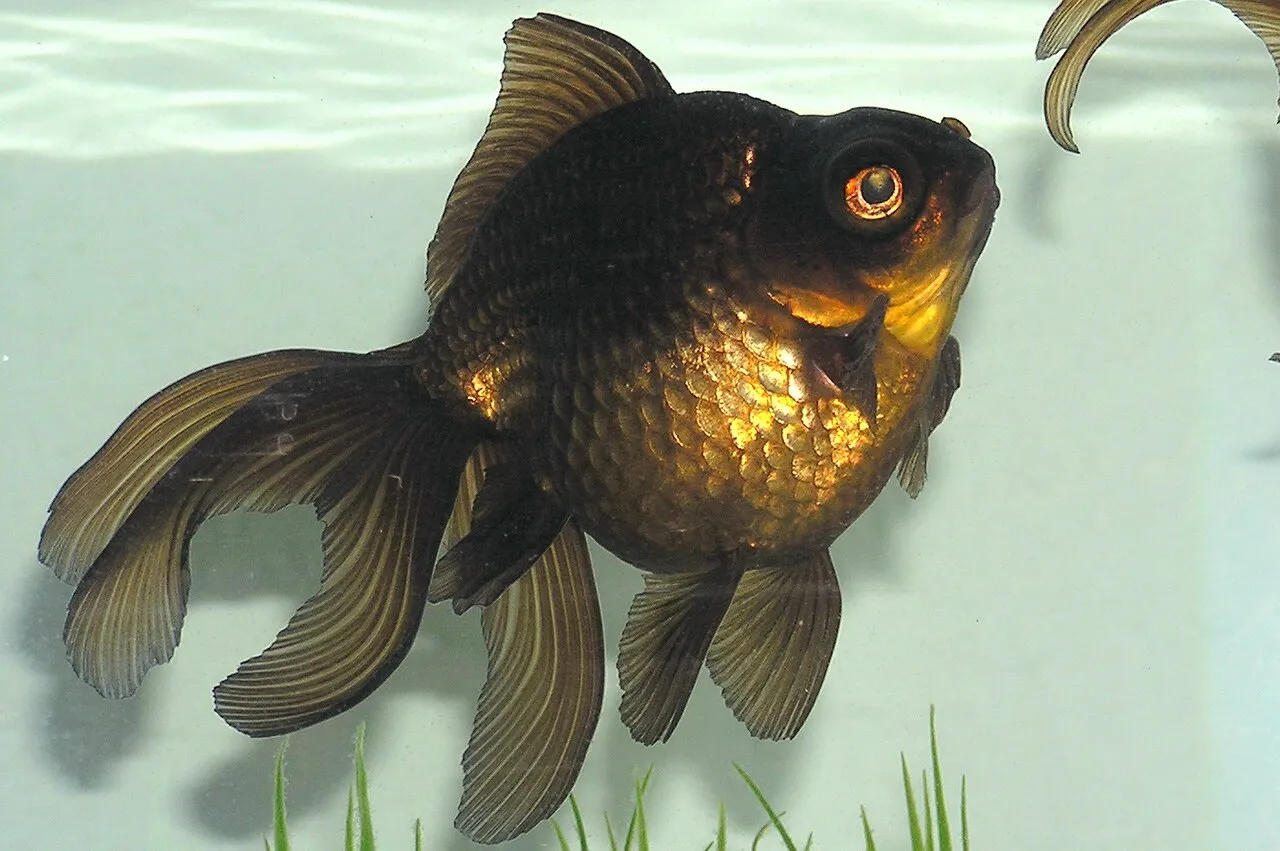
KDBlackmore · Public domain
2.1. Scientific name and lineage
The goldfish is Carassius auratus, a name given by Linnaeus in 1758. Carassius is the genus of crucian carps, and auratus is Latin for gilded. It sits in the order Cypriniformes and the family Cyprinidae, alongside common carp, minnows and barbs.
Exactly which wild fish gave rise to the goldfish has been debated for a long time. Older books often point to the Prussian or gibel carp, Carassius gibelio, but genetic studies increasingly place goldfish closest to wild crucian-type carp populations in East Asia, particularly southern China. Taxonomists still do not agree on every detail, so you will see goldfish treated as a full species in some sources and as a domestic form of a wild carp in others.
2.2. Common names around the world
The English name is plain description, and most languages took the same route. Chinese jinyu, Japanese kingyo and Korean geumbungeo all mean gold fish or gold carp, written with the same characters in Chinese and Japanese. The Korean word adds bungeo, the native crucian carp, which shows people recognised the goldfish as a coloured version of a familiar pond fish.
The name sticks even when the colour does not: white, black, blue-grey, chocolate and calico goldfish are all still goldfish. Hobbyists usually split the fish into single-tailed types such as commons and comets and double-tailed fancy types such as orandas and ranchus, because the two groups differ a great deal in size, swimming ability and care needs.
2.3. Close relatives
The nearest relatives are other Carassius species: the wild crucian carps of East Asia, the gibel carp of Europe and Asia, and the Japanese white crucian carp, Carassius cuvieri. Goldfish interbreed freely with these fish, which is one reason released goldfish tend to revert to a dull olive colour within a few generations in the wild.
Common carp and koi belong to the same family but a different genus. The quickest way to tell them apart is the mouth: carp and koi carry two pairs of barbels, while goldfish have none. Goldfish and carp occasionally hybridise, but the offspring are usually infertile.
3. History
3.1. Origins in China
Chinese writings mention unusually red carp being caught in the wild many centuries ago. Such fish were considered auspicious and were often placed in temple release ponds, where Buddhist practice encouraged freeing living creatures. By the Song dynasty (960–1279) wealthy households were keeping goldfish in garden ponds, and deliberate breeding for colour appears to have begun in earnest.
During the Ming dynasty, goldfish moved indoors into large ceramic basins and jars. Because these containers were viewed from above, breeders favoured traits that looked striking from that angle: broad, split tails, unusual eyes and wide bodies. Much of the diversity in fancy goldfish traces back to this period of top-view appreciation.
3.2. Spread to Japan, Europe and beyond
The usual account says goldfish reached Japan in the early 1500s, landing at the port of Sakai near Osaka. At first they were luxuries for the elite, but large-scale farming in the Edo period turned them into an everyday summer pleasure, sold by street vendors and scooped at festivals. Japanese breeders developed their own varieties, including the ranchu, the Tosakin and the Jikin, along with strong regional show traditions.
Goldfish reached Europe around the 17th century through Portuguese and Dutch trade and were initially prized gifts among the well-to-do. In the 19th century they spread widely in the United States, where government hatcheries distributed them and breeders produced the long-finned comet. Exact dates vary between sources, so treat them as approximate.
3.3. Goldfish in Korea
When goldfish first arrived in Korea is not well documented. Accounts suggest they came via China during the Joseon period, but sources disagree and no firm date can be given. What is clear is that a wide range of Japanese and Chinese varieties arrived in the modern era and made goldfish one of the country’s most familiar pets.
From the 1970s through the 1990s, goldfish were sold cheaply in small bags outside schools and in markets, and a round glass bowl with one or two fish was a common sight in Korean homes. As the aquarium hobby matured, more keepers moved to filtered tanks and fancy varieties such as ranchu, orandas and pearlscales, and locally bred fish now appear alongside imports.
4. Body
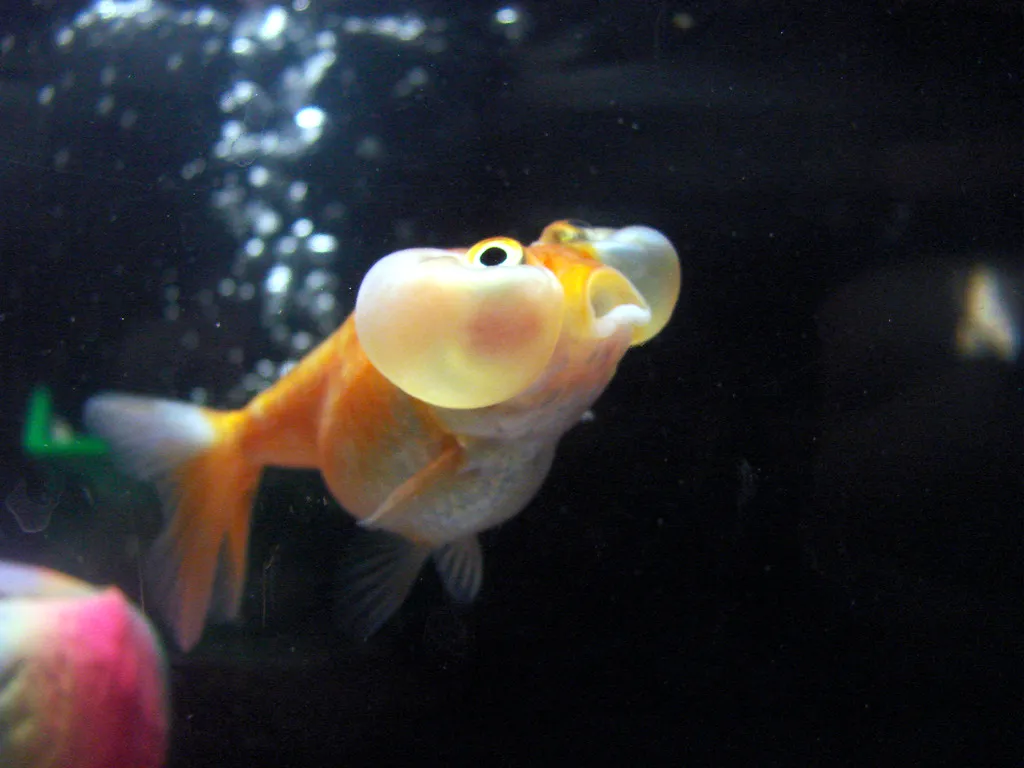
Original uploader was Jordan Hartig at en.wikipedia · CC BY-SA 3.0
4.1. Size and shape
Fancy goldfish usually reach 10–20 cm including the tail, while single-tailed commons and comets kept in ponds can pass 25–30 cm. A goldfish that stays tiny in a bowl is not cleverly sizing itself to its home; stunting is almost always the result of poor water and cramped space, and stunted fish often have organs that are out of proportion to their bodies and shorter lives.
Body shape falls into two broad camps. Single-tailed goldfish keep the long, streamlined build of their wild ancestors and are fast, strong swimmers. Double-tailed fancies have been bred for short, round bodies that look elegant but swim slowly, and the compressed internal organs make them more prone to buoyancy problems.
4.2. Senses and anatomy
Goldfish see more of the colour spectrum than we do. Alongside red, green and blue receptors they have cones sensitive to ultraviolet light, so they can distinguish patterns invisible to people. A lateral line running along each flank picks up vibrations and pressure changes, and a chain of small bones called the Weberian apparatus links the swim bladder to the inner ear, giving them good hearing. Tapping on the glass is genuinely loud to a goldfish.
Like other carp, goldfish have no true stomach: food passes from the oesophagus straight into a long intestine. Their teeth are pharyngeal teeth in the throat, used to grind food rather than bite it. Without a stomach to store a large meal, they are built to graze little and often and to produce waste constantly, which is exactly why filtration matters so much.
4.3. Scales and colour
Hobbyists group goldfish scales into three types: metallic scales with a bright mirror shine, matt scales that lack the reflective layer and look almost skin-like, and nacreous scales, a mixture of the two seen in calico fish. Pearlscale goldfish have domed, calcified scales that make each one look like a tiny bead.
Most goldfish fry hatch olive or bronze. Over weeks to months the dark pigment fades and reds, oranges, yellows and whites appear. Colour continues to shift through life with temperature, diet, light and age, so a black fish turning orange or a red fish fading to white is normal rather than a sign of illness.
4.4. Telling males from females
Young goldfish are practically impossible to sex, and differences usually appear only once fish are a year or two old and in breeding condition. In spring, males develop breeding tubercles: small white bumps on the gill covers and along the leading ray of each pectoral fin. Beginners often mistake them for white spot disease, but tubercles appear in a consistent, symmetrical pattern.
Females tend to look rounder from above, sometimes slightly lopsided when full of eggs, and their vent is rounder and more protruding. A fish being persistently chased and nudged around the tank in spring is very likely a female.
5. Varieties
Varieties are defined by combinations of body shape, tail type, presence or absence of a dorsal fin, head growth (the wen), eye shape and scale type. Chinese, Japanese and Thai lines of the same variety can look quite different, because each region has its own ideal.
| Variety | Tail | Key features | Care level |
|---|---|---|---|
| Common | Single | Wild-type streamlined body, grows large | Easy, needs a big tank or pond |
| Comet | Single | Long, deeply forked tail, very fast | Easy, needs lots of room |
| Shubunkin | Single | Matt and nacreous scales, blue, red and black calico | Easy |
| Ryukin | Double | High, humped back and broad tail | Moderate |
| Oranda | Double | Wen covering the head | Moderate, wen needs clean water |
| Red cap (tancho) | Double | White body with a red patch on the head | Moderate |
| Ranchu | Double | No dorsal fin, egg-shaped body, wen | Harder |
| Lionhead | Double | No dorsal fin, heavy wen, Chinese type | Harder |
| Pearlscale | Double | Domed scales, ball-shaped body | Harder, scales can be lost |
| Telescope | Double | Eyes protruding to the sides | Harder, avoid sharp decor |
| Celestial eye | Double | Upward-facing eyes, no dorsal fin | Difficult, poor vision |
| Bubble eye | Double | Fluid-filled sacs under the eyes | Difficult, sacs can burst |
| Tosakin | Double | Tail spreads like a fan when seen from above | Difficult, traditionally kept in shallow bowls |
Single-tailed and double-tailed types are best kept apart. Commons and comets swim rings around fancies at feeding time, and poor-sighted varieties such as celestials and bubble eyes do best with their own kind.
6. Behaviour
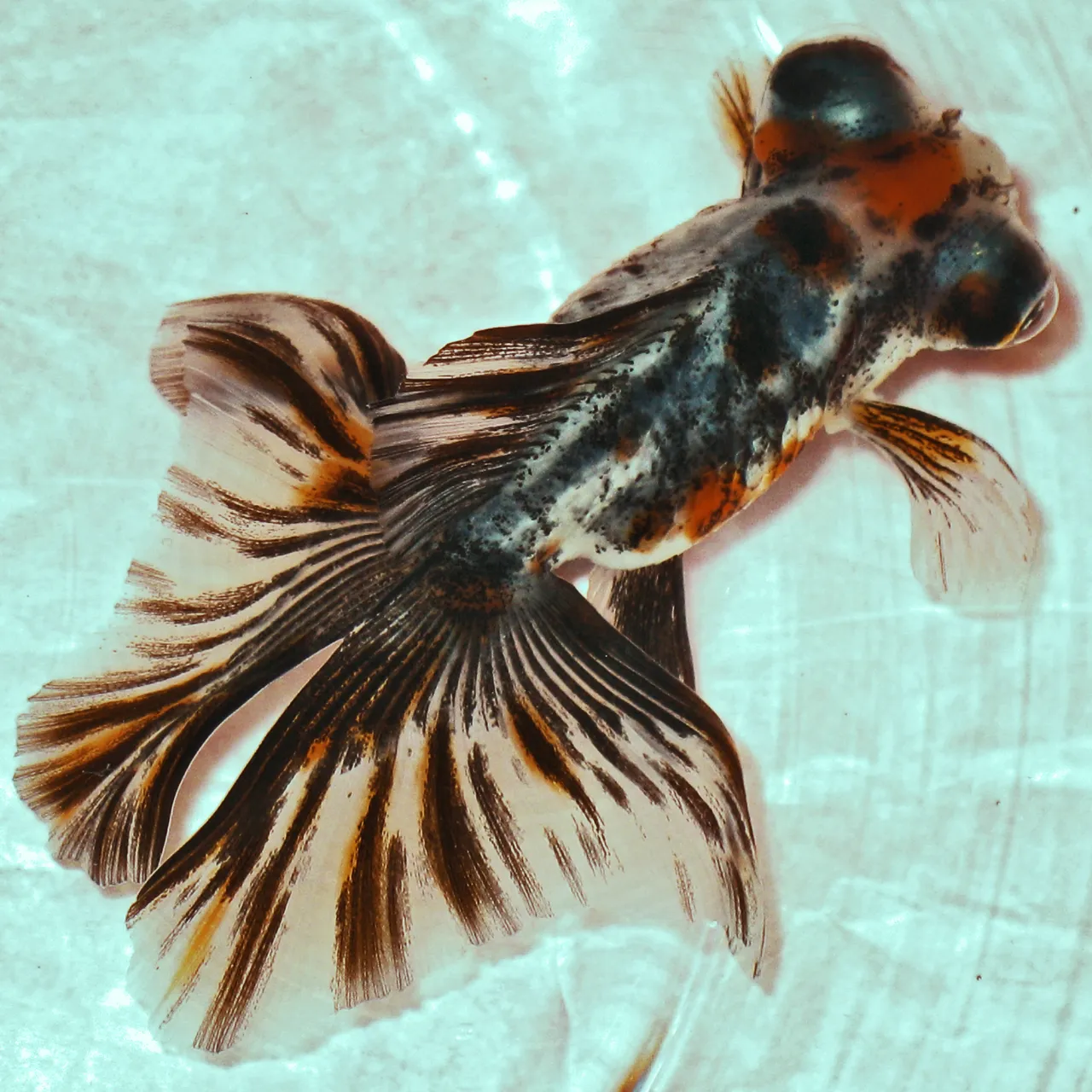
Syberspace · CC BY-SA 3.0
6.1. Habits inherited from wild carp
Wild crucian carp live in loose groups in slow, weedy ponds, ditches and paddy channels. They sift mouthfuls of mud for insect larvae, small crustaceans and plant matter, and in winter they settle near the bottom and barely move. Their tolerance of low oxygen and wide temperature swings is a big part of why they adapted so well to life in human hands.
Those habits are fully intact in a tank. Goldfish spend much of the day sifting substrate, and they will nibble, uproot and rearrange most soft plants. If you want greenery, tough species such as anubias and Java fern tied to rock or wood survive far better than delicate stem plants.
6.2. Behaviour and intelligence in the tank
The three-second memory is a myth. In experiments, goldfish have learned to associate particular sounds or colours with food and remembered the link weeks or months later. They have been trained to push levers for food, to anticipate feeding at a fixed time of day and even to navigate simple mazes. At home, most keepers notice their fish recognising the person who feeds them and crowding the glass when that person approaches.
Goldfish are social and settle better in groups of two or more. They are not aggressive and rarely injure one another, although they jostle at feeding time. At night, with the lights off, they hover low in the water or near plants with reduced movement. They have no eyelids, so they rest with their eyes open.
6.3. Reading the signals
Goldfish cannot tell you how they feel, but posture and fins are surprisingly honest. Learning these signs helps you catch problems early.
- Dorsal fin raised, actively foraging: healthy and relaxed.
- Fins clamped against the body, sitting still in one spot: often an early sign of poor water or illness.
- Gasping at the surface: suspect low oxygen or rising ammonia.
- Flashing or rubbing against gravel and decor: parasites or skin irritation.
- Tilting, floating head-down or stuck on the bottom: a buoyancy or digestive problem.
- Several fish relentlessly chasing one in spring: usually spawning behaviour, but separate the chased fish if it becomes exhausted.
7. Life stages
Lifespan depends enormously on how a goldfish is kept. Fish in small bowls often die within one to three years, while fish in roomy, well-filtered tanks or ponds commonly reach ten to fifteen and sometimes pass twenty. The best-known record belongs to a fairground prize goldfish in England that lived to 43.
| Stage | Age | What happens |
|---|---|---|
| Egg | 3–7 days after spawning | Hatches in about 4–5 days at 20–24°C |
| Larva | First 2–3 days | Clings to plants or glass, living on its yolk |
| Fry | 1 week–2 months | Free-swimming and feeding, usually bronze |
| Juvenile | 2 months–1 year | Body shape and fins develop, colour changes |
| Adult | From 1–2 years | Able to breed, growth slows |
| Senior | Roughly 8–10 years on | Less active, colour may fade, body shape shifts |
Older goldfish spend more time resting near the bottom, their reds may fade, and on wen varieties the head growth can creep over the eyes. Seniors are more sensitive to sudden changes, so keep water changes consistent and soften their food a little.
8. Housing
8.1. Tank size
A round bowl has a tiny surface area, so oxygen exchange is poor, and the small volume lets waste reach toxic levels within days. If you want a goldfish to live out its natural lifespan, start with a rectangular tank that can run a proper filter.
For two fancy goldfish, 60 litres is a sensible minimum, adding roughly 30–40 litres for each additional fish. Commons and comets grow close to 30 cm and in the long run need 150 litres or more, or better still a garden pond. Goldfish swim horizontally far more than vertically, so a long, low tank beats a tall one of the same volume.
8.2. Water quality and temperature
As a cold-water fish, a goldfish is most active at about 18–24°C and can cope briefly with water near 4°C or close to 30°C. Rapid daily swings are what really harm it, so keep the tank away from sunny windows and radiators. Most homes need no heater, though one can be useful to hold a steady temperature in a room that drops below about 15°C in winter, or while treating a sick fish.
Aim for pH 7.0–8.0, zero ammonia and nitrite, and nitrate below about 40 ppm. A new tank must be cycled first: run the filter for at least two to four weeks so nitrifying bacteria can establish, testing as you go. Tap water is fine in most places as long as you treat it with a conditioner that neutralises chlorine and chloramine.
8.3. Filtration and water changes
Choose a filter that turns over four to six times the tank volume per hour, so roughly 240–360 litres per hour for a 60-litre tank. Hang-on-back, canister and top filters all work, but long-finned fancies tire easily in strong flow, so point the outlet at the glass or diffuse it with a sponge or spray bar.
The baseline routine is a 20–30% water change once a week. Siphon debris from the substrate as you drain, then refill slowly with conditioned water at the same temperature. Never scrub filter media under the tap; the chlorine kills the bacterial colony that keeps ammonia in check. A gentle swish in a bucket of old tank water is enough.
8.4. Equipment checklist
A basic goldfish setup needs the following.
- A tank of at least 60 litres and a sturdy stand (filled, it weighs over 70 kg)
- A filter rated for the tank, plus spare sponges
- Large smooth gravel or very fine sand; avoid mid-sized gravel that can lodge in a mouth
- Water conditioner
- A liquid test kit covering ammonia, nitrite, nitrate and pH, since goldfish produce a lot of waste
- A thermometer
- A gravel siphon and a dedicated bucket
- A net, suitable food and a light on a timer for 8–10 hours a day
- Hardy plants or smooth decorations
A second, smaller tank of 20–40 litres for quarantine and hospital use is one of the best investments you can make.
9. Diet
Goldfish are omnivores. A quality goldfish pellet makes the best staple, and for fancy varieties a sinking pellet or a briefly soaked food is the safer choice, because gulping floating food at the surface makes them swallow air and can trigger buoyancy problems.
| Type | Examples | How often |
|---|---|---|
| Staple | Sinking goldfish pellets, gel food | Once or twice a day |
| Vegetables | Blanched shelled peas, spinach, courgette | Two or three times a week |
| Animal treats | Frozen brine shrimp, daphnia, bloodworm | Once or twice a week |
| Fast | Nothing | About one day a week |
Feed only what the fish finish within two or three minutes. Goldfish beg constantly whether or not they are hungry, so treating begging as a hunger signal is the fastest route to overfeeding. Digestion slows as the water cools: cut back below about 15°C, and below about 10°C most keepers stop feeding almost entirely.
Skip bread, rice and crackers. They swell, rot quickly and foul the water. Live tubifex worms and anything collected from ponds can carry parasites and bacteria, so frozen foods are the safer way to offer animal protein.
10. Health
Most goldfish illness starts with poor water and stress, so a weekly test for ammonia and nitrite does more good than any medicine on the shelf. The table below covers the conditions you are most likely to meet.
| Condition | Cause | Signs | Prevention and response |
|---|---|---|---|
| White spot (ich) | Ciliate parasite | Salt-like white dots on body and fins | Quarantine new fish, avoid temperature swings |
| Fin rot | Bacterial infection | Ragged fins with white or red edges | Improve water, remove sharp decor |
| Dropsy | Bacterial infection, organ failure | Swollen body, pinecone scales | Catch early; outlook is often poor |
| Swim bladder disorder | Overfeeding, swallowed air, body shape | Floating upside down or stuck on bottom | Sinking food, fasting, peas |
| Anchor worm | Parasitic crustacean | Thread-like parasite embedded in skin | Inspect new fish, targeted treatment |
| Fish lice (Argulus) | Parasitic crustacean | Flat, disc-shaped parasites on skin | Watch pond fish, quarantine |
| Gill and skin flukes | Flatworm parasites | Rapid gill movement, flashing | Quarantine and deworming |
| Fungus (Saprolegnia) | Water mould | Cotton-wool growth on wounds | Prevent injuries, keep water clean |
Viral disease also exists. Cyprinid herpesvirus 2, which causes haematopoietic necrosis, can kill many goldfish in a short time, particularly when water temperature shifts in spring and autumn. It cannot be diagnosed reliably at home, so losses spreading through a tank call for professional help straight away.
Contact a vet who treats fish, or an experienced aquarium specialist, if you see any of the following.
- Refusing food for more than two days
- Scales lifting or the body suddenly swelling
- Bulging or cloudy eyes
- Several fish gasping at the surface at once
- Red streaks, bleeding spots or ulcers on the skin
Follow dosing instructions exactly and avoid combining medications. Treating in a separate hospital tank protects the beneficial bacteria in your main filter.
11. Breeding
Goldfish come into breeding condition in spring, when the water warms from the mid-teens to around 20°C and the days lengthen. Males chase a female persistently, nudging her flanks to trigger spawning, and she scatters sticky eggs over plants or a spawning mop. A large female can release hundreds to more than a thousand eggs, usually in a session lasting a few hours in the early morning.
Goldfish provide no parental care and will happily eat their own eggs, so breeders move the egg-covered plants to a separate tank or remove the adults. At 20–24°C the eggs hatch in about four to five days, and the larvae live on their yolk for two or three days before swimming freely. From then on they need newly hatched brine shrimp or fine powdered food several times a day, and frequent water changes, because a crowded fry tank fouls quickly.
Home breeding brings responsibility. One spawning can produce hundreds of fish, and with fancy varieties most of the offspring will not match their parents’ shape; serious breeders cull heavily to keep a line true. If you have no room or reliable homes for the young, it is better not to breed at all, and surplus fish must never be released into rivers or ponds. If your fish are spawning without your intention, a temporary divider during the spring chasing season is usually enough.
12. Costs
The fish are cheap; the tank and filter are where the money goes. The figures below assume two or three fancy goldfish in a 60–90 litre tank and are rough examples in Korean won. Prices vary widely by brand, shop and country.
| Item | Approximate cost (KRW) | Notes |
|---|---|---|
| Two or three goldfish | 10,000–100,000+ | Pet-shop fish cost a few thousand won; show lines far more |
| Tank and stand | 40,000–120,000 | 60–90 L |
| Filter | 20,000–80,000 | Depends on type |
| Substrate, decor, plants | 10,000–30,000 | |
| Test kit, conditioner, siphon | 20,000–40,000 | Liquid kit recommended |
| Start-up total | About 80,000–250,000 | |
| Monthly food and consumables | 5,000–15,000 | Food, conditioner, filter media |
| Monthly electricity | 3,000–10,000 | Filter and light; more with a heater |
| Monthly total | About 10,000–25,000 | |
| Yearly | About 120,000–300,000 | Excluding equipment replacement |
Veterinary costs are hard to predict because few clinics treat fish. Allow for consultation fees, water testing, medication and hospital-tank equipment, and consider setting aside something like 50,000–100,000 won a year. Filters and heaters also wear out and need replacing every few years.
13. Before you get one
Before bringing goldfish home, answer these questions honestly.
- Can you commit to a pet that may live more than a decade, including through moves and holidays?
- Do you have space for a tank of 60 litres or more, and a stand that can carry the weight?
- Can you spare about half an hour every week for water changes and cleaning?
- Are you willing to run the tank without fish for two to four weeks while it cycles?
- If things do not work out, do you know where you could rehome the fish?
When choosing fish, look for fins held open and active swimming, smooth even scales with no wounds or white spots, and level posture with no listing. If a shop tank holds dead or listless fish, skip that tank entirely, however healthy your chosen fish looks.
Fair prizes arrive stressed. Float the bag in the tank for 20–30 minutes to equalise temperature, then release the fish into cycled water if you have it. If you do not, use the largest container you can find with conditioned water, change part of it every day and get a filter running as quickly as possible.
14. Laws
In most countries, keeping goldfish requires no licence or registration. Animal welfare laws vary in how far they cover fish: some protect all vertebrates including fish, others focus on mammals and birds. Check your national and local rules if you are unsure.
The area where goldfish clearly run into law is release into the wild. Dumped goldfish can grow very large, stir up sediment, uproot plants, spread disease and hybridise with native carp, and in parts of North America and Australia they have become a serious environmental problem. Releasing aquarium animals is illegal in many jurisdictions and harmful everywhere, so rehome unwanted fish through shops, clubs or local groups instead.
Some places also regulate how goldfish are sold or given away. In England and Wales, for example, animal welfare law prohibits giving pets as prizes to unaccompanied children under 16, and occasional local rules have targeted small bowls. Rules change, so check current regulations where you live.
15. Goldfish in culture
Across East Asia the goldfish has long symbolised wealth and good fortune. In Chinese, jinyu (goldfish) sounds like the words for gold and jade, and yu (fish) sounds like the word for surplus, so goldfish appear constantly in New Year prints and auspicious paintings wishing abundance. Feng shui tradition treats a goldfish tank as a magnet for prosperity.
In Japan, goldfish mean summer. Goldfish scooping is a fixture of festival stalls, and goldfish patterns decorate summer kimono, wind chimes and fans. In Korea, a goldfish from the school stationery shop or a fairground game is a common childhood memory.
On screen, Cleo, the goldfish in Disney’s Pinocchio (1940), is a classic, and Hayao Miyazaki’s Ponyo (2008) centres on a goldfish-like fish girl who wants to become human. In English, a goldfish bowl means a situation with no privacy, and the idea of a goldfish memory, though scientifically wrong, is a common joke about forgetfulness.
16. Trivia
- Goldfish can survive months in an ice-covered pond with almost no oxygen. They convert the lactic acid produced by oxygen-free metabolism into ethanol and release it through their gills, a rare trick among vertebrates.
- News stories regularly report enormous goldfish, sometimes weighing several kilograms, pulled from lakes and rivers where pets were dumped. Without the limits of a tank, goldfish can grow astonishingly large.
- The Tosakin of Kochi Prefecture is so treasured in Japan that it has been designated a natural monument of the prefecture.
- Because their colour vision is so good, goldfish have been used for decades as laboratory models in research on how animals see colour.
- The constant mouthing and spitting of gravel is not a nervous habit. It is simply how a goldfish searches for food, exactly as its wild ancestors did in muddy ponds.
Health notes are general information. If something seems wrong, contact a vet who treats this species.
FAQ
Do goldfish really have a three-second memory?
No. Studies have shown goldfish remembering feeding cues, colours and sounds for weeks or months, which is why they rush to the person who feeds them.
Does a goldfish tank need a heater?
Usually not, as long as the room stays above about 15°C. A heater is useful for stabilising temperature in draughty rooms or during treatment of a sick fish.
My goldfish is floating upside down. Is it dying?
Often it is a buoyancy problem linked to diet or water quality. Test the water, fast the fish for a day or two, then offer a little blanched pea. If it does not improve or the body swells, seek expert advice.
Further reading
- 🗳️ Starting a fish tank: goldfish or guppies?
- ☀️ Keeping Pets Safe in Summer Heat
- 🚗 Moving House and Traveling With Pets
Photo credits
Photos are freely licensed images from Wikimedia Commons. Authors and licenses are listed below.
- Gold fish1.jpg — לינה אבוגוש · CC BY-SA 3.0
- Black Moor Goldfish.jpg — KDBlackmore · Public domain
- Bubble Eye goldfish.jpg — Original uploader was Jordan Hartig at en.wikipedia · CC BY-SA 3.0
- Calico-butterfly-tail-demekin.png — Syberspace · CC BY-SA 3.0