TailVille
At a glance
Rough ranges for supplies, food and electricity in Korea (USD is approximate). Purchase or adoption fees are not included.
People who want a rodent that's up and about during the day and who will stick to a strict, low-sugar menu.
Homes with hay or dust allergies, or where summer air conditioning can't be left running.
1. Overview
Degus are rodents from the dry scrubland of central Chile. At 170–300 g they sit between a hamster and a guinea pig in size, with brown agouti fur, a slender tail ending in a small tuft and bright orange front teeth. People often take them for a squirrel or a large rat, but they are actually closer relatives of guinea pigs and chinchillas.
What makes degus special is that they are awake during the day and intensely social. Most small pet rodents are nocturnal; degus are busiest in the morning and late afternoon, which fits neatly around human routines. They live in family groups, groom one another and keep up a running conversation of chirps, warbles and squeaks. A well-socialised degu can learn to come when called and will happily take treats from a familiar hand.
They also come with some very specific weaknesses. Degus handle sugar poorly and are prone to diabetes, they overheat easily, and if grabbed by the tail the skin can strip away. They live a fairly long time for a small rodent, usually six to nine years and sometimes more than ten. This article covers their name and classification, history, anatomy, colours, behaviour, housing, diet, health, breeding, costs, law and culture.
2. Name and classification
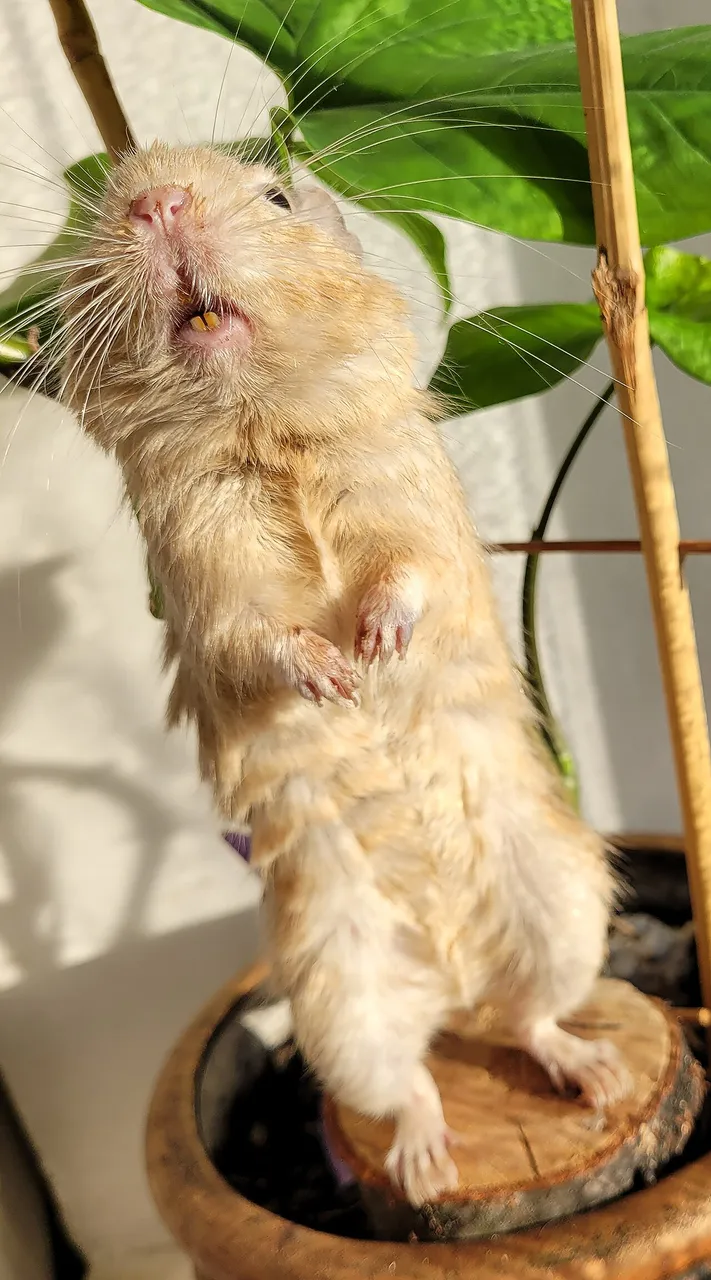
Vadim Chuprina · CC BY-SA 4.0
2.1. Taxonomy
Degus belong to the rodent suborder Hystricomorpha and the family Octodontidae. They share this broad lineage with guinea pigs, chinchillas and porcupines, groups whose young tend to be born furred with their eyes open after a long pregnancy.
| Rank | Name |
|---|---|
| Order | Rodentia |
| Suborder | Hystricomorpha |
| Family | Octodontidae |
| Genus | Octodon |
| Species | Common degu, Octodon degus |
| Other species in the genus | Bridges's degu (O. bridgesi), moon-toothed degu (O. lunatus) and others |
Octodontids live mainly in Chile, Argentina and Bolivia. Virtually all pet degus are Octodon degus.
2.2. Name
The English name comes from the Spanish degú, which is usually said to derive from Mapudungun, the language of Chile's Mapuche people, though sources disagree on the original word and its meaning. The genus name Octodon combines the Greek for eight and tooth, because the grinding surface of each cheek tooth looks like a figure eight. Degus are sometimes nicknamed brush-tailed rats, a misleading label since they are not rats at all.
3. History
In Chile degus are common wild animals, and farmers have long regarded them as pests that nibble crops and pasture. They became known outside South America mostly as laboratory animals from the mid-twentieth century onward. A day-active rodent is valuable for studying circadian rhythms, their weak sugar metabolism made them useful in diabetes research, and studies reporting Alzheimer's-like changes in the brains of ageing degus drew attention from neuroscientists. How well degus actually model human Alzheimer's disease remains debated.
Laboratory-bred animals are thought to have reached the pet market in Europe, particularly Britain and Germany, around the 1980s and 1990s. Degus arrived in Korea through exotic pet shops and clubs in the 2010s and found fans among people looking for a step up from hamsters. Numbers there are still far smaller than for hamsters or guinea pigs, so vets with degu experience and specialised supplies can be harder to find.
4. Body
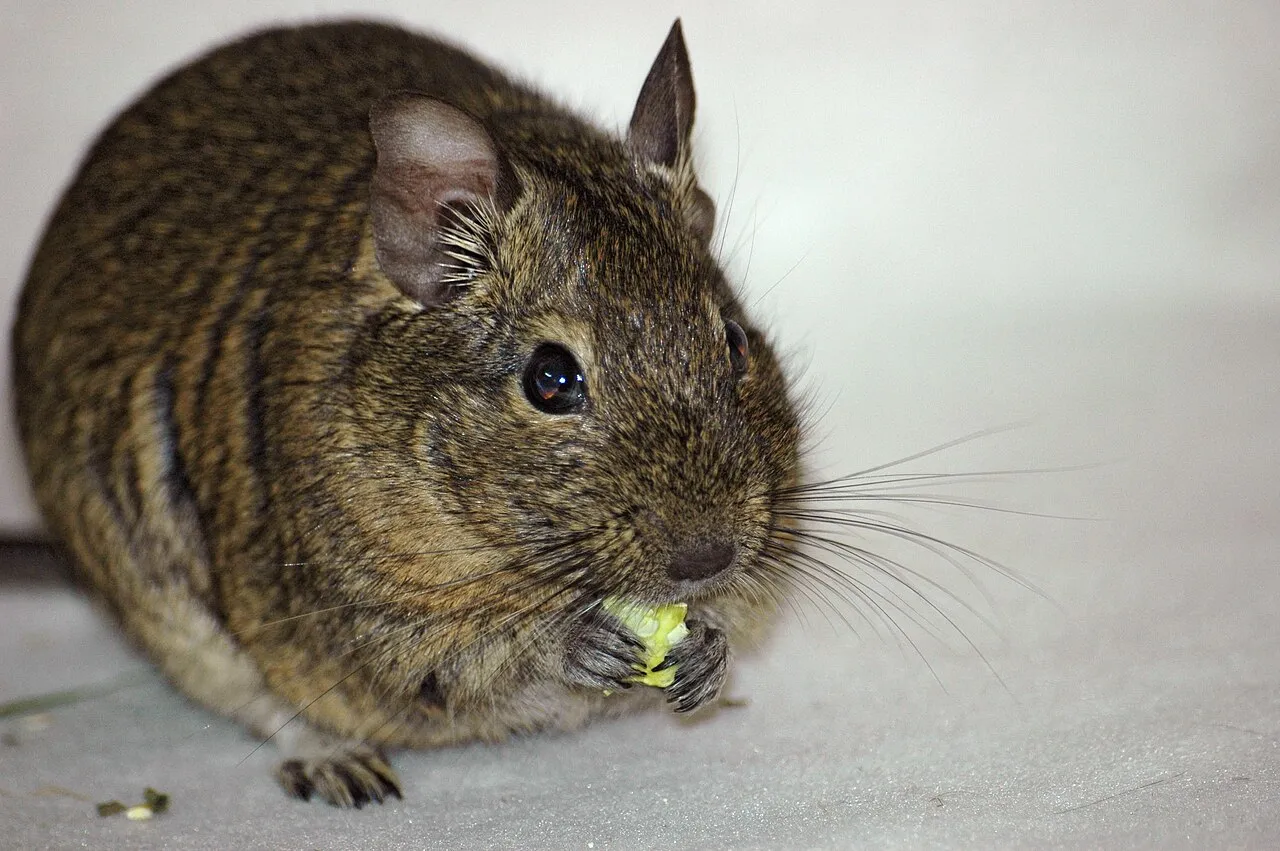
Vera Buhl · CC BY-SA 3.0
4.1. Size and build
Adults measure 12–20 cm with a 10–13 cm tail and usually weigh 170–300 g, with little difference between the sexes. The body is stocky but the legs are strong, built for sprinting and jumping, and the forepaws hold food while eating. The black tuft at the tail tip helps with balance and signalling.
The strangest feature is the tail skin. If a predator grabs the tail, the skin and fur slip off like a glove, a response called tail degloving. The exposed bone and muscle later dry up and drop off or are chewed away by the degu, and the tail never grows back. The same thing can happen if a person lifts a degu by the tail, so never do it.
4.2. Teeth
All of a degu's teeth grow continuously. Healthy incisors are a deep orange on the front surface, a colour usually attributed to iron in the enamel. Incisors that fade to pale yellow or white are often taken as a sign the diet needs checking. The cheek teeth are designed to be ground down by long hours of chewing tough grass; without enough hay they overgrow and can spike into the tongue or cheeks.
4.3. Senses and ultraviolet vision
As a day-active animal the degu has good eyesight, and research suggests it can see ultraviolet light invisible to us. Their belly fur and urine reflect UV, which may let degus recognise one another and read scent marks visually. Hearing is sharp and extends into high frequencies people barely notice. Whiskers guide them through burrows, and smell identifies group members.
4.4. Sexing
Sexing degus is tricky because both males and females have a cone-shaped structure in front of the genital area. The reliable clue is distance: in males the gap between that cone and the anus is relatively large, around a centimetre in adults, while in females the vaginal opening lies between them and the distance is much shorter. Mis-sexed degus are sold surprisingly often, so get an experienced breeder or vet to check.
5. Colours
Degus have not been bred into many varieties the way guinea pigs and rats have. The wild-type agouti is by far the most common, and a handful of colour mutations have been established in captivity. Names and genetics vary somewhat between countries and breeders.
| Colour | Appearance |
|---|---|
| Agouti | Brown with each hair banded yellow and black, cream belly; wild type |
| Blue | Blue-grey, cooler in tone than agouti |
| Sand or cream | Pale sandy or cream |
| Pied | Agouti or blue with white patches |
Because coloured lines started from small numbers, inbreeding is more likely and prices tend to be higher. Some keepers suspect certain pied lines carry health problems, but that has not been firmly established. The health, lifespan and diabetes history of the parents matter far more than colour.
6. Behaviour
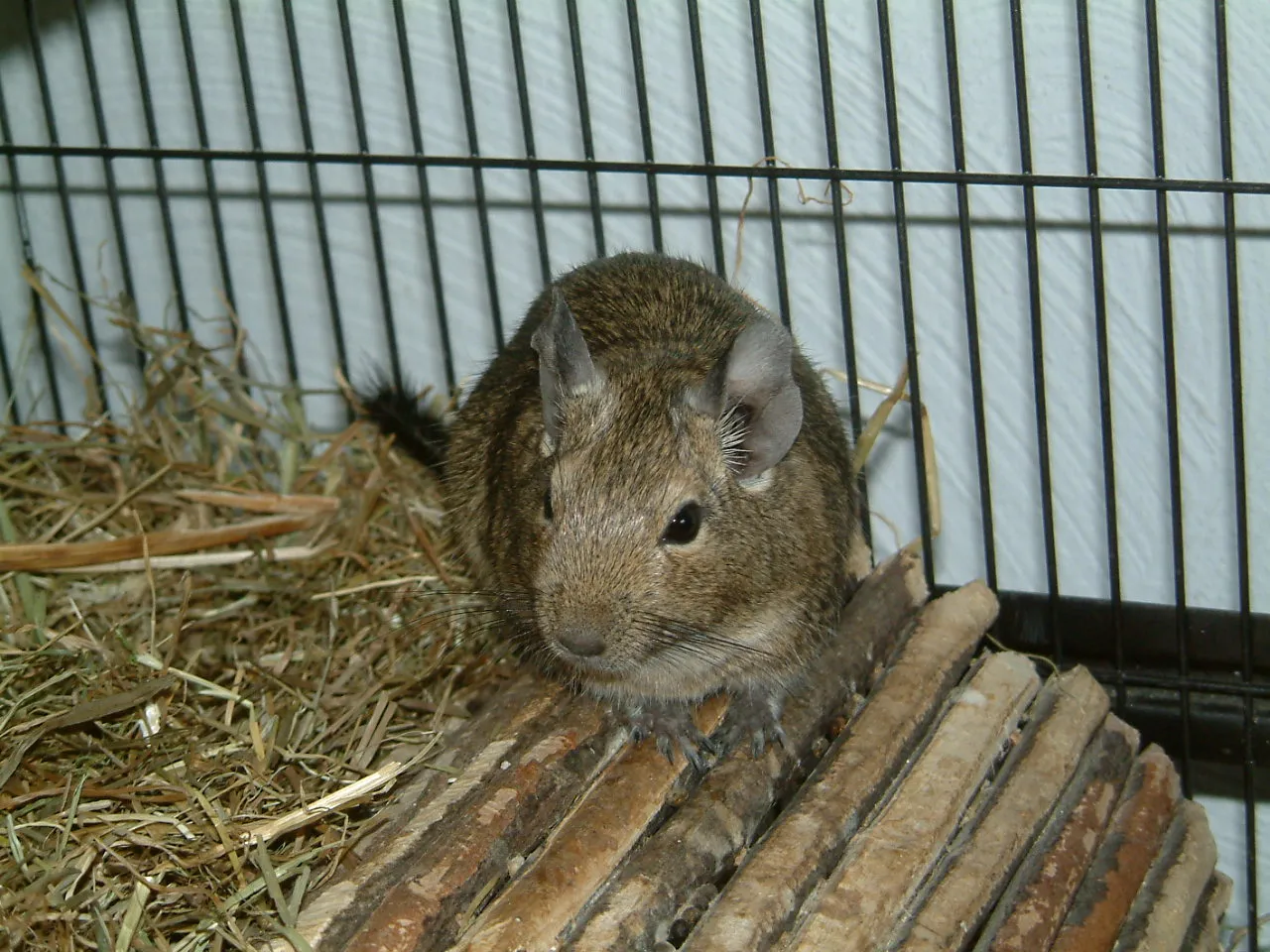
Photographed by: Heike 'Speck' Hellwig · CC BY-SA 3.0
6.1. In the wild
Wild degus live in the matorral, the Mediterranean-type scrubland of central Chile. They dig extensive burrow systems shared by family groups of a few females, one or two males and their young, and neighbouring families may form large colonies. Although active by day, they avoid the midday sun and forage mostly in the cooler morning and late afternoon on grasses, leaves, seeds and bark.
Degus cache food near their burrows and are known for piling stones, sticks and droppings around burrow entrances, possibly as territorial markers, though the purpose is still being studied. When a hawk or fox appears one degu sounds the alarm and the rest dive underground.
6.2. At home
Pet degus are liveliest in the morning and evening and rest through midday and night. They dig in their bedding, build tunnels, run on the wheel for long stretches and chew everything. Plastic accessories can be shredded within days, and swallowed fragments cause gut trouble.
Degus must live with companions. A lone degu is prone to fur-pulling, bar-chewing and other repetitive stress behaviours. The easiest set-up is two or three same-sex littermates raised together. Introducing adults takes weeks: side-by-side cages to swap scents, then short meetings on neutral ground.
They dust-bathe too. Offer a bowl of chinchilla dust two or three times a week and they will roll in it to clean their coats. Mutual grooming is constant and is an important way of reinforcing bonds.
6.3. Sounds and signals
Degus are among the most vocal of small rodents; researchers have described roughly fifteen distinct calls.
- A warbling, song-like chatter: contentment, or greeting a companion or keeper.
- Short high squeaks: surprise or mild complaint.
- Sharp, repeated alarm calls: danger, and everyone hides.
- Teeth grinding or chattering: usually irritation or wariness.
- Rapid tail wagging: excitement or courtship.
- Standing upright and scanning: alert and curious.
- Rump-shoving and rolling wrestling matches: play or sorting out rank. Blood, or one degu being chased relentlessly, may mean they need separating.
Many degus rush to the front of the cage warbling when they expect food, so keepers quickly learn to read their mood from sound alone.
7. Life stages
Degus age slowly for small rodents, and like guinea pigs their young become independent early.
| Stage | Age | What happens |
|---|---|---|
| Newborn | 0–1 week | Born furred with eyes open, walking within days |
| Nursing | 1–4 weeks | Starts on hay and pellets alongside milk |
| Weaning | 4–6 weeks | Weaned; prepare to separate by sex |
| Juvenile | 6 weeks–6 months | Sexual maturity, peak energy; usually rehomed after about 8 weeks |
| Adult | 6 months–5 years | Weight and hierarchy settle |
| Senior | From about 5–6 years | Weight loss, cataracts, dental issues, slowing down |
Typical lifespan is six to nine years, and some exceed ten. Seniors use the wheel less and struggle with high shelves, so add ramps and softer bedding. When one of a pair dies the survivor is suddenly alone, so think ahead about whether and how you would introduce a new companion.
8. Housing
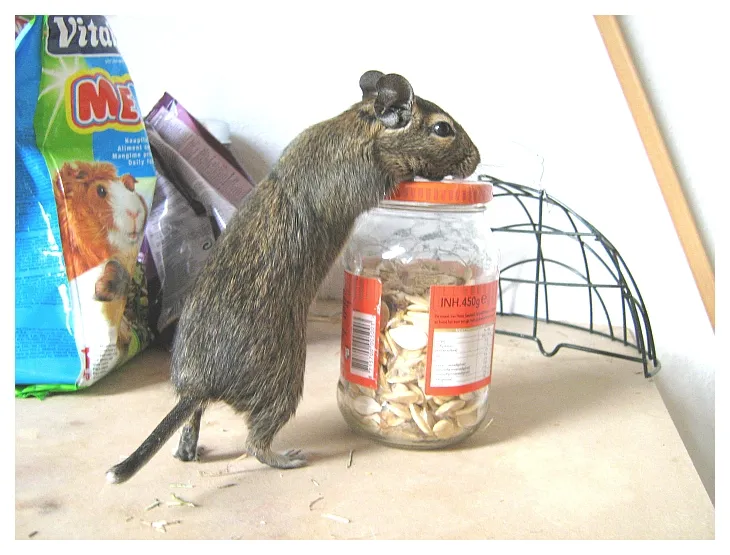
Leo Vietor · CC BY-SA 3.0
8.1. The cage
Degus chew hard and love to climb, so a multi-level metal wire cage works best. For two or three, treat 80 × 50 × 80 cm (W × D × H) as the minimum, and go bigger if you can. Bar spacing should be 1.3 cm or less, narrower if there are babies. A deep base tray rather than a wire floor lets you lay bedding thickly.
Use metal, ceramic or thick untreated wood for shelves and hides, and avoid plastic. Put down at least 10 cm of paper pellets, paper bedding or aspen so they can dig, with a deep layer of hay in one area. Glass tanks trap heat and ventilate poorly, which makes them a poor choice.
8.2. Temperature, humidity and placement
Degus overheat easily. Aim for 18–24 °C and 40–60% humidity, switch on cooling once the room passes 25 °C, and treat sustained temperatures above 28 °C as dangerous. In hot summers that means air conditioning while you are out, plus frozen bottles or ceramic tiles ready for power cuts. In winter normal room temperature is fine; just keep the cage out of window draughts.
As day-active animals they benefit from a naturally lit room, but direct sun on the cage can push temperatures up fast. Once used to people, many degus become more engaged when kept where the household passes by.
8.3. Equipment
- Multi-level metal cage, bar spacing 1.3 cm or less
- Wheel: 30 cm or larger, solid metal track. Small hamster wheels force the back into a painful curve.
- Hides: ceramic houses, untreated wood, cork tunnels
- Hay rack and a heavy ceramic food bowl
- Water bottle with a metal guard; degus destroy plastic bottles
- Chinchilla dust and a bath bowl
- Chews: apple and willow sticks, untreated wood, hay toys
- Thermo-hygrometer, 1 g scale and a carrier
Free-roaming time is great exercise, but degus vanish into small gaps and can sever a cable in seconds. Use a playpen in a cleared area and start with short sessions.
9. Diet
9.1. Staples
Degus are herbivores adapted to coarse, high-fibre, low-sugar plants. Unlimited grass hay such as timothy, orchard grass or meadow hay is the foundation, and it should make up most of what they eat to keep teeth and gut healthy.
Add degu pellets, or chinchilla or guinea pig pellets with no added sugar or molasses, at about one tablespoon (10–15 g) per degu per day. Guinea pig pellets often contain added vitamin C, which does degus no harm but is not required. Avoid muesli-style mixes with seeds and dried fruit, because degus pick out the sweet pieces and diabetes and obesity follow. Refresh water daily.
9.2. Treats
Keep treats low in sugar and small. Dried dandelion leaves, plantain, chamomile, other dried herbs and a little leafy greens such as kale, romaine or coriander are typical. Fatty seeds like sunflower seeds or peanuts are best limited to one or two a week. Hand-feeding is the best way to build trust, but more treats means less hay.
9.3. Avoid
The golden rule for degus is no sugar. Their blood-sugar control is weak, and a sugary diet leads straight toward diabetes and cataracts.
- All fresh and dried fruit, including apple, banana and raisins
- Sweet vegetables such as carrot, corn, sweet potato and squash
- Treat sticks and yoghurt drops containing honey, molasses or sugar
- Bread, biscuits, cereal and other human food
- Too many nuts and seeds
- Dairy and meat
- Toxic plants: avocado, onion, garlic, potato sprouts and many houseplants
Plenty of small-animal treats on shop shelves contain sugar or honey, so always read the label.
10. Health
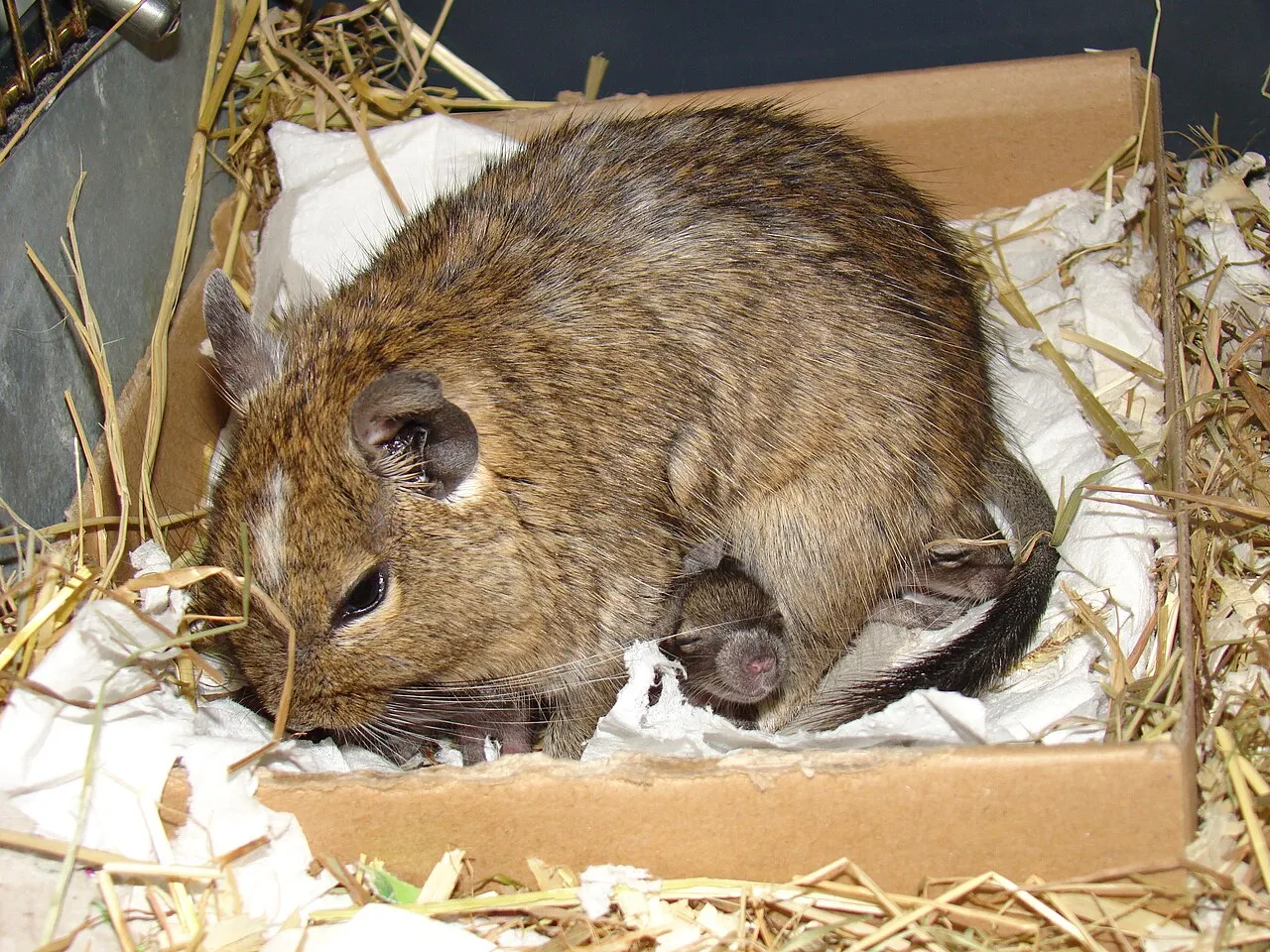
Jennie Sörensen · CC BY-SA 4.0
Most degu health problems come back to diet, temperature or teeth. As prey animals they hide illness, so weigh weekly and keep an eye on incisor colour, eyes and droppings. This information is general; see an exotic vet experienced with degus whenever something seems off.
10.1. Common conditions
| Condition | Cause | Signs | Prevention or response |
|---|---|---|---|
| Diabetes | Sugary diet, predisposition | Drinking and urinating more, weight loss | Sugar-free diet, weight log, vet |
| Cataracts | Linked to diabetes, age | Cloudy white pupils | Limit sugar, regular checks |
| Malocclusion | Too little hay, genetics | Drooling, eating less, weight loss | Unlimited hay, dental checks |
| Heatstroke | Heat above about 25–28 °C | Limp, rapid breathing, drooling | Cooling, move somewhere cool and call a vet |
| Tail degloving | Tail grabbed or trapped | Skin stripped from the tail, bone exposed | Never hold the tail, see a vet |
| Respiratory infection | Dusty bedding, poor ventilation | Sneezing, discharge, wheezing | Low-dust bedding, fresh air |
| Diarrhoea | Sudden diet change, too much fresh produce | Soft droppings, soiled rear | Change food slowly, vet |
| Hair loss and barbering | Stress, rank fights, loneliness | Bald or chewed patches | Check the group, improve the environment |
| Fatty liver | Fatty treats, little exercise | Lethargy, poor appetite | Limit seeds, provide a wheel |
Diabetes in degus usually creeps up slowly. A water bottle that empties faster than usual or unusually wet bedding may be the first sign. Cataracts are hard to reverse once formed, so strict sugar control from the start is the best defence.
10.2. When to see a vet
- Eating little for more than a day, or far fewer droppings
- Noticeably more drinking and urinating
- Pupils starting to cloud over
- A wet chin from drooling
- Skin missing from the tail or any tail wound
- Noisy breathing or nasal discharge
- Incisors turning white or growing crooked
- Lying limp on a hot day
A small rodent that stops eating can go downhill within a day. Aim for a same-day vet visit when you notice any of these.
11. Breeding
Degus are prolific. Females can conceive within a few months of birth, and males mature on a similar schedule. Gestation is long for a small rodent at around 90 days, and litters average five or six pups, occasionally nearly ten. Pups are born furred with eyes open, walk within days and are weaned at four to six weeks. Females come back into season right after giving birth, so a male in the cage means another pregnancy almost at once. In groups, females have been seen nursing one another's young.
Planned home breeding takes serious preparation. You need to sex a large litter accurately at around six weeks, house the young in extra same-sex groups and then find homes for every pup that will keep it with companions for six to nine years. Pups from diabetic parents may inherit the same tendency.
Accidental litters caused by mis-sexing are common with degus. Double-check the sex of any animals you buy, and talk to an exotic vet about neutering if you are not keeping a same-sex group. Without a clear plan, not breeding is the safest choice for degus and owners alike.
12. Costs
Rough Korean figures for a group of two or three, excluding purchase price. Costs vary widely by region, product and clinic.
| Item | Approximate cost (KRW) | Notes |
|---|---|---|
| Multi-level metal cage | 150,000–350,000 | 80 × 50 × 80 cm or larger |
| Metal wheel, 30 cm or more | 50,000–120,000 | Solid track |
| Hides, shelves, bowl, bottle | 40,000–80,000 | Ceramic, metal, wood |
| Dust bath and dust | 20,000–40,000 | |
| Thermo-hygrometer, scale, carrier | 30,000–60,000 | |
| First vet check for the group | 50,000–120,000 | Include a sex check |
| Starting total | about 300,000–650,000 | |
| Monthly hay, pellets, bedding, dust | 35,000–70,000 | Deep bedding gets used up fast |
| Summer cooling | can add tens of thousands a month | |
| Annual check-ups | 40,000–100,000 each |
Diagnosing diabetes or cataracts takes blood and urine tests, and malocclusion may need repeated dental work under anaesthesia. With several animals, medical costs multiply accordingly.
13. Before you get one
- More than one: degus need at least one companion. Bringing home same-sex littermates is easiest.
- Summer cooling: be sure you can keep the room below about 25 °C in hot weather.
- No sugar: everyone in the household has to stick to the no-fruit, no-sweets rule. Agree on it in advance, especially with children.
- Chewing: wallpaper, curtains and cables near the cage are at risk.
- Noise: wheels and chatter, but nothing like a dog or a parrot.
- Lifespan: six to nine years, sometimes more than ten.
- Vet access: find an exotic vet nearby who sees degus.
- Seller: check that the seller has whatever licence local law requires, ask whether the animals are locally bred, ask about diabetes or cataracts in the parents, and confirm the sex.
- Healthy animal: deep orange incisors, clear eyes with no cloudiness, an intact tail, even fur and a clean rear end.
For the first week, rest your hand in the cage and let the degus come to sniff it. They are curious and usually start climbing onto a hand for treats within days. To lift one, scoop it with both hands under the body; never pick it up by the tail.
14. Laws
Degus are not listed under CITES. Some places restrict them anyway because escaped degus could establish wild populations, damage crops and disturb native ecosystems. In the United States, California is the most commonly cited state that prohibits them, and a few others restrict them. Check your state and city rules before buying, and check again if you plan to move.
In South Korea there is no registration requirement, but licensing for businesses that import or sell wild animals was tightened from December 2025, so buyers there should use a licensed seller of locally bred animals. Elsewhere in Asia and in Europe, degus are generally legal to keep, but rules can change. Wherever you live, releasing a pet degu outdoors is dangerous for the animal and harmful to local wildlife.
15. In culture
With a short history as pets and a small fan base, degus have rarely starred in films or cartoons. Their fame lies in science instead. They appear in a large body of research on circadian rhythms, diabetes, ageing, social behaviour and vocal communication, and have been used to study how early separation from the mother affects brain development.
In Chile they are everyday wildlife, regarded with a mix of affection and annoyance, and they feature in documentaries and educational material about the central Chilean landscape. Online, videos of degus warbling away or tidying hay with their tiny hands have slowly given them a reputation as the chatterboxes of the small-pet world.
16. Trivia
- Because they are day-active, degus became a standard comparison species in body-clock research alongside nocturnal lab rodents.
- In one series of experiments, degus learned to use a small rake to pull food within reach, and they are often cited as a rare example of tool use in rodents.
- Their habit of piling stones and sticks at burrow entrances shows up at home as heaps of hay and bedding pushed in front of the hide.
- The orange colour of the incisors is part of the enamel, not staining. White incisors are the worrying sign.
- Unlike guinea pigs, degus are not thought to depend on vitamin C from their food.
- Group members seem to keep track of each other by trading calls. Take one into another room and the others may keep calling.
- The tail tuft works like a signal flag, and an excited degu wags it rapidly.
Health notes are general information. If something seems wrong, contact a vet who treats this species.
FAQ
Do degus like being handled?
Most prefer climbing onto you over being held. Let them come to an open palm with a herb treat rather than scooping them up, and trust builds much faster.
Can I keep just one?
It's possible but not kind. Solitary degus often develop fur-chewing or repetitive pacing, so a same-sex pair or trio is strongly recommended.
Is chinchilla dust OK for degus?
Yes, chinchilla bathing sand or dust works well. Avoid play sand or garden soil, which is too coarse and may be contaminated.
Further reading
Photo credits
Photos are freely licensed images from Wikimedia Commons. Authors and licenses are listed below.
- Octodon degus -Heidelberg Zoo, Germany-8a.jpg — Markus · CC BY-SA 2.0
- 'Common degu' Name Zefyrka 2022 Vadim Chuprina.jpg — Vadim Chuprina · CC BY-SA 4.0
- 2007-12-09 (20) Degu.JPG — Vera Buhl · CC BY-SA 3.0
- Degu-Rudi.jpg — Photographed by: Heike 'Speck' Hellwig · CC BY-SA 3.0
- Degu Dolly.jpg — Leo Vietor · CC BY-SA 3.0
- Degu father.JPG — Jennie Sörensen · CC BY-SA 4.0