TailVille
At a glance
Rough ranges for supplies, food and electricity in Korea (USD is approximate). Purchase or adoption fees are not included.
Families looking for a gentle, interactive small pet, provided an adult supervises daily care.
Households that cannot provide fresh vegetables every day or have space for only a single animal.
1. Overview
The guinea pig is a rodent of the family Caviidae, domesticated in the Andes of South America. Despite the name it has nothing to do with pigs. It is a tailless, barrel-shaped animal with short legs and an extraordinary vocabulary of squeaks, purrs and rumbles.
Guinea pigs rarely bite and are generally placid, which makes them one of the best small pets for families with children. They are awake on and off throughout the day, so they share more of their owners' waking hours than nocturnal hamsters do, and many greet their people, or the sound of the fridge, with loud whistling calls.
They do come with specific needs. They are herd animals that should live with at least one companion, they cannot make their own vitamin C and must get it from food every day, and they eat and excrete a great deal. This article covers their origins, anatomy, breeds, behaviour and vocal language, housing, diet, health, breeding, costs, legal issues and cultural history.
2. Name and classification
Alex Lozupone · CC BY-SA 4.0
2.1. Scientific name and relatives
The scientific name is Cavia porcellus. Cavia is thought to derive from an indigenous South American word, and porcellus is Latin for piglet. Guinea pigs belong to the caviomorph rodents, a South American radiation that also includes chinchillas, degus and New World porcupines.
Their own family, Caviidae, contains the capybara, the world's largest rodent, and the long-legged maras of Patagonia. There is no wild guinea pig; its closest wild relative is generally considered to be the montane guinea pig, Cavia tschudii, of the Andes.
2.2. Why guinea and why pig
Nobody is sure where the guinea came from. Suggestions include Guiana in northern South America, the ships that carried them to Europe via the Guinea coast of West Africa, and a price of one guinea coin. The pig part probably comes from their grunting, squealing voices and stout bodies. German calls them Meerschweinchen, little sea pigs that came over the ocean, and Andean Spanish uses cuy, imitating their call.
In Japan, and from there in Korea, they are often called by a word derived from the Dutch for marmot, reportedly because Dutch traders who brought them to Japan in the 19th century confused them with that unrelated animal. Their long history in research means that in English, Japanese and Korean alike, the animal's name has become a byword for a test subject.
3. History
Guinea pigs are thought to have lived alongside people in the Andean highlands of present-day Peru, Bolivia and Ecuador for around 7,000 years. They were originally kept indoors as a source of meat rather than as pets, and roast cuy remains a festive dish in the region today. Under the Inca they were also used in religious offerings, and a folk healing practice of rubbing a guinea pig over a patient to diagnose illness survives in parts of the Andes.
After the Spanish conquest in the 16th century, Spanish and Dutch traders carried guinea pigs to Europe, where they became fashionable curiosities for the wealthy. A late-16th-century English portrait of three children shows one of them holding a guinea pig, among the earliest European depictions of the animal as a pet.
From the 19th century guinea pigs became important laboratory animals. In 1907 two Norwegian researchers feeding guinea pigs a grain diet found that they developed scurvy, and because guinea pigs share humans' inability to make vitamin C, they became central to the research that eventually identified the vitamin. Laboratory use has fallen sharply as animal welfare standards have tightened.
As pets, guinea pigs boomed in Britain and North America through the 20th century, aided by fancier clubs that standardised breeds. Today they are among the most widely kept small mammals in Europe, the Americas and East Asia.
4. Body and anatomy
Jmajonis · CC BY-SA 3.0
4.1. Size and build
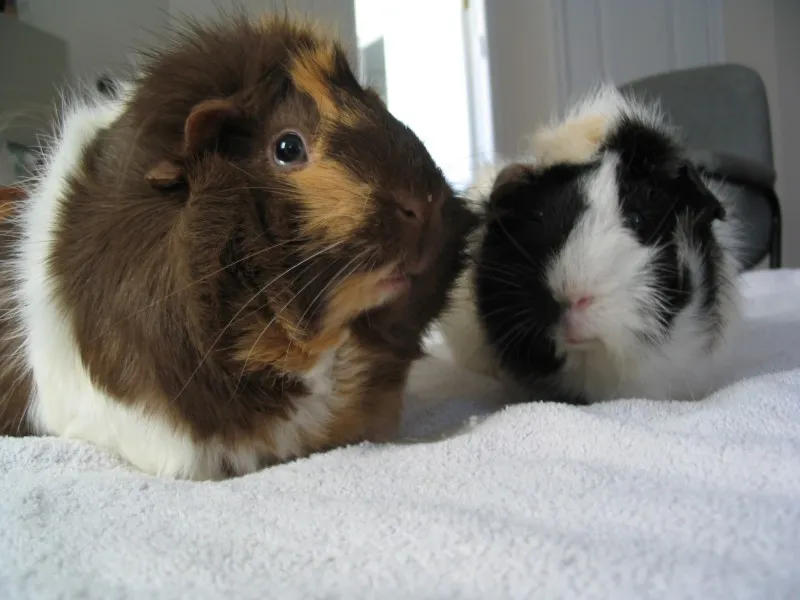
Adults are 20–25 cm long and weigh roughly 0.7–1.2 kg, with males (boars) usually a little larger than females (sows). They keep growing until they are about a year old or a little more. There are four toes on each front foot and three on each hind foot, and no visible tail.
Short legs and a heavy body make them poor jumpers and climbers. Falls from height injure them easily, and a large flat floor suits them far better than tall multi-level housing.
4.2. Teeth and digestion
Guinea pigs have 20 teeth, four incisors and sixteen cheek teeth, and all of them grow continuously. Unlike rabbits they have no extra peg teeth, and their incisors are white. When the lower molars overgrow they can arch inward over the tongue and trap it, a painful condition that stops the animal eating.
Their gut is built to ferment fibre, and they re-ingest nutrient-rich caecal droppings. The gene for the final enzyme in vitamin C synthesis does not work in guinea pigs, so any shortfall in dietary vitamin C shows up quickly.
4.3. Senses and coat
Side-set eyes give guinea pigs a wide field of view, and they appear to see some colour, but their depth perception is poor, which is one reason they misjudge edges and fall. Their hearing and sense of smell are sharp; they quickly learn the voices and rustling bags that predict food, and long whiskers help them gauge narrow gaps.
Coats range from short and sleek to floor-length, curly, wiry or swirled into rosettes, and there are almost hairless breeds too. Boars have a grease gland near the base of the spine that can make the fur there sticky and benefits from occasional cleaning.
4.4. Telling boars from sows
With gentle pressure above the genital area, a boar's penis appears as a rounded dot with the testicles felt either side, giving an overall lowercase i shape. A sow's genital opening forms a Y shape sitting close to the anus. Young pups are tricky to sex, so ask an experienced keeper or vet to confirm.
Older boars often develop impaction of the perineal sac, a fold around the anus where droppings accumulate, and need it checked and cleaned regularly.
5. Breeds and colours
Guinea pig clubs in the United States and Britain recognise a range of breeds defined mainly by coat length, texture and pattern. The best known are summarised below.
| Breed | Coat | Notes and care |
|---|---|---|
| American (English) | Short and smooth | The most common and easiest to groom |
| Abyssinian | Short with multiple rosettes | Tufts stick out in every direction |
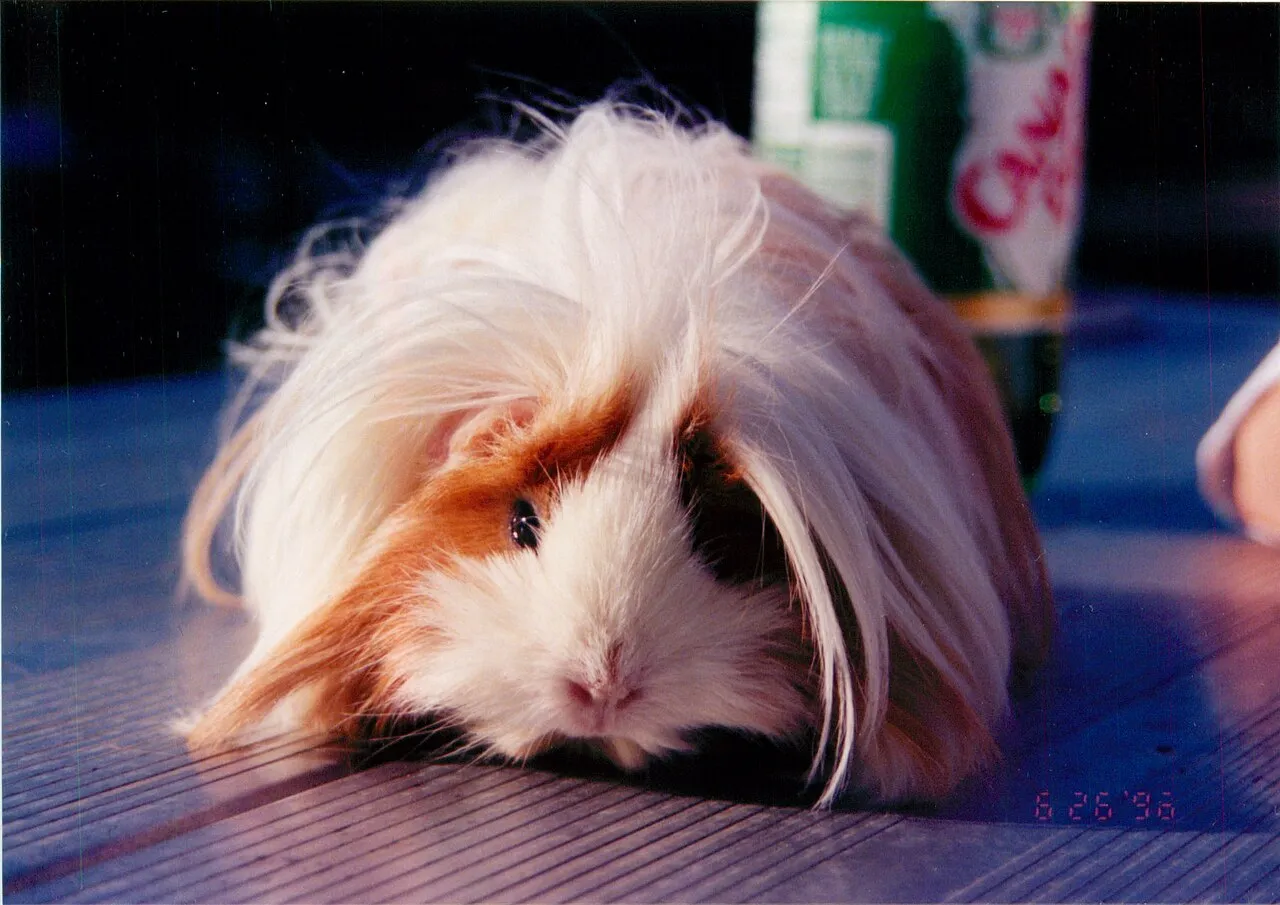
| Peruvian | Long, falling forward over the face | Hair can exceed 30 cm and needs daily care |
| Silkie (Sheltie) | Long, sweeping backwards | Short face, long train behind |
| Coronet | Long with a crown rosette | Essentially a Silkie with a crest |
| Teddy | Short, dense and kinked | Plush feel, ears need regular checks |
| Texel | Long and curly | Tangles easily, high maintenance |
| Crested | Short with one forehead rosette | The White Crested has a contrasting white crown |
| Rex | Short, coarse and wavy | Larger and wirier than the Teddy |
| Skinny pig and Baldwin | Nearly hairless | Need a reliably warm environment |
Colours and patterns include wild-type agouti, Dutch (coloured patches on white), tortoiseshell (a patchwork of red and black), Himalayan (white with dark points), roan (coloured and white hairs intermixed) and dalmatian.
Two genetic issues are worth knowing. Mating two roans or two dalmatians can produce lethal whites, pups with tiny or missing eyes and dental defects. Satin-coated lines, prized for their sheen, have been linked to fibrous osteodystrophy, a bone-weakening disease, and some breeders avoid the satin gene for that reason.
6. Behaviour
6.1. Herd life and daily rhythm
Wild cavies live in groups of a few to a dozen or so animals in grassland and rocky scrub. Rather than digging deep burrows they shelter in burrows made by other animals, in thick vegetation or among rocks, and they travel along regular runways to graze.
Pet guinea pigs divide their day into many short naps and meals. They rarely sleep for long at a stretch, often dozing for a few minutes with their eyes open. They are active on and off around the clock but tend to be busiest around dawn and in the evening.
Groups have a pecking order, and members of either sex settle disputes by raising their heads in a nose-to-nose standoff. Most arguments end there, but cramped housing or too few hides can turn posturing into real fights.
6.2. A vocal animal
It is no exaggeration to call the guinea pig the most talkative of small pets. The main sounds are:
| Sound | What it sounds like | Meaning |
|---|---|---|
| Wheek | Loud, drawn-out whistle | Anticipating food or calling for you |
| Low purr | Soft, deep vibration | Contentment |
| Short high purr | Clipped, higher-pitched | Irritation or unease |
| Rumble | Deep rumble with a swaying walk | Courtship or asserting dominance |
| Chut | Short, repeated clucks | Contented exploring |
| Teeth chattering | Rapid clicking | Anger, a warning to back off |
| Squeal or shriek | Sharp, loud cry | Pain or fear |
| Chirping | Bird-like trilling | A rare sound whose meaning is not well understood |
Many guinea pigs learn to wheek at the front door, the fridge or the crinkle of a vegetable bag, and owners often joke that they never need an alarm to remind them about dinner.
6.3. Reading body language
- Popcorning: hopping straight up on the spot, usually in excited youngsters.
- Zoomies: a rapid lap of the enclosure, another happy sign.
- Freezing: going rigid at a strange noise while assessing danger.
- Lying stretched out flat: deeply relaxed and feeling safe.
- Raised fur and a stiff sideways walk: a threat display or dominance.
- Staying hidden constantly: nervousness in a new home, or a possible sign of illness.
- Barbering, chewing a cagemate's fur: dominance, boredom or stress.
A newly arrived guinea pig often hides for several days, which is normal. Offering a piece of vegetable on a flat palm and letting it come to you builds trust far faster than pulling it out of its hide.
7. Life stages
Guinea pigs are precocial: they are born furred, with open eyes and a full set of teeth, which makes their development very different from that of most rodents.
| Stage | Age | What happens |
|---|---|---|
| Newborn | 0–1 week | Born furred, eyes open, about 60–120 g |
| Nursing | 1–3 weeks | Drinks milk while already eating hay and greens |
| Weaning | about 3 weeks | Weaned, and males must be separated from mother and sisters |
| Sexual maturity | 3–6 weeks | Pregnancy is possible remarkably early |
| Juvenile | 2–6 months | Rapid growth and lots of popcorning, best rehomed from about 6–8 weeks |
| Adult | 1–4 years | Full size and settled temperament |
| Senior | from about 5 years | Weight loss, stiff joints, more dental problems and lumps |
The typical lifespan is five to eight years, and well-kept individuals sometimes live longer. With age the coat coarsens, nails thicken, activity drops and weight slowly falls. Weekly weigh-ins make it much easier to tell normal ageing from illness.
Seniors may struggle with ramps and high-lipped hides, so swap in low-entry shelters, and if chewing becomes difficult, offer chopped hay and softened pellets. When one of a pair dies, the survivor may grieve and stop eating, so talk to your vet or an experienced keeper about introducing a new companion.
8. Housing
8.1. Space and enclosures
For two guinea pigs, provide at least 0.7 m² of floor (about 120 × 60 cm), and preferably 1 m² or more, adding space for each extra animal. Because they barely climb, floor area matters far more than height, and any low second level needs a gentle ramp and side rails.
Many commercial small-animal cages are too small for a pair. Keepers around the world have adopted so-called C&C cages, built from wire storage-cube grids and a corrugated plastic base, because they can be assembled to almost any size. Walls need not be high, but a lid or a secure room is essential if cats or dogs share the home.
8.2. Bedding and hides
Absorbent paper bedding or washable fleece liners over an absorbent layer are the usual choices. Guinea pigs produce a lot of urine, so the corners they favour need changing daily to control smell and prevent foot problems. Avoid cedar and pine shavings and cover any wire floor completely.
Provide at least one hide per animal, plus one extra, to reduce squabbles. Tunnel-style hides with two exits stop a timid pig being cornered, and a generous pile of hay doubles as both shelter and entertainment.
8.3. Temperature and humidity
Guinea pigs do best at 18–24°C with humidity of roughly 40–70%. Fur-covered and almost unable to sweat, they face heatstroke above about 27°C, and long-haired or overweight animals are even more vulnerable. Keep them away from sunny windows and balconies, and use air conditioning in hot spells.
They also dislike cold and drafts, and spaces below about 15°C invite respiratory infections. Hairless skinny pigs and Baldwins need extra warmth, ideally 22°C or more.
8.4. Shopping list
- An enclosure with at least 0.7 m² of floor for two, such as a C&C cage
- Paper bedding or fleece liners with an absorbent layer
- More hides and tunnels than there are guinea pigs
- A large hay rack
- Two or more heavy ceramic bowls
- Water bottles or bowls, ideally one per animal
- A kitchen scale
- Small-animal nail clippers and combs (wide and fine for long-haired breeds)
- A carrier
- Wooden chews and apple sticks
9. Diet
Guinea pigs are strict herbivores. Grass hay such as timothy or meadow hay is the foundation and must be available all day to wear the teeth and keep the gut moving. On top of that come vitamin C-fortified guinea pig pellets and fresh vegetables.
| Category | Examples | Guide amount |
|---|---|---|
| Grass hay | Timothy, meadow, orchard grass | Unlimited, topped up several times a day |
| Pellets | Vitamin C-fortified guinea pig pellets | About 1–2 tablespoons per pig per day |
| Vegetables | Bell pepper, romaine, coriander, endive, cucumber, bok choy | About a cup per pig per day, varied |
| High-calcium or high-oxalate greens | Spinach, kale, parsley | Small amounts once or twice a week |
| Fruit treats | Apple without seeds, kiwi, strawberry, blueberries | Small pieces once or twice a week |
Adults need roughly 10–30 mg of vitamin C per kg of body weight daily, and more during pregnancy or illness. Red bell pepper is the richest everyday source. Vitamin C in pellets degrades over time, so avoid old stock and store pellets somewhere cool and dark. Adding vitamin drops to the water is discouraged because the vitamin breaks down quickly and the taste can make guinea pigs drink less.
Never feed onions, garlic, chives or other alliums, potatoes or sprouting potatoes, avocado, dairy products or meat, chocolate, crisps or bread, rabbit pellets that lack vitamin C, or toxic plants such as rhododendrons and lilies. Add new vegetables one at a time and in small amounts.
10. Health and disease
Guinea pigs mask illness so as not to look weak within the group. Weekly weighing and daily checks of appetite and droppings are the foundations of good health care, and treatment should come from an exotic vet who sees guinea pigs regularly.
10.1. Common conditions
| Condition | Cause | Main signs | Prevention and response |
|---|---|---|---|
| Scurvy | Vitamin C deficiency | Swollen joints, limping, bleeding gums, rough coat, poor appetite | Daily fresh vegetables and fortified pellets |
| Bladder stones | Excess calcium, low water intake, genetics | Bloody urine, squeaking while urinating, hunching | Limit high-calcium foods, encourage drinking |
| Respiratory infection and pneumonia | Bordetella and other bacteria, drafts | Nasal discharge, crusty eyes, noisy breathing, poor appetite | Avoid drafts, see a vet quickly |
| Mange | Trixacarus caviae mites | Intense itching, hair loss, scratching so violent it can resemble a seizure | Antiparasitic treatment for all cagemates |
| Ringworm | Fungal infection | Round bald, scaly patches on the face and ears | Treatment, and note it can spread to people |
| Dental disease | Too little hay, genetics, scurvy | Drooling, dropping food, weight loss | Plenty of hay, regular dental checks |
| Ovarian cysts | Very common in older sows | Symmetrical hair loss on the flanks, swollen belly | Check-ups, discuss surgery or hormone treatment |
| Bumblefoot | Wet or hard floors, obesity | Swollen, scabbed footpads | Clean soft flooring, weight control |
| Cervical lymphadenitis | Bacterial infection | Lumps under the jaw or neck | Avoid sharp, stalky hay, see a vet |
| Heatstroke | Temperatures above about 27°C | Lethargy, rapid breathing, drooling | Cool immediately and seek emergency care |
Guinea pigs are dangerously sensitive to certain antibiotics, including several penicillins, which can wreck their gut flora. Only use medicines prescribed by a vet experienced with guinea pigs. A bulge of tissue under the lower eyelid, nicknamed pea eye or fatty eye, is usually a harmless trait, but one that appears suddenly should still be checked.
10.2. When to see a vet
- Not eating for half a day, or smaller and fewer droppings
- Weight loss of more than about 50 g in a week, or a steady decline
- Noisy breathing, nasal discharge or crusty eyes
- Blood in the urine or crying while urinating
- Limping or swollen joints
- Drooling or food falling from the mouth
- Frantic scratching or sudden heavy hair loss
- A pregnant sow straining near term without producing a pup
- Lethargy and fast breathing on a hot day
11. Breeding
Guinea pigs can conceive astonishingly young, from about three to six weeks, so accidental litters between siblings or between mother and son are common. Male pups must be separated from their mother and sisters at around three weeks.
Pregnancy is long for a rodent, about 59–72 days, and litters are usually two to four pups, occasionally one to six. Because the pups are born large and well developed, birth is demanding. The joint between a sow's pelvic bones tends to fuse after about six to eight months of age, and a sow that has her first litter after that point may be unable to deliver, endangering both mother and young. Pregnancy toxaemia is another serious late-pregnancy risk.
Sows come back into season within hours of giving birth, so a boar left with a pregnant sow will almost certainly get her pregnant again immediately. Mixed-sex pairs are usually managed by neutering the boar, and since he can remain fertile for several weeks after surgery, keep them apart for that period.
Breed only if you can handle the risk of a difficult birth, guarantee lifelong homes for every pup and provide extra housing to separate the sexes. Breeding to sell may also bring licensing obligations, so check local rules first.
12. Costs
Because guinea pigs should live in at least pairs, it makes sense to budget for two. All amounts are rough estimates in Korean won.
| Item | Approximate cost (KRW) | Notes |
|---|---|---|
| Guinea pig, per animal | 30,000–150,000 | Varies with breed and source |
| Cage or C&C enclosure | 70,000–200,000 | Generous size |
| Hides and tunnels | 30,000–60,000 | More than one per pig |
| Bedding or fleece liners | 30,000–60,000 | |
| Hay rack, bowls, bottles | 20,000–50,000 | |
| Scale, carrier, nail clippers | 30,000–50,000 | |
| Setup total | about 250,000–450,000 | More once two animals are included |
| Monthly hay | 20,000–40,000 | For a pair |
| Monthly vegetables and pellets | 20,000–30,000 | |
| Monthly bedding | 10,000–20,000 | |
| Monthly total | about 50,000–90,000 |
Vet costs depend on the problem and the clinic. A consultation with basic tests typically runs to tens of thousands of won, and procedures needing anaesthesia, such as bladder stone or ovarian surgery, can cost several hundred thousand or more. Over the five to eight years a pair may live, total spending in the millions of won is realistic.
13. Before you get one
- Do you have the space and budget for at least two?
- Can you buy and prepare fresh vegetables every day, including holidays and busy weeks?
- Is your household happy with loud wheeking every morning and evening?
- Is anyone allergic to hay dust or guinea pig dander?
- If a child is the main carer, will an adult check daily care?
- Is there a vet nearby who treats guinea pigs?
The easiest start is a same-sex pair of siblings or an established, already bonded pair. If you want a mixed pair, choose a neutered boar. To add a newcomer to an existing pig, keep it separate for about two weeks to check its health, then introduce them slowly on neutral ground.
A healthy guinea pig has clear eyes, a dry nose, a glossy coat and no scabs or bald patches. Its rear should be clean, it should move briskly and it should feel firm and solid in the hand. If a sow has been housed with males, assume she may be pregnant until proven otherwise.
14. Laws and regulations
Guinea pigs are legal to keep virtually everywhere, and the notable regulations concern how they are kept rather than whether you may own one. Switzerland is the famous example: its animal welfare rules require social species such as guinea pigs to have contact with others of their kind. The popular claim that it is illegal to own a single guinea pig in Switzerland is a simplification of that welfare principle.
In South Korea, guinea pigs are one of six animals defined as companion animals under the Animal Protection Act's enforcement rules. Businesses that sell or breed them can fall under licensing requirements, and the prohibitions on cruelty and abandonment apply, but individual owners do not need to register them.
If you intend to breed or sell, check with your local authority, and anyone importing guinea pigs across borders should confirm quarantine and health certificate requirements with the destination's veterinary authority.
15. Guinea pigs in culture
The guinea pig is woven into Andean culture. In Cusco Cathedral in Peru hangs an 18th-century Last Supper by the indigenous painter Marcos Zapata in which Christ and the apostles sit down to a platter of roast cuy. Peru is also reported to have an official national day for the cuy, and regional cuy festivals are held across the Andes.
In English, to be a guinea pig is to be the first to try something untested. During the Second World War, airmen who underwent pioneering reconstructive surgery for burns under the surgeon Archibald McIndoe proudly called themselves the Guinea Pig Club.
On screen, Disney's G-Force (2009) followed a squad of guinea pigs trained as secret agents, and online, photos of guinea pigs in tiny hats and videos of them munching through mountains of vegetables are perennial favourites.
16. Trivia
- Being in the same family as the capybara, guinea pigs are sometimes affectionately called pocket capybaras.
- Pups are born with all their teeth and start nibbling hay alongside their mother within a day or two.
- Hairless skinny pigs are generally traced to a natural mutation that appeared in a laboratory colony in the 1970s.
- Along with humans, some other primates and certain fruit bats, guinea pigs are among the few mammals that cannot make their own vitamin C.
- Long-haired breeds such as the Peruvian grow hair so fast that many pet owners keep it trimmed short.
- Guinea pigs have little sense of the danger of heights and often injure themselves by leaping off a lap without warning.
- International media have reported on a Swiss service that rents out companion guinea pigs to animals who have lost their partner.
- The sea in the German name refers to the voyage across the ocean from the Americas, not to any aquatic lifestyle.
Health notes are general information. If something seems wrong, contact a vet who treats this species.
FAQ
Can two males live together?
Often yes, especially brothers or an older and younger boar. Fights are more likely in cramped cages or when females are nearby, so provide plenty of space and duplicate hides, bowls and hay racks.
My guinea pig eats its own droppings. Is that normal?
Completely normal. They re-ingest special soft droppings called caecotrophs, which are rich in B vitamins and protein produced by gut bacteria.
Which vegetables are safe every day?
Bell pepper, romaine, coriander, endive and cucumber are good daily staples. Carrots and fruit are sugary treats for once or twice a week, and introduce any new vegetable in small amounts while watching the droppings.
Further reading
- 🗳️ A child's first pet: hamster or guinea pig?
- 🗳️ Do guinea pigs really need a companion?
- 🏠 How to Adopt a Shelter or Rescue Animal
- 🐾 The First Week Home With a New Pet
- ☀️ Keeping Pets Safe in Summer Heat
- 🦎 Finding an Exotic Pet Vet and Planning Checkups
Photo credits
Photos are freely licensed images from Wikimedia Commons. Authors and licenses are listed below.
- George the amazing guinea pig.jpg — Unknown · CC BY-SA 3.0
- Guinea pig 2011 01 10 12 58 15.jpg — Alex Lozupone · CC BY-SA 4.0
- Nibbles and strips 2.jpg — Jmajonis · CC BY-SA 3.0