TailVille
At a glance
Rough ranges for supplies, food and electricity in Korea (USD is approximate). Purchase or adoption fees are not included.
First-time bird keepers and apartment dwellers who want a lively, talkative companion without big-parrot volume.
People bothered by feather dust and scattered husks, or who would leave a single bird alone most of the day.
1. Overview
The budgerigar is a small parrot from the dry grasslands and scrub of inland Australia. Most English speakers call it a budgie, and in North America it is often sold simply as a parakeet. At around 18 cm including the tail and 30 to 40 grams, it fits in the palm of your hand, yet its intelligence and social needs are far bigger than its body.
It is widely regarded as the most commonly kept parrot on the planet. Budgies are cheap, breed readily and adapt well to indoor life, which is why so many people start their bird-keeping journey with one. That does not make them low-effort ornaments. They evolved to live in noisy, mobile flocks, and a bored or lonely budgie can develop problems such as feather-plucking or constant screeching.
Males are gifted mimics, and a vocabulary of several dozen words is not unusual. Wild birds are a fairly uniform green with a yellow face and black scalloping, but more than 170 years of captive breeding have produced an enormous palette of blues, whites, yellows, greys and violets. This article covers classification, history, anatomy, behaviour, housing, diet, health, breeding, costs, legal points and the budgie's place in culture.
2. Name and classification
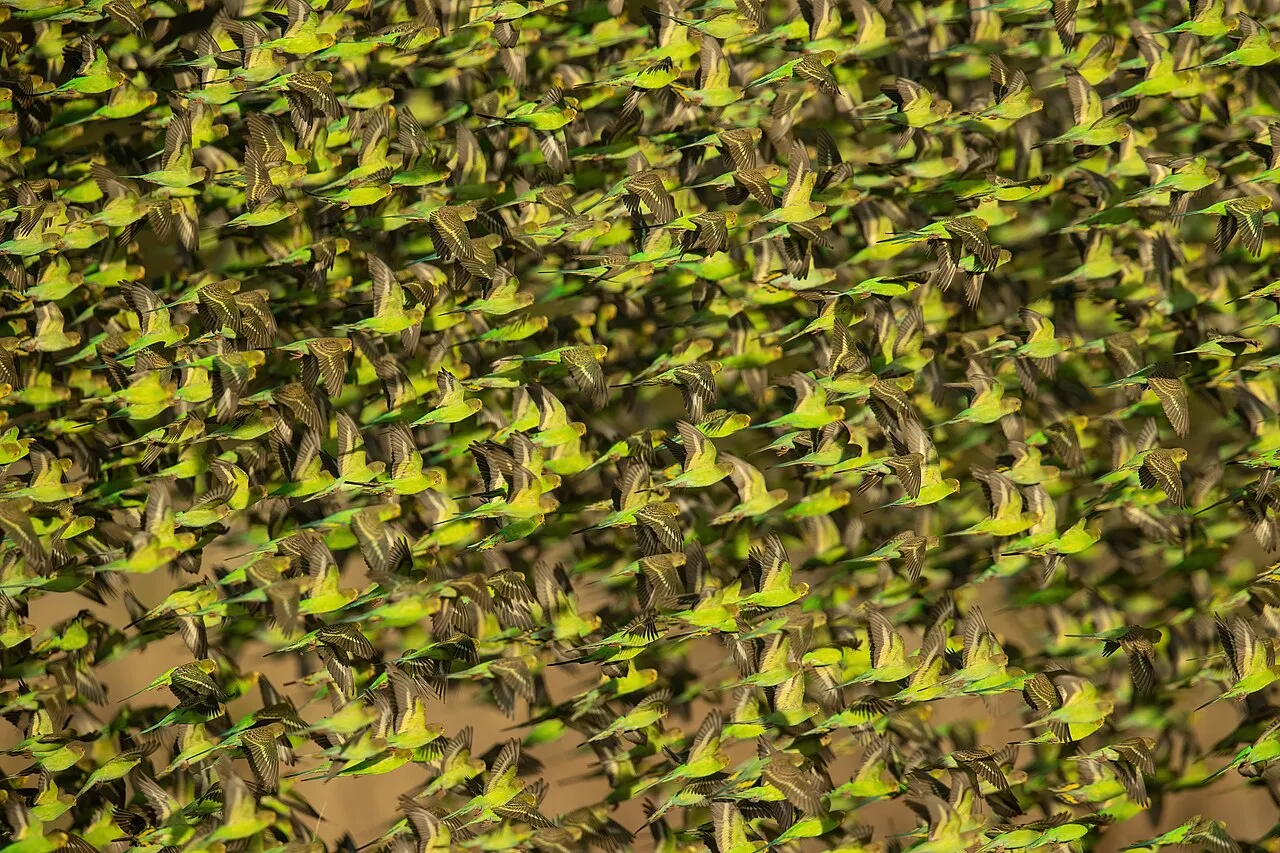
JJ Harrison · CC BY-SA 3.0
2.1. Scientific name and etymology
The scientific name is Melopsittacus undulatus. The genus name joins the Greek melos, meaning song or melody, with psittakos, meaning parrot, so it translates roughly as 'song parrot'. The species name undulatus is Latin for 'wavy', a nod to the black scalloped barring on the head and back. The English naturalist George Shaw first described the bird in 1805, and John Gould gave it its current genus around 1840.
The word budgerigar is generally thought to come from an Aboriginal Australian language. Which language, and whether the original meaning was 'good bird' or 'good to eat', is still disputed, so treat any confident translation with caution.
2.2. Korean names
In Korea the bird is best known as ingkko, a loanword from the Japanese inko, which originally covered a broad group of small long-tailed parrots. Over time Koreans came to use ingkko almost exclusively for the budgie. The more formal Korean name, sarang-aengmu, literally means 'love parrot' and refers to the affectionate way bonded pairs touch beaks and preen each other. Korean hobbyists also borrow the English word 'budgie', and use 'English budgie' or 'show budgie' for the large exhibition type.
2.3. Taxonomy and relatives
The budgie belongs to the order Psittaciformes and the family Psittaculidae, and it is the only species in its genus. Because of its shape it was long assumed to be close to Australia's grass parakeets, but molecular studies have instead grouped it near the lories, lorikeets and fig parrots. Parrot taxonomy is still being revised, so check recent literature for the finer subfamily and tribe placements.
Other Australian pet birds such as the cockatiel and Bourke's parakeet are in different genera altogether. The similarly sized lineolated parakeet is often confused with the budgie, but it comes from Central and South America and has a quieter, more deliberate personality.
3. History
3.1. From the outback to the world
Aboriginal Australians knew the budgie long before Europeans arrived, but live birds only reached Europe in meaningful numbers around 1840, when the naturalist and bird artist John Gould returned to England from Australia with specimens. Small, colourful and eager to breed, the budgie quickly became fashionable among wealthy European households.
Demand was so high that huge numbers of wild birds were trapped and shipped out, many dying on the long sea voyage. Australia eventually restricted the export of wild birds in the late nineteenth century, by which point large breeding establishments in Belgium, France, Germany and Britain were supplying the market. Yellow birds appeared in European aviaries in the later 1800s, followed by blue, and the hunt for new colours was on.
In the twentieth century British fanciers formed specialist societies and began judging birds on shape and feathering. Selection for exhibition produced the big-headed, heavily feathered show type now called the English budgie, while ordinary homes continued to keep the slimmer pet type that looks much closer to the wild bird.
3.2. Arrival and popularity in Korea
Nobody seems to have recorded exactly when the first budgies reached Korea. The Japanese-derived name suggests they came by way of Japan, and by the 1970s and 1980s they were a common sight in city bird markets and neighbourhood pet shops. Back then a pair would often live in a small round cage on a diet of nothing but seed.
From the 2000s online bird-keeping communities spread better information about pellets, larger cages and avian veterinary care. Budgies are increasingly seen as decade-long family members rather than cheap disposable pets, and hand-raised birds and unusual colour mutations are now in demand.
4. Physical characteristics
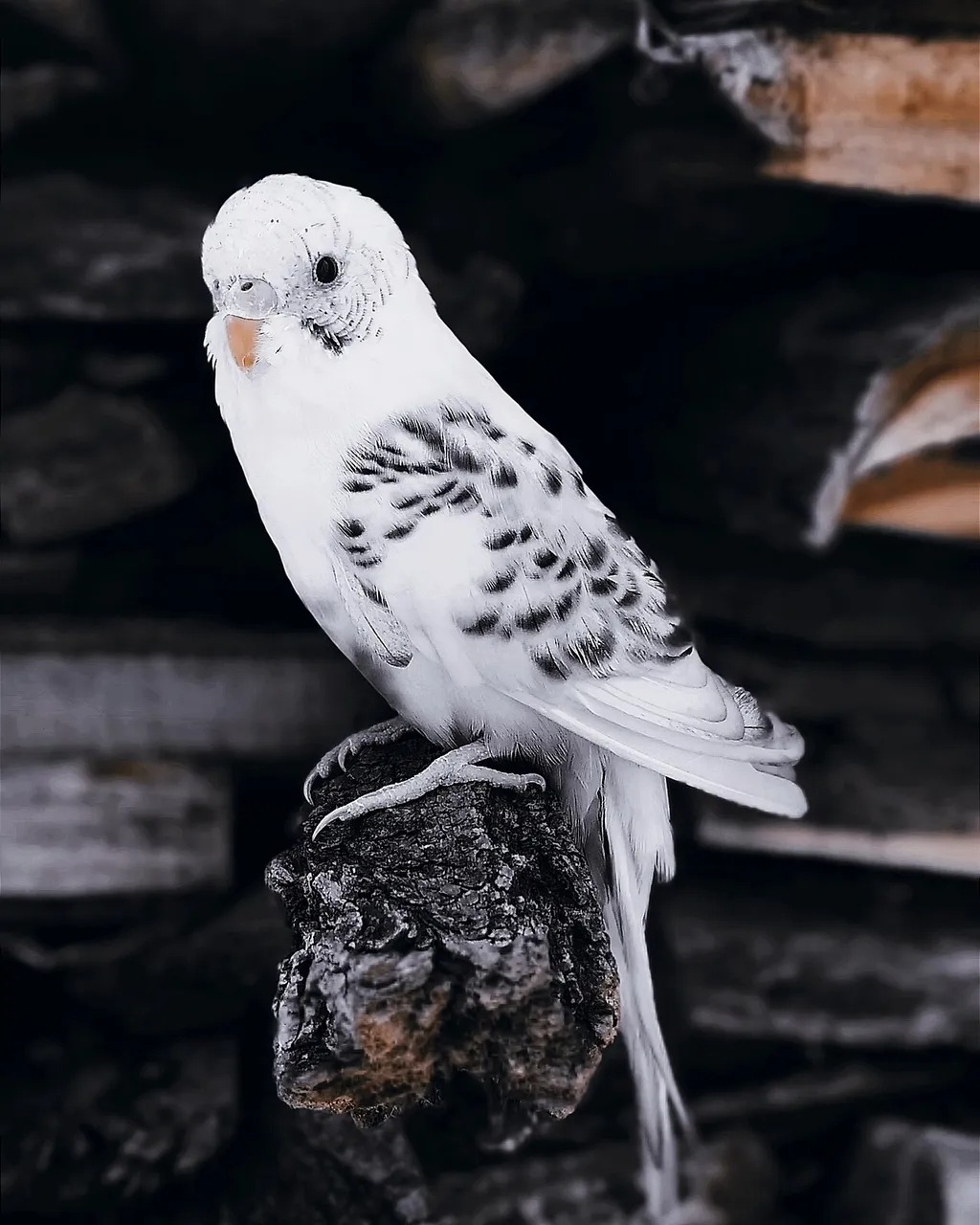
Saif-ul Islam Shah 007 · CC BY-SA 4.0
4.1. Size and build
Wild and pet-type budgies measure about 18 cm and weigh 30 to 40 grams. Nearly half that length is the slender, tapering tail, and the long pointed wings are built for fast, direct flight. The English show type can exceed 20 cm and weigh 45 to 60 grams, with puffed-up head feathers that make the face look broad and round.
Like all parrots, budgies have zygodactyl feet, with two toes pointing forward and two back, giving a strong grip for perching, climbing and holding food. The hooked upper beak grows continuously, so regular chewing is part of keeping it in shape.
4.2. Plumage and markings
Wild-type budgies have a bright green body, a yellow face and forehead, and dense black scalloping on a yellow ground from the back of the head across the wings. Each cheek carries a violet-blue patch, and a row of roughly six black throat spots sits below the face. The spot pattern varies slightly between individuals, which can help tell similar birds apart.
The green colour is produced by yellow pigment combined with feather structure that scatters blue light. Remove the yellow pigment through mutation and you get a blue bird; remove the blue structural effect and you get a yellow one.
4.3. Senses
Budgies see into the ultraviolet range. Their yellow forehead and cheek feathers fluoresce under UV light, and researchers have reported that this glow plays a role in mate choice. For that reason many avian vets recommend natural daylight or a full-spectrum bird lamp for indoor birds.
With eyes on the sides of the head, a budgie has a very wide field of view but a narrow zone of binocular vision straight ahead, which is why it tilts its head to inspect new objects with one eye at a time. Its hearing covers a similar range to ours, but it is particularly good at tracking rapid changes in sound, which helps explain its talent for copying short words and whistles.
4.4. Telling males from females
In adults, sex is usually judged by the cere, the patch of skin around the nostrils above the beak. Males typically show a smooth blue or purplish-blue cere, while females range from pale whitish-blue to beige, turning crusty brown when in breeding condition. Males of some mutations, including lutino, albino and recessive pied, keep a pink or lilac cere for life, which makes sexing by eye unreliable.
Chicks under three or four months have pinkish or pale lilac ceres in both sexes. Young males often have a more evenly coloured pink cere, while young females may show a whitish ring around the nostrils, but even experienced breeders get it wrong. A DNA test from a feather or blood sample is the dependable answer. If an older male's cere turns brown, have him checked, because hormonal changes such as testicular tumours can cause it.
5. Colour mutations and types
Budgie colours are easiest to understand in three layers: the base series (green or blue), the depth of colour set by the dark factor, and pattern mutations on top. Combine several and the names get long; a 'cobalt opaline spangle', for example, is a blue-series bird with one dark factor plus the opaline and spangle patterns.
| Name | Key features | Notes |
|---|---|---|
| Light green | Green body, yellow face like the wild bird | The basic wild type |
| Sky blue | Blue body, white face | Blue series lacks yellow pigment |
| Cobalt and mauve | One dark factor gives cobalt, two give greyish mauve | Green-series equivalents are dark green and olive |
| Violet | Vivid purple tone | Most striking combined with cobalt |
| Lutino | All-yellow bird with red eyes | Sex-linked, more common in hens |
| Albino | All-white bird with red eyes | The blue-series counterpart of lutino |
| Opaline | Reduced barring on head and neck, body colour on the back | Gives a V-shaped wing pattern |
| Cinnamon | Black markings turned brown | Soft, warm look |
| Greywing and clearwing | Wing markings grey or almost absent | Strong contrast with body colour |
| Spangle | Each wing feather has a dark edge and a pale centre | Became known from Australia in the 1970s |
| Pied | Patches of clear, unmarked feathers | Dominant, recessive and clearflight forms exist |
| Crested | Tuft or circular crest on the head | Breeders avoid pairing two crested birds |
There are also two broad body types: the slim pet type and the large English show type. Show budgies are often calm and laid-back, but some vets and keepers report shorter lifespans and more obesity and tumours. A rare inherited condition in heavily feathered lines, nicknamed 'feather duster', causes endlessly growing plumage and a short life, so affected lines should not be bred.
6. Behaviour
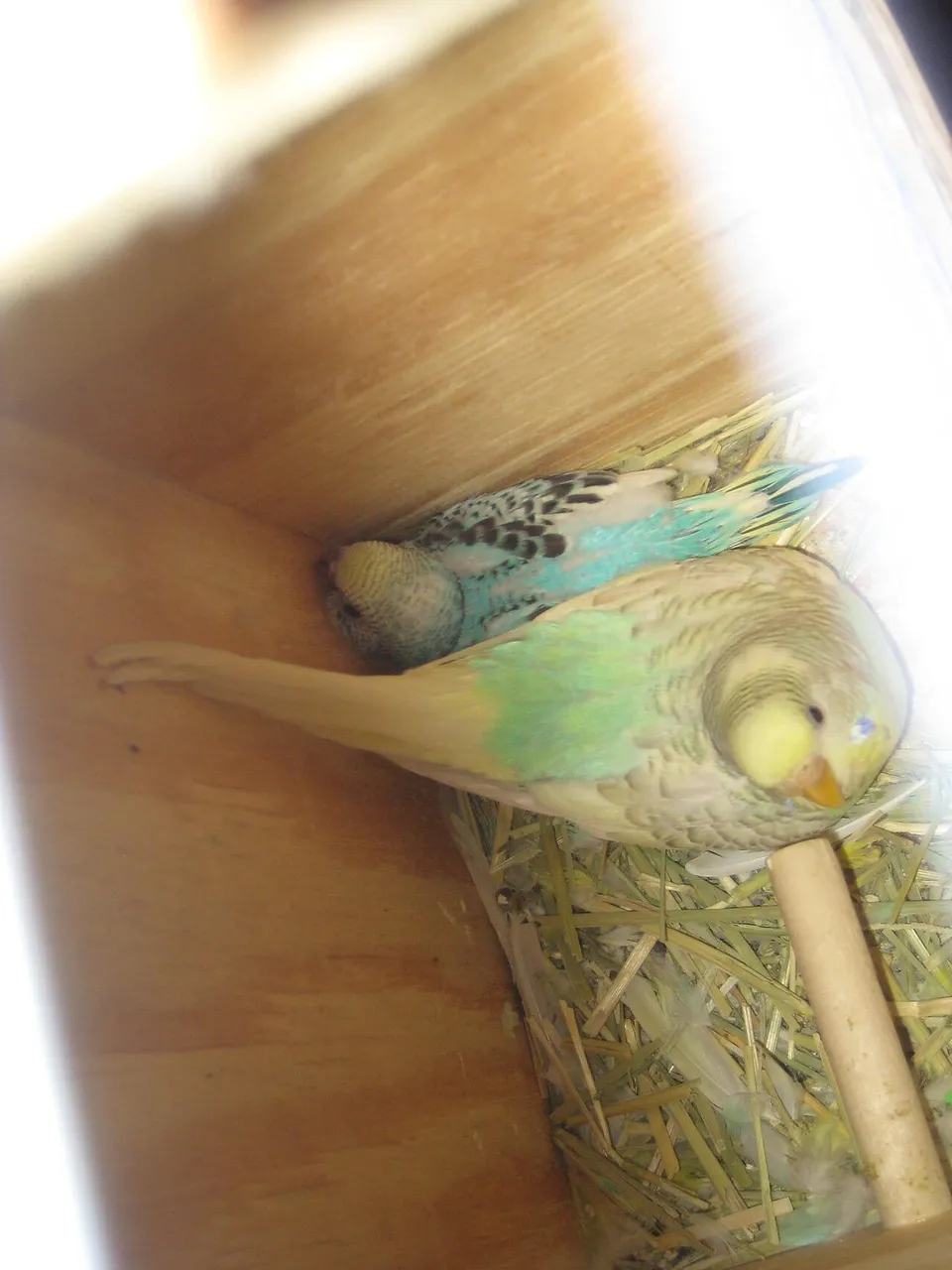
Koala234 · CC BY-SA 4.0
6.1. Life in the wild
Wild budgies are nomads. Rainfall in inland Australia is unpredictable, so flocks travel hundreds of kilometres to wherever rain has brought grasses into seed. In good years they gather in swirling flocks of many thousands.
A typical day begins at a waterhole, where the flock drops down together, drinks quickly and leaves. They spend the morning picking fallen seeds from the ground, shelter in tree shade through the midday heat, and feed again later in the day. Breeding follows rain and the burst of food it brings, with pairs nesting in hollows in eucalyptus and other trees. Constant chatter keeps every bird aware of where the others are and whether danger is near.
6.2. Behaviour at home
Pet budgies keep their flock instincts. They call out when you walk into the room, head to the food bowl when you sit down to eat, and generally try to do what the group is doing. Chatter starts at sunrise, peaks again around dusk and fades once the room is dark.
Males will bob their heads and warble at a mirror or bell for long stretches, sometimes regurgitating seed to 'feed' the bird in the mirror. That is courtship behaviour, and too much of it can keep a bird permanently hormonal, so offer mirrors only occasionally. Hens tend to talk less but chew more enthusiastically and look for dark corners to nest in.
Talking usually begins between three and six months of age and develops most during the first year. Repeat the same cheerful word in the same situation every day. Budgies speak in a fast, small, slightly buzzy voice, so early attempts can be hard to recognise.
6.3. Reading body language
- A quick fluff followed by a shake: relaxed, resetting the feathers.
- Staying fluffed with eyes closed: sleepy, cold or unwell; if it lasts through the day, check its health.
- Rapid head-bobbing: courtship, excitement or keen interest, mostly in males.
- Pupils rapidly shrinking and widening (pinning): excitement or focus; with a stiff posture it can mean the bird is on guard.
- Soft beak grinding: contentment, often heard just before sleep.
- Perching on one leg: a settled, comfortable resting posture.
- Wings held slightly away from the body: cooling off or stretching; open-beaked panting means it is too hot.
- Crouching low with sharp, short calls: alarm; look for what has startled it.
7. Life stages
Budgies typically live 7 to 12 years, and well-kept birds sometimes approach 15. Birds raised on seed alone in cramped cages often fail to reach five, so housing and diet make an enormous difference.
| Stage | Age | What happens |
|---|---|---|
| Egg | About 18 days of incubation | Laid every other day and incubated by the hen |
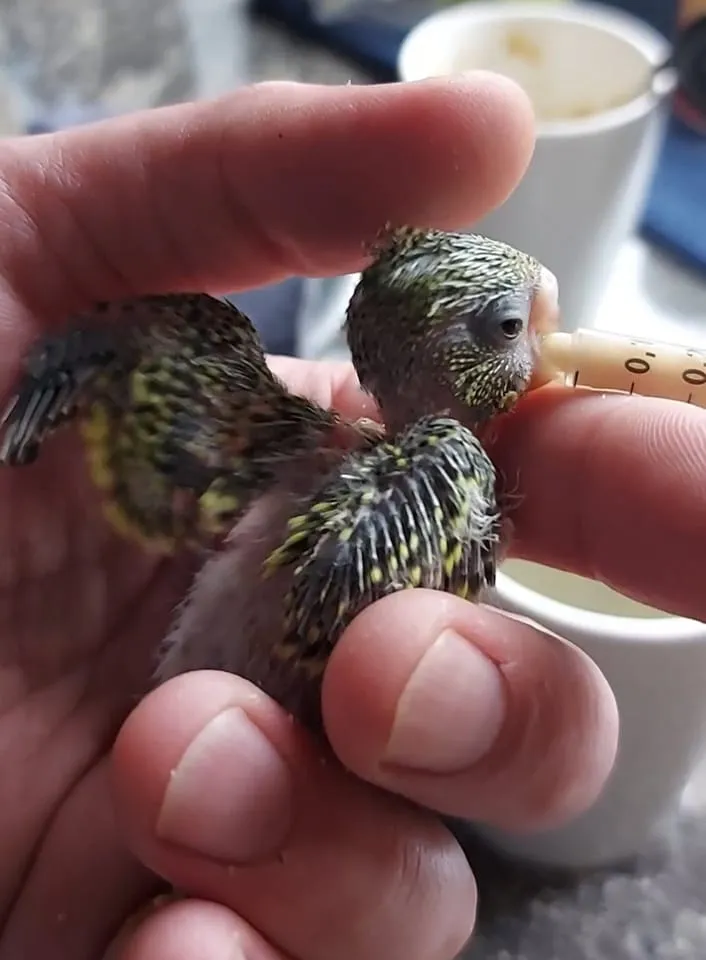
| Chick | 0 to 4 weeks | Hatches naked, eyes open around day 10, pin feathers at about two weeks |
| Fledgling | 4 to 6 weeks | Leaves the nest and practises flying while parents still feed it |
| Juvenile | 6 weeks to 4 months | Eats independently; barring reaches the forehead and eyes are solid black |
| Adolescent | 4 to 8 months | First moult clears the forehead, iris rings appear and cere colour settles |
| Adult | 1 to 6 years | Peak fitness and activity |
| Senior | 7 years and up | Slows down; tumour and organ disease risk climbs |
Ageing budgies fly less and spend more time on low perches or the floor. Nails and beak may overgrow, scales on the legs thicken, plumage loses gloss and moults drag on. Limping on one leg or a swollen belly is a classic warning sign of the kidney and reproductive tumours common in older budgies, so see a vet promptly. Lower the perches, add soft flooring and keep food and water within easy reach for a senior bird.
8. Housing
8.1. Choosing and placing a cage
For one or two budgies, 60 cm long, 40 cm deep and 50 cm high is the minimum, and longer is always better. Budgies fly horizontally, so a wide rectangular cage beats a tall narrow one, and round cages offer no corners to retreat into. Keep bar spacing at 1 to 1.2 cm or less so a head cannot get stuck.
Place the cage against a wall in a living area where people pass regularly; having at least one solid side helps the bird feel secure. Avoid kitchens, where cooking fumes and non-stick gases are a risk, and windows, where direct sun, drafts and the sight of cats or hawks outside can cause stress. Chest-to-eye height is ideal.
8.2. Temperature, humidity and light
Aim for 20 to 26°C. Healthy adults tolerate a fair range, but sudden swings are hard on them. If the room drops below 15°C in winter, partly cover the cage or add a bird-safe heat lamp or panel heater to create a warm zone. Above about 30°C a budgie will pant with beak open and wings held out, which calls for shade and ventilation. Humidity of 40 to 60 percent suits them.
Keep roughly 12 hours of daylight and 10 to 12 hours of darkness. Late nights under living-room lights and television noise lead to sleep-deprived, irritable birds and can keep hormones switched on. Window glass blocks most UV, so for an indoor-only bird a few hours a day under a full-spectrum avian lamp is worth considering.
8.3. Equipment checklist
- A wide cage with bars no more than 1 to 1.2 cm apart and a zinc- and lead-free finish
- Two or three natural-wood perches of different diameters, roughly 1 to 1.5 cm; skip sandpaper perches, which damage feet
- At least two food bowls and two water bowls so you can rotate them, or a drinker bottle
- Small-parrot pellets and a seed mix
- A cuttlebone or mineral block
- Several chew and foraging toys in wood, paper or palm leaf, rotated regularly
- A shallow bath dish or a fine mister
- A cage cover for night-time
- A digital scale reading in single grams for weekly weigh-ins
- A travel carrier for vet visits and emergencies
- Newspaper or plain uncoated paper for the cage floor
- A bird-safe heat source for cold months
9. Diet
9.1. Staple diet
For decades budgies were fed nothing but millet, canary seed and other small seeds. We now know that is not enough. Seeds are rich in fat and carbohydrate but short on vitamin A, calcium and certain amino acids, so a long-term seed diet leads to obesity, fatty liver and weakened respiratory linings. Budgies are also known for developing an enlarged thyroid, or goitre, when their diet lacks iodine.
The usual recommendation is a small-parrot pellet making up 50 to 70 percent of the diet, with the rest from seed and vegetables. Seed-addicted birds may not recognise pellets as food and can starve, so mix a few pellets into the seed and shift the ratio slowly over weeks or months. Weigh daily during the change and slow down if weight drops by more than about ten percent.
9.2. Vegetables, fruit and treats
Offer a little fresh veg every day. Dark, nutrient-dense choices such as bok choy, broccoli, kale, carrot, squash, bell pepper, cucumber, coriander and dandelion leaves are ideal, while watery iceberg lettuce adds little. Chop it finely or clip it to the bars on a skewer so eating becomes a game. Fruit like seedless apple, pear, blueberries or strawberries, a fingernail-sized piece two or three times a week, is plenty.
Millet spray is the classic treat and an excellent training reward, but it is calorie-dense, so limit it to a two- or three-centimetre piece a day. Sprouted seeds are easy to digest and highly nutritious, but make them fresh daily so mould never gets a chance.
9.3. How much and how often
An adult eats about 5 to 10 grams a day, roughly one to two teaspoons. Budgies hull their seeds and drop the husks back into the bowl, so a dish that looks full can contain nothing edible. Blow off or replace the husks each morning and change water at least daily.
- Pellets and seed: every morning, one day's portion
- Vegetables: a small amount daily, removed after two or three hours
- Fruit: small pieces two or three times a week
- Millet spray: about 2 to 3 cm a day, mainly as a reward
- Weigh-in: once a week at the same time of day
A gain or loss of close to ten percent over two weeks deserves a closer look at diet and health.
9.4. Foods to avoid
- Avocado: contains persin, which can cause fatal heart and breathing problems.
- Chocolate, coffee, tea and energy drinks: caffeine and theobromine strain the heart.
- Alcohol: dangerous in tiny amounts.
- Onion, garlic and chives: can damage red blood cells.
- Apple seeds and cherry, peach or apricot pits: contain compounds that release cyanide.
- Salty, greasy snacks, seasoned human food, milk and dairy.
- Raw dried beans and any mouldy seed or peanuts.
Beyond food, fumes from overheated non-stick cookware, scented candles and diffusers, aerosol air fresheners and cigarette smoke can all be lethal. A bird's respiratory system extracts gases from the air so efficiently that toxins we barely notice can overwhelm it.
10. Health and disease
Birds instinctively hide illness to avoid attracting predators, so by the time an owner notices symptoms the disease is often well advanced. Keeping a record of weight and droppings, and having a check-up with an avian or exotic-animal vet when you bring a bird home and yearly afterwards, is the best prevention. The information below is for understanding only; diagnosis and treatment belong with a vet.
10.1. Common conditions
| Condition | Cause | Main signs | Prevention |
|---|---|---|---|
| Tumours (lipomas, kidney and gonad tumours) | Genetics, obesity, age | Lumps, lameness in one leg, swollen abdomen | Pellet-based diet, exercise, regular check-ups |
| Scaly face (Knemidocoptes mites) | Burrowing mites | White honeycomb crusts on beak, cere and legs | Early treatment, quarantine newcomers |
| Megabacteria (Macrorhabdus) | Yeast-like organism in the stomach | Weight loss, regurgitating seed, undigested seed in droppings | Faecal tests, hygiene |
| Goitre | Iodine deficiency | Wheezing or clicking breath, trouble swallowing | Pellets and a balanced diet |
| Psittacosis (chlamydiosis) | Chlamydia infection | Eye and nasal discharge, lime-green loose droppings | Testing; zoonotic, so practise good hygiene |
| French moult (polyomavirus, PBFD and others) | Viruses | Young birds losing flight and tail feathers, unable to fly | Buy tested birds, quarantine |
| Egg binding and chronic laying | Low calcium, constant hormones | Straining, crouching, tail-bobbing | Remove nest sites, long nights, calcium |
| Bumblefoot | Obesity, hard or sandpaper perches | Red or scabbed soles, limping | Varied natural-wood perches |
Budgies are thought to develop tumours more often than many other parrots. Lameness in one leg is not always an injury; a kidney tumour pressing on the nerves to the leg can cause it, so never dismiss it.
10.2. When to see a vet
Contact an avian vet as soon as possible if you notice any of the following. A bird this small can deteriorate after a single day without food.
- Sitting fluffed with eyes closed for long periods during the day
- Pronounced tail-bobbing with each breath, or breathing through an open beak
- Unable to perch, huddled on the cage floor
- Droppings that turn black, red or lime green and watery, or almost no droppings at all
- Pretending to eat while losing weight
- Vomiting, or sticky matted feathers on the head and face
- Bleeding, especially from a broken blood feather
- A hen straining without passing an egg for more than a few hours
For the journey, cover the carrier with a towel to keep it dark and warm, and bring the latest cage-floor paper so the vet can see fresh droppings.
11. Breeding
Budgies are famously easy to breed in captivity, but easy does not mean casual. Hens can lay from about six months old, yet most experienced keepers wait until birds are at least a year old and fully mature. Once a nest box goes in, the hen starts spending time inside and the cock courts her by regurgitating food for her.
A clutch is usually four to six eggs, occasionally up to eight, laid every other day. The hen incubates for about 18 days while the male brings her food. Eggs hatch in the order they were laid, so the oldest chick can be much larger than the youngest. Chicks leave the nest at roughly four to five weeks and feed themselves by six to eight weeks.
Before breeding at home, ask yourself:
- Can I care for four to eight chicks, or find each one a reliable home?
- Do I know the parents' backgrounds well enough to avoid inbreeding?
- Is there an avian vet nearby for emergencies such as egg binding?
- Will I limit the pair to two clutches a year with proper rest in between?
If you don't plan to breed, skip the nest box and dark hidey-holes and give long nights; that alone prevents much unwanted laying. When a hen has already laid, swapping her eggs for dummy eggs and letting her sit can sometimes reduce repeated laying, but discuss the approach with your vet.
12. Costs
Prices vary a lot by country, city and clinic, so treat these as rough guides. In Korea a budgie usually costs the equivalent of about 10 to 50 US dollars, with hand-raised birds, rare colours and show types costing more. A suitable cage runs roughly 40 to 120 dollars, and perches, bowls and toys another 25 to 60. A first vet check including faecal and mite testing is commonly 25 to 80 dollars, more if infectious-disease PCR tests are added.
| Item | Typical range | Notes |
|---|---|---|
| Bird | Low tens of dollars | Hand-tame or unusual colours cost more |
| Cage | 40 to 120 dollars | Wide, solidly finished |
| Perches, bowls, toys | 25 to 60 dollars | Toys are consumables |
| First vet visit | 25 to 80 dollars | Tests add to the bill |
| Monthly food | 8 to 20 dollars | Pellets, seed, produce |
| Monthly supplies | 8 to 20 dollars | Paper, replacement toys |
| Annual check-up | 40 to 120 dollars | Depends on tests |
| Emergency or surgery | Several hundred dollars or more | Egg binding, tumour removal, hospital stays |
It is tempting to assume a small bird is cheap, but avian vets are fewer than dog and cat vets and diagnostic work is not inexpensive. Setting aside a little each month for veterinary care makes surprises far less stressful.
13. Before you get one
Before bringing a budgie home, answer these questions honestly.
- Can I commit for ten years or more, through moves, job changes and family changes?
- Do I have at least an hour a day to talk and play, and if not, can I keep a pair?
- Am I ready for early-morning chatter, feather dust and scattered husks?
- Is there an avian vet within reasonable reach?
- Are there cats, dogs, ferrets or other animals in the home that might hunt a bird?
- Does anyone in the household have bird allergies or asthma?
When choosing a seller, see the bird in person. Look for clear eyes, clean nostrils, a clean vent, intact wing and tail feathers and lively movement. Avoid overcrowded, dirty setups and sellers who wean chicks too early to sell them sooner. Young birds of two to four months, still with forehead bars, tame most easily, but adults can bond well too with patience.
For the first few days, keep the cage somewhere quiet and resist pushing your hand inside; let the bird settle first. If you already have birds, quarantine the newcomer in a separate room for at least 30 days and have it checked before introductions.
14. Laws and regulations
The budgerigar is one of only a handful of parrots exempted from CITES Appendix II, which covers almost every other parrot species. No CITES paperwork is needed to buy, sell or keep one in most countries.
A few general points still apply.
- Animal welfare laws in most countries, including Korea, cover birds, so cruelty and abandonment can be prosecuted. Check your local legislation for current details.
- Mandatory pet registration schemes, where they exist, usually apply to dogs rather than birds; check what your local authority requires.
- During outbreaks of highly pathogenic avian influenza, authorities may temporarily restrict the movement, sale and exhibition of birds.
- Taking a bird across borders involves veterinary import and export rules that differ widely between countries.
- Releasing a pet budgie outdoors is abandonment in many jurisdictions and usually a death sentence for the bird. In some warm regions escaped budgies have formed small feral groups, which is another reason not to release them. Rehome instead.
If you plan to breed and sell birds as a business, check whether a licence is required where you live.
15. Budgies in culture
Korean has the expression ingkko bubu, literally 'budgie couple', for a husband and wife who are visibly devoted to each other. It comes from the way paired birds lean together and preen one another; whether the original image was a budgie or a lovebird is unclear, but both have long served as symbols of a loving pair.
Their talking ability has made budgies record-breakers. An American budgie named Puck was credited by Guinness World Records with a vocabulary of more than 1,700 words, earning the title of the bird that knew the most words. In the internet era, videos of budgies singing songs or reeling off long phrases have drawn millions of views.
In Britain, Sarah Ferguson, Duchess of York, wrote the children's books Budgie the Little Helicopter, later turned into an animated series, with the hero named after the bird's nickname. In Australia the budgie is so familiar that tight men's swimming briefs are jokingly called 'budgie smugglers', a phrase that has even turned up in national political commentary.
16. Trivia
- Captive budgies are larger and far more varied in colour than their wild ancestors, which are almost uniformly green.
- Researchers have reported contagious yawning in budgies, one of the few cases documented in birds rather than mammals.
- Budgies are a favourite subject in animal cognition research, from number and shape discrimination to learning by watching other birds.
- The UV glow of their forehead feathers became widely known when pet photographers began shooting budgies under black light.
- Lacking sweat glands, budgies shed heat by panting with an open beak and holding their wings away from the body.
- A male's cere colour reflects his hormonal state so closely that vets use it as a health clue.
- Wild flocks dodge falcons by wheeling in unison at high speed. That explosive take-off habit is also why indoor budgies so often crash into windows and mirrors when startled.
Health notes are general information. If something seems wrong, contact a vet who treats this species.
FAQ
Can female budgies talk?
Some do, but it's much less common and their vocabulary is smaller. Hens are usually keener on chewing and nest-building than chatter.
Should I keep one budgie or two?
A single bird bonds more tightly to you and may talk more, but needs a lot of your time. If the house is empty most days, a pair is kinder.
How do I tell males from females?
In adults, a blue cere usually means male and a tan or brown one female. Young birds and some colour mutations are tricky, so a DNA feather test is the reliable option.
Further reading
- 🗳️ Is wing clipping parrots necessary?
- 🗳️ Pet birds: is more time out of the cage always better?
- ☀️ Keeping Pets Safe in Summer Heat
- ❄️ Winter Care: Keeping Pets Warm and Heaters Safe
- 🦎 Finding an Exotic Pet Vet and Planning Checkups
- 🚗 Moving House and Traveling With Pets
Photo credits
Photos are freely licensed images from Wikimedia Commons. Authors and licenses are listed below.
- Melopsittacus undulatus (24082227505).jpg — Sean Kelleher from Melbourne, Australia · CC BY-SA 2.0
- Budgerigar- Mount Hope.jpg — JJ Harrison · CC BY-SA 3.0
- Budgerigar (Karayil).jpg — Saif-ul Islam Shah 007 · CC BY-SA 4.0
- Female budgerigar and her chick .jpg — Koala234 · CC BY-SA 4.0
- Handaufzucht Wellensittich Melopsittacus undulatus.jpg — Torben Friedrich · CC BY-SA 4.0