TailVille
1. Overview
Magpies are medium-sized members of the crow family, instantly recognisable by their crisp black-and-white plumage and a long, wedge-shaped tail that makes up nearly half of their total length. Across Europe and much of Asia they are among the most familiar birds of towns, farmland and parks, and in Korea in particular the magpie is woven into everyday life: it nests on power poles beside apartment blocks, struts across school playgrounds and calls loudly from rooftops at dawn.
The bird on this page has a more complicated identity than its familiarity suggests. For most of the twentieth century, magpies from Ireland to Kamchatka and Korea were lumped into a single species, the Eurasian magpie, Pica pica. Genetic studies published over the past two decades showed that this 'species' actually contains several deeply separated lineages, and most major checklists now treat the magpies of eastern China, Korea, Taiwan and parts of Japan as a separate species, the Oriental magpie, Pica serica. This article covers the Eurasian magpie in the broad sense, and explains carefully where Korean magpies fit.
Magpies are also famous for their brains. They were the first non-mammals reported to pass the mirror self-recognition test, and Korean researchers have shown that urban magpies remember the faces of people who have climbed to their nests. At the same time, their boldness causes real conflict with farmers and power companies, which makes them one of the most loved and most resented birds in East Asia.
2. Name and classification
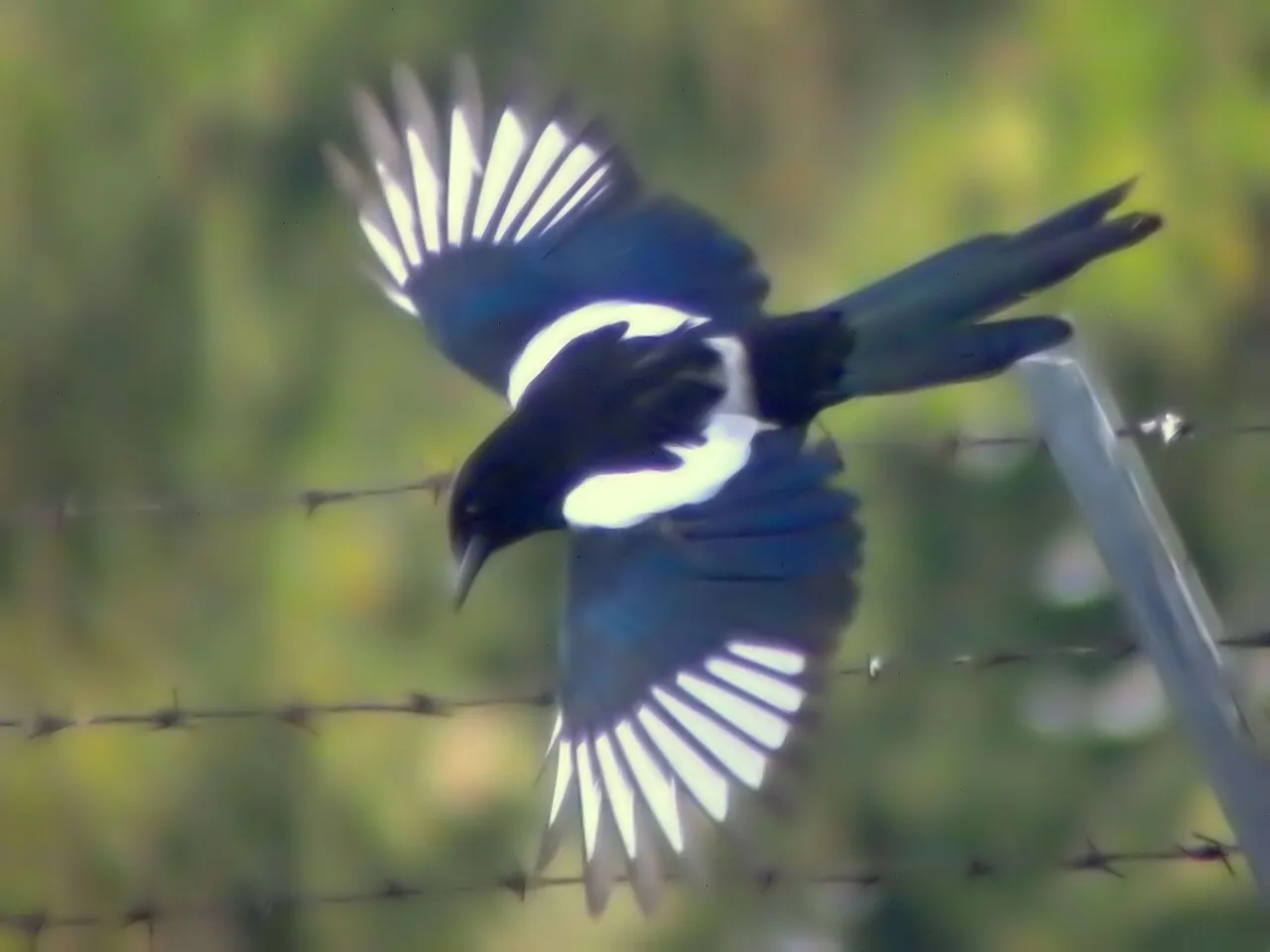
Charles Lam from Hong Kong, China · CC BY-SA 2.0
Magpies belong to the genus Pica in the crow family, Corvidae, within the huge order of perching birds (Passeriformes). Their relatives include crows, ravens, jays, nutcrackers and choughs, a group known for large brains, curiosity and flexible behaviour.
2.1. Scientific name and etymology
Pica is simply the Latin word for magpie, so the tautonym Pica pica literally means 'magpie magpie'. The Oriental magpie's species name serica comes from the Latin for silk, a word the Romans associated with China, the 'land of silk'. The English word 'magpie' combines 'pie', the old name for the bird, with 'Mag', a pet form of Margaret once used for chattering women. The medical term pica, for a craving to eat non-food items, also borrows the bird's Latin name because magpies were believed to eat almost anything.
2.2. The Korean name
In Korean the bird is called kkachi, a name usually traced to its harsh 'kkak-kkak' call. Older texts spell it in similar ways, and in classical Chinese characters it was written 鵲 or 喜鵲, 'bird of joy'. Mandarin speakers still call it xique, the joy bird. When Korean writers need to separate the two species they use 동양까치 (Oriental magpie) and 유라시아까치 (Eurasian magpie), but in everyday speech kkachi simply means the local bird.
2.3. The taxonomic split: why the Oriental magpie stands apart
Through most of the twentieth century, magpies from western Europe, North Africa, south-west Arabia, Central Asia and East Asia were all treated as one species, Pica pica, split into roughly ten subspecies. The Korean population was usually labelled Pica pica serica.
That picture began to change as molecular studies appeared from the late 2000s onward. Analyses of mitochondrial and later nuclear DNA showed that East Asian magpies were genetically very distinct from European and Siberian birds, in some studies even more distinct than the North American black-billed magpie (Pica hudsonia), which had already been accepted as a separate species. Treating the Asian birds as a mere subspecies looked inconsistent.
Building on this work, the IOC World Bird List and other major checklists began recognising the Oriental magpie, Pica serica, as a full species in the late 2010s. In the same reshuffle, the Maghreb magpie (Pica mauritanica) of North Africa, the Asir magpie (Pica asirensis) of south-western Saudi Arabia and the black-rumped magpie (Pica bottanensis) of the Tibetan Plateau were also split. Checklists did not all adopt the changes at the same time or in exactly the same way, and the boundary between Eurasian and Oriental magpies in the Russian Far East and northern China is still being studied.
The practical result is that Korean magpies, under current taxonomy, are Oriental magpies rather than Eurasian magpies. The two look almost identical in the field; reported differences involve subtle details of wing pattern, rump colour and voice rather than anything a casual observer would notice.
2.4. Species in the genus Pica
Under current taxonomy the genus contains around seven species, although the exact count varies between checklists.
| Species | Scientific name | Range |
|---|---|---|
| Eurasian magpie | Pica pica | Europe to Siberia and Central Asia |
| Oriental magpie | Pica serica | Eastern China, Korea, Taiwan, parts of Japan, northern Indochina |
| Maghreb magpie | Pica mauritanica | North-west Africa |
| Asir magpie | Pica asirensis | South-western Saudi Arabia |
| Black-rumped magpie | Pica bottanensis | Tibetan Plateau and surroundings |
| Black-billed magpie | Pica hudsonia | Western North America |
| Yellow-billed magpie | Pica nuttalli | Central California |
3. Evolution
The crow family arose from an ancient radiation of songbirds centred on Australasia, then spread into Asia and eventually to every continent except Antarctica. Magpies represent a branch that diversified in Eurasia; combining fossils and molecular clocks, researchers estimate that the main magpie lineages began separating a few million years ago. Bones attributed to Pica have been found in Pliocene and Pleistocene deposits in Europe.
One of the more surprising results of genetic work is that the two North American magpies appear to descend from East Asian rather than European ancestors. The likely route was the Bering land bridge, exposed during glacial periods when sea levels dropped. Once in the New World, the founding population later split into the widespread black-billed magpie and the yellow-billed magpie, which is confined to California.
Estimates of when Oriental and Eurasian magpies diverged vary from study to study, but the general story is that repeated ice ages fragmented their range from east to west, allowing each population to evolve independently while keeping nearly the same appearance. Biologists call species like this cryptic species, and magpies have become a textbook example. The exact position of Pica within the crow family is still debated; some analyses place it near the ground jays of Central Asian deserts, but the relationships are not fully settled.
4. Range and habitat
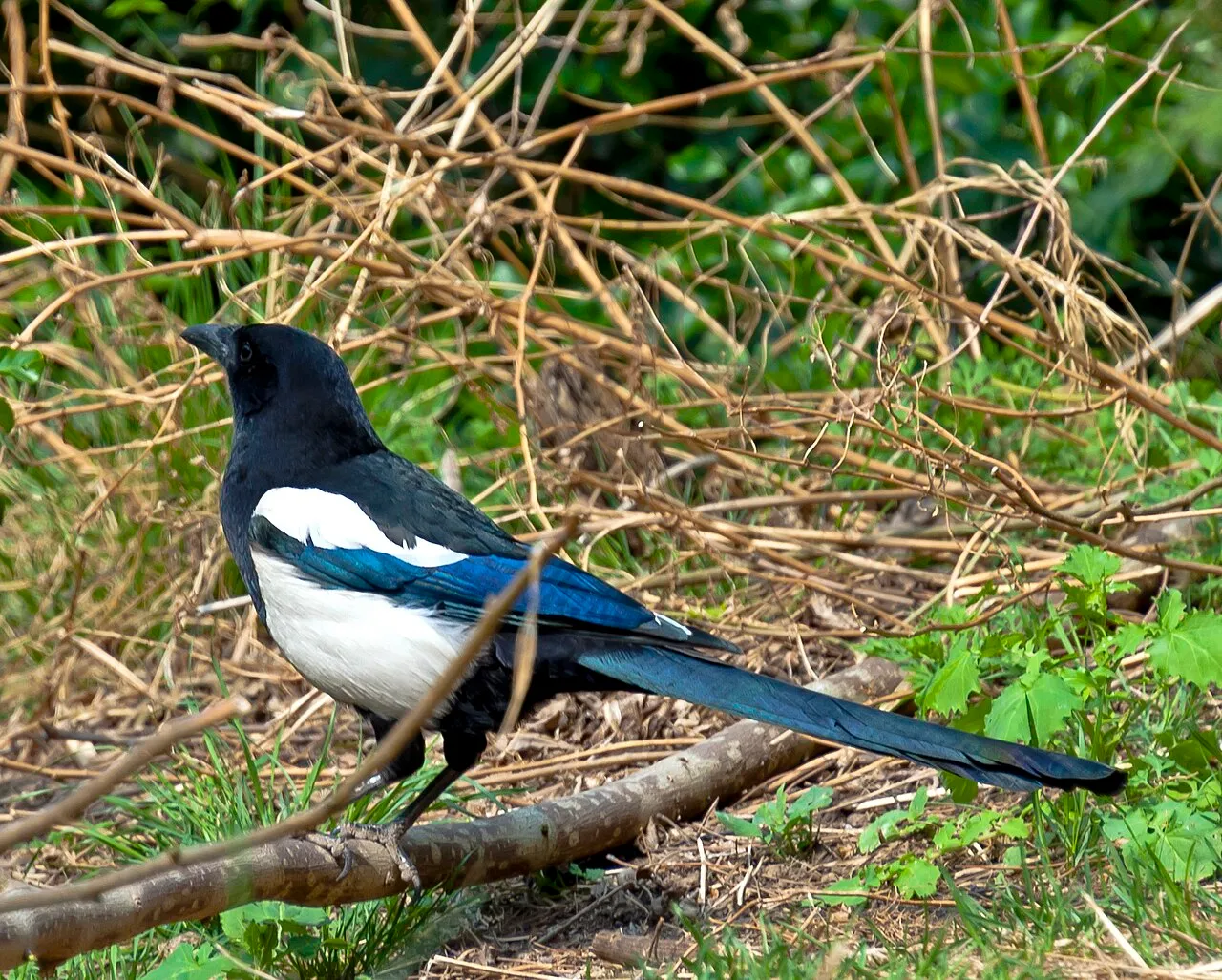
In the broad sense, magpies range from Ireland and Iberia in the west to Kamchatka and Japan in the east, and south to North Africa, south-western Arabia and northern Indochina. The Eurasian magpie in the narrow sense covers Europe, Siberia and Central Asia, while the Oriental magpie occupies eastern and southern China, the Korean Peninsula, Taiwan, northern Indochina and a small area of northern Kyushu in Japan.
In Korea the magpie is a year-round resident almost everywhere, including Jeju Island, though Jeju is a special case. Magpies did not originally live there; in 1989 a few dozen birds were brought from the mainland and released as part of a promotional event. With few predators and plenty of food, they multiplied quickly and now occupy the whole island, where they raid the nests of native birds and damage crops. The episode is often cited in Korea as a cautionary tale about introducing species. Magpies in Kyushu are also said to have been brought from Korea centuries ago, though the details are uncertain.
Magpies are birds of open country with scattered trees rather than dense forest. Farmland mixed with villages, riverside willows, city parks and tree-lined streets all suit them well. They adapt readily to human landscapes, building nests on power poles, transmission towers and ornamental trees in apartment complexes, and are scarce in deep forest and high mountains.
5. Body
From a distance a magpie looks simply black and white, but in good light the 'black' turns out to be glossy and iridescent. The wings shine blue and turquoise and the long tail flashes green, bronze and purple. These colours are structural: tiny arrangements within the feathers reflect light, so the hue shifts with the viewing angle. The white shoulder patches, belly and inner wing feathers form bold white panels in flight.
| Measurement | Typical value |
|---|---|
| Total length (including tail) | about 40–50 cm |
| Tail | about 20–25 cm, nearly half the total length |
| Wingspan | about 52–62 cm |
| Weight | about 180–270 g |
| Bill | black, stout, slightly curved |
Males tend to be a little larger with longer tails, but both sexes share the same plumage, so they are hard to tell apart in the field. Recently fledged young have short tails, duller gloss and a pinkish tinge around the gape.
Magpies have strong legs and walk with a confident stride or hop with both feet together. Their short, rounded wings are built for agile short flights rather than long soaring, and like other corvids they have excellent eyesight and a large brain relative to body size.
6. Behaviour and ecology
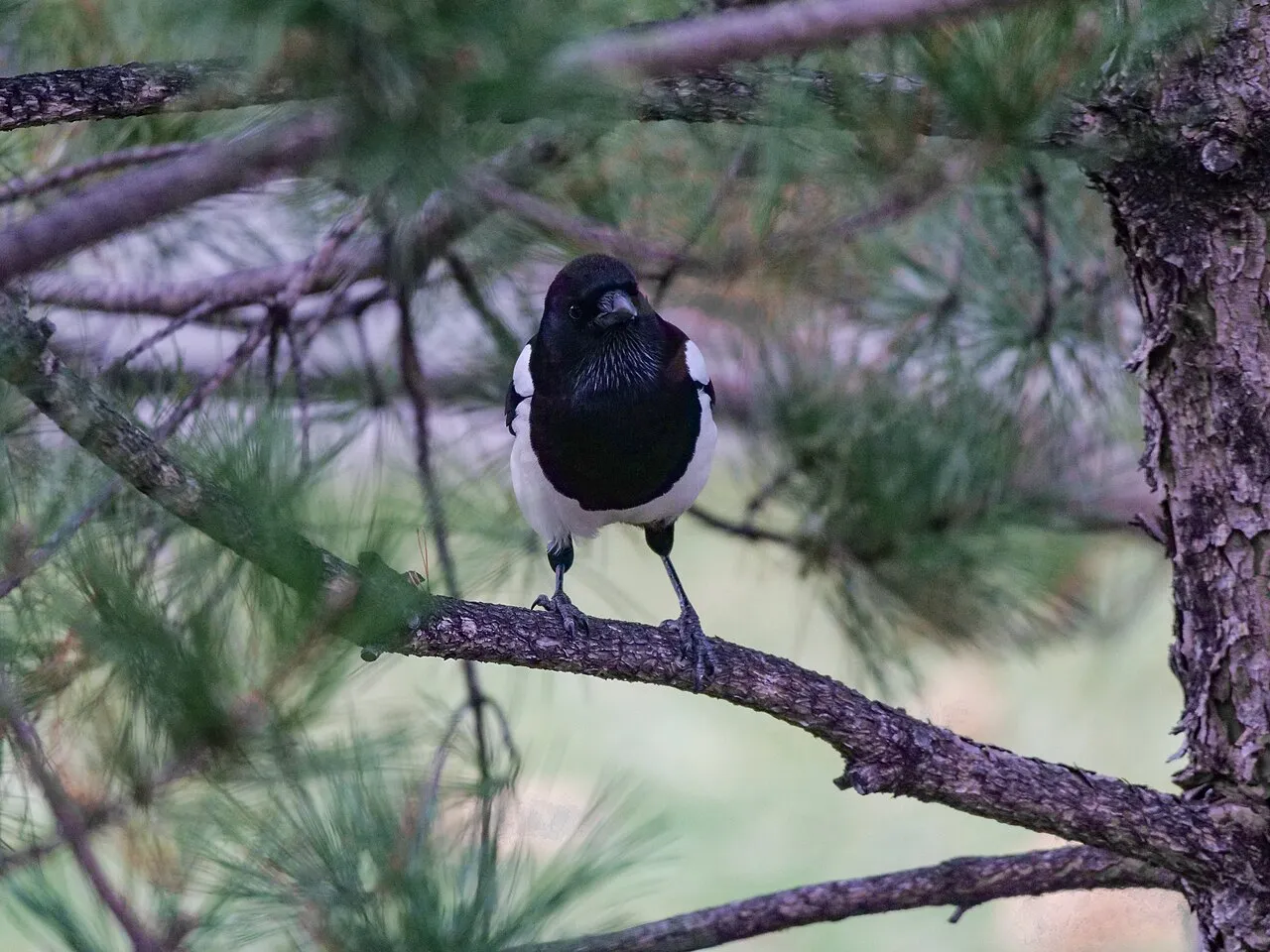
Sun Jiao (Interaccoonale) · CC BY-SA 2.0
Magpies are active by day, spending much of their time on the ground searching for food. Established pairs often defend a territory year-round, chasing off intruding magpies with loud chattering calls, while young unpaired birds roam in loose flocks waiting for a vacancy. On winter evenings dozens of birds may gather in a single grove to roost together.
They are resident birds and do not migrate. In hard winters they simply widen their foraging range rather than leaving.
One of their best-known behaviours is mobbing. When a hawk, cat, snake or owl appears, nearby magpies converge, scolding noisily and taking turns to dive at the threat. During the breeding season they may treat people the same way, swooping low over pedestrians near the nest. It looks alarming, but it is a parent's warning rather than a real attack.
Magpies also cache food, burying surplus scraps in the soil or tucking them under leaves to retrieve later. Observations suggest they sometimes re-hide food or fake a cache when another bird is watching, behaviour that hints at an understanding of what others can see.
Research increasingly shows differences between urban and rural birds. City magpies tolerate people at closer range and make heavy use of food waste and scraps.
7. Diet and feeding
Magpies are thorough omnivores. In spring and summer they eat large numbers of beetles, grasshoppers, caterpillars, earthworms and other invertebrates, and when feeding chicks they focus on protein-rich insects. In autumn and winter, fruit, grain and seeds become more important. They also take the eggs and nestlings of smaller birds, frogs, mice and lizards when they get the chance, and readily scavenge roadkill and food waste.
They forage mostly by walking and turning over soil and leaf litter with the bill. They will perch on the backs of cattle or deer to pick off ticks, and they crack hard nuts by holding them down with a foot and hammering with the bill.
This flexible diet is also why farmers dislike them. In Korea magpies peck ripening apples, pears and persimmons, spoiling them for sale, and dig up freshly sown beans and corn. At the same time they eat many crop pests, so their overall effect on farmland is mixed rather than purely harmful.
A charming Korean custom reflects this long relationship: when harvesting persimmons in late autumn, farmers traditionally left a few fruits at the top of the tree. These were called kkachi-bap, 'magpie rice', a small offering for birds facing the winter.
8. Reproduction and life cycle
Magpies in Korea start breeding early, often in January or February before winter has ended. The pair builds together, and their nest is one of the most elaborate made by any bird: an outer framework of sturdy sticks topped with a domed roof, an inner cup plastered with mud and lined with rootlets, hair and soft fibres, and a side entrance that makes it harder for crows to reach the eggs from above. A single nest may contain hundreds to around a thousand sticks.
A typical clutch is 5–7 eggs, though anything from 3 to 9 has been recorded. The eggs are pale blue-green speckled with brown. The female does most or all of the incubating while the male brings her food.
| Stage | Duration | Notes |
|---|---|---|
| Nest building | about 1–2 months | both partners; old nests are often repaired |
| Incubation | about 17–19 days | mostly the female |
| Nestling period | about 24–30 days | both parents bring insects |
| After fledging | weeks to months | young learn to forage in the parents' territory |
| First breeding | usually after 1–2 years | requires a territory and a mate |
Chicks hatch naked and blind but grow fast, leaving the nest after about a month. Mortality in the first months is high, with cats, raptors, traffic and starvation taking many young birds. Average lifespan in the wild is only a few years, but birds that survive their first year can live a decade or more, and ringing records show some reaching around twenty years.
Pairs often stay together for several seasons, and they may rebuild or refurbish a nest in the same territory year after year.
9. Intelligence, communication and special abilities
As members of the crow family, widely regarded as the cleverest birds, magpies show impressive cognitive abilities.
The most famous study is the mirror test. In 2008 researchers in Germany placed a coloured mark on the throat feathers of Eurasian magpies, visible only in a mirror, and reported that some birds repeatedly tried to remove it while looking at their reflection. Until then, mirror self-recognition had been shown convincingly only in humans, great apes, dolphins and elephants, so the result made headlines. Later attempts by other teams to replicate it with magpies produced weaker or negative results, so whether magpies truly recognise themselves remains an open question.
Korean research added another striking finding. On a university campus in Seoul, scientists who had climbed to magpie nests for study were later recognised and scolded by the birds from a distance, while colleagues wearing the same clothes were ignored. The magpies were evidently remembering individual people, not clothing, confirming what Korean villagers had long claimed about the birds knowing strangers.
Their harsh chatter sounds simple, but its length, repetition and pitch vary with context. Alarm calls, territorial calls and contact calls between partners differ, and in the breeding season magpies add quiet, warbling notes that can sound almost like song. Some individuals mimic other birds or environmental sounds.
The idea that magpies steal shiny objects is deeply rooted in European folklore, even inspiring Rossini's opera The Thieving Magpie. However, experiments in Britain found that magpies were actually wary of novel shiny objects and tended to avoid them, so the shiny-thief reputation has little scientific support.
10. Predators and survival
Adult magpies are hunted by goshawks, sparrowhawks, eagle-owls and falcons, while on the ground feral cats, martens, weasels and foxes are dangers. Eggs and nestlings are targeted by large crows, snakes and squirrels.
Magpies rarely face these threats alone. Mobbing drives predators away, and alarm calls alert neighbouring magpies and other birds. Choosing nest sites that are hard to reach, such as thorny trees or tall power poles, and building a roofed nest add further protection.
In cities natural predators are fewer, but human-related hazards increase: collisions with windows and vehicles, electrocution, poisoned food, and culling as a designated pest species. Even so, magpies breed prolifically and adapt so well that their overall numbers appear stable or growing.
11. Relationship with humans
Human attitudes to magpies have varied enormously between cultures and eras. In East Asia they have mostly been birds of joy and luck, while in much of Europe they were associated with bad omens and theft.
11.1. From lucky bird to pest
For centuries Korean magpies were welcome messengers of good news. A widely cited 1964 newspaper poll to choose a national bird is said to have placed the magpie first, and Seoul and many other cities and provinces later adopted it as their official bird.
Industrialisation changed the relationship. Magpie nests on power poles, sometimes woven with wire and metal scraps, began causing short circuits and blackouts, and power companies now spend large sums every year removing nests. Orchard damage also grew. As a result, since around 2000 the magpie has been listed under Korean wildlife law as a harmful wild animal, and permits can be issued to cull birds where damage occurs.
Some local governments have even considered replacing the magpie as their emblem. The story shows how quickly a species can shift from national favourite to official pest as human landscapes change.
11.2. Magpies in Europe
European folklore is full of magpie superstitions. In Britain a counting rhyme assigns sorrow, joy, weddings and births to the number of magpies seen, and many people still greet or salute a lone magpie to ward off bad luck. Gamekeepers persecuted magpies heavily for eating the eggs of pheasants and partridges. In parts of Scandinavia, by contrast, the magpie was a familiar farmyard bird with a more neutral reputation.
12. Conservation
Both the Eurasian magpie and the Oriental magpie are assessed as Least Concern on the IUCN Red List. Their ranges are vast, their numbers large and they thrive in human-modified landscapes. European breeding populations are estimated in the millions of pairs, and Oriental magpies are common across eastern China and Korea, though precise global totals are uncertain and estimates vary widely.
In Korea the magpie is not protected; it is listed as a harmful wild animal under the Wildlife Protection and Management Act. That does not mean anyone may kill one freely: culling requires a permit from local authorities and must follow approved methods, and destroying nests or taking chicks without permission can be illegal.
Jeju Island faces the opposite problem. There, introduced magpies threaten native wildlife, and authorities run ongoing culls to reduce their numbers. The same species can mean very different things for conservation depending on where it lives.
In parts of Europe people worried that rising magpie numbers were driving declines in small songbirds. Large-scale studies, however, found little evidence that magpies are a major cause; habitat loss and changes in farming practices appear far more important.
13. In zoos and rescue centres
Because magpies are so common, zoos rarely display them. They are, however, frequent patients at wildlife rescue centres, usually as fledglings picked up by well-meaning people in spring. Young magpies typically spend a few days on or near the ground after leaving the nest, unable to fly well, while their parents watch and feed them nearby. Unless a bird is clearly injured, the best thing is to leave it alone or place it on a nearby branch.
Keeping a magpie at home is not a good idea. They are intelligent, active birds that suffer in confinement, and hand-raised birds struggle to return to the wild. In Korea and many other countries, taking wild birds without a permit is illegal; if a bird genuinely needs help, contact a local wildlife rescue centre.
14. Magpies in culture
Few birds appear as often in Korean culture as the magpie.
- The Chilseok legend: once a year, on the seventh day of the seventh lunar month, crows and magpies form a bridge across the Milky Way so the Herd Boy and the Weaver Girl can meet. Korean folklore jokes that magpies look bald afterwards from carrying the lovers.
- Magpie-and-tiger paintings: a cheerful magpie on a pine branch above a comically grumpy tiger is one of the classic themes of late Joseon folk painting, combining good news with protection from evil.
- Kkachi Seollal: a beloved children's song calls New Year's Eve 'magpie New Year'. One explanation is that an old word for 'little New Year' shifted to the similar-sounding kkachi.
- The grateful magpie: a folktale tells of a scholar who saved birds from a serpent and was later rescued when a magpie rang a temple bell with its head; the story is linked to Chiaksan mountain in Gangwon Province, though some versions feature a pheasant.
In Europe, the British counting rhyme and Rossini's opera are the best-known cultural references. Newcastle United, the English football club, is nicknamed the Magpies for its black-and-white stripes. Australian sports teams also use the name, but the Australian magpie is an unrelated bird.
In Korea the magpie featured on stamps and in public campaigns for decades and is still the emblem of many cities and provinces.
15. Trivia
- Folk wisdom says magpies face their nest entrance south or east, but surveys show the direction varies with local conditions.
- To reduce blackouts, Korean power companies have tried nest-deterrent devices, decoy raptors and dedicated nest-removal crews.
- Magpies sometimes perform 'anting', rubbing ants through their feathers, possibly because formic acid helps control parasites.
- Magpies may gather noisily around a dead companion, behaviour that newspapers have called a 'magpie funeral'; scientists generally see it as a way of learning about danger.
- The yellow-billed magpie, found only in central California, suffered heavy losses during the West Nile virus outbreak of the early 2000s.
- In Japan the magpie is called kasasagi or kachigarasu, and its habitat in parts of Saga Prefecture is protected as a natural monument.
Wild animals are not pets. Catching, trading or keeping them is illegal in most places. If you find an injured wild animal, call your local wildlife rescue centre.
FAQ
Are Korean and European magpies the same bird?
They look almost identical but are genetically quite distinct. Since the late 2010s major checklists have treated the magpies of Korea and eastern China as a separate species, the Oriental magpie (Pica serica), though adoption varies and boundary zones are still being studied.
Why is a 'lucky bird' listed as a pest in Korea?
Nests on power poles cause blackouts and the birds damage orchards, so since around 2000 they have been listed as harmful wild animals that may be culled under permit where damage occurs.
Do magpies really steal shiny things?
It is a famous European belief, but experiments in Britain found magpies were actually wary of unfamiliar shiny objects. The evidence for the myth is weak.
Photo credits
Photos are freely licensed images from Wikimedia Commons. Authors and licenses are listed below.
- Korean magpie in Daejeon (side profile).jpg — Yoo Chung · CC BY-SA 2.5
- Flying (5405942436).jpg — Charles Lam from Hong Kong, China · CC BY-SA 2.0
- Oriental Magpie on Longevity Hill, Beijing.jpg — Daniel Case · CC BY-SA 3.0
- Oriental magpie (Pica serica) in Yanqi Lake.jpg — Sun Jiao (Interaccoonale) · CC BY-SA 2.0