TailVille
1. Overview
The Galápagos giant tortoise is a colossal land tortoise found only on the Galápagos Islands, an archipelago straddling the equator about 1,000 km off the coast of Ecuador. With shells that can exceed a metre and a half in length and big males weighing several hundred kilograms, it shares the title of largest living tortoise with the Aldabra giant tortoise of the Indian Ocean.
Size is only part of its fame. Tortoises on different islands look noticeably different, from rounded, dome-shelled giants in the misty highlands to lanky, saddle-backed forms on arid islands. When Charles Darwin visited in 1835, local officials told him they could tell which island a tortoise came from by its shell, an observation that later fed into his thinking about how species change.
The tortoises paid a terrible price for being slow, tasty and able to survive for months without food or water. Pirates, whalers and sealers stacked them alive in ships' holds as fresh meat, and settlers later brought goats, pigs, rats and fire. Several island lineages vanished entirely. Yet the story did not end there: decades of captive breeding, repatriation and eradication of invasive mammals have brought numbers back up, making these tortoises both a symbol of extinction and one of conservation's most encouraging comebacks.
2. Name and classification
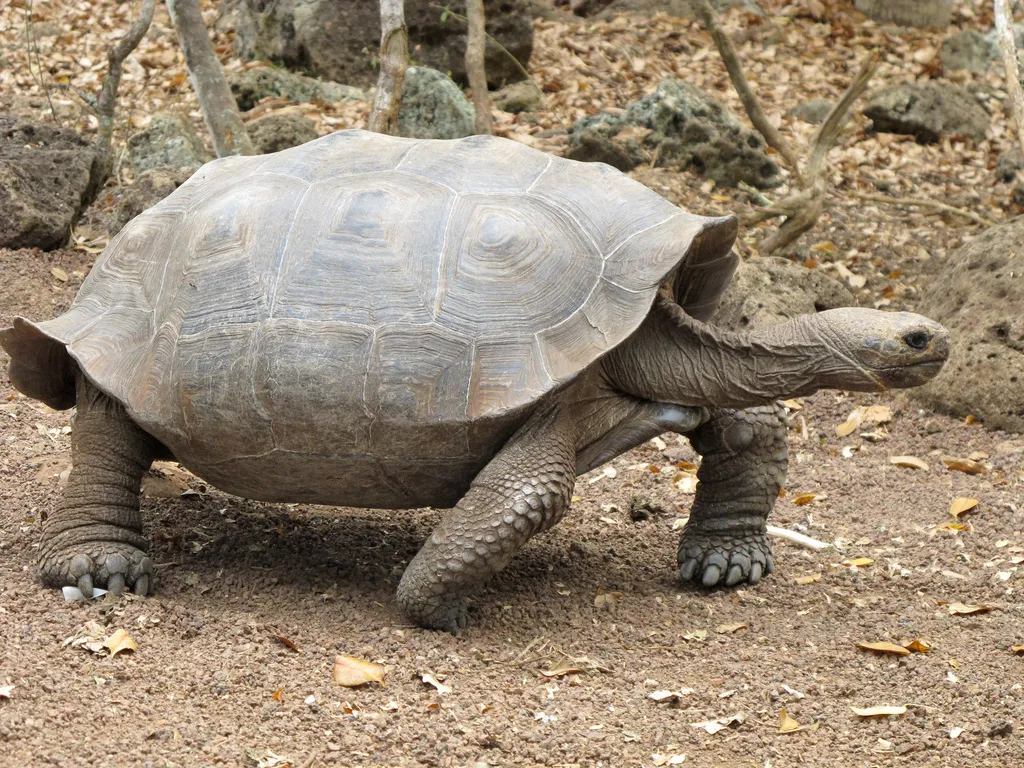
mtkopone · CC BY-SA 2.0
The islands are named after the tortoise, not the other way around. In old Spanish, galápago referred to a tortoise and also to a type of saddle; Spanish sailors in the sixteenth century are said to have named the islands for the saddle-shaped shells they found there.
Scientifically the tortoises belong to the family Testudinidae and the genus Chelonoidis, which also includes several mainland South American tortoises. For most of the twentieth century they were treated as one species, Chelonoidis nigra or niger, divided into subspecies by island. Genetic studies since the 1990s have shown that many of these island populations are deeply distinct, and today most authorities treat them as a species complex of roughly a dozen or more species. You will therefore see both naming systems in use, which can be confusing; neither is exactly wrong, they simply reflect different points in an ongoing scientific discussion.
2.1. Island lineages
Around fifteen lineages were originally recognised, several of which are now extinct. Names and counts vary between sources, but a few examples show the range:
| Island or area | Typical name | Shell type | Status |
|---|---|---|---|
| Western Santa Cruz | C. porteri | Domed | Surviving, fairly numerous |
| Eastern Santa Cruz | C. donfaustoi | Domed | Surviving; described as distinct in 2015 |
| Alcedo Volcano, Isabela | C. vandenburghi | Domed | Surviving, one of the largest populations |
| Española | C. hoodensis | Saddleback | Recovered from about fifteen animals |
| Pinta | C. abingdonii | Saddleback | Extinct (Lonesome George) |
| Floreana | C. niger | Intermediate | Extinct; restoration via hybrid descendants |
| Fernandina | C. phantasticus | Saddleback | One female found in 2019 |
3. Evolution
The Galápagos are oceanic volcanic islands that rose from the sea floor over a hotspot and were never connected to a continent. So how did giant tortoises get there? DNA studies point to a surprising closest living relative: the much smaller Chaco tortoise of Argentina and Paraguay. The two lineages are thought to have split roughly two to three million years ago.
The most likely explanation is a rafting voyage. Tortoises float well, can hold their heads up to breathe, and can go weeks or months without eating or drinking, which makes them remarkably good accidental ocean travellers. A tortoise or a small group swept out to sea from South America, perhaps by a flood, could have ridden the Humboldt Current westward and washed ashore on one of the older eastern islands. From there, descendants spread to younger islands as they emerged, each new colony founded by a handful of individuals.
Whether large size evolved on the islands or came with the founders is debated, because fossil giant tortoises are known from mainland South America too. What is clear is that, once isolated, island populations diverged in shell shape, neck length and body size, a classic case of adaptive radiation alongside Darwin's finches.
4. Range and habitat
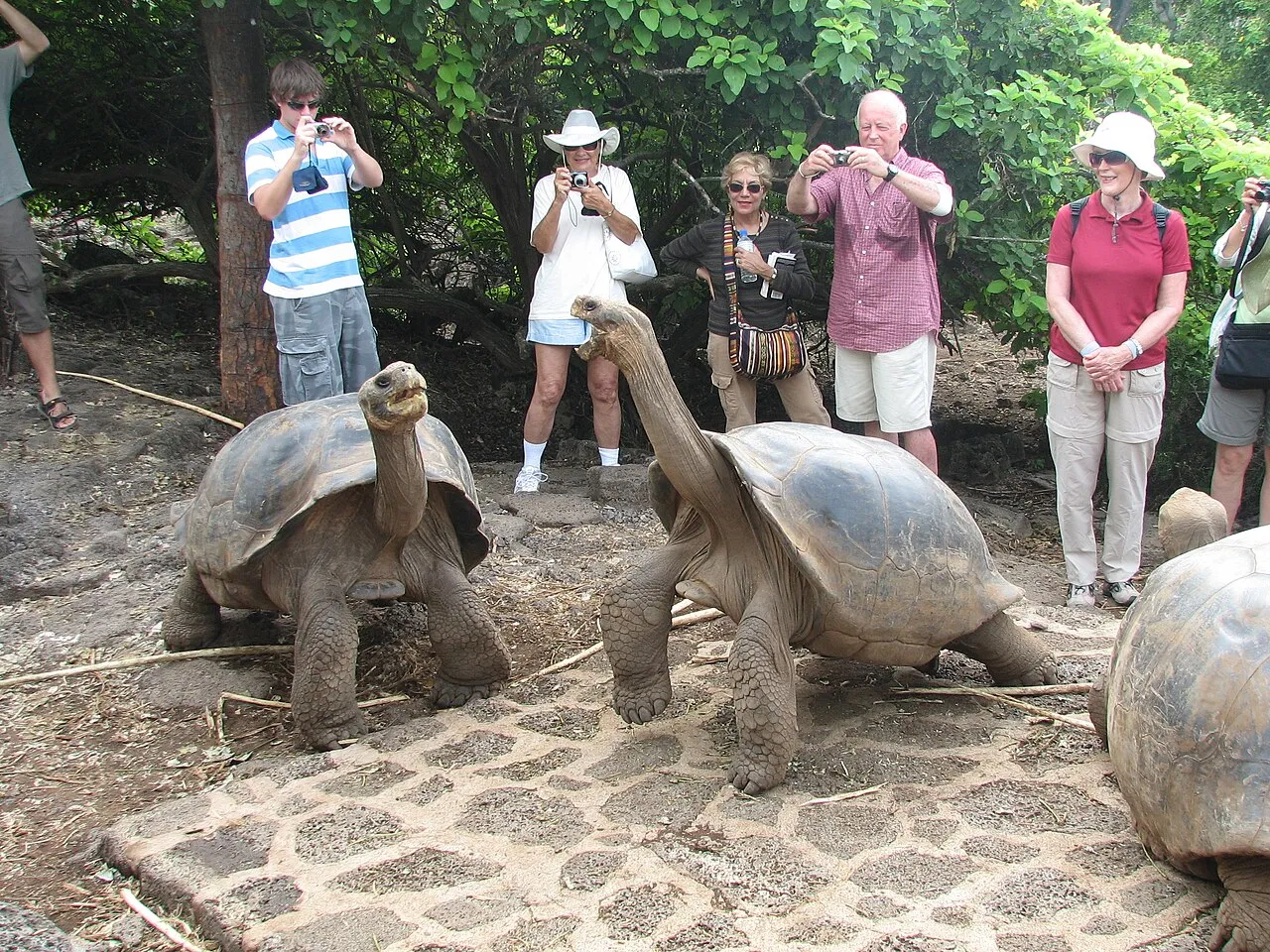
NH53 · CC BY 2.0
These tortoises occur naturally nowhere else on Earth. Wild populations survive on Isabela, where each of five volcanoes holds its own lineage, as well as on Santa Cruz, San Cristóbal, Santiago, Pinzón and Española, with a newly confirmed remnant on Fernandina. On Isabela, wide fields of jagged lava separate the volcanoes and act almost like stretches of sea, which is why each volcano developed its own tortoise.
Although the islands sit on the equator, the cold Humboldt Current keeps them cooler and drier than you might expect. Lowlands are arid scrub dotted with tree-sized prickly pear cactus, while the highlands of larger islands catch a fine mist called garúa and support lush grass and forest. On these islands, dome-shelled tortoises make seasonal migrations, trudging uphill to the green highlands in the dry season and returning to the lowlands to nest when the rains come. Some of their trails, worn over centuries, are still visible.
Populations on Floreana, Pinta and Santa Fe were wiped out by people. Rangers have since released tortoises of related lineages on some of these islands, such as Española-lineage animals on Santa Fe in 2015, so that giant herbivores can once again shape the vegetation.
5. Body
Size varies a lot with island, lineage and sex, but large individuals are enormous:
| Feature | Males | Females |
|---|---|---|
| Shell length | Typically 1.0–1.5 m | Typically 0.6–1.0 m |
| Weight | Large animals 250–400 kg | Usually under half a male's weight |
| Walking speed | Around 0.3 km/h | Similar |
The shell is the tortoise's skeleton turned inside out in part: ribs and backbone are fused to broad bony plates, covered by scutes made of keratin. Beneath the outer layer the bone has a honeycomb structure, which makes the shell lighter than its size suggests. The legs are thick, elephantine pillars covered in heavy scales, ideal for walking over spiny scrub and sharp lava. The record weight for a wild or captive animal is often given at just over 400 kg, though such giants are rare.
There are no teeth. Instead, a sharp, horny beak shears grass, leaves and cactus. Neck length varies; saddlebacks have especially long necks. Smell and sight are key for finding food, and tortoises detect low-frequency vibrations well. Males are much larger than females, have longer, thicker tails, and have a concave plastron (lower shell) that helps them mount females during mating.
5.1. Domes and saddles
Shell shapes fall broadly into two types. Domed tortoises have high, rounded shells and live on larger islands with humid highlands, where ground-level vegetation is plentiful and pushing through dense undergrowth matters more than reaching up.
Saddlebacks have a shell whose front edge flares upward like the pommel of a saddle, letting the tortoise stretch its neck almost vertically. They live on low, dry islands where food near the ground is scarce in the dry season and animals must reach cactus pads and shrub leaves. Intriguingly, prickly pear cacti on those islands grow tall with woody, tree-like trunks, which some biologists interpret as an evolutionary arms race between grazing tortoises and cacti. Saddlebacks also tend to be smaller and use their raised posture in dominance contests, where the winner is the male who can lift his head higher. Several lineages have intermediate shells.
6. Behaviour and ecology
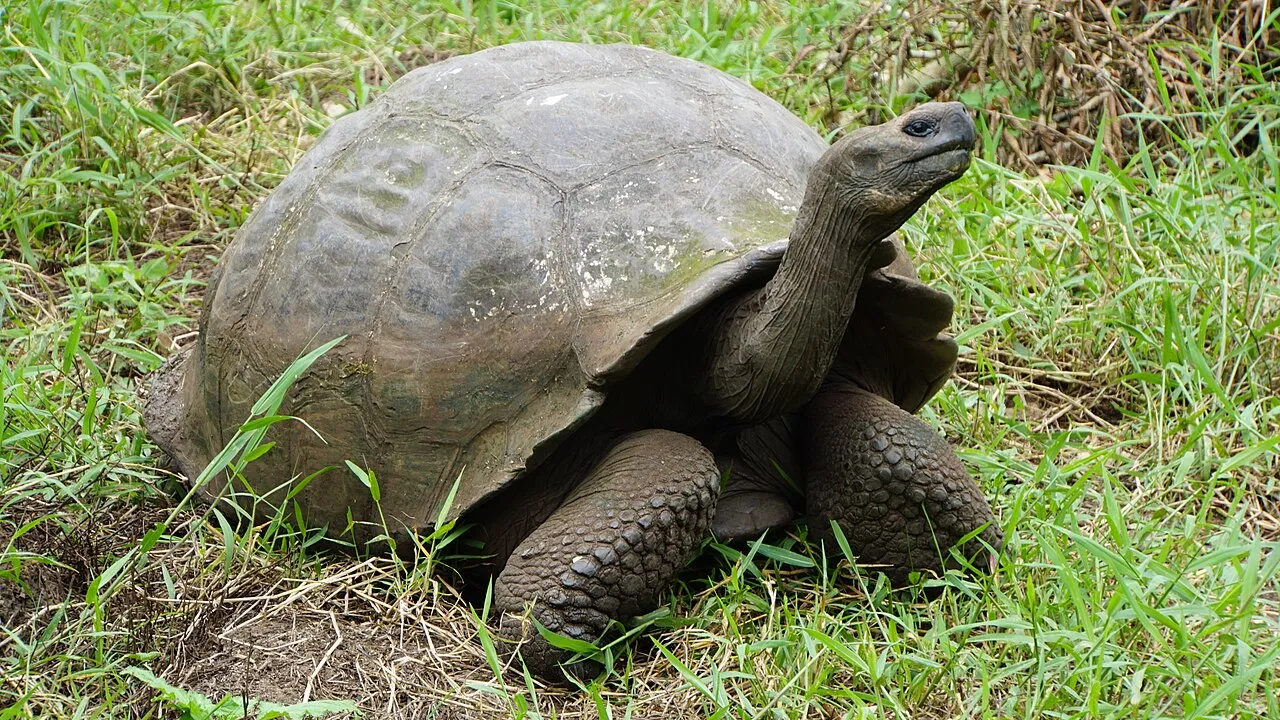
Thecodemachine · CC0
A tortoise's day is unhurried. It starts moving once the sun has warmed it, grazes through the morning, and escapes the midday heat in shade, mud wallows or rain pools. Much of the day, by some estimates around sixteen hours, is spent resting. At night many tortoises settle into a scrape in the soil or under bushes to conserve heat. Wallowing in pools and mud may also help them shed ticks and mosquitoes.
They do not form structured herds or defend territories, but dozens may gather at a good pool or feeding area. Rival males settle disputes with a strange ritual: they face each other, open their mouths and stretch their necks as high as possible. The one that rises higher usually wins, and the other backs away, so serious injuries are rare.
Giant tortoises are ecosystem engineers. They eat huge amounts of vegetation, carry seeds for kilometres before depositing them in dung, trample paths through scrub and influence which plants dominate. Where tortoises vanished, woody plants have sometimes taken over open areas, changing habitats for other species.
They also have small helpers. Some Galápagos finches and mockingbirds pick ticks off tortoises; a tortoise approached by such a bird will often raise itself on straightened legs and stretch out its neck to give the bird access.
7. Diet and feeding
Galápagos tortoises are strict herbivores. They eat grasses, leaves, flowers, fruit, mosses, lichens and fungi, and on arid islands the pads and fruit of prickly pear cactus are a staple. Spines do not seem to bother them; they chew cactus pads whole. They even eat the fruit of the poison apple tree, which is toxic to many animals, apparently without harm.
Their real talent is water management. They get moisture from cactus, dew and rainwater pools, and when water is available they drink deeply and store it in the bladder and body tissues. Combined with an extremely slow metabolism, this lets them survive many months without eating or drinking, a trait that unfortunately made them perfect living provisions for sailors.
Digestion is slow and thorough. Food can take one to several weeks to pass through the gut, during which seeds travel long distances. Some plant seeds actually germinate better after passing through a tortoise, so the plants depend on the tortoises as much as the tortoises depend on them.
8. Reproduction and life cycle
Mating can happen year-round but peaks roughly between January and May, around the wet season. A male pursues a female, bumps her shell or nips her legs until she stops, then mounts from behind. During mating males produce deep, groaning bellows, one of the few loud sounds these otherwise silent animals make.
As the dry season begins, females migrate to sunny lowland areas with dry soil. Using only her hind legs, a female digs a flask-shaped hole, softens the soil with urine, lays her eggs and seals the nest with a muddy plug that hardens like a lid. Clutches contain roughly two to sixteen eggs depending on lineage, and a female may nest several times a year.
Incubation takes about three to eight months. As in many turtles, nest temperature determines sex: warmer nests produce more females, cooler ones more males. Hatchlings weigh only around 50–80 grams and may spend weeks digging their way out.
| Stage | Approximate age | Notes |
|---|---|---|
| Egg | 3–8 months | Buried nest; temperature sets sex |
| Hatchling | 0–5 years | Tiny and vulnerable to introduced predators |
| Juvenile | 5–20s | Slow growth, strongly linked to food supply |
| Adult | Breeding from about 20–25 years | Growth continues slowly |
| Old age | Can exceed 100 years | Growth almost stops |
Lifespans are among the longest of any vertebrate. Wild tortoises probably regularly pass a century, and captive individuals with good records have reached about 170 years. Because hatch dates were rarely recorded, many longevity claims remain uncertain.
9. Intelligence, communication, special abilities
Tortoises are often dismissed as dim, but experiments suggest otherwise. In one study, captive Galápagos and Aldabra giant tortoises were trained to bite a coloured ball in exchange for food. They learned the task readily, some learned faster after watching another tortoise do it, and several remembered the trick when tested again years later. Their learning is slow by mammalian standards, yet clearly real.
Communication is mostly visual and postural: the head-height contest between rival males, a defensive hiss as air is forced out when the head is pulled in, and the deep bellows of mating males. Scent probably carries information too, though it is less studied.
Their most remarkable ability is extreme thrift. A slow metabolism, water storage and the capacity to go months without food let adults survive the boom-and-bust conditions of the islands, including the droughts and floods brought by El Niño years. Growth rings appear on the scutes, but they are irregular and wear away, so they are unreliable for ageing older animals.
10. Predators and survival
Adult giant tortoises have essentially no natural predators. Before humans arrived, the main threat was the Galápagos hawk, which takes some hatchlings. Over millions of years the tortoises evolved without needing speed or hiding skills, which made them defenceless once people and their animals arrived.
Introduced species changed everything. Black rats eat eggs and hatchlings; feral dogs and cats kill young tortoises; pigs dig up nests; and goats and donkeys strip vegetation, competing directly with tortoises for food. On Pinta, Santiago and northern Isabela, goat herds once reduced lush habitat to bare ground.
When threatened, a tortoise withdraws its head and limbs into its shell with a loud hiss. For an adult, the shell is protection enough. Hatchlings, however, are small and soft-shelled. That is why breeding programmes raise young tortoises in protected pens for several years, releasing them only once they are too large for rats to harm.
11. Relationship with humans
The Galápagos were first recorded in 1535, when a Spanish bishop's ship drifted there by accident. In the following centuries pirates used the islands as a hideout, and in the 1800s whalers and sealers arrived in great numbers. For them tortoises were a gift: fresh meat that needed no refrigeration and stayed alive for months. Sailors stacked them upside down in the hold, and tortoise fat was rendered into oil.
Studies of whaling logbooks suggest that well over 100,000 tortoises were taken during the nineteenth century alone. Females, which come down to the lowlands to nest, were easier to catch, so the populations lost much of their breeding capacity. Settlers then cleared land, hunted tortoises and released livestock that ran wild.
Darwin spent five weeks in the islands in 1835 aboard HMS Beagle. He rode on tortoises, timed their walking speed, and noted the vice-governor's claim that he could identify a tortoise's island by its shell. Somewhat ironically, the crew ate many of the tortoises they collected on the voyage home.
Today the tortoises are a source of national pride for Ecuador and the stars of Galápagos tourism. Visitors can watch wild tortoises grazing in the highlands of Santa Cruz, and tourism revenue helps fund conservation and research.
12. Conservation
For decades the IUCN Red List treated the Galápagos giant tortoise as a single species categorised as Vulnerable. Assessed lineage by lineage, the picture is more varied: the Pinta tortoise is Extinct, several lineages are Critically Endangered or Endangered, and a few are in better shape. Categories have changed with new assessments and taxonomy, so it is worth checking the latest listing.
Historical numbers are thought to have been in the hundreds of thousands. By the 1970s the total may have fallen to around 3,000. Thanks to long-term recovery work, current estimates are commonly given at roughly 20,000–25,000, though the figures differ greatly between islands.
Main threats include:
- Introduced rats, cats, pigs, goats and donkeys
- Habitat loss from farming, roads and settlement
- Disturbance from a growing human population and tourism
- Climate change and extreme El Niño droughts and floods
- Occasional poaching and illegal trade
The Galápagos National Park and the Charles Darwin Foundation were founded in 1959, and the islands later became a UNESCO World Heritage Site. The best-known success involves Española. By the 1960s and 1970s only about fourteen adults survived. Brought to a breeding centre on Santa Cruz, they produced well over 2,000 young that were returned to Española, which now has a self-sustaining population. A male named Diego, returned from a US zoo, became famous for fathering a large share of them. Massive goat eradication campaigns in the 2000s allowed vegetation on northern Isabela, Santiago and Pinta to recover.
On Wolf Volcano, researchers discovered tortoises carrying genes from the extinct Floreana and Pinta lineages, probably descendants of animals dumped there by sailors. Selective breeding from these hybrids aims to partly restore the lost lineages. Internationally, the tortoises are on CITES Appendix I, meaning commercial trade is prohibited; in Korea they are regulated as internationally endangered species.
13. In zoos
Galápagos tortoises are kept in a modest number of zoos worldwide. Because export is tightly controlled, most are descendants of animals removed long ago or were obtained through exchanges between institutions. They need spacious outdoor yards, heated indoor shelters, pools and mud wallows, and a high-fibre diet based on grasses, hay and leafy greens; too much fruit causes digestive trouble.
Zoo animals have contributed to conservation in a few ways. Some, like Diego, returned to join breeding programmes on their home islands. Research on captive tortoises has revealed much about growth, reproduction and cognition. And for many people, a zoo visit is their first encounter with these animals and with the story of the Galápagos.
There are ethical challenges too. An animal that may live over a century will outlast its keepers, policies and sometimes the institutions themselves, so long-term planning matters. Many captive tortoises have unknown or mixed ancestry, limiting their value for restoring specific lineages. The emphasis today is shifting from exhibition toward genetic management and support for conservation in the islands.
14. In culture
No individual tortoise is more famous than Lonesome George. Found on Pinta in 1971, he was the last known member of his lineage. Years of efforts to find him a suitable mate failed, and his death in 2012 made headlines around the world, giving many people their first understanding of what it means for the last of a kind to disappear. His preserved body was later returned to the Galápagos for display.
The word Galápagos itself has become a metaphor. In Japan and Korea, 'Galápagos syndrome' describes technology or products that evolve in isolation to suit a domestic market but fail to compete abroad, mobile phones being the classic example. The image behind it is of island creatures following their own evolutionary path.
In many cultures tortoises stand for longevity and wisdom, and the Galápagos giants seem to embody that symbol. They appear as wise, slow elders in children's books and animated films, as iconic scenes in nature documentaries about evolution, and on Ecuadorian coins, stamps and countless souvenirs.
15. Trivia
- The Fernandina lineage was known from a single male collected in 1906 and was long presumed extinct. In 2019 an expedition found an elderly female on the island, nicknamed Fernanda, and genetic tests later confirmed she belonged to that lineage.
- Stories that a tortoise collected by Darwin lived on in an Australian zoo until the 2000s circulated widely, but the records are shaky and the claim is doubtful.
- Because sailors sometimes dumped surplus tortoises on whatever island was convenient, genes from one island's lineage occasionally turn up on another.
- Researchers often identify individuals by unique scute patterns, scars and shell damage.
- Tortoises raised at breeding centres are marked and microchipped and followed for decades; it is common for a tortoise to outlive the career of the scientist who first tagged it.
- Diego, the prolific Española male, retired from the breeding programme in 2020 and was returned to his home island.
- Galápagos tortoises have been recorded living through several major El Niño events, during which island vegetation changes dramatically, showing how resilient adults can be.
Wild animals are not pets. Catching, trading or keeping them is illegal in most places. If you find an injured wild animal, call your local wildlife rescue centre.
FAQ
Can Galápagos tortoises really live 200 years?
Reliably documented individuals have reached roughly 170 years. In the wild, around a century is more typical; claims of 200 years are usually exaggerated or poorly documented.
Who was Lonesome George?
He was the last known tortoise of the Pinta Island lineage. When he died in 2012 that lineage was considered extinct, and he became a worldwide symbol of extinction.
Can people keep one as a pet?
No. It is on CITES Appendix I, so commercial trade is essentially banned, and an animal that grows to hundreds of kilograms and lives over a century is not something a private keeper can responsibly take on.
Photo credits
Photos are freely licensed images from Wikimedia Commons. Authors and licenses are listed below.
- Galapagos giant tortoise Geochelone elephantopus.jpg — Mfield, Matthew Field, http://www.photography.mattfield.com · CC BY-SA 3.0
- Chathamensis.jpg — mtkopone · CC BY-SA 2.0
- GalapagosTortoiseTourists.jpg — NH53 · CC BY 2.0
- Galapagos Tortoise Closeup.jpg — Thecodemachine · CC0