TailVille
1. Overview
On a handful of small islands in eastern Indonesia lives the largest lizard on Earth. Adult male Komodo dragons reach 2.5 to 3 metres in length and typically weigh 70 to 90 kilograms, and they are the top predators of their island ecosystems, hunting deer, wild pigs and occasionally water buffalo.
Western science only learned of the Komodo dragon in the early twentieth century. Before that, rumours of giant 'land crocodiles' circulated among fishermen and islanders. When specimens were confirmed in the 1910s, newspapers announced the discovery of a living dragon, and the animal went on to inspire monsters in films and novels.
For decades it was said that a Komodo's bite killed through septic bacteria in its saliva. Research in the 2000s showed instead that the dragon has venom glands in its lower jaw, producing secretions that interfere with blood clotting and lower blood pressure. Scientists were equally surprised to discover that female Komodos can produce offspring without males through parthenogenesis.
The wild population is estimated at a few thousand animals. In 2021 the IUCN moved the species to Endangered, citing the threat of habitat loss from rising sea levels. Komodo National Park is a UNESCO World Heritage Site.
2. Name and classification
Photograph by Mike Peel (www.mikepeel.net). · CC BY-SA 4.0
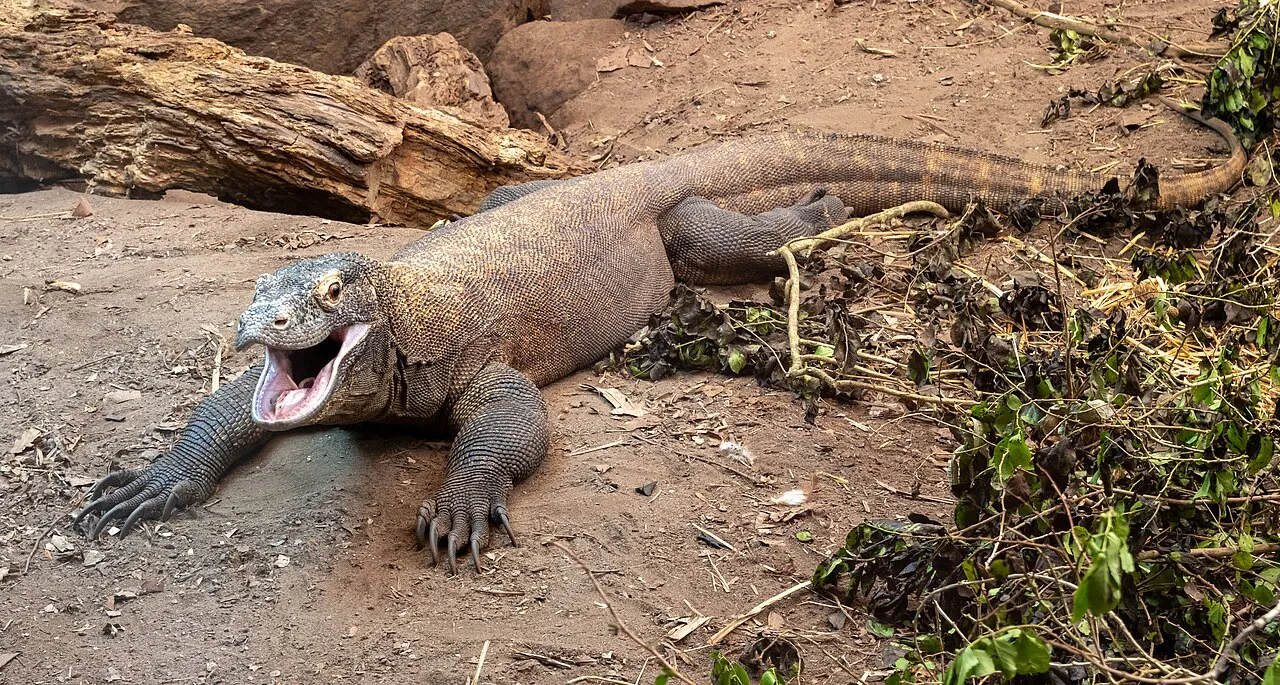
The Komodo dragon, Varanus komodoensis, is a monitor lizard in the family Varanidae. It was formally described in 1912 by Peter Ouwens, director of the zoological museum in Buitenzorg (now Bogor) in the Dutch East Indies, after a Dutch officer stationed on Flores heard local accounts, obtained an animal and sent its skin and photographs to him.
The species name means 'from Komodo'. 'Dragon' began as a nickname and stuck. Locally the animal is known as ora, or buaya darat, 'land crocodile'. The Korean name 코모도왕도마뱀 simply combines the island's name with the term for monitor lizards.
The genus Varanus contains around eighty species spread across Africa, Asia and Australia, and the Komodo is the largest and heaviest of them. Genetic studies place it within a group of Australian monitors, including the lace monitor. No subspecies are recognised.
3. Evolution
The Komodo dragon was long described as a classic case of island gigantism: on islands without big mammalian carnivores, a lizard grew huge to fill the empty niche. A fossil study published in 2009 painted a different picture.
Bones of a very similar giant monitor were found in Queensland, Australia, in deposits about 3.8 million years old. The researchers identified them as Komodo dragons and argued that the species evolved its large size in Australia, then spread west to the Indonesian islands; fossils from Flores date back roughly 900,000 years. On this view, the Komodo is not an island giant but the last survivor of a group of large monitors that disappeared everywhere else.
Australia was once home to an even bigger monitor, Varanus priscus, often called Megalania, estimated at several metres long, though size estimates vary widely. These giants vanished during the Pleistocene, leaving the Komodo dragon as the sole survivor on a few small islands.
Flores once also hosted the small-bodied hominin Homo floresiensis and dwarf elephant relatives called Stegodon, and ancestral Komodos may well have hunted those dwarf proboscideans.
4. Range and habitat
Bloopityboop · CC BY-SA 4.0
The Komodo dragon's range is astonishingly small. It survives only on Komodo, Rinca, parts of the western and northern coasts of Flores, and the tiny islands of Gili Motang and Nusa Kode (Gili Dasami) in the Lesser Sunda Islands of Indonesia. Most of these lie within Komodo National Park.
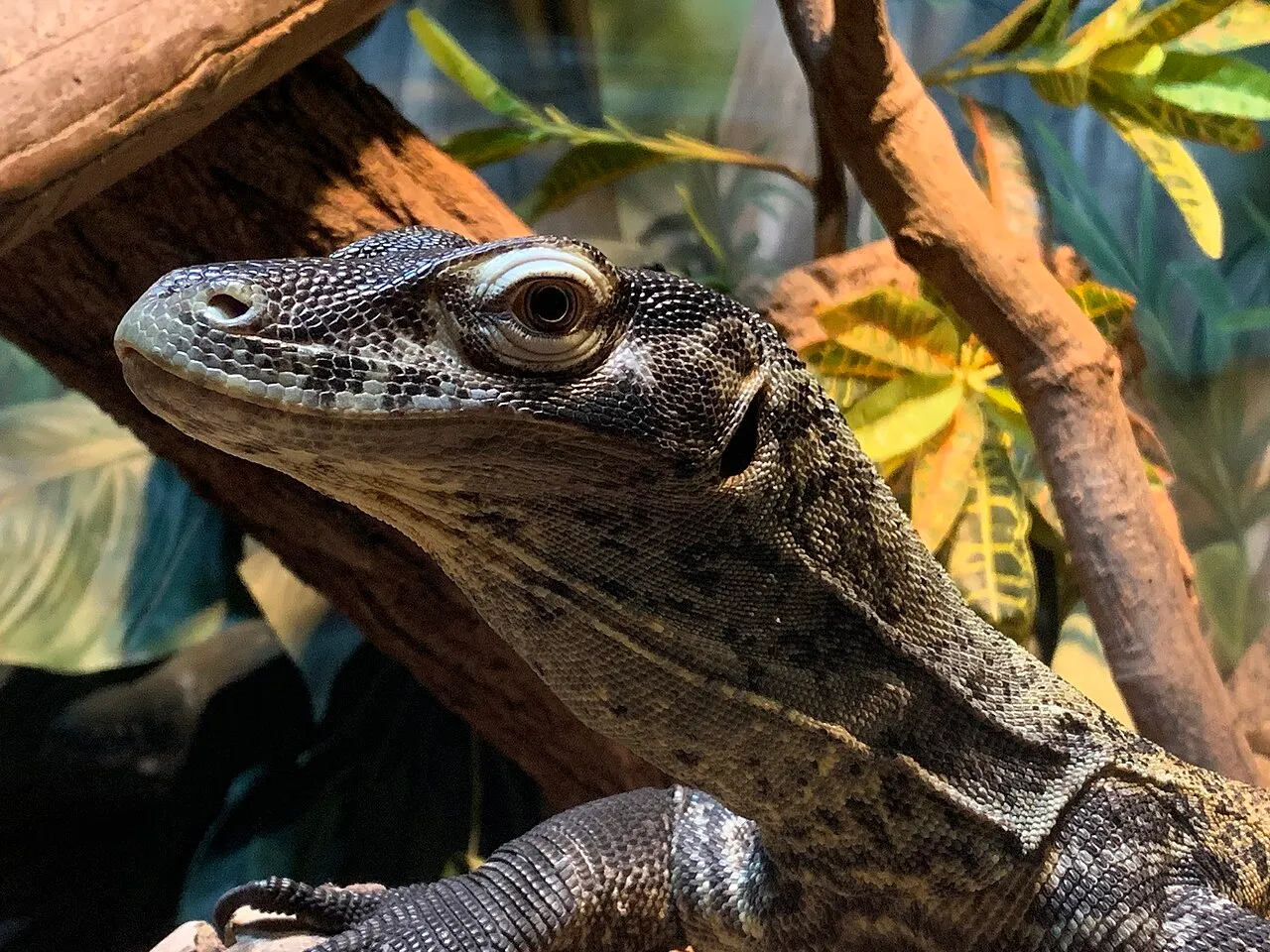
This is one of the driest parts of Indonesia, with a short wet season and a long dry one. Instead of rainforest, the islands are covered in grassy savanna, low deciduous monsoon forest and palm-dotted grassland. Komodos live mainly in these open savannas and dry forests and also visit mangroves and beaches. Juveniles spend much of their time in trees.
The species once occupied more of Flores, but expanding villages and farmland have confined it to coastal pockets. The Flores populations lie outside the national park and are less well protected, and some of the smallest island populations are at real risk of disappearing.
5. Body
| Measurement | Males | Females |
|---|---|---|
| Length | about 2.5–3 m | about 1.8–2.3 m |
| Weight (wild) | about 70–90 kg | about 40–70 kg |
| Teeth | about 60, serrated | same |
| Top speed | about 20 km/h over short bursts | same |
Records of animals just over 3 metres and more than 150 kilograms exist, but such figures usually come from captive animals or individuals weighed after a large meal, and do not reflect typical wild dragons.
The body is long and heavy, with a thick, muscular tail making up nearly half its length. The legs are short but powerful and end in sharp curved claws used for digging and holding prey. Adults are usually greyish-brown or earth-coloured; juveniles are more colourful, with yellow and black bands.
Beneath the skin lies a dense layer of small bones called osteoderms, forming a kind of chain-mail armour. These develop with age and are almost absent in hatchlings.
The teeth are flattened and serrated like a shark's, ideal for slicing flesh, and are replaced throughout life. A recent study found that their cutting edges and tips carry an orange, iron-rich coating that helps keep them sharp and strong.
The long forked tongue samples scent molecules from the air and delivers them to the Jacobson's organ in the roof of the mouth. Komodos are said to detect carrion several kilometres away, although the distance depends heavily on wind and conditions. Their eyesight is good, able to pick up movement hundreds of metres away, while hearing is comparatively weak.
6. Behaviour and ecology
Spencer Weart · CC BY-SA 3.0
As ectotherms, Komodo dragons regulate their body temperature by moving between sun and shade. They emerge from burrows in the morning to bask, rest in shade or burrows through the hottest hours, and become active again in the late afternoon. At night they shelter in self-dug burrows, which can be several metres long, or in rock crevices to retain heat.
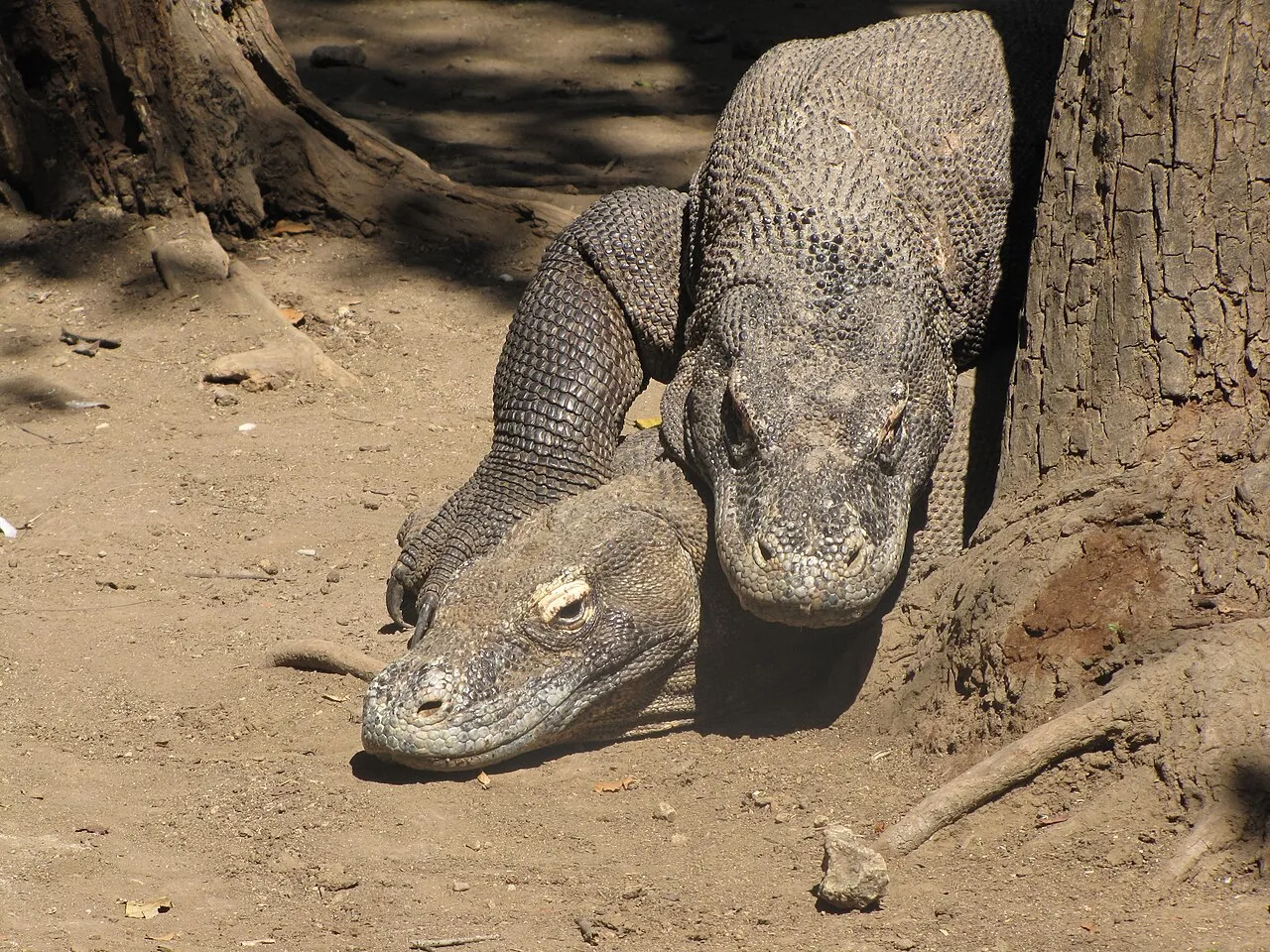
They are basically solitary, but several may gather at a large carcass, where a clear hierarchy appears: the largest males eat first while smaller animals wait. Dominance disputes between males can escalate into dramatic wrestling bouts, with rivals rearing up on their hind legs and tails, grappling and trying to topple each other.
Komodos have large home ranges and may walk several kilometres a day. They swim well and have been seen crossing narrow straits between islands, though gene flow between populations is limited and each island's dragons show slight genetic differences.
Because large adults will eat smaller dragons, juveniles spend their first years mostly in trees, feeding on insects, geckos and birds' eggs before descending to the ground as they grow.
7. Diet and feeding
Komodo dragons are strict carnivores. Adults mainly eat large mammals: Timor deer (rusa deer), wild pigs and feral water buffalo, which were probably introduced to the islands by people long ago but are now vital to the dragons' survival. They also take monkeys, birds, eggs, small animals and fish or turtles washed ashore. Cannibalism, especially of juveniles, is common.
Hunting is mostly by ambush. A dragon waits motionless in tall grass beside a game trail, then lunges at a passing animal, biting the legs, belly or throat. The serrated teeth inflict deep wounds while venom prevents clotting and lowers blood pressure, pushing the prey into shock. Even if the victim escapes, it weakens from blood loss, and the dragon follows its scent until it collapses.
Komodos eat enormous meals, sometimes up to around 80 percent of their own body weight at once. Flexible jaws and a loosely jointed skull let them swallow huge chunks, and indigestible hair, bone and hooves are later regurgitated as a pellet. Thanks to a low metabolic rate, a dragon can go weeks without eating after a large meal.
7.1. Bacteria or venom?
For decades, textbooks and documentaries claimed that a Komodo's mouth teemed with virulent bacteria from rotting meat, and that bitten prey died of blood poisoning.
In 2009, however, a study using MRI scans and dissection revealed well-developed venom glands in the lower jaw. Their secretions inhibit blood clotting and dilate blood vessels, causing a sharp drop in blood pressure. Later research found that the bacteria in Komodo mouths are not unusually dangerous compared with those of other carnivores.
The current consensus is that massive tissue damage from the teeth combined with venom brings prey down. Researchers still debate exactly how important the venom is, and infection of wounds can genuinely occur in animals such as buffalo that wallow in dirty water, so bacteria are not entirely irrelevant.
8. Reproduction and life cycle
Mating takes place mainly in the dry season, around May to August. Males wrestle for access to females, and the winner approaches a female, tongue-flicking and rubbing against her. Females often resist vigorously, so courtship can be rough.
Females lay eggs around August and September. Some dig their own nest chambers, but many use the large mounds of soil and leaf litter built by orange-footed scrubfowl, which stay warm from decomposing vegetation. Females dig decoy holes to disguise the real nest and may guard it for months.
| Stage | Timing | Notes |
|---|---|---|
| Mating | around May–August | males compete by wrestling |
| Egg-laying | around August–September | about 15–30 eggs, averaging around 20 |
| Incubation | about 7–8 months | hatching near the end of the wet season |
| Hatchlings | about 40 cm long | independent from birth, live in trees |
| Maturity | about 8–10 years | move to the ground as they grow |
| Lifespan | estimated 30 years or more | figures vary between sources |
Hatchlings receive no parental care and immediately climb trees to avoid being eaten by adults. Juveniles have been reported rolling in faeces to mask their scent when feeding near larger dragons.
With maturity taking eight years or more and a slow reproductive rate, Komodo populations recover slowly from declines.
8.1. Virgin births
In 2006, researchers in Britain reported that two captive female Komodos with no access to males had produced viable eggs. Genetic tests confirmed parthenogenesis: the offspring carried only their mother's genes.
All of the young were male. Like birds, Komodos have ZW sex chromosomes, with females ZW and males ZZ. In this form of parthenogenesis the mother's chromosomes are duplicated, giving ZZ or WW embryos; WW embryos are not viable, so only ZZ males hatch.
Scientists suspect this ability may help colonise new islands: a lone female washed ashore could produce sons and then mate with them to found a population, albeit one with very low genetic diversity.
9. Intelligence, communication and special abilities
Komodos may look sluggish, but they are cleverer than they seem. Captive animals distinguish individual keepers, appear to play with objects and quickly learn feeding times and places. In the wild they seem to remember game trails and waterholes when choosing ambush sites.
Communication relies mainly on scent and body language. Dragons investigate each other with their tongues; when threatening, they inflate the throat, hiss and gape. Subordinates lower their bodies or retreat to avoid fights.
Their toolkit is impressive: a low metabolism that allows long fasts, explosive short sprints, slicing teeth and venom, and the capacity for parthenogenesis. Their immune systems also appear robust, and some scientists have studied compounds in Komodo blood as a source of new antimicrobial agents.
10. Predators and survival
Apart from humans, adult Komodo dragons have no real predators; they sit at the top of their island food webs. Eggs and young are another matter. Wild pigs and civets dig up eggs, and hatchlings fall prey to raptors, snakes and above all adult Komodos. Some studies estimate that cannibalism accounts for a substantial share of juvenile deaths.
Tree-dwelling habits, scent-masking and camouflaging juvenile colours are therefore vital to survival.
For adults the biggest threat is prey shortage: poaching of deer and pigs by people reduces the large prey dragons depend on. On the smallest islands, inbreeding and loss of genetic diversity pose a longer-term danger.
11. Relationship with humans
The Ata Modo, the indigenous people of Komodo Island, tell of a princess who gave birth to twins: one a human boy, the other a lizard, which went into the forest and became the ora. Traditionally, islanders treated dragons as kin and avoided harming them.
After the species became known in the West, expeditions and collectors flocked to the islands. A 1926 American expedition brought live animals and specimens back to the United States, and its story is widely said to have helped inspire the film King Kong. As zoos around the world sought dragons, early protection measures were introduced to curb uncontrolled capture.
Attacks on people are rare but real. Villagers living within the national park, rangers and tourists have been bitten, and a few fatalities have been recorded. Visitors must therefore stay on designated trails accompanied by park rangers.
Komodo National Park is one of Indonesia's flagship tourist destinations. Tourism revenue supports conservation and local livelihoods, but rapid growth has raised concerns about environmental damage. Around 2019 the Indonesian government considered temporarily closing Komodo Island to visitors before dropping the idea, and a later tourism development on Rinca sparked controversy when a photo of a dragon facing down a construction truck went viral.
12. Conservation
The Komodo dragon was listed as Vulnerable for many years until the IUCN uplisted it to Endangered in 2021. Numbers inside the national park are relatively stable, but the range is tiny, and projections suggested that rising seas could eliminate a large share of suitable low-lying habitat within decades.
The wild population is estimated at roughly 3,000 animals, of which perhaps around 1,000 or more are breeding adults, though figures vary with survey method and year and should be treated with caution. Komodo and Rinca hold the largest populations; those on Flores and the small islands are much smaller.
Key threats include:
- habitat loss from climate change and sea-level rise
- farmland expansion and fires on Flores
- poaching of deer and pigs, reducing prey
- low genetic diversity in small populations
- disturbance from tourism development
Komodo National Park was established in 1980 and inscribed as a UNESCO World Heritage Site in 1991. The species is protected under Indonesian law and listed on CITES Appendix I, which bans commercial international trade.
13. In zoos
Komodo dragons are a major attraction in zoos worldwide. Captive care demands large enclosures, powerful heat sources, deep substrate for digging and separate spaces to prevent fights; most zoos house adults individually and introduce them only for breeding.
Zoo populations are managed through international studbooks, and captive breeding is well established. The discovery of parthenogenesis came from zoo animals, an example of how captive research has advanced understanding of the species.
Captive dragons exercise less and eat more regularly than wild ones, so obesity is a risk; zoos use enrichment such as hidden food and scent trails to encourage natural behaviour. Ethical debate continues over keeping wide-ranging predators in confined spaces.
Private ownership is effectively impossible and prohibited under international and Indonesian law, and smuggled hatchlings have been seized from the illegal reptile trade.
14. Komodo dragons in culture
- The 1926 expedition is often credited with helping inspire the 1933 film King Kong, with its monster-filled uncharted island.
- The Komodo dragon is a national emblem of Indonesia, appearing on coins, stamps and tourism campaigns.
- It has served as the model for giant lizard monsters in films and games, and its name has been borrowed for products and software, including a well-known computer chess engine.
- Footage of dragons hunting water buffalo is among the most dramatic in wildlife documentaries.
- Komodo National Park was named in the much-publicised 'New 7 Wonders of Nature' campaign announced in 2011.
15. Trivia
- Dragons on small islands such as Gili Motang tend to be smaller than those on Komodo and Rinca, probably reflecting smaller prey.
- Komodos often wait near waterholes where deer come to drink.
- Tongue-flicking rates rise sharply when a dragon follows a scent trail.
- Islanders are said to have traditionally left part of their deer kills for the dragons.
- Despite the dinosaur-like look, Komodos are not dinosaur descendants; birds are. Lizards split from the dinosaur lineage long before dinosaurs appeared.
- The waters of the national park are a famous diving destination for coral reefs and manta rays.
Wild animals are not pets. Catching, trading or keeping them is illegal in most places. If you find an injured wild animal, call your local wildlife rescue centre.
FAQ
Is it true that bacteria in its saliva kill prey?
That is an outdated idea. A 2009 study confirmed venom glands in the lower jaw, and the current view is that deep wounds plus venom bring prey down, though the venom's relative importance is still debated.
Why was it uplisted to Endangered in 2021?
Its range is limited to a few small islands, and rising seas are projected to remove much of its low-lying habitat. The wild population is estimated at a few thousand.
Does it attack people?
Rarely, but yes. Villagers, rangers and tourists have been bitten, with occasional fatalities, so visitors must stay on trails with park rangers.
Photo credits
Photos are freely licensed images from Wikimedia Commons. Authors and licenses are listed below.
- 202306 Varanus komodoensis.jpg — James Jolokia (james1203) · CC BY 4.0
- At Chester Zoo 2023 019 - Komodo Dragon (cropped).jpg — Photograph by Mike Peel (www.mikepeel.net). · CC BY-SA 4.0
- Juvenile Komodo Dragon (Varanus komodoensis) 2.jpg — Bloopityboop · CC BY-SA 4.0
- Komodo-mating.JPG — Spencer Weart · CC BY-SA 3.0