TailVille
1. Overview
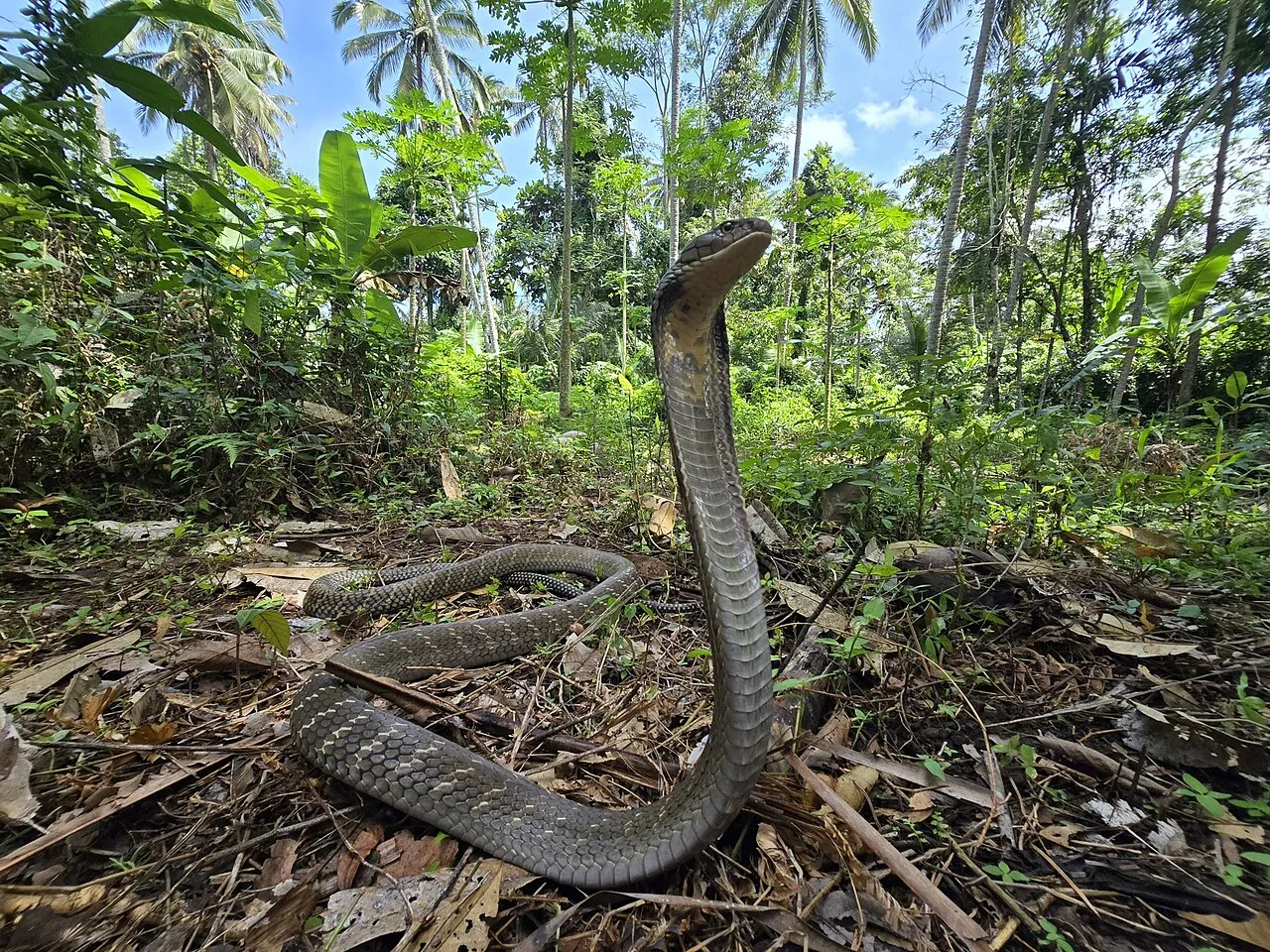
The king cobra is the world's longest venomous snake. Adults commonly reach three to four metres, and a few individuals over five metres have been recorded. When threatened, it raises the front third of its body high off the ground, spreads a narrow hood and emits a deep, growl-like hiss, one of the most arresting sights in the forests of South and Southeast Asia.
Despite its name, the king cobra is not a 'true' cobra of the genus Naja but a distinct lineage of its own. Its scientific name, Ophiophagus, means 'snake-eater', and other snakes are indeed its main prey. It is also famous as one of the only snakes that builds a nest, heaping up leaf litter and guarding its eggs.
A king cobra can deliver a very large quantity of venom in a single bite, and a serious envenomation can kill a person without treatment. In temperament, though, it is generally cautious and will usually try to avoid people.
Recent research has shown that the king cobra may not be a single species at all. A taxonomic study published in 2024 proposed dividing it into four species, although that proposal has not yet been universally adopted. This article covers the king cobra in the broad sense and explains the classification debate carefully.
2. Name and classification
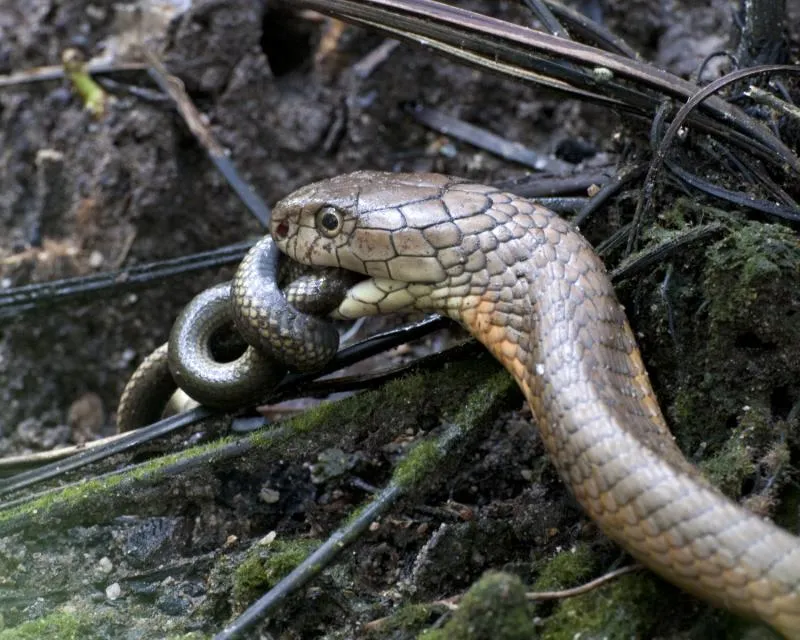
The king cobra belongs to the family Elapidae, which also includes true cobras, kraits, mambas, sea snakes and Australia's taipans. All share short, fixed fangs at the front of the mouth.
In the name Ophiophagus hannah, the genus combines the Greek ophis (snake) and phagos (eating). The origin of hannah is uncertain; it is often linked to a tree nymph of Greek mythology. The species was described in 1836 by the Danish naturalist Theodore Cantor.
The 'king' in its English name is usually attributed to its size and its habit of eating other cobras. Genetically, the king cobra is not closely related to Naja cobras and is often recovered as a distinct early-branching lineage within Elapidae, so hood-spreading may have evolved more than once in the family.
2.1. One species or four?
For a long time the king cobra was treated as a single species ranging from western India to the Philippines, even though regional differences in banding, colour and pattern were well known. Western Ghats animals have relatively few broad bands, while some island populations in Southeast Asia have faint bands or almost none.
In 2021 a genetic study led by researchers in India found that king cobras fall into four deeply divergent geographic lineages. In 2024 the same group combined morphological and genetic evidence in a taxonomic paper proposing four species:
| Proposed species | Approximate range |
|---|---|
| Ophiophagus hannah (northern king cobra) | Eastern India, Himalayan foothills, Indochina, southern China, Andaman Islands and nearby areas |
| Ophiophagus kaalinga (Western Ghats king cobra) | Western Ghats of India |
| Ophiophagus bungarus (Sunda king cobra) | Southern Malay Peninsula, Sumatra, Borneo, Java, parts of the Philippines and nearby areas |
| Ophiophagus salvatana (Luzon king cobra) | Luzon, Philippines |
The name kaalinga comes from a local name for the snake in the Western Ghats, salvatana from a Tagalog name, and bungarus revives an old scientific name.
The proposal is still recent. Some databases and researchers have adopted it, but many institutions, including the IUCN Red List, appear to have continued treating the king cobra as one species as of 2026, and the exact boundaries between lineages, particularly around the Malay Peninsula and Indochina, need further study. If the split is widely accepted, each species will have a smaller range and conservation statuses may need reassessment; the Western Ghats and Luzon forms in particular could prove more vulnerable.
The question matters medically too. Venom composition may vary between lineages, so it has become important to test how well antivenom made from one region's snakes works against bites elsewhere.
3. Evolution
Snakes evolved from lizard ancestors and became limbless during the Cretaceous. The cobra family Elapidae appeared much later, in the Cenozoic, and diversified across Asia, Africa and Australia; the fact that most Australian venomous snakes and the sea snakes are elapids shows how widely the family spread.
Fossils of the king cobra lineage are very rare, so its history is reconstructed mainly from molecular data. These suggest the lineage split from other elapids long ago, developing large size and a specialised diet of other snakes.
The four lineages within the king cobra are thought to have evolved in isolation for millions of years. The Western Ghats are a humid forest 'island' surrounded by drier plains, and Southeast Asian islands were repeatedly joined and separated as sea levels rose and fell during the ice ages, barriers that likely split king cobras into distinct lineages.
Hood-spreading may have evolved independently in the king cobra, true cobras and some other snakes. Making the body look bigger is such an effective defence that similar displays arose in several lineages.
4. Range and habitat
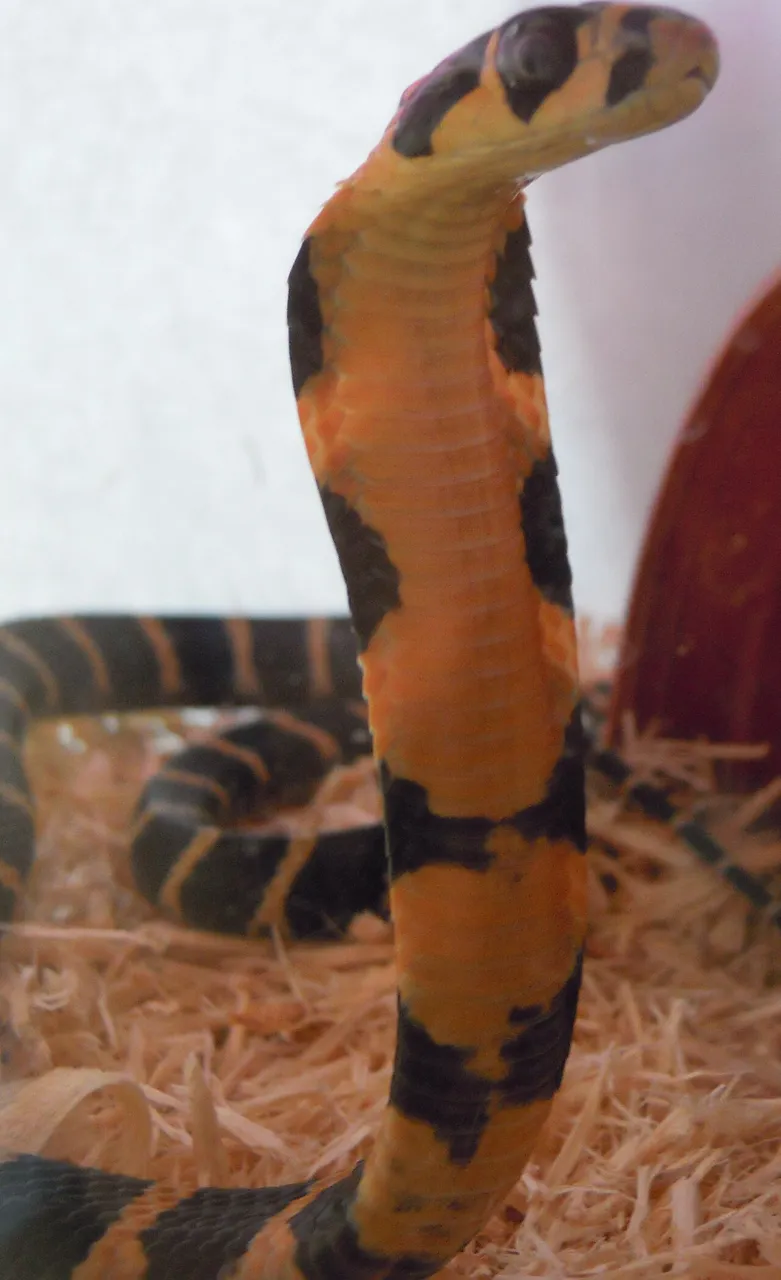
Biomedicinal · CC BY-SA 3.0
In the broad sense, king cobras range across South and Southeast Asia: from India's Western Ghats, east coast, north-east and Himalayan foothills through Nepal, Bhutan, Bangladesh, Myanmar, southern China, Thailand, Laos, Cambodia and Vietnam to Malaysia, Singapore, Indonesia and the Philippines.
Their main habitat is dense tropical and subtropical forest, including evergreen and semi-evergreen forest, bamboo thickets, mangroves and humid forest along streams, often near water. They occur from the lowlands up to around 2,000 metres in some areas.
As forests shrink, king cobras are increasingly seen in plantations, tea estates, rubber and oil-palm groves and near villages, often following rat snakes that hunt rodents around farms. More encounters mean more conflict.
5. Body
| Measurement | Typical value |
|---|---|
| Length | usually 3–4 m, maximum recorded over 5.5 m |
| Weight | usually 5–6 kg, large individuals around 10 kg |
| Fangs | around 1 cm, fixed at the front of the mouth |
| Raised height | about a third of body length |
The longest recorded king cobra, caught on the Malay Peninsula in the early twentieth century and later kept in captivity, reportedly exceeded 5.5 metres. Males are noticeably larger and heavier than females, probably because males compete through wrestling.
Colouration varies greatly by region: olive, brown, black or yellowish, often crossed by pale bands, with a cream or yellow belly. Juveniles are strikingly black with bright white or yellow bands that fade with age.
The head is large and broad, with a pair of large occipital scales behind the crown that distinguishes the king cobra from true cobras. Its hood is narrower and longer than that of the Indian cobra and lacks the spectacle marking.
King cobras have good eyesight and can detect movement from a considerable distance. Like other snakes they analyse scents with the forked tongue and Jacobson's organ, and although they lack external ears they can sense ground vibrations and low-frequency sounds.
6. Behaviour and ecology
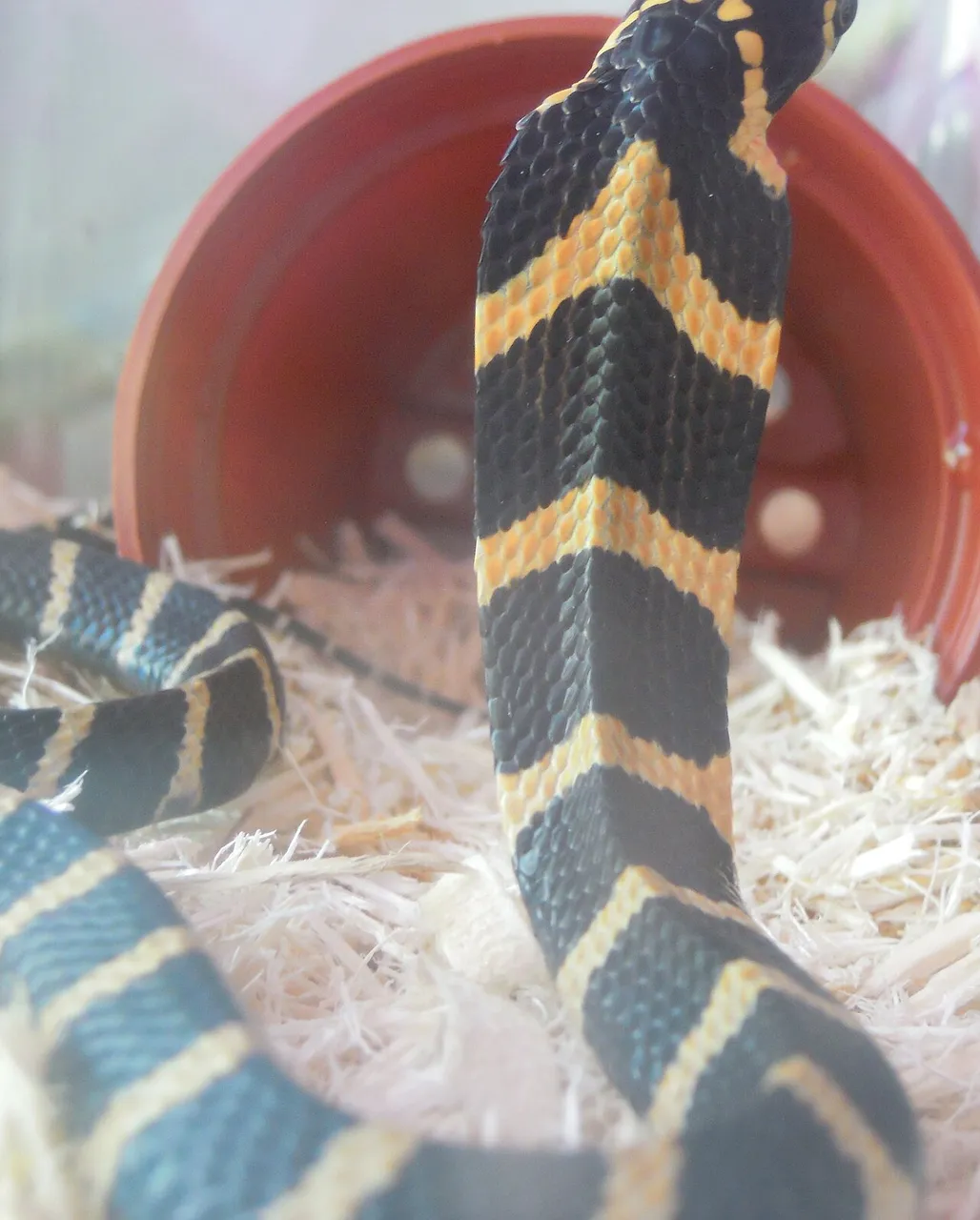
Biomedicinal · CC BY-SA 3.0
King cobras are mainly diurnal. They glide across the forest floor in search of prey, climb trees with ease and swim well. At night they rest in burrows, under logs, in rock crevices or in leaf litter.
Radio-telemetry studies in the rainforests of Karnataka, India, revealed that king cobras use large home ranges and may move from a few hundred metres to more than a kilometre in a day, with males travelling especially far in search of females during the breeding season. They are solitary outside the mating period.
When threatened, a king cobra's first choice is to escape. If cornered, it rears up, spreads its hood and produces a low, resonant hiss, far deeper than the hiss of other snakes and often likened to a dog's growl. If the threat persists, it may lunge forward and bite.
During the breeding season, especially when females guard nests, king cobras can be much more defensive, and some forest accidents happen at this time.
7. Diet and feeding
Other snakes form the bulk of the king cobra's diet: rat snakes, keelbacks, young pythons, kraits, cobras and vipers, venomous or not. Cannibalism has also been recorded. When snakes are scarce, it may take monitor lizards and, rarely, birds or small mammals.
It locates prey by scent and sight, approaches quickly and bites near the head. Once the venom takes effect, the prey is swallowed whole, head first. The two halves of a snake's lower jaw move independently and stretch widely, allowing a king cobra to slowly swallow a snake nearly as long as itself.
After a large meal it can go weeks without food, and nest-guarding females are thought to fast for months.
King cobras are believed to have some resistance to the venom of other snakes, but they are not completely immune.
8. Reproduction and life cycle
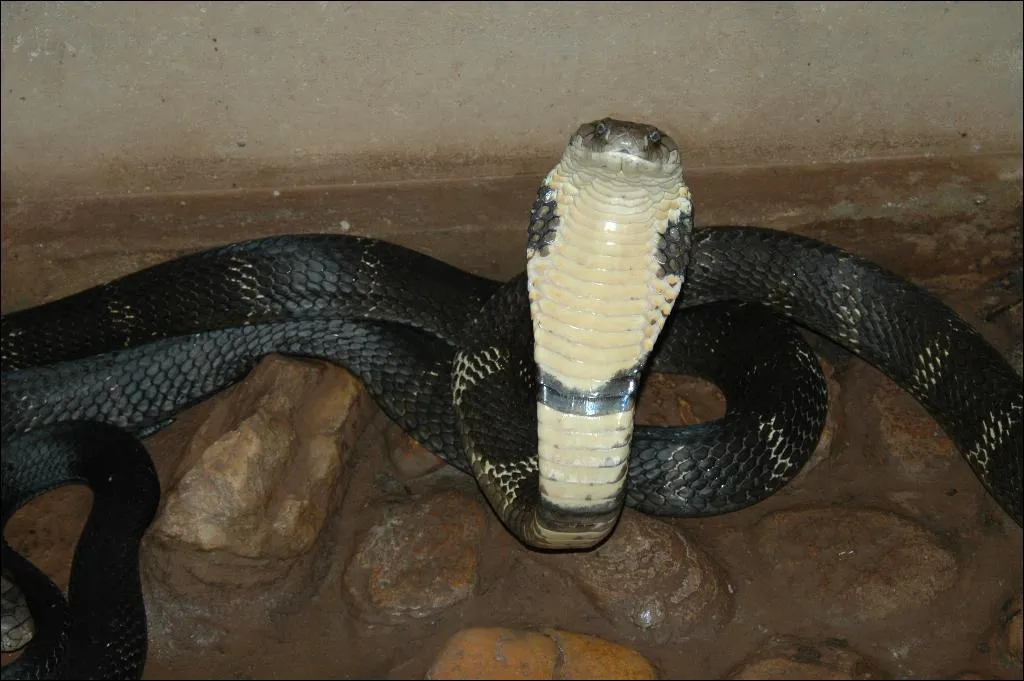
Hari Prasad · CC BY-SA 2.0
Breeding timing varies by region; in South Asia mating generally occurs around the transition from the dry season to the monsoon. Rival males perform ritual combat, intertwining their bodies and rearing up, each trying to pin the other to the ground. Biting is rare in these contests.
Some weeks after mating, the female builds a nest. Using her body as a hook, she rakes leaves and twigs into a mound tens of centimetres high and lays her eggs inside, where decomposing litter generates warmth. Nest-building is extremely rare among snakes and is one of the king cobra's best-known traits.
| Stage | Duration / number | Notes |
|---|---|---|
| Mating | breeding season, varies by region | ritual combat between males |
| Nesting and laying | about 20–40 eggs | laid inside a leaf-litter mound |
| Nest guarding | about 2–3 months | female stays nearby |
| Hatching | hatchlings about 40–55 cm | venomous from birth |
| Maturity | several years | reportedly at around 2.5 m or more |
| Lifespan | about 20 years in the wild (estimated) | data are limited |
The female guards the nest until shortly before the eggs hatch, often leaving just beforehand. Some suggest this prevents her from eating her own young, but the idea is unproven. Hatchlings are fully independent and already venomous; their venom yield is small but similar in composition to an adult's.
9. Venom and special abilities
King cobra venom consists mainly of neurotoxins, especially proteins known as three-finger toxins, which block signals between nerves and muscles and can paralyse the muscles used for breathing. It also contains components that damage tissue.
Drop for drop, it is not the most potent snake venom; the inland taipan of Australia and some sea snakes have stronger venom. But a king cobra's size allows it to inject a very large dose, which makes a bite extremely dangerous. A serious bite can cause breathing failure quickly. Stories of Asian elephants killed by king cobra bites circulate, but how well documented such cases are is unclear.
Fortunately, bites are relatively uncommon compared with those of other venomous snakes. King cobras live in forests, tend to avoid people and give clear warning displays. Most snakebite deaths in South Asia are caused by the Indian cobra, kraits, Russell's viper and saw-scaled vipers.
Treatment requires specific antivenom. The polyvalent antivenom widely used in India often does not cover king cobras, so monovalent king cobra antivenom produced in Thailand and elsewhere is used. Because venom may differ between lineages, researchers continue to test antivenom effectiveness across regions.
Other special traits include hunting snakes, moving forward while reared up, nest-building and the eerie growling hiss, which is thought to be produced by resonating air pockets associated with the trachea.
10. Predators and survival
Max Tibby · CC0
Adult king cobras have few natural predators. Mongooses, with their speed, thick fur and partial venom resistance, attack cobras, but tackling a full-grown king cobra is rare. Large raptors and other king cobras pose some risk.
Young king cobras face many more threats from raptors, civets, mongooses, wild pigs and other snakes. Monitor lizards and wild pigs may dig up nests, which is why maternal nest-guarding matters.
Today humans are the greatest threat, through habitat destruction, road deaths, killing out of fear, and capture for skins, meat and traditional medicine.
11. Relationship with humans
Snakes, and cobras in particular, have long been sacred in South and Southeast Asia. The nagas of Hindu and Buddhist mythology, often portrayed as part human, part serpent or as many-headed cobras, guard water, rain and treasure. A well-known story tells of a great serpent who sheltered the meditating Buddha from a storm by coiling around him and spreading its hoods like an umbrella. It is unclear which species inspired these figures, but the king cobra and Indian cobra likely shaped the imagery.
In parts of Karnataka, India, king cobras are traditionally revered and not harmed, and residents often call rescue organisations to relocate snakes found near homes. A village in Thailand has long been known for keeping king cobras and staging shows, which some see as cultural heritage and tourism and others as an animal-welfare problem.
The snakes used by Indian snake charmers are mostly Indian cobras rather than king cobras. India has outlawed such performances under its wildlife protection law, though they still occur in places.
Souvenirs such as cobra wine and snakeskin products sold in Southeast Asian markets may involve CITES-listed species, and travellers carrying them home can face seizure and penalties.
12. Conservation
The king cobra is listed as Vulnerable on the IUCN Red List. It has a wide range, but forest loss and exploitation are thought to be driving declines, and no reliable global population estimate exists.
If the four-species split is adopted, each species will need its own assessment, and some may warrant higher threat categories; the narrowly distributed Western Ghats and Luzon forms are of particular interest.
Key threats include:
- conversion of tropical forest to farms, oil-palm and rubber plantations and settlements
- capture for skins, meat, traditional medicine and the pet trade
- killing out of fear during encounters
- road traffic
The species is listed on CITES Appendix II, so international trade requires permits. It is strictly protected under India's wildlife law and legally protected in a number of other range countries.
Conservation work includes radio-telemetry research, community education and rescue-and-relocation programmes run by Indian research stations and rescue groups. Finding ways for people and king cobras to share the same landscapes is the central challenge.
13. In zoos
King cobras appear in the reptile houses of various zoos but are demanding to keep. Their snake-eating diet can make it hard to switch them to rodents, their length requires large enclosures, and venomous-snake protocols and antivenom must always be on hand for keeper safety.
Zoos use king cobras to teach about venomous snakes and coexistence, and some cooperate with venom research and antivenom production. Others question the welfare of keeping a wide-ranging forest snake in a limited enclosure.
Private keeping is strongly discouraged. Antivenom is rarely available quickly, venomous snakes are tightly regulated or banned in most places, and the illegal pet trade harms wild populations.
14. King cobras in culture
- India's Nag Panchami festival honours snakes with offerings of milk and flowers to serpent deities; capturing live snakes for the rituals is harmful to them and has been banned.
- The king cobra is often described as India's national reptile.
- Rudyard Kipling's story 'Rikki-Tikki-Tavi' pits a mongoose against cobras, generally interpreted as Indian cobras rather than king cobras.
- The name 'king cobra' symbolises power and has been borrowed for sports teams, motorcycles, wrestling moves and military hardware.
- King cobras appear as dangerous, mystical creatures in Southeast Asian films and martial-arts stories.
- Footage of king cobras hunting other snakes or building nests ranks among the most memorable in wildlife documentaries.
15. Trivia
- It is often said that a king cobra can look a person in the eye, but in reality it raises roughly a third of its body; a large individual may still stand well over a metre high.
- Agumbe in Karnataka, India, is nicknamed the 'capital of king cobras' for its research history.
- Snake-charmers' cobras do not 'dance' to the music; they track the movement of the pipe and player, treating it as a threat.
- The king cobra's hiss is so low that people hearing it for the first time sometimes mistake it for a growling mammal.
- Scientists have sequenced the king cobra genome to study how venom genes evolved.
- Researchers have also investigated components of king cobra venom for potential painkilling properties.
Wild animals are not pets. Catching, trading or keeping them is illegal in most places. If you find an injured wild animal, call your local wildlife rescue centre.
FAQ
Has the king cobra been split into four species?
In 2024 researchers proposed four species based on genetic and morphological data: O. hannah, O. kaalinga (Western Ghats), O. bungarus (Sunda) and O. salvatana (Luzon). Some sources have adopted it, but many, including the IUCN, still largely treat it as one species.
Is king cobra venom the most potent?
Drop for drop, the inland taipan and some sea snakes are stronger. The king cobra is dangerous because of the large volume it injects, and bites require specific antivenom.
Do king cobras chase people?
They usually try to escape and give warning displays when cornered, though nest-guarding females can be more defensive. Most South Asian snakebite deaths involve other species.
Photo credits
Photos are freely licensed images from Wikimedia Commons. Authors and licenses are listed below.
- 12 - The Mystical King Cobra and Coffee Forests.jpg — Michael Allen Smith from Seattle, USA · CC BY-SA 2.0
- A royal meal.jpg — Lip Kee · CC BY-SA 2.0
- Baby king cobra front view.JPG — Biomedicinal · CC BY-SA 3.0
- Baby king cobra neck pattern.JPG — Biomedicinal · CC BY-SA 3.0
- King-Cobra.jpg — Hari Prasad · CC BY-SA 2.0
- Ophiophagus hannah 381373252.jpg — Max Tibby · CC0