TailVille
1. Overview
When a male fans out a shimmering train studded with dozens of eyes and makes it rattle and quiver, the result is one of the most famous displays in the animal kingdom. The performer is the Indian peafowl, the peacock of fable and folklore.
Peafowl are large members of the pheasant family, related to chickens and junglefowl. Native to the Indian subcontinent, they have been carried around the world for thousands of years as ornamental birds and now strut through parks, gardens and islands on several continents. India declared the species its national bird in 1963 and protects it strictly by law.
The male's dazzling 'tail' is not a tail at all but a train of greatly elongated upper tail coverts, grown afresh each year and shed after the breeding season. Why such an extravagant, conspicuous ornament evolved has been one of the central puzzles of evolutionary biology since Darwin.
In English, peacock strictly means the male, peahen the female and peafowl the species, though peacock is widely used for all.
2. Name and classification
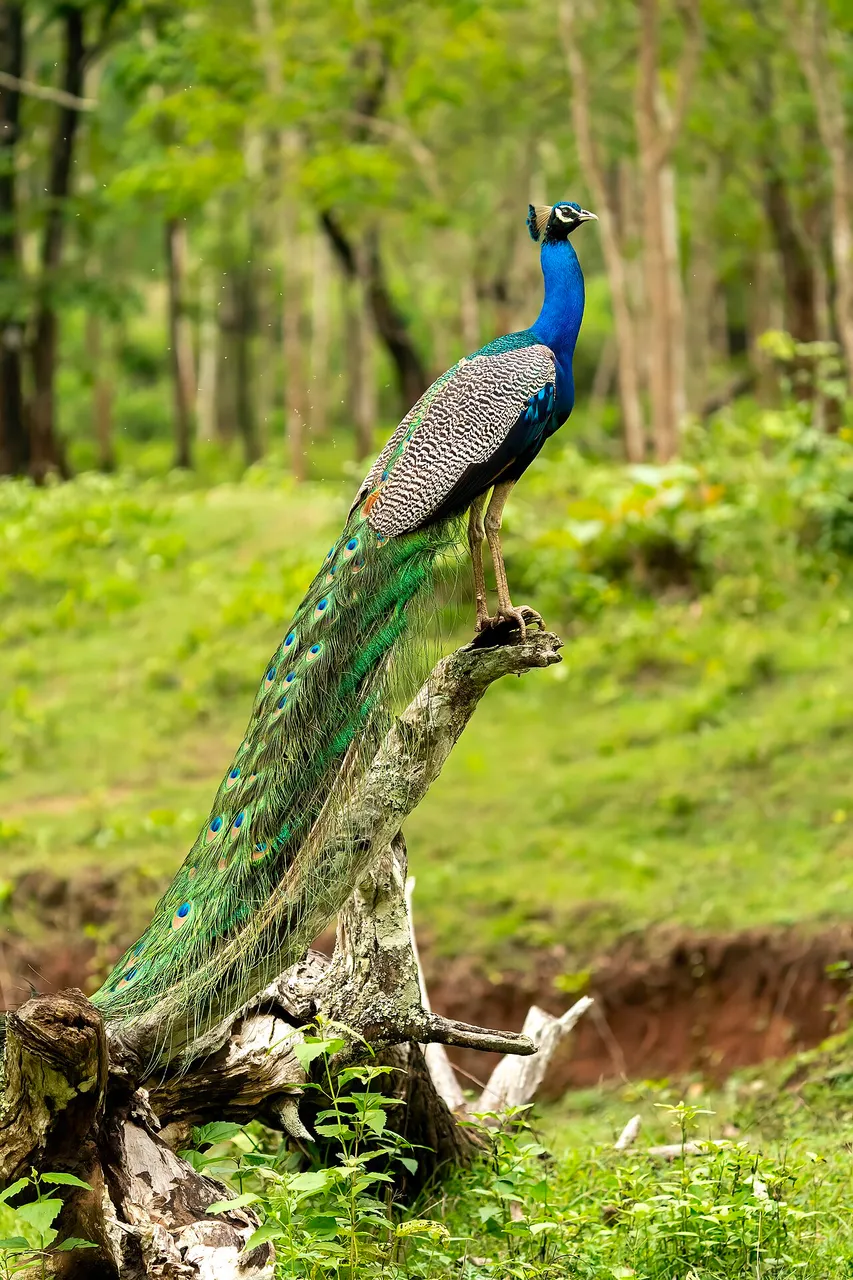
Kandukuru Nagarjun from Bangalore, India · CC BY 2.0
The scientific name Pavo cristatus comes from Latin: pavo means peafowl and cristatus means crested, after the fan of feathers on the head. Linnaeus named it in 1758.
The Korean name gongjak comes from Chinese characters; one interpretation links the first character, meaning hole, to the round eyespots, though the etymology is debated. The English pea- derives from Latin pavo via Old English pawa.
The genus Pavo also contains the green peafowl of South-east Asia, taller than the Indian species, with scaly green neck feathers and a tufted crest. In the rainforests of the Congo Basin lives a more distant relative, the Congo peafowl, unknown to science until 1936; its discovery famously began with a single unidentified feather in a museum collection.
| Species | Scientific name | Range | IUCN |
|---|---|---|---|
| Indian peafowl | Pavo cristatus | Indian subcontinent | Least Concern |
| Green peafowl | Pavo muticus | SE Asia, southern China | Endangered |
| Congo peafowl | Afropavo congensis | DR Congo | Vulnerable |
No subspecies of the Indian peafowl are recognised. White, pied, black-shouldered and other forms are captive-bred colour varieties, not subspecies.
3. Evolution
Peafowl belong to the pheasant family, Phasianidae, along with junglefowl (the ancestors of chickens), pheasants, quail, turkeys and partridges. Genetic studies place peafowl close to the junglefowl lineage, making them nearer kin to the farmyard hen than most people would guess.
The distribution of the Congo peafowl in Africa and the two Pavo species in Asia has long intrigued biogeographers. One explanation is that a common ancestor spread when forests connected the two continents, and drying climates later split the populations. Estimates of when the African and Asian lineages diverged range over several million years.
The fossil record is sparse, but bones attributed to Pavo have been reported from Pliocene and Pleistocene deposits in South Asia and Europe, suggesting a once wider range.
The peacock's train is a landmark in evolutionary thought. Darwin worried that such a cumbersome ornament seemed impossible to explain by natural selection, famously writing to a friend that the sight of a feather in a peacock's tail made him sick. His answer was sexual selection: females preferring more ornamented males could drive the evolution of traits that are costly for survival.
4. Range and habitat
The Indian peafowl's native range is the Indian subcontinent: almost all of India, Sri Lanka, the lowlands of southern Nepal, eastern Pakistan and parts of Bangladesh. It ranges from the Himalayan foothills to the southern tip of India but is scarce above about 2,000 metres.
It favours dry and moist deciduous forest, scrub, riverine woodland and farmland near water. It feeds in the open by day but needs tall trees for its night roost. In India it is common around temples and villages, where religious tradition has protected it for centuries, and it has become comfortable living near people.
Introduced peafowl have established feral populations in Hawaii, California, Florida, Australia, New Zealand, South Africa and on islands and estates in Europe. There they often clash with residents over their loud calls and damage to gardens, roofs and cars, and on some islands there are concerns about effects on native wildlife.
5. Body
Peafowl are a classic case of sexual dimorphism, the sexes differing dramatically in appearance.
| Measure | Male | Female |
|---|---|---|
| Body length (bill to tail) | about 100–115 cm | about 90–95 cm |
| Total length with train | about 1.95–2.25 m | no train |
| Train length | about 1.4–1.6 m | |
| Weight | about 4–6 kg | about 2.7–4 kg |
| Wingspan | about 1.3–1.6 m | about 1.2–1.3 m |
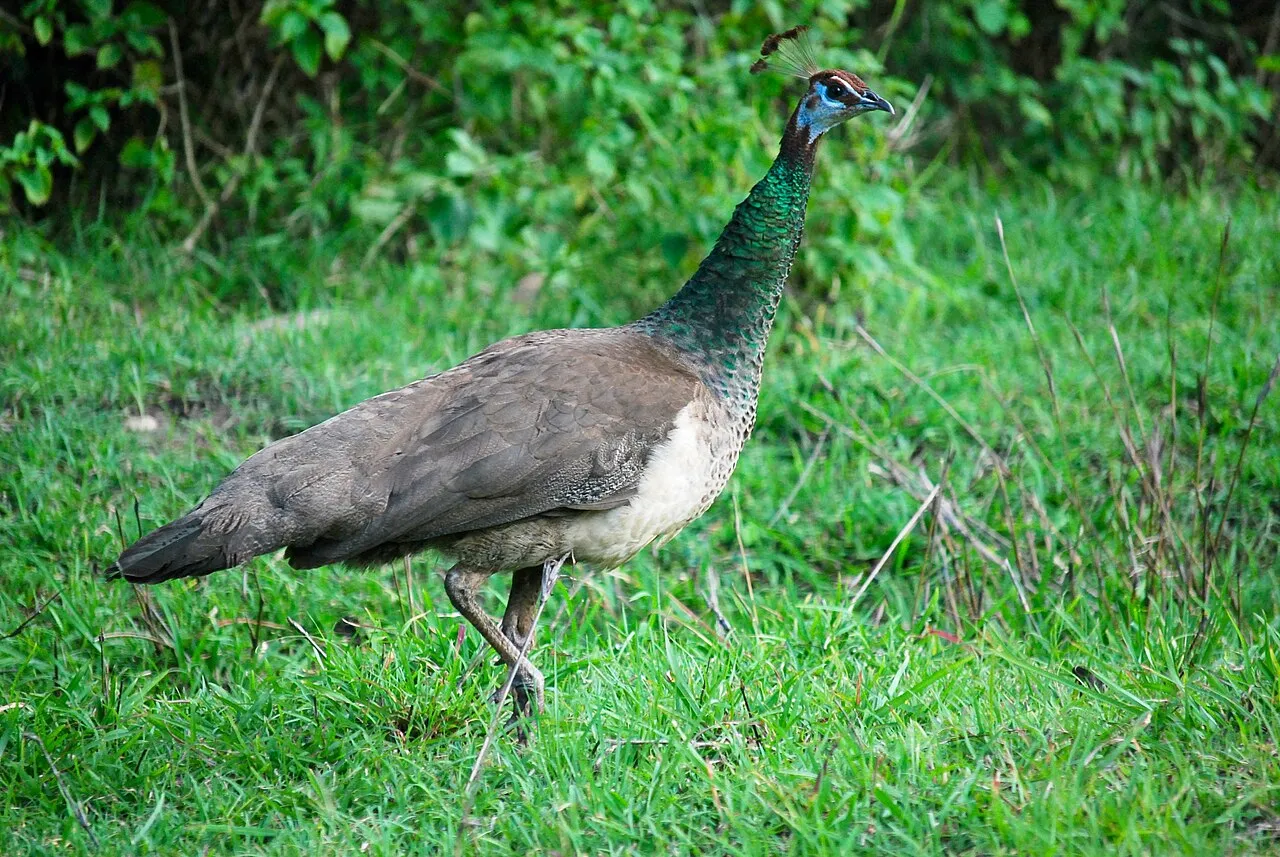
The male has a metallic blue neck and breast, a bronze-green scaled back and barred brown-and-black wings, with white facial stripes above and below the eye and a fan-shaped crest of spatula-tipped feathers. The female is mottled brown and grey with a metallic green lower neck and a white belly; she has a crest too.
5.1. The train and its eyespots
The train usually consists of around 150 to 200 feathers, most ending in an eyespot, or ocellus, with fishtail-shaped feathers lacking eyes along the edges. When the train is raised, the short brown true tail feathers behind it act as a prop.
The train lengthens over several years and reaches full size at about three or four years old. It is moulted every year in late summer after the breeding season and regrown before the next, which is why in India naturally shed feathers can be collected without harming the birds.
5.2. Structural colour
The blues, greens and bronzes of peacock feathers are not pigments. Within the tiny barbules, melanin rods are arranged in a regular lattice, and their spacing causes certain wavelengths of light to be reflected strongly through interference. This is structural colour, related to the rainbow sheen on soap bubbles or a CD.
As a result, the colours shift with viewing angle, and a ground-up feather is merely brown. Zones with slightly different lattice spacing produce the concentric rings of each eyespot. The principle inspires research into fade-proof colours, anti-counterfeiting features and displays.
6. Behaviour and ecology
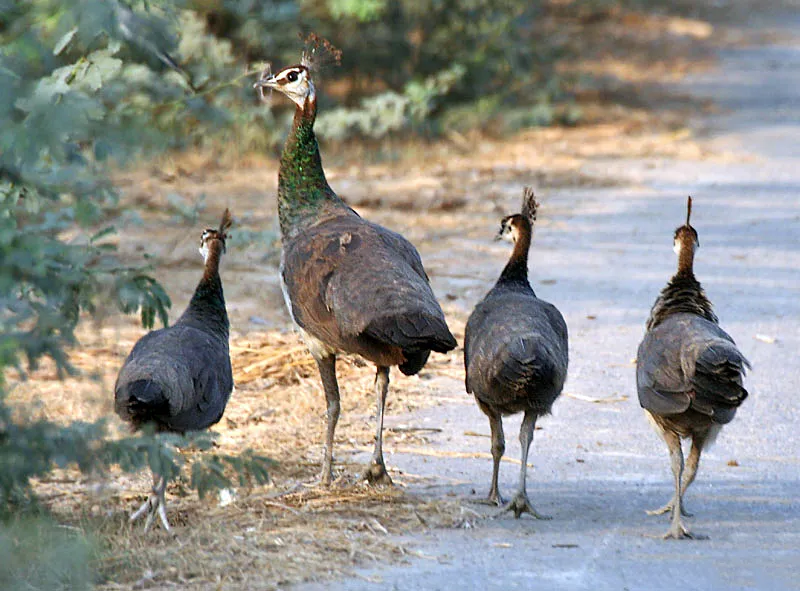
J.M.Garg · CC BY-SA 3.0
Peafowl are diurnal. At dawn they glide down from their roost trees, feed through the morning, rest or dust-bathe in the shade at midday, feed again in the late afternoon and then, calling loudly, fly up to roost before dark. Roosts are high branches used by several birds for years.
They can fly. Heavy bodies and long trains limit them to short flights, but they burst powerfully into the air to escape danger or reach a roost. On the ground they prefer to run for cover.
Outside the breeding season, females and young form small groups, while males gather separately or wander alone. In the breeding season, males set up display sites and wait for females to visit.
Peafowl are highly vigilant and give loud alarm calls at tigers and leopards. Deer and monkeys respond to these calls, and safari guides in India use them to judge where a big cat might be.
7. Diet and feeding
Peafowl are omnivores that scratch and peck for food:
- Seeds, grain and grass shoots
- Berries, fruit, petals and buds
- Termites, grasshoppers, beetles and other insects
- Spiders, worms and millipedes
- Lizards, frogs and small rodents
- Small snakes
Their willingness to kill snakes, including young cobras, has long made them welcome in Indian villages, though they rarely tackle large venomous snakes.
Near farms, peafowl eat grain, vegetables and fruit, and in parts of India rising numbers cause real crop losses, a frustrating situation for farmers since the birds are legally protected. Mass poisonings from eating pesticide-treated seed have also been reported.
8. Reproduction and life cycle
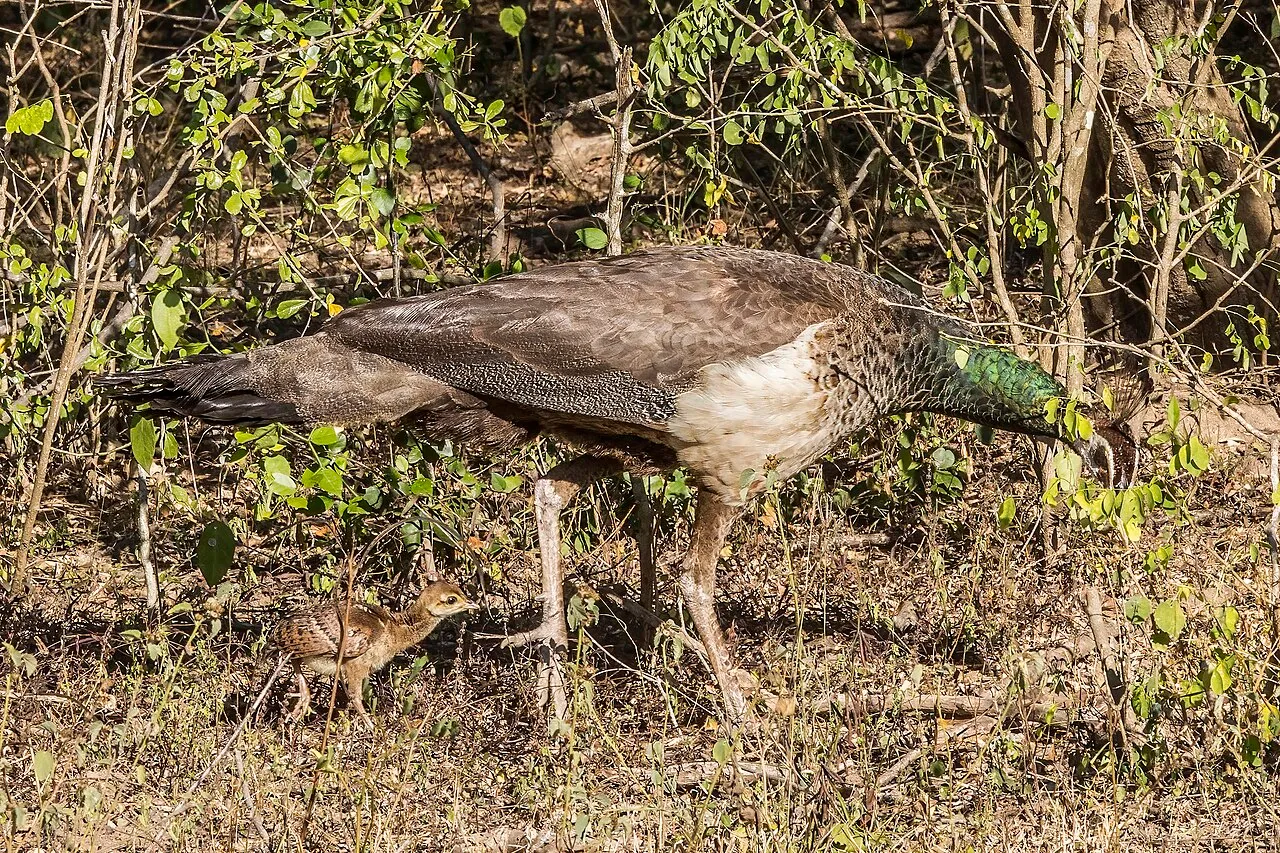
Charles J. Sharp · CC BY-SA 4.0
In India the breeding season largely coincides with the monsoon and lasts several months. Males gather at display grounds known as leks, each defending a small patch, and wait for females.
When a hen approaches, the male raises his train into a shimmering fan and turns to face her, sometimes swivelling to show his back before spinning round again. He then shivers the train so that it rattles. Research suggests this display includes low-frequency sound, partly below human hearing, that females can detect. Females visit several males before choosing. Males mate with multiple females and take no part in nesting or chick-rearing.
The hen scrapes a shallow nest on the ground in dense cover and lays three to six buff eggs, incubating them alone for about 28 days. Chicks hatch covered in down, can walk almost immediately and feed themselves while following their mother, who broods them under her wings at night.
| Stage | Timing | Notes |
|---|---|---|
| Egg | about 28 days | Incubated by the female alone |
| Chick | At hatching | Downy, walks immediately |
| First flights | From about 2 weeks | Flutters up into branches |
| Juvenile | Months to 1 year | Stays with mother; sexes look alike |
| Male train | 2–4 years | Longer each year |
| First breeding | Females about 2, males about 3–4 years |
Wild peafowl live about 15 to 20 years, and captive birds have exceeded 20.
8.1. Sexual selection and the train
The train looks like a liability: heavy, conspicuous to predators and seemingly a hindrance to flight and running. The leading explanation for why it evolved anyway is sexual selection.
If females prefer more ornamented males, those males sire more offspring, and over generations the ornament becomes ever more elaborate. Why females would prefer showier males has several proposed answers:
- The handicap principle: surviving despite such a costly ornament proves a male's quality.
- Good genes: an impressive train honestly advertises resistance to parasites and disease.
- Runaway selection: female preference and male ornament reinforce each other in an escalating feedback loop.
A study at an English park in the 1990s found that males with more eyespots mated with more females and that their offspring fared better. A later long-term study of feral peafowl in Japan, however, found no clear link between eyespot number and mating success, and debate continues. Newer work suggests that the shivering display, the accompanying sound, and the colour and iridescence of the eyespots may matter more than their number.
The cost of the train is also less obvious than it seems: experiments found that males with full trains did not take off much more slowly than those without, suggesting their bodies have co-evolved to carry it.
9. Intelligence, communication, special abilities
The peacock's call is loud and piercing, a 'may-awe' that can sound like a wailing cat or a person crying for help. Peafowl call most around the onset of the monsoon and in the breeding season, giving rise to the Indian belief that a calling peacock heralds rain. They also give short alarm calls and males produce a distinctive hoot just before mating.
The crest may be more than decoration. A 2016 study found that peafowl crest feathers vibrate in resonance with the frequency of a male's train-rattling display, suggesting females might feel the performance through their crests.
Peafowl learn and remember well: they recall where and when food is available, turning up punctually where people feed them, and feral birds in towns often time their movements to human routines.
10. Predators and survival
In India, adult peafowl are hunted by tigers, leopards, dholes, jungle cats and mongooses, as well as large raptors and pythons. Eggs and chicks are taken by jackals, mongooses, crows, snakes, and feral cats and dogs.
Faced with a predator, peafowl usually run for cover or explode into flight and land in a tree; roosting high at night is itself an anti-predator strategy. One might expect the train to make males easy to catch, but studies indicate it hampers take-off less than expected.
Today the more serious threats in India are human-related: poisoning from pesticide-treated grain, poaching for feathers and meat, attacks by dogs and cats, power-line collisions and road traffic.
11. Relationship with humans
Peafowl have enjoyed a special status for thousands of years. In India the bird is sacred: Kartikeya (Murugan), the Hindu god of war, rides a peacock; Krishna wears a peacock feather in his hair; and Saraswati, goddess of learning, is often shown with one. In Buddhism the peacock, believed able to eat poison unharmed, symbolises transforming harmful passions into wisdom.
Trade carried the bird west. The Bible records King Solomon's ships returning with gold, silver, ivory, apes and peacocks. In Greece and Rome the peacock was sacred to Hera (Juno): when her hundred-eyed watchman Argus was slain, she placed his eyes in the peacock's tail. Wealthy Romans served peacock at banquets, and medieval European nobles presented roast peacock redressed in its own feathers as the ultimate luxury.
The Mughal emperor Shah Jahan commissioned the jewelled Peacock Throne, seized in a Persian invasion in 1739; the phrase later came to stand for the Iranian monarchy.
In East Asia, too, the peacock was prestigious. In Qing China, peacock-feather plumes on officials' hats were honours bestowed by the emperor, and peacock motifs appeared on official rank badges. In Korea, peacocks feature in Joseon-era bird-and-flower paintings, folk art and embroidery as emblems of splendour and prosperity, though as exotic imports rather than native birds.
Today peafowl are kept in zoos, parks and private gardens worldwide. They are very loud, need lots of space and high perches, and require shelter from cold; escapees can become feral nuisances. In India, the species enjoys the highest level of protection under the Wildlife (Protection) Act, and hunting or trading it is strictly prohibited.
12. Conservation
The IUCN lists the Indian peafowl as Least Concern. It is common across its native range, and religious and legal protection keep many populations stable or growing. No precise global total exists, but it is clearly large. Surveys in India in the 2020s even suggested the species is expanding its range, possibly because some formerly very wet regions are becoming drier and more suitable.
Local declines still occur. Main threats:
- Poisoning by pesticide-treated grain
- Poaching for feathers and meat
- Loss of scrub and forest habitat
- Attacks by stray dogs
- Power lines and road traffic
In India the species is on Schedule I of the Wildlife (Protection) Act, the same top tier as the tiger. Collecting naturally shed feathers is traditionally permitted, but there are calls for tighter controls on the feather trade to stop birds being killed for their plumes.
Its relative the green peafowl, by contrast, has declined sharply through hunting and habitat loss and is listed as Endangered: the abundance of the Indian species does not mean all peafowl are safe. Korea has no domestic protection category for the Indian peafowl.
13. In zoos and parks
Indian peafowl are among the commonest zoo birds. Fairly cold-hardy and easily habituated, they are often allowed to roam free in zoos and parks, where a male fanning his train beside visitors is a crowd favourite.
Free-ranging has downsides. Birds fed snacks and bread by visitors suffer poor nutrition, and some have had feathers pulled out by people. Deliberately plucking train feathers causes pain and stress; only naturally moulted feathers should be collected.
Captive breeding has produced white, pied and other colour varieties. These exist for human aesthetics and have no conservation value, and white birds in particular would be conspicuous to predators in the wild.
14. In culture
The peacock stands for beauty and splendour, but also vanity: proud as a peacock describes someone who struts and preens.
In early Christian art the peacock symbolised resurrection and immortality, drawing on the ancient belief that its flesh did not decay and on the annual renewal of its plumage. It appears often in catacomb paintings and mosaics.
The multicoloured peacock logo of the American broadcaster NBC was created to promote colour television. James McNeill Whistler's Peacock Room in London is a celebrated interior decorated entirely with peacock imagery, and the motif was a favourite of Art Nouveau jewellers and glassmakers.
As India's national bird it appears on currency, stamps and official emblems, and classical Indian dance includes movements imitating the peacock. The peacock dance of the Dai people in Yunnan, China, is another famous tradition.
In animation, Lord Shen, the villain of Kung Fu Panda 2, is a white peacock. In Buddhism, the wisdom king Mahamayuri rides a peacock and protects against poison and calamity.
15. Trivia
- The male's train is moulted and regrown every year, so peacock feathers can in principle be obtained without harming the bird.
- When a peacock spreads its tail, it is really raising its upper tail coverts; the true tail feathers prop them up from behind.
- Because the colours are structural, old peacock feathers resist fading far better than pigmented ones.
- In India, the call of the peacock is welcomed as a sign that the monsoon rains are coming.
- Very old peahens, or those with hormonal changes, occasionally develop male-like plumage.
- Strictly speaking, only the male is a peacock; the female is a peahen, and both are peafowl.
Wild animals are not pets. Catching, trading or keeping them is illegal in most places. If you find an injured wild animal, call your local wildlife rescue centre.
FAQ
Do peahens have the big fan?
No, only males grow the train. Peahens are mottled brown and grey with a greenish neck, camouflage that helps while sitting on eggs.
Is the white peacock a different species?
It's a leucistic colour form of the Indian peafowl, not albino (the eyes are normally coloured). It is conspicuous to predators, so nearly all white peafowl are bred in captivity.
Can I keep a peacock at home?
We don't recommend it. Peafowl are very loud, need lots of space and high roosts, and escapees cause trouble wherever they go feral. In India they are strictly protected by law as the national bird.
Photo credits
Photos are freely licensed images from Wikimedia Commons. Authors and licenses are listed below.
- Blue Peacock Safari Park.jpg — Abdul Momin · CC BY-SA 4.0
- Peacock on tree (52077240794).jpg — Kandukuru Nagarjun from Bangalore, India · CC BY 2.0
- Indian Peafowl or Peahen.jpg — Akash Satpathy · CC BY-SA 4.0
- Indian Peahens I IMG 9647.jpg — J.M.Garg · CC BY-SA 3.0
- Indian peafowl (Pavo cristatus) female with chick.jpg — Charles J. Sharp · CC BY-SA 4.0