TailVille
1. Overview
An insect standing motionless in the grass with its forelegs folded, turning its triangular head to look straight at you as you approach: that is a mantis. Because the folded forelegs resemble hands in prayer, English speakers call it the praying mantis.
Mantises make up the order Mantodea, with roughly 2,400 to 2,500 species. All are predators of live prey, seizing victims in an instant with spiny, sickle-shaped forelegs. Korea's largest and most common species is the Chinese mantis (Tenodera sinensis), the focus of this article, which also introduces mantises in general.
Unusually among insects, mantises can swivel their heads freely and judge distance with true stereo vision, a skill demonstrated with tiny 3D glasses. They are notorious for females eating males during mating, though how often this happens in the wild is not what most people assume.
Mantises are a familiar sight in Korean fields in late summer and autumn. Often praised as pest controllers, they are in fact indiscriminate hunters that eat whatever they can catch.
2. Name and classification
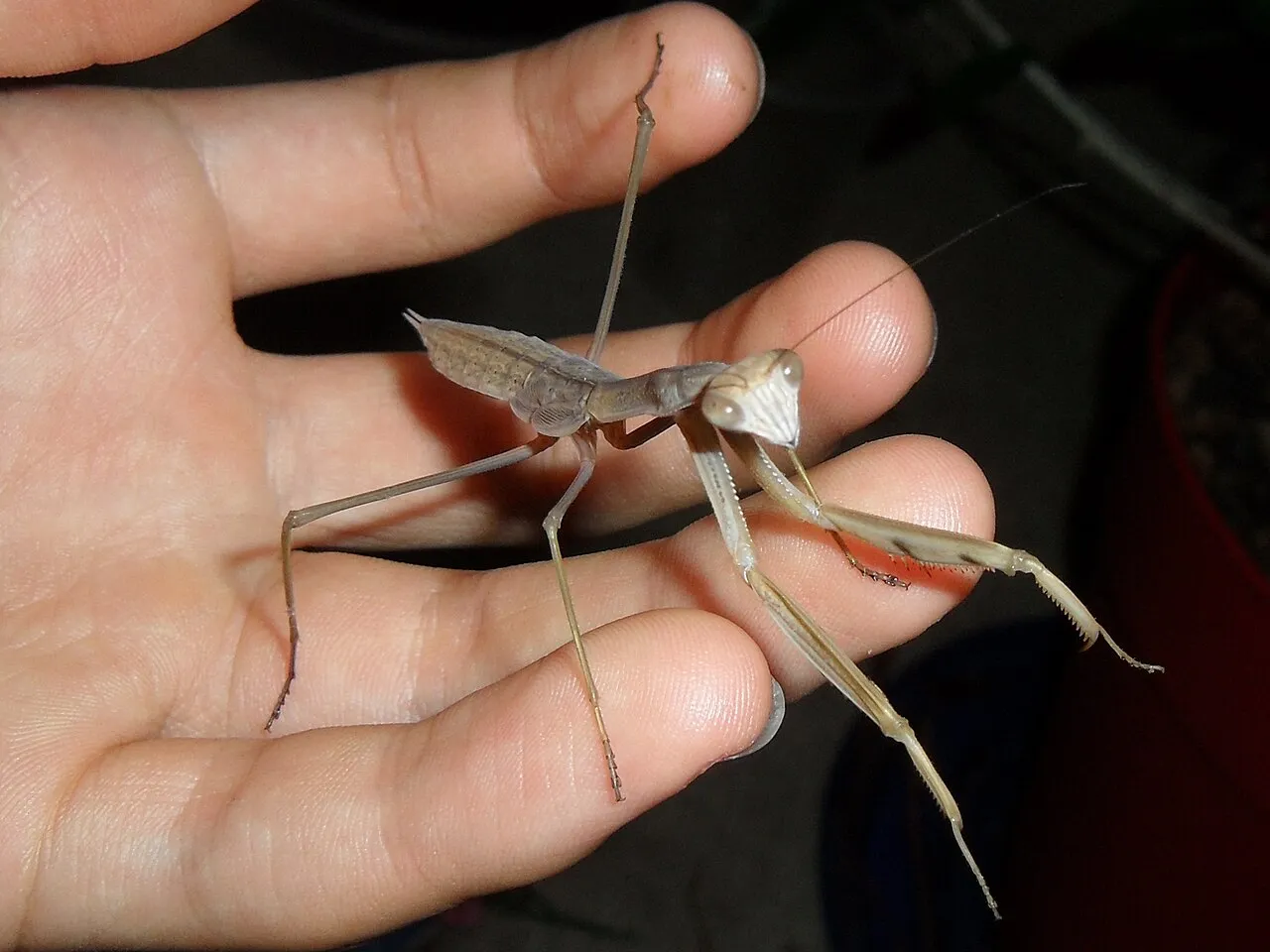
Happy1892 · CC BY-SA 3.0
Mantises form the order Mantodea, which together with cockroaches and termites makes up the superorder Dictyoptera. Different as they look, mantises and cockroaches are relatively close relatives.
Mantodea and mantis come from the Greek mantis, prophet, perhaps because the insect's poised stance suggested a seer delivering an oracle.
The Korean name samagwi is the same word as wart, and a widely told folk belief holds that letting a mantis bite a wart makes it disappear, though the true etymology is not settled. Regional names have included beomajaebi. In Chinese characters it is written 螳螂.
| Korean name | Scientific name | Female length | Notes |
|---|---|---|---|
| Wang-samagwi (Chinese mantis) | Tenodera sinensis | about 7 to 9.5 cm | Largest and most common; dark patch on hindwings |
| Samagwi (narrow-winged mantis) | Tenodera angustipennis | about 7 to 9 cm | Slimmer; orange at the base of the forelegs |
| Neopjeokbae-samagwi (giant Asian mantis) | Hierodula patellifera | about 5 to 7 cm | Broad abdomen, white spot on forewings |
| Jom-samagwi | Statilia maculata | about 4.5 to 6 cm | Brown, lives near the ground |
| Hangna-samagwi (European mantis) | Mantis religiosa | about 5 to 7 cm | Black eyespot inside the forelegs; also in Europe |
Mantises apparently introduced from abroad have recently been reported in parts of Korea. Classification and names may change as research continues.
3. Evolution
Mantises are thought to have arisen from cockroach-like ancestors. Insects close to the common ancestor of mantises and cockroaches lived in the Carboniferous and Permian, and one lineage specialised in hunting other insects, becoming the mantises.
Unambiguous mantis fossils appear in the Cretaceous, including specimens around 130 million years old and mantises preserved in Cretaceous amber from Myanmar and Lebanon. These early forms show primitive traits, such as differently arranged foreleg spines and spines on the middle and hind legs.
Mantis-like forelegs are not unique to mantises. Mantidflies, members of the lacewing order, have nearly identical raptorial forelegs despite being unrelated, a classic case of convergent evolution driven by an effective prey-grabbing tool. The marine mantis shrimp got its name for the same reason.
Modern mantises have evolved astonishing disguises: orchid mantises that mimic flowers, dead-leaf mantises, and species that resemble twigs.
4. Range and habitat
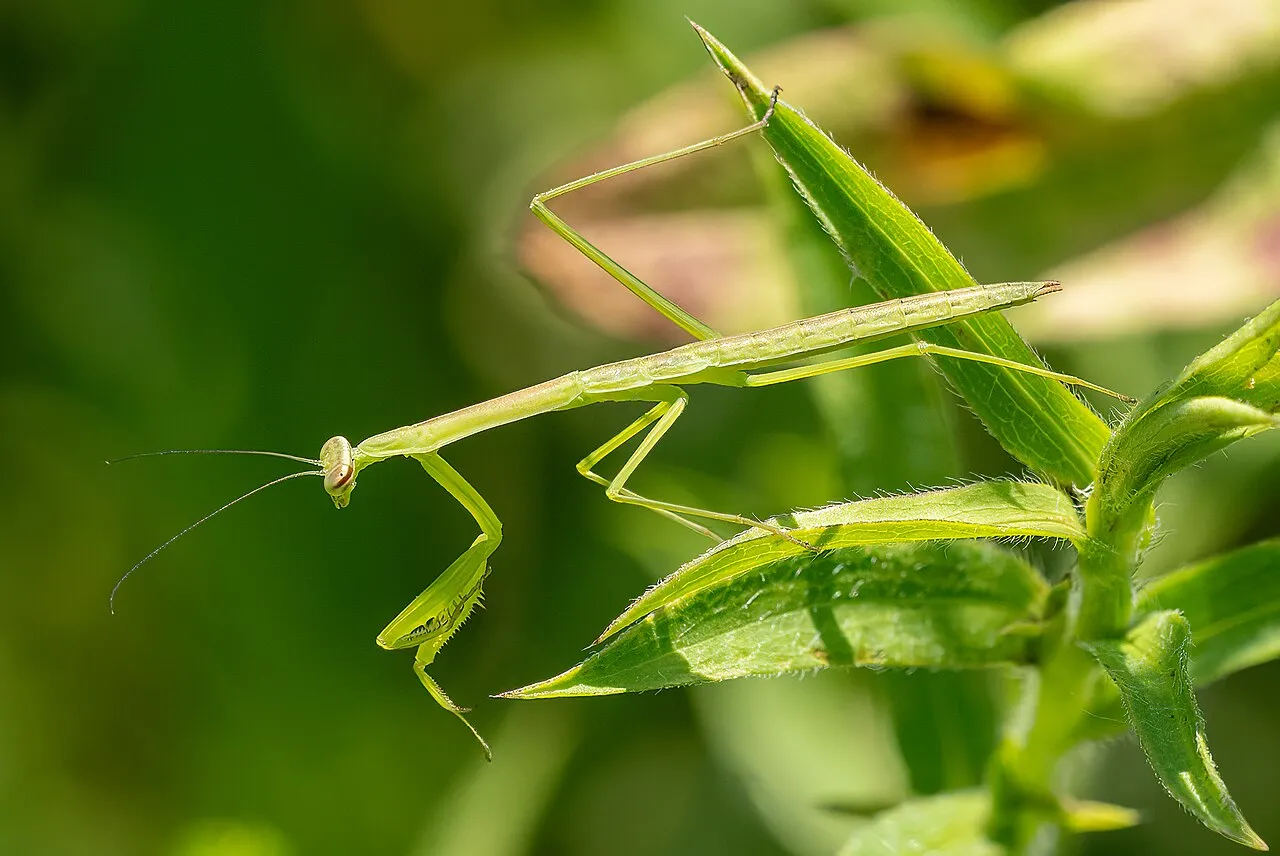
Rhododendrites · CC BY-SA 4.0
Mantises live on every continent except Antarctica, but most species are tropical or subtropical. Temperate regions host fewer species, which survive the winter as eggs.
The Chinese mantis is native to East Asia, including Korea, China and Japan. It was first found in North America near Philadelphia around 1896, probably arriving as egg cases on nursery stock, and later spread further as egg cases were sold for pest control. Hence its American name, Chinese mantis.
In Korea, it lives in fields, meadows, farm margins, parks, woodland edges and gardens nationwide, favouring tall grass and shrubs for concealment and ambush. Some Korean species, like Statilia maculata, live near the ground, while Hierodula patellifera spends much of its time in trees.
With warming climate, H. patellifera, once mainly southern, appears to be spreading northward in Korea.
5. Body
A mantis is elongated, with a long, neck-like prothorax that lets it raise its forelegs high while waiting for prey.
| Feature | Chinese mantis |
|---|---|
| Length | Female about 7 to 9.5 cm, male about 6.5 to 8 cm |
| Colour | Green and brown forms |
| Wings | Both sexes winged; heavy females fly poorly |
| Marks | Dark brown patch on hindwings, yellow spot between the foreleg bases |
The raptorial forelegs are the defining feature. Two rows of sharp spines line the femur and tibia, which snap together into a trap. The mantis walks on its middle and hind legs.
The triangular head sits on a flexible neck joint and can turn widely. Between the two large compound eyes are three simple eyes. A black dot in each compound eye seems to follow you around; this pseudopupil appears because the facets aimed directly at you absorb light, so the mantis always seems to be looking at you.
Females are larger, with plumper abdomens, while males are slimmer with slightly longer antennae. Both green and brown individuals occur, depending on environment and genetics.
6. Behaviour and ecology
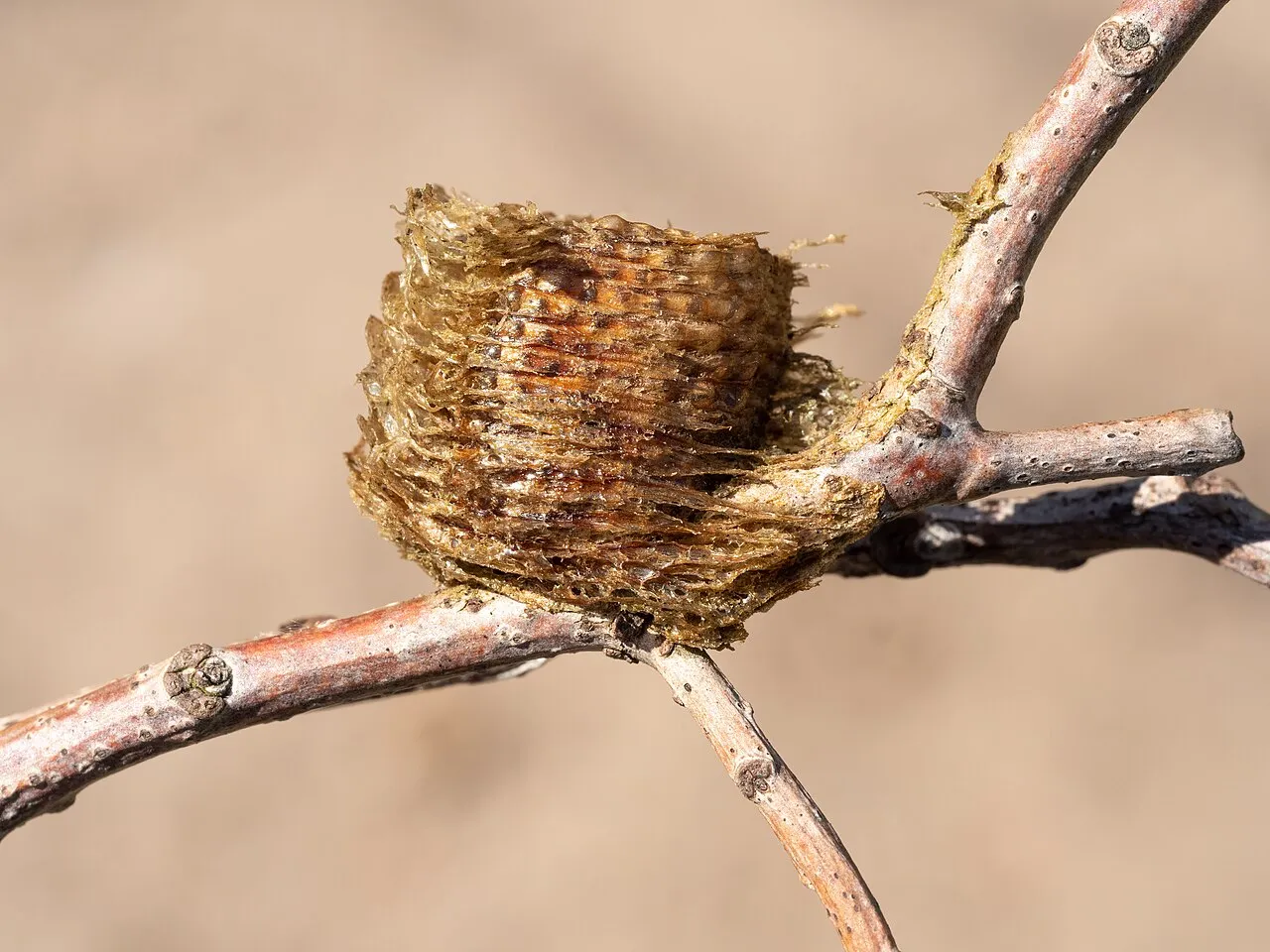
Rhododendrites · CC BY-SA 4.0
Most mantises are solitary ambush hunters. They cling to stems, flowers or twigs and wait motionless for hours, then strike in an instant when prey comes within reach. Sometimes they stalk, swaying gently back and forth like a leaf in the breeze as they creep forward. The swaying helps them blend in, and research suggests it also produces motion cues that help them judge distance.
Threatened, a mantis puffs itself up, spreads its wings and raises its forelegs in a deimatic display. The Chinese mantis flashes the dark patches on its hindwings and may rub its wings to make a hissing sound, startling birds and small mammals long enough to escape.
Many mantis species have a single ear on the underside of the thorax, tuned to bat ultrasound. When a flying mantis hears a bat's calls at night, it swerves or dives abruptly.
In Korea, mantises complete one generation a year: they hatch from egg cases in spring, grow through summer, mature in late summer, mate and lay eggs in autumn, and die around the first frost.
7. Diet and feeding
Mantises are strict carnivores that eat only live, moving prey. Their main criteria are whether something moves and whether it is the right size to catch.
Young nymphs take tiny insects such as aphids, fruit flies and small midges. Adult Chinese mantises eat grasshoppers, crickets, moths, butterflies, flies, bees, cicadas, dragonflies and other mantises. Large mantises have been recorded around the world eating small frogs, lizards and even small birds such as hummingbirds; in the United States, mantises hunting hummingbirds at feeders have drawn much attention.
The strike lasts a small fraction of a second. Prey is pinned between the spines, and the mantis usually starts eating at the head or neck, which quickly ends resistance.
Mantises do eat pests, but they eat honey bees, butterflies and other pest predators just as readily, so their value for crop protection is generally considered limited. They can go days or weeks without food and drink dew and raindrops.
8. Reproduction and life cycle
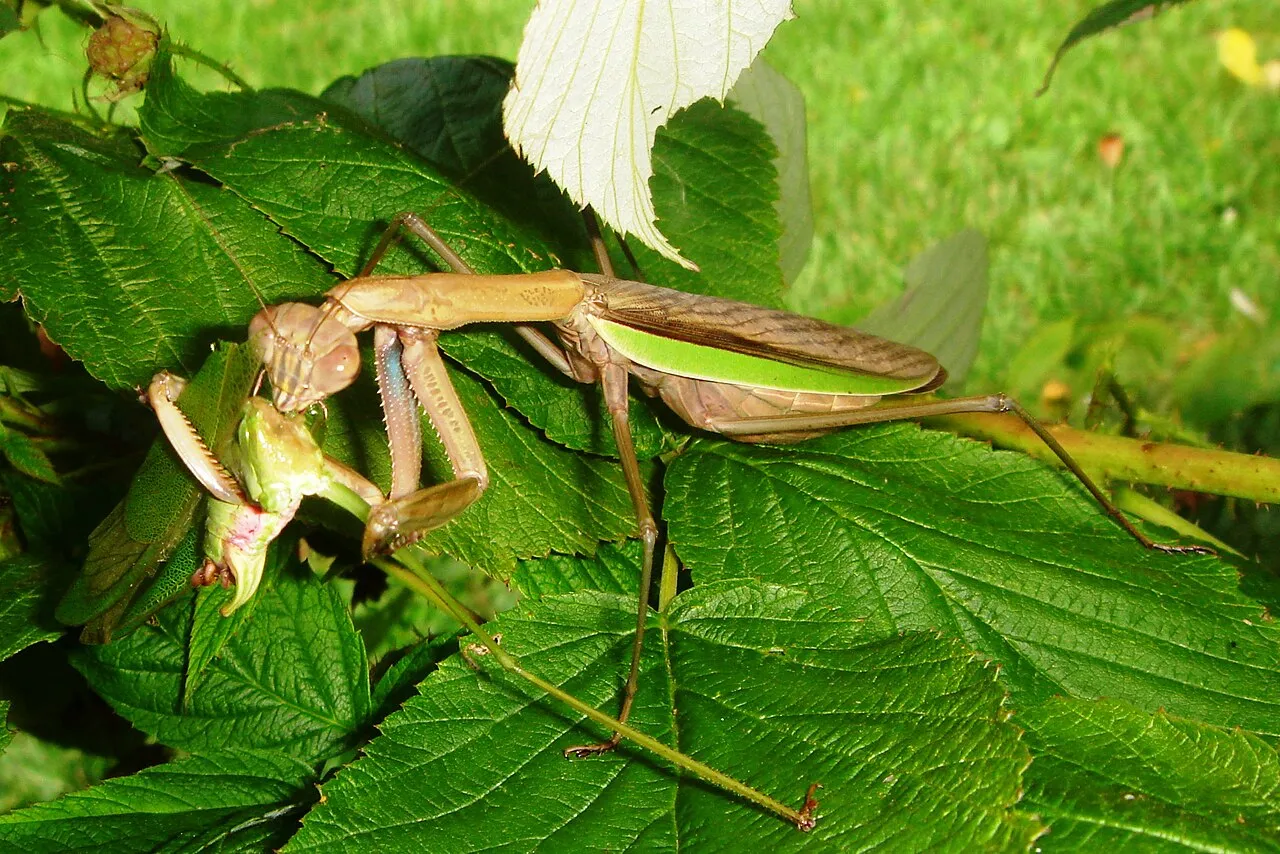
Mantises undergo incomplete metamorphosis: egg, nymph and adult, with no pupal stage. Nymphs resemble small, wingless adults and grow through successive moults.
In autumn, mature females release pheromones to attract males, which approach cautiously and mount from behind. Mating can last for hours.
Afterwards, the female builds an egg case, or ootheca, on a twig, stem or wall. She extrudes a froth from the tip of her abdomen and lays eggs in layers within it; the foam hardens into a spongy shell that protects the eggs from cold, drying and predators. A Chinese mantis ootheca is brown and a little smaller than a ping-pong ball, holding roughly 100 to 300 or more eggs, and a female may produce several in a season.
| Stage | Timing in Korea (Chinese mantis) | Notes |
|---|---|---|
| Egg case | October to the following May | Overwinters |
| Hatching | Around May | Dozens to hundreds emerge together |
| Nymph | May to August | About seven or eight moults |
| Adult | August to November | Mates, lays eggs, dies around first frost |
Newly hatched nymphs are under a centimetre long and pour out together, dangling on threads before dispersing. Ants, spiders, other insects and their own siblings eat many of them, so very few survive to adulthood. With the final moult they gain wings. Adults usually live two to three months.
8.1. The truth about sexual cannibalism
Mention mantises and most people think of females eating males during mating. It does happen: females may devour males, head first, during or after copulation, and headless males have been seen to continue mating, since ganglia elsewhere in the body can sustain basic movements.
But it does not happen every time. Early observations were mostly made in cramped containers with hungry females, conditions that make cannibalism very frequent. Field studies more often find males eaten in a minority of encounters, commonly in the range of roughly ten to thirty percent depending on species and conditions. Many males mate and leave unharmed.
Research shows cannibalism can feed hungry females so they lay more eggs. In experiments with the Chinese mantis, females that ate males produced more eggs, and nutrients from the male's body were traced into the eggs. For a male that has already mated, becoming a meal can still benefit his offspring.
Males also try to avoid being eaten: they prefer well-fed females, approach very slowly while the female looks away, and leap off quickly after mating. In at least one species, males wrestle females with their forelegs; winners mate, losers may be eaten.
9. Senses and special abilities
Mantises are highly visual hunters. Their broadly overlapping compound eyes give stereo vision of the space in front, allowing precise distance judgements. Researchers at Newcastle University in the UK fitted mantises with tiny 3D glasses attached with beeswax and showed them virtual prey on a screen. The mantises struck when the 3D image appeared within reach, confirming stereo vision in an insect for the first time. Interestingly, mantis stereo vision seems to rely on changes in moving images rather than static detail, unlike ours.
Turning the head through close to 180 degrees lets a mantis track prey without moving its body and giving itself away.
Mantises cannot change colour at will, but after moulting they may become green or brown depending on surrounding colour and humidity. The tropical orchid mantis mimics a flower with petal-like legs and a pink-and-white body, and studies show it can attract insects even better than real flowers.
The strike itself is over in roughly 50 to 70 milliseconds, faster than a human blink.
10. Predators and survival
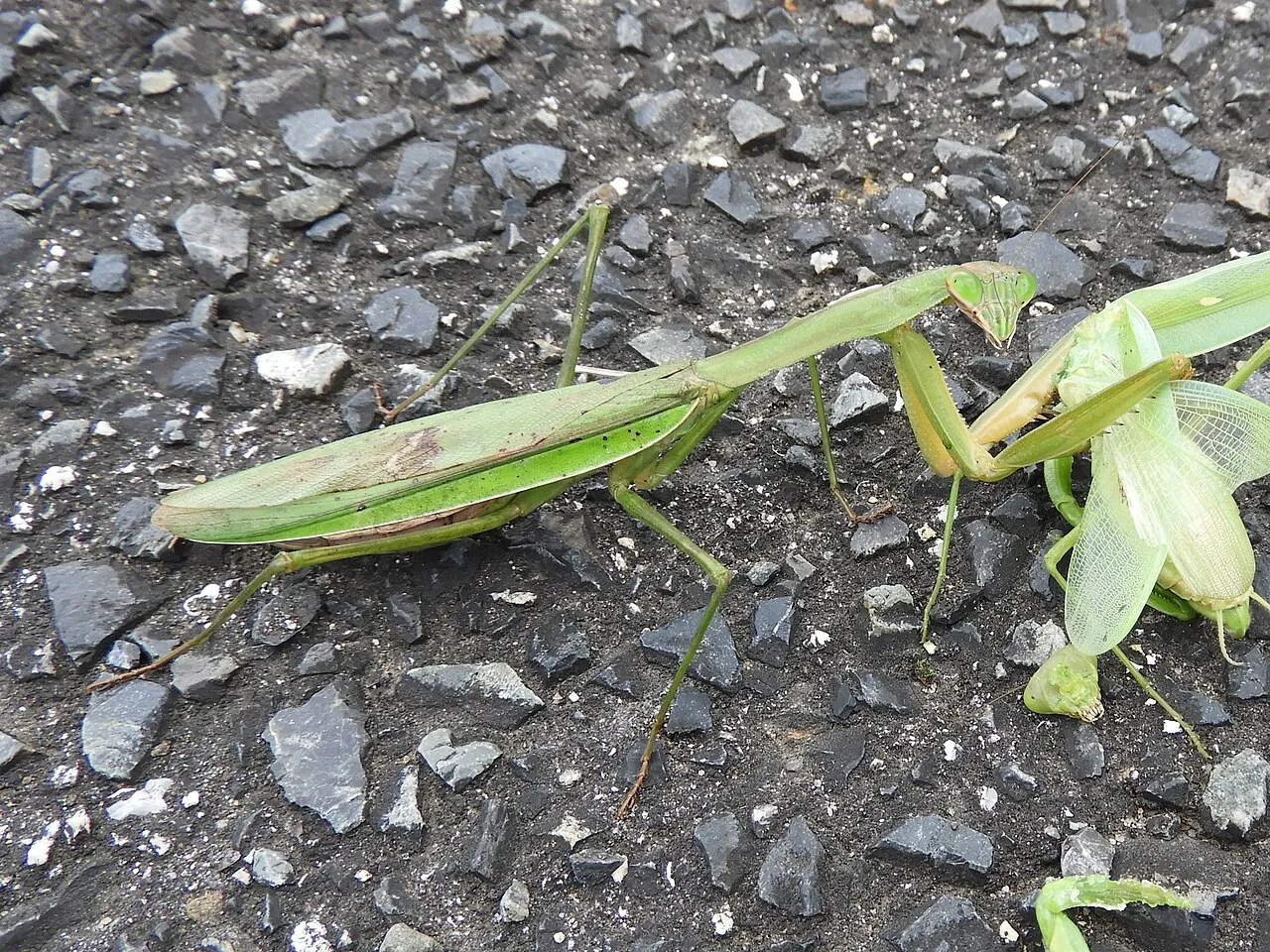
TekuraDF · CC0
Mantises are hunters but also prey for birds such as shrikes, bulbuls and magpies, as well as frogs, lizards, bats, spiders and other mantises. Egg cases attract some birds and parasitoid wasps, including tiny wasps that lay eggs only in mantis oothecae.
The mantis's most famous parasite is the horsehair worm. Its larvae hatch in water and are eaten by aquatic insects; when those insects emerge as winged adults and are eaten by a mantis, the worm enters the mantis and grows inside it. The mature worm must return to water to breed and is known to manipulate its host into seeking water and jumping in, then wriggles out from the tip of the abdomen. Worms can reach tens of centimetres in length.
Horsehair worms are not known to parasitise people or pets. The 2012 Korean disaster film Deranged (Yeongasi) imagined a mutant strain infecting humans, which is pure fiction.
Mantises defend themselves through camouflage, threat displays and flight, spending most of their time blended into grass and leaves.
11. Relationship with humans
Mantises have long fascinated people. In ancient Greece they were said to show lost travellers the way, and in the mythology of the San people of southern Africa, the trickster creator god /Kaggen often takes the form of a mantis.
In East Asia, mantis egg cases were used as a traditional medicine, with those found on mulberry trees especially valued, though such remedies are not well supported by modern evidence.
In the twentieth century, mantises gained a reputation as natural pest control, and egg cases became a common garden product in the United States. Because they eat beneficial insects as readily as pests, though, they are generally rated less effective than specialist natural enemies such as lady beetles or parasitoid wasps. Where non-native mantises have been introduced, they may compete with native mantises and prey on native insects.
For Korean children, mantises are summer-vacation insect-collecting favourites, and keeping mantises as pets has become more popular. Briefly observing a native mantis does little harm, but importing tropical species may be restricted under plant quarantine rules, and releasing non-native mantises can harm ecosystems. Native mantises should be returned to where they were found once observation is over.
12. Conservation
The Chinese mantis has not been evaluated by the IUCN. It is common in its native East Asia and has actually expanded its range into North America. Across the order Mantodea, only a tiny fraction of species have been assessed, and most lack data. Some tropical mantises with very small ranges could be at risk if their forests are destroyed.
Pressures on mantises include:
- Loss of meadows, hedgerows and woodland edges
- Pesticides reducing both mantises and their prey
- Mowing and lawn management in cities
- Competition from introduced mantises
- Wider declines in insect populations
In parts of Europe, species such as the European mantis are protected regionally. In Korea, mantises have no legal protection. Leaving patches of long grass and shrubs and reducing pesticide use helps mantises along with many other insects.
13. In insectariums and captivity
Mantises are frequently displayed in insect museums, nature centres and zoo insectariums, especially tropical species with remarkable camouflage such as orchid, dead-leaf and ghost mantises. Many facilities breed them for education.
Because mantises eat each other, they must be housed singly, with room to hang while moulting, suitable humidity and a steady supply of live food. Failed moults often leave legs or wings deformed and can be fatal.
Online trade in foreign mantises and egg cases has grown, raising problems: escaped or abandoned exotic species can disturb local ecosystems, importing live insects may break quarantine rules, and trade in wild-caught tropical mantises can burden source populations. For learning, watching native mantises in the wild is the best approach.
14. Mantises in culture
East Asian idioms feature mantises prominently. One describes a mantis raising its forelegs to stop a chariot wheel, mocking reckless defiance of an overwhelming force, though some read it as praise for courage. Another describes a mantis stalking a cicada while an oriole stalks the mantis, warning against chasing gain without seeing the danger behind.
Chinese martial arts include Praying Mantis Kung Fu, known for hooked, grabbing hand movements, and one of the Furious Five in the animated Kung Fu Panda films is Mantis.
In the West, sexual cannibalism made the mantis a symbol of the femme fatale, and Surrealist artists were famously fascinated by it. Games are full of mantis-inspired creatures, such as Pokémon's Scyther.
In Korea, the film Deranged spread awareness of mantises and horsehair worms, and the folk belief that a mantis can cure skin warts has long been told.
15. Trivia
- Mantises are among the few insects that can look over their shoulder without turning the body.
- After eating, mantises carefully lick their forelegs clean, since food stuck between the spines would hamper hunting.
- Chinese mantis egg cases are easy to spot in winter. Bring one indoors, and the warmth may trigger a midwinter hatch of hundreds of nymphs.
- Males fly better than females and are often drawn to lights on autumn nights, turning up on balconies and under streetlights.
- Mantises prefer protein, but captive individuals have been seen eating honey or pollen.
- The folded forelegs look prayerful but are really a loaded hunting stance, inspiring the common pun praying versus preying mantis.
- Newly hatched nymphs of some species look and move like ants, which may help them avoid predators.
Wild animals are not pets. Catching, trading or keeping them is illegal in most places. If you find an injured wild animal, call your local wildlife rescue centre.
FAQ
Do female mantises always eat the male?
No. It is frequent in cramped containers, but field studies see it in a minority of matings, roughly 10–30% depending on species; many males leave unharmed.
Can horsehair worms infect people?
No. Horsehair worms parasitise insects such as mantises and crickets and are not known to infect people or pets; the film plot is fiction.
Can I bring a mantis egg case indoors?
Better not. Indoor warmth can trigger a midwinter hatch of hundreds of nymphs with nothing to eat; leave the case where you found it.
Photo credits
Photos are freely licensed images from Wikimedia Commons. Authors and licenses are listed below.
- Tenodera sinensis 5 Luc Viatour.jpg — Luc Viatour · CC BY-SA 3.0
- Brown sub-adult female Chinese Mantis on hand1243.JPG — Happy1892 · CC BY-SA 3.0
- Chinese mantis nymph (60923).jpg — Rhododendrites · CC BY-SA 4.0
- Mantis ootheca in Marine Park (91115).jpg — Rhododendrites · CC BY-SA 4.0
- Prayingmantismeal.jpg — Dave Parker · CC BY 3.0
- Tenodera aridifolia(Female,Japan,2017.10.25).jpg — TekuraDF · CC0