TailVille
1. Overview
The red panda is a small mammal of the high forests of the Himalayas and south-western China. A little bigger than a house cat, with russet fur, a white-marked face and a thick ringed tail, it is often mistaken for a relative of raccoons or foxes. In fact it is the only living member of its own family, the Ailuridae.
Despite the name, it is not closely related to the giant panda. Both eat mostly bamboo and both have a false thumb made from an enlarged wrist bone, but these similarities arose independently as two unrelated lineages adapted to similar lives, a textbook case of convergent evolution. Amusingly, the red panda had the name panda first.
Its looks make it a zoo favourite, but in the wild it is listed as Endangered by the IUCN because its forests are shrinking and fragmenting. Quiet, tree-dwelling and highly sensitive, the red panda is a wild animal with very particular needs.
2. Name and classification
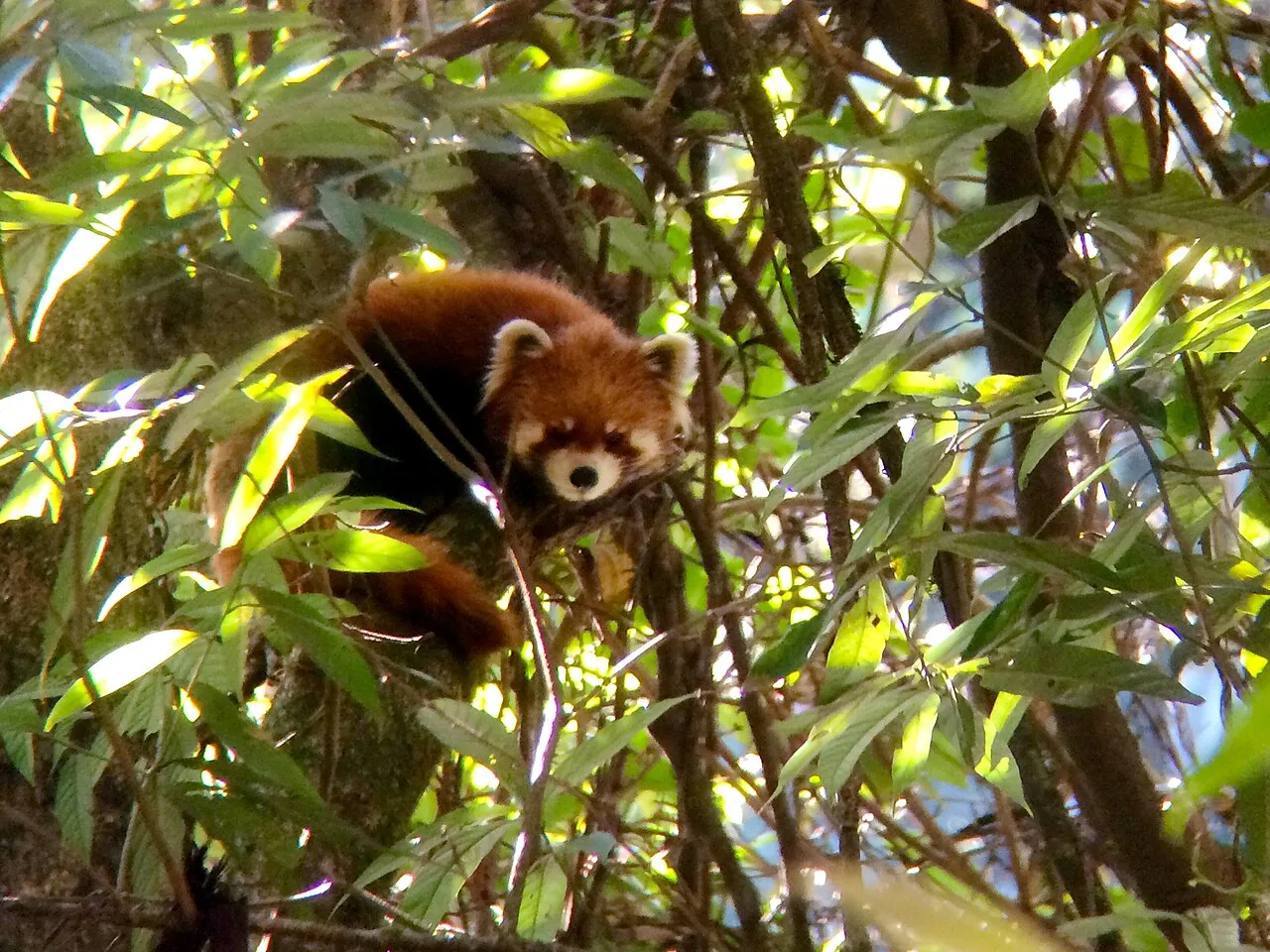
Marie Chappell · CC BY 4.0
The scientific name Ailurus fulgens combines the Greek for cat and the Latin for shining or fiery: the fiery cat. The French naturalist who introduced it to Western science in the early nineteenth century reportedly called it one of the most beautiful animals he knew.
The origin of the word panda is uncertain, but it is widely thought to come from a Himalayan language, possibly Nepali. When the big black-and-white bear from China became known, it took the title giant panda, and the original animal gained the prefix lesser or red. In Mandarin it is xiaoxiongmao, the little bear-cat, and in English it has also been called the firefox.
Classification was long a puzzle. The red panda was placed with raccoons at one time and with bears at another. Molecular studies settled it within the superfamily Musteloidea, alongside weasels, skunks and raccoons, but in its own family, Ailuridae, of which it is the sole living member.
2.1. One species or two?
Two subspecies have traditionally been recognised.
| Form | Scientific name | Range | Features |
|---|---|---|---|
| Himalayan red panda | A. f. fulgens | Nepal, north-east India, Bhutan, southern Tibet | Paler face and lighter coat |
| Chinese red panda | A. f. styani (or A. styani) | Sichuan and Yunnan in China, northern Myanmar | Deeper red coat, bolder tail rings |
A genomic study published in 2020 argued that the two are distinct enough to be separate species, the Himalayan red panda (Ailurus fulgens) and the Chinese red panda (Ailurus styani), with a major river in south-eastern Tibet marking the boundary. Not every authority has adopted the split, and many still treat them as subspecies of one species.
3. Evolution
Only one (or two) red panda species survive today, but the family was once far more diverse and widespread, with fossil relatives known from Europe, Asia and North America.
Ailurids seem to have originated in Europe and diversified across Eurasia by the Miocene. Some later crossed the Bering land bridge into North America. A fossil site in Tennessee has produced a red panda relative about five million years old that was larger than today's animal and already had a structure resembling the false thumb. Pliocene relatives are also known from several European sites.
As climates changed, most of these lineages disappeared, leaving only the line that lived in the cool, damp forests of the Himalayas and south-western China. That is why the red panda is sometimes described as something close to a living fossil.
Its false thumb looks like the giant panda's, but the two evolved independently. One idea is that the red panda's ancestors first used the extra digit to grip branches in the trees, and only later put it to work holding bamboo.
4. Range and habitat
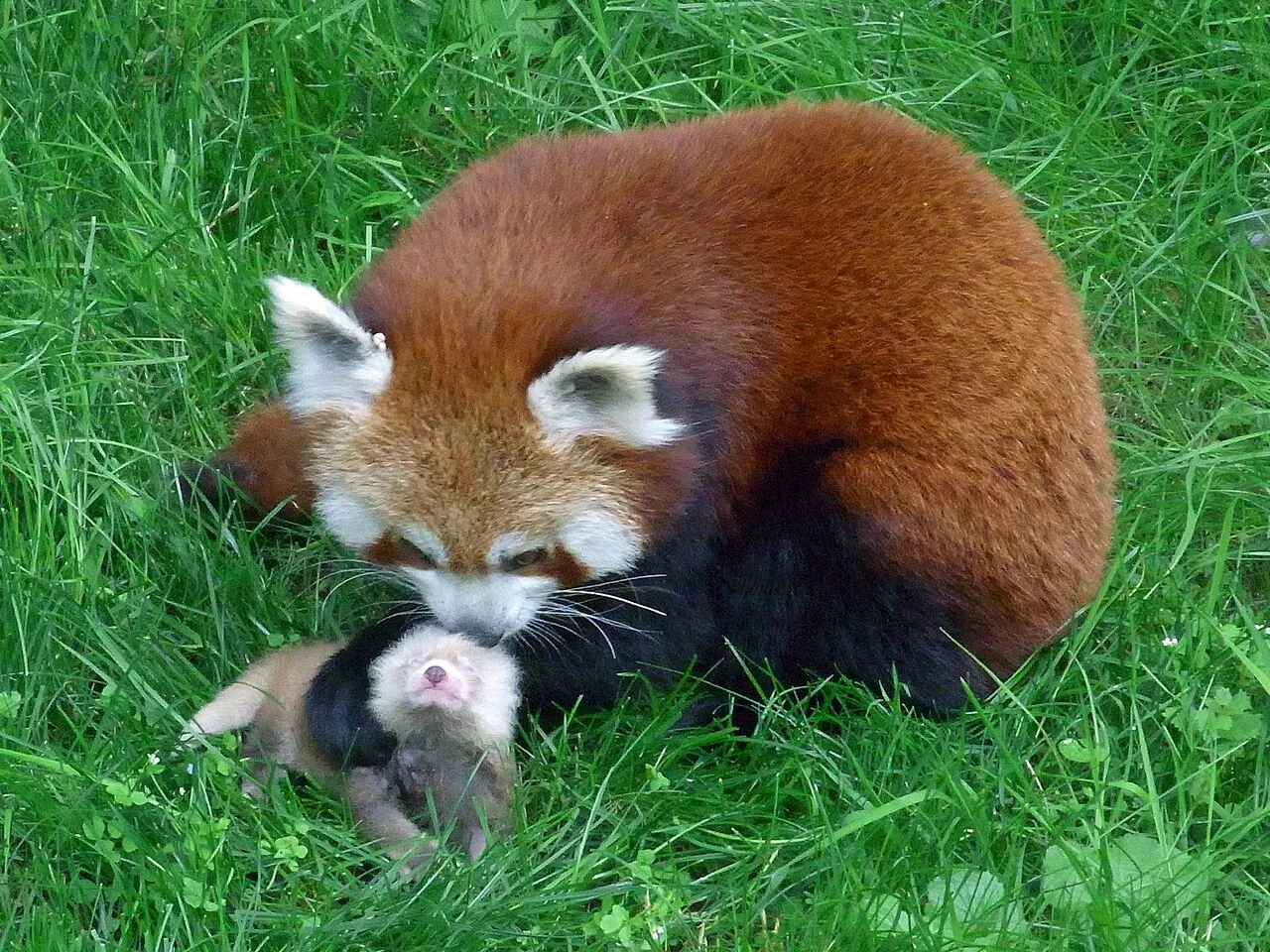
Rainer Halama · CC BY-SA 3.0
Red pandas live in the Himalayas and the mountains of south-western China: Nepal, north-eastern India (including Sikkim, Arunachal Pradesh and northern West Bengal), Bhutan, northern Myanmar, and China's south-eastern Tibet, Yunnan and Sichuan.
They inhabit temperate mountain forest at roughly 2,200 to 4,800 metres, favouring oak, maple, rhododendron and fir forest with a dense bamboo understorey. These are cool, misty, rainy places, and red pandas cope poorly with heat; temperatures much above 25°C stress them. They shelter in tree hollows and rock crevices and thrive in old forest rich in fallen logs and moss.
| Region | Habitat |
|---|---|
| Nepal, India, Bhutan | Eastern Himalayan temperate forest with bamboo understorey |
| Northern Myanmar | Montane forest; very little survey data |
| South-western China | Forests of Sichuan and Yunnan, partly shared with giant pandas |
In parts of Sichuan, red and giant pandas share the same forests. Both eat bamboo, but giant pandas take more stems and shoots while red pandas pick the tender leaves, reducing competition.
5. Body
Red pandas are about cat-sized or slightly larger, with a tail nearly as long as the body.
| Measure | Value |
|---|---|
| Head and body length | About 50 to 64 cm |
| Tail | About 28 to 50 cm |
| Weight | About 3 to 6 kg |
| Sex differences | Minimal |
The back is a vivid russet, while the belly and legs are dark brown to black. The face is white with reddish tear-track markings running from the eyes to the mouth, and the ears are edged in white; facial patterns vary between individuals. The bushy tail is ringed in alternating dark and light bands.
Those bright colours sound conspicuous, but they work well as camouflage. The trees in red panda forest are draped in reddish-brown moss and pale lichens, so a curled-up red panda blends right in. The dark underside also looks like shadow to a predator looking up from below.
The soles of the feet are furred, insulating against cold branches and snow and improving grip. Sharp, semi-retractable claws make red pandas excellent climbers, and flexible ankles let them descend trunks head-first.
Like the giant panda, it has a false thumb, an elongated wrist bone used to grip bamboo stems while stripping leaves.
The dense coat and thick tail are cold-weather gear. When sleeping, a red panda curls into a ball and wraps its tail around its face like a blanket.
6. Behaviour and ecology
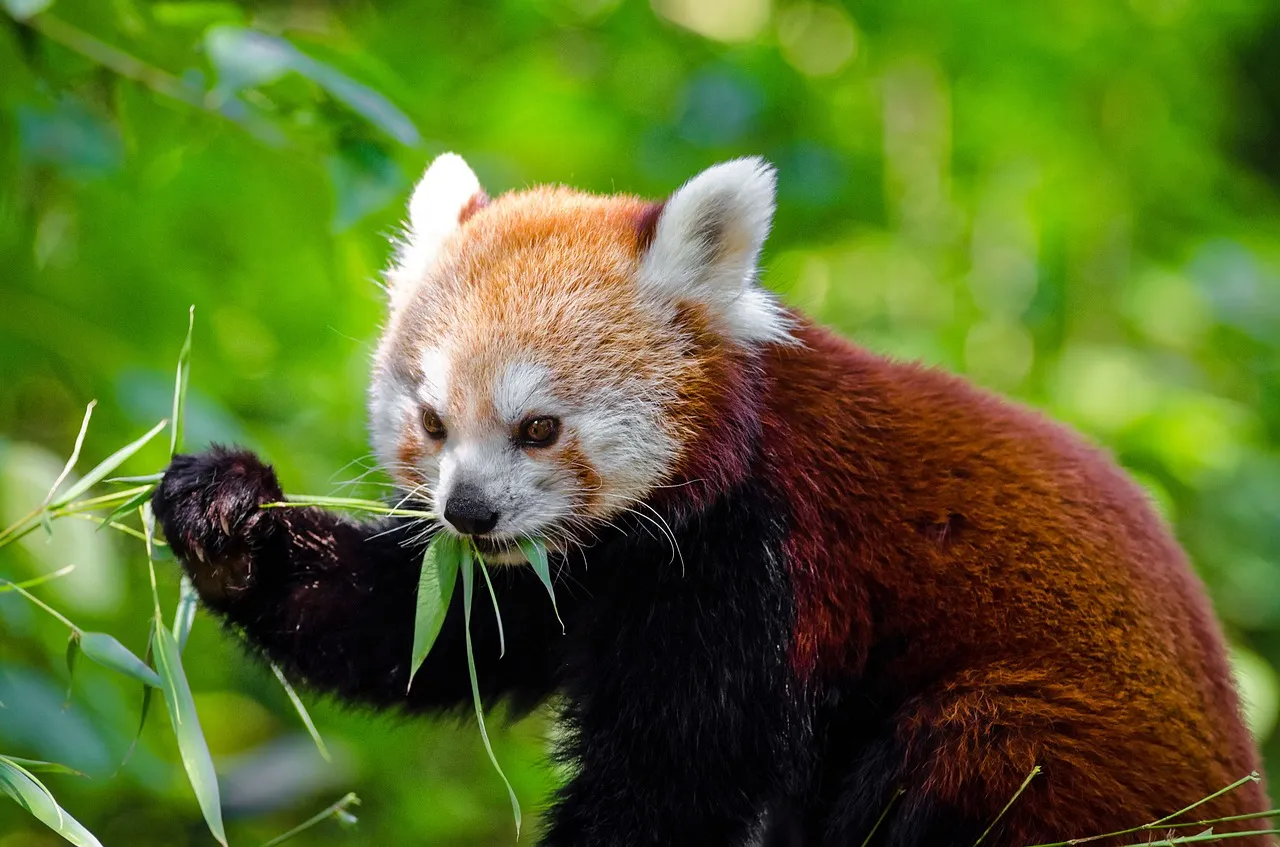
Red pandas spend most of their lives in trees. They come down to forage, but they climb up to rest, sleep and escape danger. Sprawled along a branch with all four legs dangling is the classic red panda pose.
They are mainly crepuscular, most active at dawn and dusk, with some activity at night and rest during the middle of the day. Much of their time goes to eating and resting.
Red pandas are solitary, avoiding each other outside the breeding season and keeping individual home ranges, generally reported at roughly one to ten square kilometres. Males range more widely and overlap several females.
They are masters of energy saving. Bamboo leaves are poor food, so red pandas keep activity low and metabolism slow. On cold days they curl up tightly, and research suggests they can lower their metabolic rate further in severe cold. When it is warm, they stretch out on branches to shed heat.
They are fastidious groomers, licking their paws and washing their faces much like cats.
7. Diet and feeding
Red pandas belong to the order Carnivora, yet bamboo makes up most of their diet. Studies commonly find that bamboo leaves and shoots account for 80 to 90 percent or more of what they eat, with a preference for the tender, most nutritious young leaves and for shoots when they sprout.
They also eat fruit, acorns, berries, roots, fungi, flowers and lichen, and occasionally birds' eggs, small birds, insects and small rodents. In zoos they get bamboo plus fruit, specialist pellets and sometimes boiled egg, and they have a notable sweet tooth for apples and grapes.
Their digestive system is that of a carnivore: a simple stomach and short gut that handle fibre poorly. They digest only about a fifth or so of the bamboo they eat. To compensate they eat large quantities, select the best parts and live as economically as possible; estimates suggest they may eat leaves equal to 20 to 30 percent of their body weight a day.
A feeding red panda grips a stem with its forepaws and false thumb and strips the leaves with its mouth, chewing them finely with its molars. Eating fills a large part of each day.
8. Reproduction and life cycle
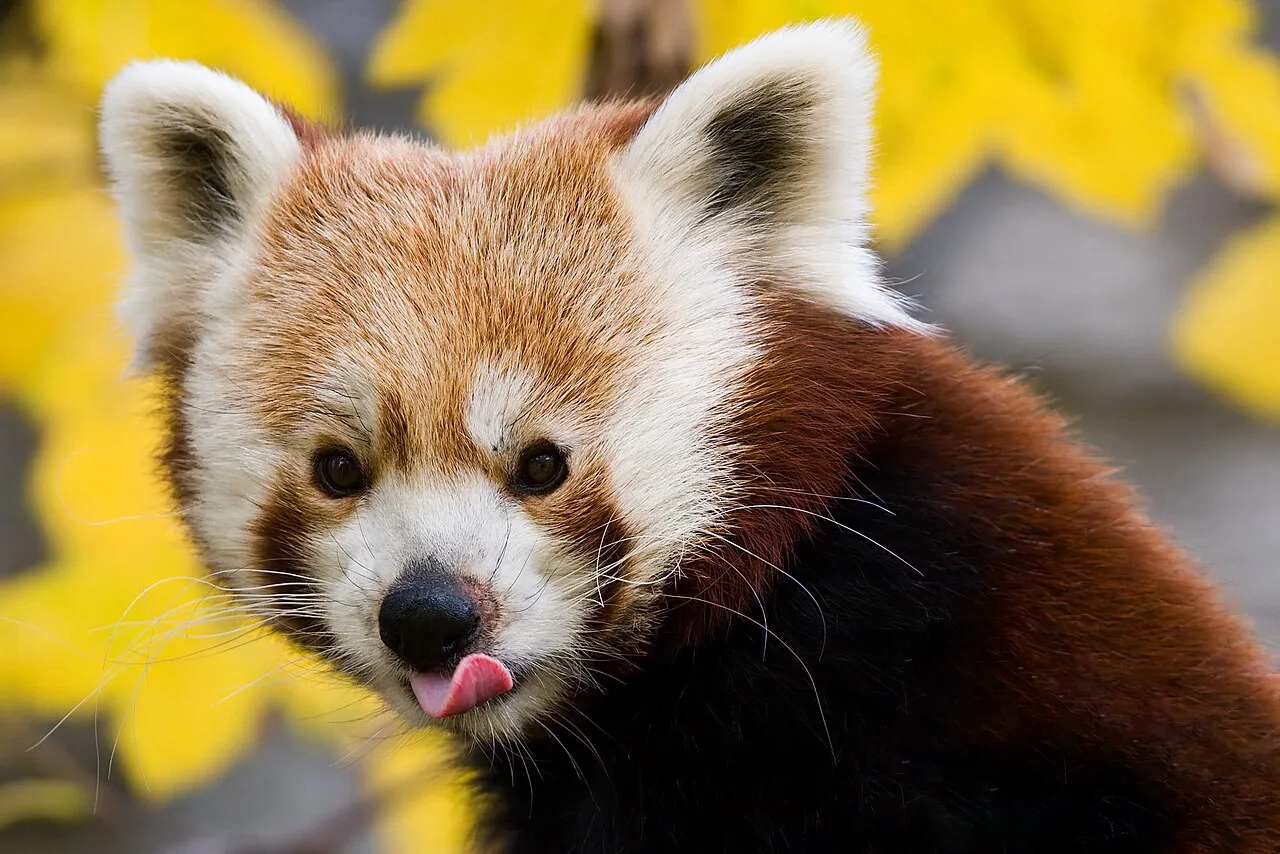
Christian Mehlführer, User:Chmehl. Edit by Böhringer · CC BY 2.5
The breeding season usually falls in winter, roughly January to March, when otherwise solitary males and females briefly meet. A female's fertile period is very short, often just a day or two.
Like giant pandas, red pandas have delayed implantation, so gestation varies widely, from about 110 to 160 days. Births typically happen in late spring or summer, around June and July, when fresh bamboo leaves and shoots are abundant for nursing mothers.
Before giving birth, the female lines a tree hollow or rock crevice with grass and leaves. Litters range from one to four, usually one or two. Newborns weigh around 110 to 130 g, with eyes closed and greyish fur. The mother stays close at first, later leaving to feed and returning to nurse. Males normally take no part in raising young.
| Stage | Age | What happens |
|---|---|---|
| Newborn | 0 to 3 weeks | Eyes closed, grey fur, stays in nest |
| Eyes open | Around 3 weeks | Still nest-bound |
| First outings | About 3 months | Leaves the nest and follows mother; coat turns red |
| Weaning | About 6 to 8 months | Starts eating bamboo, stops nursing |
| Independence | About 1 year | Leaves mother around the next breeding season |
| Maturity | About 18 months | Able to breed |
| Lifespan | About 8 to 10 years in the wild | Captive animals have lived beyond 15 |
Cubs are born greyish and gradually develop the adult red coat. Surviving the first winter is a major hurdle.
9. Intelligence, communication, special abilities
Red pandas communicate mainly through scent. Glands around the tail base and on the soles of the feet leave traces as they walk, and they mark with urine and droppings. Other red pandas read these signals to learn about sex and breeding condition, so a red panda sniffing along a trail is gathering news.
They are vocal too, producing short whistles, twittering sounds, hisses and snorts when threatened, and a distinctive huff-quack call during the breeding season.
Body language matters. When threatened, a red panda rears up on its hind legs with forelegs raised to look bigger. People find this pose adorable and it has gone viral many times, but it is actually a warning: keep away, or meet the claws. Head bobbing and an arched tail also signal tension.
Red pandas are known to have a special sensory structure involved in combining smell and taste, and they are one of the few carnivores shown to be sensitive to sweetness, unlike cats, which cannot taste sweet at all.
10. Predators and survival
Natural predators include snow leopards and martens; yellow-throated martens are a particular danger to cubs and young animals, and large birds of prey may also take youngsters. Threatened red pandas scramble up trees or, if cornered, rear up in their defensive stance.
They are vulnerable to heat and disease. Village dogs near their forests attack them and can spread diseases such as canine distemper. Free-ranging livestock grazing in the forest also strip the bamboo understorey that red pandas depend on.
Mass bamboo flowering and die-off is another risk, since red pandas rely heavily on particular bamboo species.
11. Relationship with humans
Red pandas have long been familiar to people of the Himalayan region. In some areas their pelts were used for hats and ornaments; among certain communities in south-western China, red panda fur hats were reportedly regarded as lucky, for instance at weddings. Such traditional uses contributed to hunting pressure.
Western science learned of the red panda in the early nineteenth century, decades before the giant panda, which is how it came to hold the name panda first.
Today the main problem is habitat loss. Forests are being cut for firewood, cleared for farms and pasture and broken up by roads. In some areas red pandas are illegally captured for the pet trade, and cross-border smuggling cases have been reported as demand for these photogenic animals has grown.
Red pandas can also bring new opportunities. In Nepal and India, programmes employ local people as forest guardians to monitor red pandas, and community-run ecotourism lets visitors look for them in the wild. The Indian state of Sikkim has adopted the red panda as its state animal.
Red pandas are listed on CITES Appendix I, so international commercial trade is prohibited.
12. Conservation
The red panda is listed as Endangered on the IUCN Red List, uplisted from Vulnerable in the 2015 assessment.
Wild numbers are hard to pin down. Red pandas live in dense forest on steep terrain and are shy, so direct counts are difficult. Many estimates put mature individuals at fewer than ten thousand, though some studies suggest much lower or higher figures. The overall trend over recent decades has been downward, and further declines are expected.
Key threats:
- Habitat loss and fragmentation from logging, farming, grazing, roads and hydropower
- Livestock and dogs reducing food, attacking red pandas and spreading disease
- Poaching for fur and illegal capture for the pet trade
- Climate change pushing suitable habitat upslope and altering bamboo distribution
- Small, isolated populations losing genetic diversity
Conservation measures include protected areas, forest restoration and corridors, community-based monitoring and ecotourism, and international zoo breeding programmes. In Nepal, local forest guardians survey red panda signs and help protect their forests.
The species is listed on CITES Appendix I.
13. In zoos
Small and appealing, red pandas are popular in zoos worldwide, and international breeding programmes move animals between zoos to manage genetic diversity.
They need cool conditions above all. Because heat is dangerous for them, summer care calls for shade, cooling and cool shelters. As tree-dwellers they need tall trees or climbing structures and elevated resting spots, plus a steady supply of fresh bamboo.
Videos of zoo red pandas rearing up on their hind legs have been enormously popular online, but the pose signals alarm or threat, so startling or teasing them is not okay. They are sensitive animals, and noise and camera flashes can stress them.
Red pandas are not pets. Some people want one because of their looks, but they are internationally protected, cannot legally be kept privately in most places, and need cool temperatures, large amounts of fresh bamboo and extensive climbing space. They scent-mark heavily, are mostly active at dawn and dusk, and do not enjoy handling. Red pandas sold illegally are often wild-caught, so demand itself threatens wild populations.
14. In culture
Red pandas have become much more visible in popular culture. Pixar's 2022 film Turning Red follows a girl who turns into a giant red panda whenever her emotions run high. In the Kung Fu Panda films, the hero's master is modelled on a red panda.
A Japanese animated series features a red panda office worker who vents her frustration by belting out death metal at karaoke after work, a character many employees found very relatable.
The Firefox web browser is said to take its name from the red panda's English nickname, though the animal in its logo is usually read as a fox.
In Japan, media coverage of a zoo red panda standing upright sparked a craze in the 2000s, and red pandas became star attractions in Japanese zoos. The third Saturday of September is International Red Panda Day, marked by conservation events around the world.
15. Trivia
- The red panda held the name panda for decades before the giant panda was known to Western science.
- Its tail helps with balance in the trees and doubles as a blanket on cold nights.
- It is one of relatively few mammals that can rotate its ankles to climb down trees head-first.
- Facial markings differ between individuals, and keepers and researchers use them for identification.
- A red panda draped limply over a branch on a warm day is not being lazy; it is shedding heat.
- Research suggests red pandas can taste certain artificial sweeteners, unusual among carnivores.
- Cubs are born greyish and only gradually turn the rich red of adults.
Wild animals are not pets. Catching, trading or keeping them is illegal in most places. If you find an injured wild animal, call your local wildlife rescue centre.
FAQ
Is the red panda related to raccoons?
It belongs to the same superfamily as weasels, raccoons and skunks, but is the sole living member of its own family, Ailuridae.
Does a standing red panda mean it is happy?
No. Rearing up to look bigger is a defensive posture shown when the animal feels threatened.
Can you keep a red panda as a pet?
No. It is internationally protected, needs cool temperatures and lots of fresh bamboo, and the illegal pet trade threatens wild populations.
Photo credits
Photos are freely licensed images from Wikimedia Commons. Authors and licenses are listed below.
- Red Panda, Gentle Tree-Dweller of the Himalayas.jpg — Sunuwargr · CC BY-SA 4.0
- Ailurus fulgens styani 59714096.jpg — Marie Chappell · CC BY 4.0
- Dortmund-Zoo-Kleiner Panda151930.jpg — Rainer Halama · CC BY-SA 3.0
- Endangered Red Panda.jpg — 27707 · CC0
- MC Kleiner Panda.jpg — Christian Mehlführer, User:Chmehl. Edit by Böhringer · CC BY 2.5