TailVille
1. Overview
Born in a river, grown in the open ocean, then swimming thousands of kilometres back to the very stream where it hatched to spawn and die: the salmon's life is one of the great journeys of the animal world. The fish Koreans call yeoneo is almost always the chum salmon, Oncorhynchus keta, the species that pushes up the Namdaecheon River in Yangyang and other east coast rivers every autumn.
This article centres on chum salmon while also covering Pacific salmon more generally. The orange salmon fillets in supermarkets are usually farmed Atlantic salmon, Salmo salar, from Norway or Chile, a different species from the fish that return to Korean rivers.
Chum salmon have one of the widest ranges of any Pacific salmon, spawning in rivers around the North Pacific rim from Korea and Japan through Russia, Alaska and Canada to the north-western United States. After three to five years at sea they come home. Once in fresh water they stop eating, their colours change dramatically and males grow hooked jaws. All of them die after spawning, and their bodies feed the river and the forest.
Korea has run hatchery and release programmes since the 1970s, but returns have fallen sharply in recent years, prompting research into the causes.
2. Name and classification
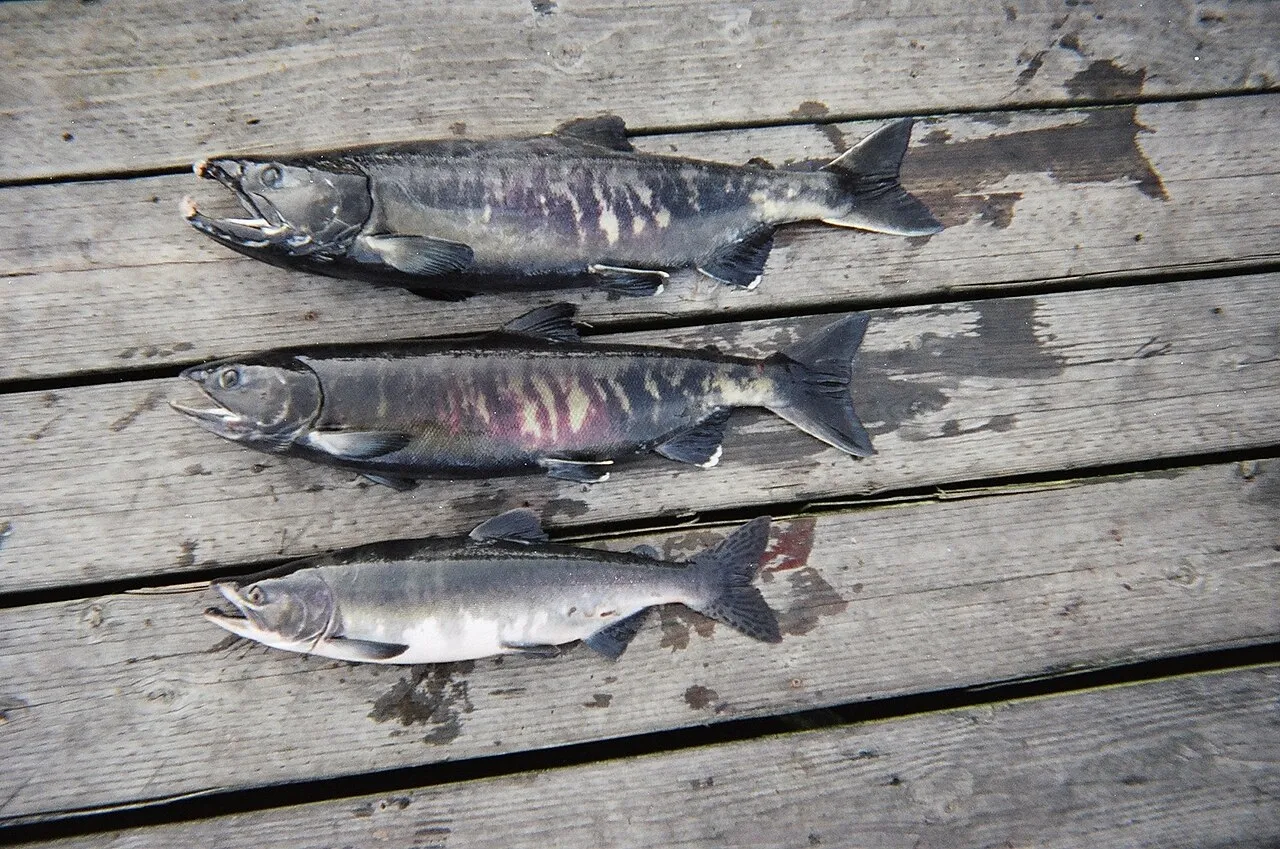
The scientific name is Oncorhynchus keta. Oncorhynchus combines Greek words for 'hook' and 'snout', describing the curved jaws of spawning males, while keta comes from a name used for the fish in the Russian Far East. The species was named in the 18th century based on material from expeditions to Kamchatka.
Salmon belong to the family Salmonidae, along with trout, chars, graylings, lenok and taimen. The main Pacific salmon species are:
| Common name | Scientific name | Notes |
|---|---|---|
| Chum salmon | O. keta | Returns to Korean east coast rivers; very wide range |
| Masu or cherry salmon | O. masou | Korea, Japan, Russian Far East; some stay in rivers for life |
| Pink salmon | O. gorbuscha | Smallest; two-year life cycle; males develop a hump |
| Sockeye salmon | O. nerka | Turns bright red when spawning; uses lake systems |
| Coho salmon | O. kisutch | Silvery; popular with anglers |
| Chinook salmon | O. tshawytscha | Largest; records of tens of kilograms |
| Rainbow trout | O. mykiss | Sea-run form is called steelhead |
The English name 'chum' is often said to come from a word in Chinook Jargon, the old trade language of the Pacific Northwest, meaning 'spotted' or 'marked', a reference to the blotchy spawning colours. The fish is also called 'dog salmon' because of the large canine-like teeth of spawning males, and in Japan it is shirozake or simply sake, the default 'salmon'.
No subspecies are formally recognised, but chum salmon form many regional populations that differ in timing and genetics. Summer-run and fall-run populations are often managed separately.
3. Evolution
A pivotal event in salmon history was a whole-genome duplication: somewhere around 80 to 100 million years ago, the ancestor of the salmon family doubled its entire genome. Many researchers think the spare gene copies gave salmonids raw material for evolving new traits, contributing to their remarkable flexibility in lifestyle.
Pacific salmon (Oncorhynchus) and Atlantic salmon and brown trout (Salmo) are estimated to have split roughly 15 to 20 million years ago. As the geography and climate of the North Pacific changed, the Pacific lineage diversified into several species. Chum salmon group fairly closely with pink and sockeye salmon.
The most famous fossil relative is Oncorhynchus rastrosus, a giant salmon that lived in western North America roughly 5 to 12 million years ago and probably exceeded 2 metres in length. It was long called the 'sabre-toothed salmon' because of its large front teeth, but a study in the 2020s argued that those teeth pointed sideways like tusks, and it is now often called the 'spike-toothed salmon'. It appears to have been a filter feeder that, like modern salmon, migrated up rivers to spawn.
Whether migration between sea and river began from a marine or a freshwater ancestor has long been debated. The prevailing view today is that salmonids descend from freshwater fish, some of which later began exploiting the richer feeding grounds of the ocean.
4. Range and habitat
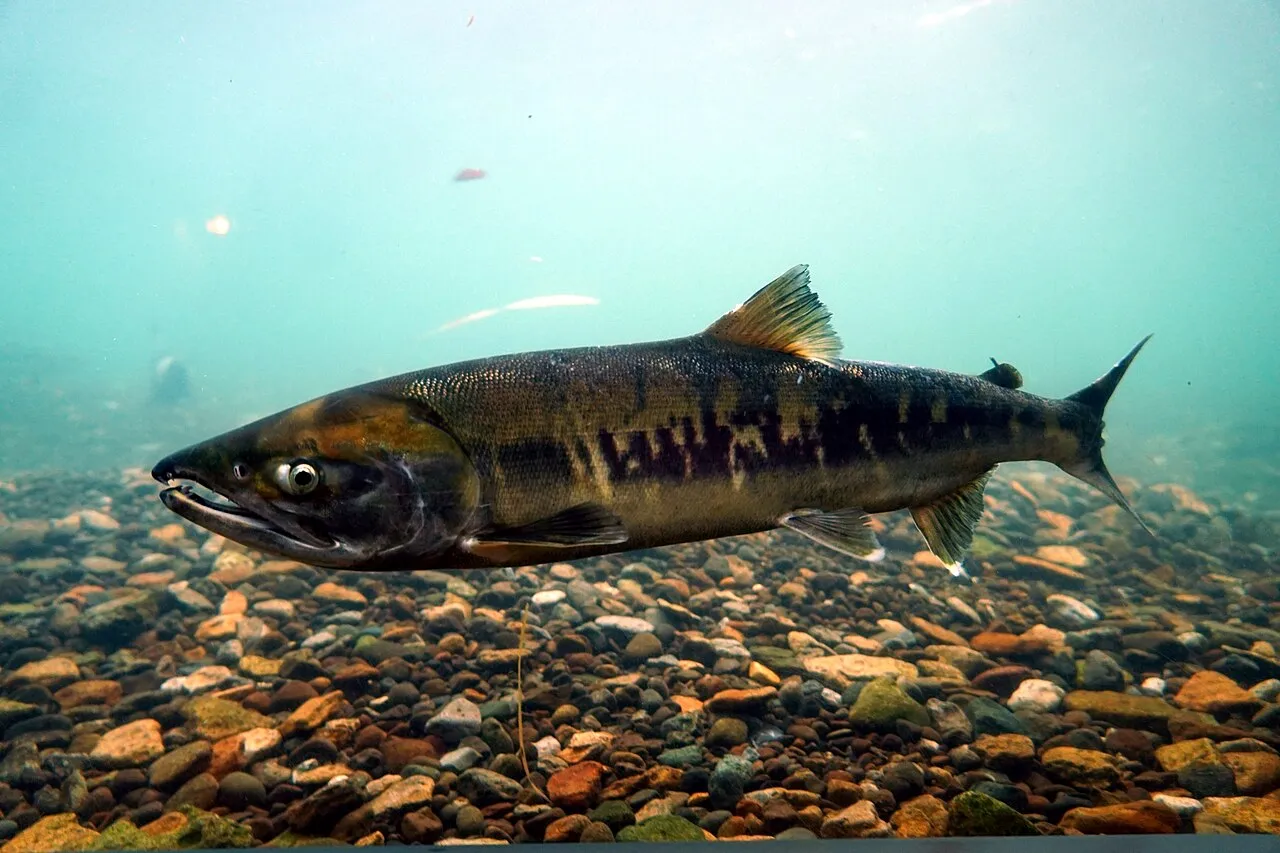
Focus Saranpat Ouilapan · CC0
Chum salmon range across the entire North Pacific. In Asia, major spawning areas include Korea's east coast, Hokkaido and northern Honshu in Japan, and the Russian Far East, including Primorye, Sakhalin, Kamchatka and the Amur basin. In North America they return to rivers in Alaska, British Columbia, Washington and Oregon, and they have been recorded in some Arctic rivers as well.
In Korea the best-known salmon river is the Namdaecheon in Yangyang, Gangwon Province, which accounts for a large share of the country's returns and hosts an annual salmon festival. Other east coast streams, including rivers in Gangneung, Samcheok and Uljin, also receive runs, and historical records mention salmon in rivers flowing to the south coast such as the Nakdong and Seomjin.
Young salmon leaving Korean rivers first move north along the coast, then through the Sea of Okhotsk into the vast feeding grounds of the Bering Sea and the Gulf of Alaska. Tagging and genetic studies have confirmed that Korean chum reach the Bering Sea. At sea they prefer cold water, roughly 3 to 13 degrees Celsius, shifting north and south with the seasons.
For spawning they choose stretches with moderate current and gravel beds. Chum salmon typically spawn closer to the sea than many other salmon and rarely tackle big waterfalls, although in giant rivers like the Amur and the Yukon some populations travel more than 2,000 kilometres upstream.
Korea lies near the southern edge of the species' range, which may make Korean populations especially sensitive to ocean warming.
5. Body
Chum salmon are long and streamlined, with a small adipose fin behind the dorsal fin. This fleshy, rayless fin is a hallmark of the salmon family.
| Feature | Chum salmon |
|---|---|
| Length | Usually 60 to 80 cm; up to about 1 m |
| Weight | Usually 3 to 6 kg; large fish over 10 kg recorded |
| Colour at sea | Dark blue-green back, silvery sides and belly |
| Spawning colour | Blotchy vertical bands of green, purple and black |
| Lifespan | Mostly 3 to 5 years, occasionally 6 to 7 |
At sea they wear classic ocean camouflage: dark above to blend with the depths when seen from above, silvery below to blend with the bright surface when seen from beneath.
5.1. Spawning transformation
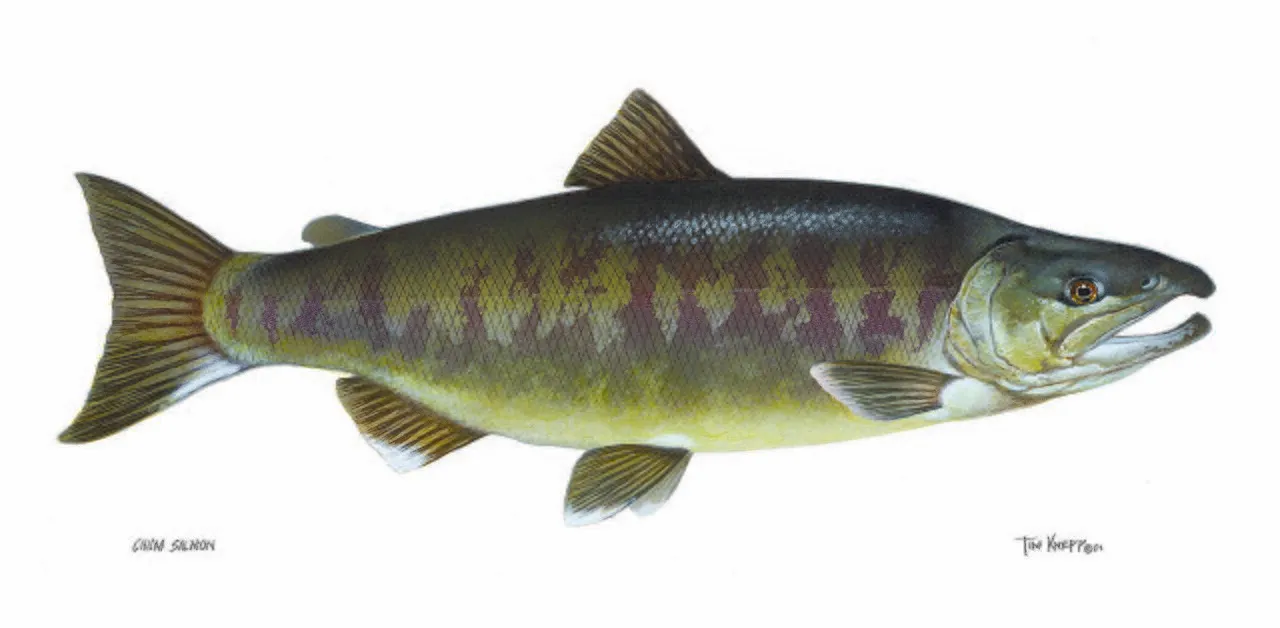
As they approach their home rivers, salmon transform. The silver fades and blotchy vertical bars of green, purple and black appear on the flanks, earning the name 'calico salmon' in some places.
Males change most dramatically. Their jaws lengthen and hook into a kype, and large, sharp canine-like teeth grow at the front of the mouth, used as weapons against rival males. The back rises slightly and the body becomes more compressed. Females change less, but their bellies swell with eggs and they often develop a dark horizontal stripe.
Once in fresh water, salmon essentially stop eating. They fuel the upstream journey and the final development of eggs and sperm by breaking down fat and muscle stored at sea. By the time they reach the spawning grounds, many have soft flesh, damaged skin and patches of white fungus. Even the flesh colour fades, because pigments are shifted into the eggs and skin.
5.2. Senses
Smell is the salmon's most celebrated sense. The olfactory tissue in the nostrils can detect extremely dilute chemicals, allowing a returning fish to recognise the scent of its home stream learned in youth. The lateral line senses currents and vibrations, the eyes see colour underwater, and studies suggest salmon can sense Earth's magnetic field, possibly using magnetite-containing cells.
6. Behaviour and ecology
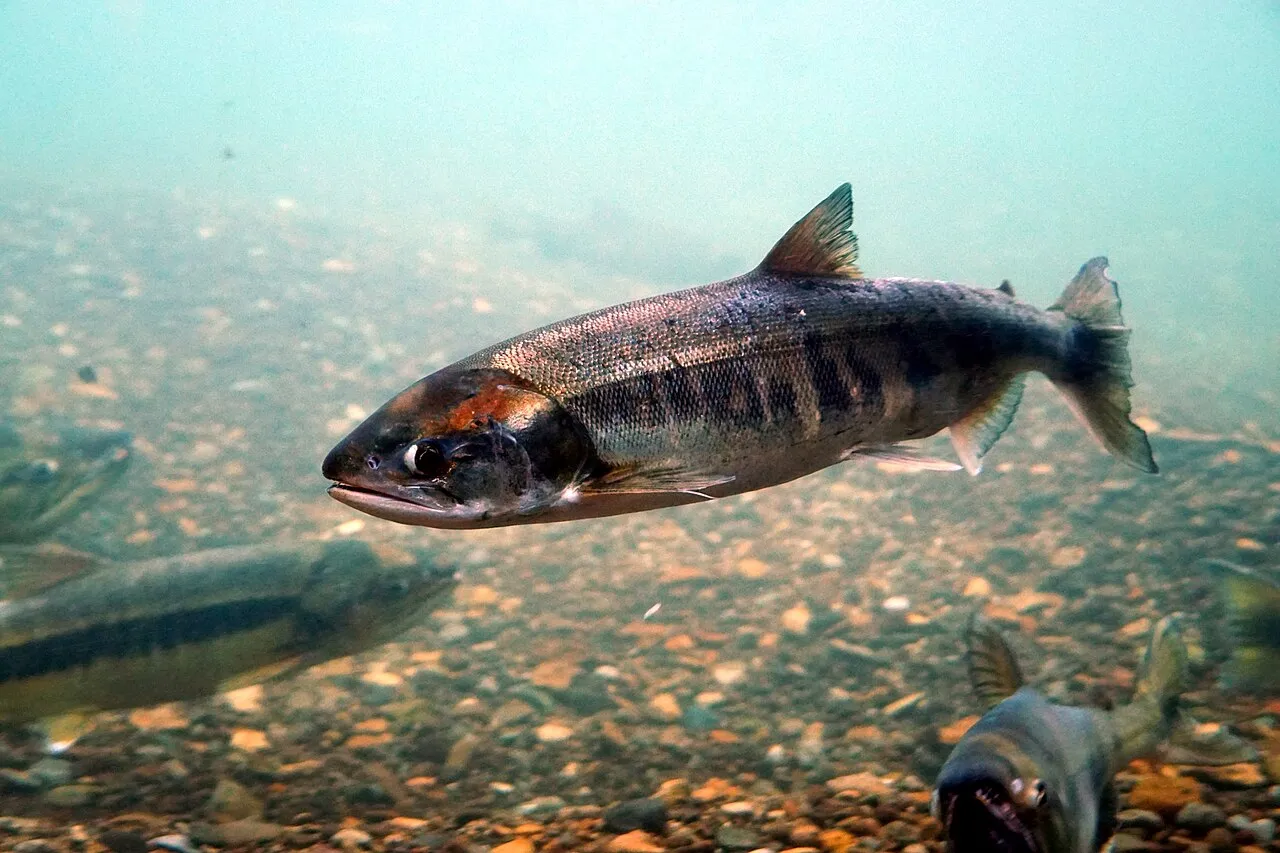
Focus Saranpat Ouilapan · CC0
Chum salmon are anadromous: they hatch in fresh water, grow at sea and return to fresh water to breed. Many other salmon spend a year or two in rivers as juveniles, but chum head to sea within weeks to a few months of emerging from the gravel. With so little time in rivers, their fortunes depend more on ocean conditions than on stream habitat.
Young chum spend their first months in coastal waters, feeding and growing. This period is critical, and coastal temperatures and food supplies can largely determine how many survive from a given year. They then move offshore, travelling widely in schools for three to five years, feeding in northern waters such as the Bering Sea in summer and shifting south to milder seas in winter.
Mature fish return to their natal river, a behaviour called homing. In Korea, salmon mainly enter rivers in October and November, when schools can be seen pushing upstream in the lower Namdaecheon. Fish often gather in the estuary to adjust to fresh water and then surge upstream after rain raises river levels.
Homing is not perfect. A small proportion of salmon stray into neighbouring rivers. These strays can establish or reinforce populations in other streams, which helps the species as a whole recover from local disasters.
7. Diet and feeding
Newly hatched salmon live off their yolk sac for weeks while still hidden in the gravel. Once the yolk is absorbed they emerge and start feeding on tiny aquatic insect larvae and zooplankton. Because young chum leave rivers so quickly, they eat relatively little in fresh water.
At sea, chum salmon have a distinctive diet. They eat krill, copepods, small fish and squid, but they also consume large amounts of gelatinous zooplankton such as jellyfish, comb jellies and salps. These are low in calories but extremely abundant, letting chum avoid competing head-on with other salmon. Studies note that chum have relatively large stomachs, an apparent adaptation for eating large quantities of watery prey.
The menu shifts with season, region and ocean conditions. In productive years they eat more crustaceans and fish; in lean years jellies make up a larger share.
In recent decades, hatchery releases around the North Pacific have climbed into the billions of fish per year. Some researchers argue that competition, particularly between abundant pink salmon and chum, has pushed the ocean's carrying capacity and contributed to declining body size in returning salmon.
Spawning salmon in rivers essentially stop eating, though they sometimes strike at lures, probably out of aggression or ingrained habit rather than hunger.
8. Reproduction and life cycle
On arrival at the spawning grounds, a female selects a gravel patch, turns on her side and beats her tail powerfully against the bottom. The current carries away sand and small stones, leaving a shallow depression called a redd. Males battle fiercely, biting and chasing, to win a place beside her.
When the moment comes, the female and the dominant male lie side by side, mouths agape and bodies quivering, and release eggs and sperm together. The female then digs gravel just upstream to cover the eggs and repeats the process several times. A female typically lays around 2,000 to 4,000 eggs, each large and orange, about 7 to 9 millimetres across. She may guard the redd for a few days before dying; males spawn with several females and then die too.
| Stage | Approximate timing in Korea | Notes |
|---|---|---|
| Egg | About 2 months | Develops in the gravel; timing depends on temperature |
| Alevin | 1 to 2 months | Stays in the gravel with a yolk sac |
| Fry | Weeks to months | Emerges and migrates to sea in spring |
| Coastal juvenile | Several months | Grows rapidly near shore |
| Ocean immature | 2 to 4 years | Feeds in the Bering Sea, Gulf of Alaska and beyond |
| Returning adult | Usually autumn of year 3 to 5 | Spawns in its home river and dies |
Breeding once and dying is called semelparity. Salmon pour all the energy they gathered at sea into a single, all-out reproductive effort. In Korea, returning fish are captured, their eggs stripped and fertilised by hand, and the young raised in hatcheries before being released the following spring.
9. Special abilities: finding home
The salmon's most extraordinary ability is finding its way home from thousands of kilometres away. Scientists generally describe this as a two-stage process.
In the open ocean, Earth's magnetic field appears to be key. The 'geomagnetic imprinting' hypothesis proposes that young salmon memorise the magnetic signature of their home river mouth as they head to sea, then seek it out years later. Studies of North American salmon found that year-to-year shifts in the magnetic field matched changes in the routes salmon took to return. The sun's position and ocean currents may provide additional cues.
Near the coast, smell takes over. Every river carries a distinctive chemical mix from the soils, plants and rocks of its watershed. Young salmon memorise this scent on their way downstream, a process called olfactory imprinting. Experiments dating back to the 1950s showed that salmon with blocked nostrils struggled to find their home stream, and fish raised with exposure to particular artificial chemicals later homed to streams scented with those chemicals.
The upstream journey is a feat of strength. Salmon swim against strong currents and leap over low weirs and small falls. Chum salmon are weaker jumpers than some other species, so dams and weirs affect them heavily, which is why fish ladders matter on Korean salmon rivers.
10. Predators and survival
Salmon face predators at every life stage. Eggs in the gravel are eaten by trout, sculpins and insect larvae, and floods can scour redds or smother them in silt. Fry heading downstream are taken by herons, kingfishers, mergansers and larger fish. At sea, sharks, seals, sea lions, orcas and large fish all prey on salmon.
Returning adults run another gauntlet. In North America and the Russian Far East, brown and black bears snatching salmon at waterfalls are an iconic sight, and bald eagles, Steller's sea eagles, otters and wolves also feast on the runs. In Korea, otters, herons and egrets, and people are the main predators.
Out of thousands of eggs, only a handful of fish typically survive to return. Return rates vary hugely by region and year; for Korean hatchery releases they have generally been reported at around one percent or well below, though figures differ between sources.
The salmon's contribution does not end with death. Carcasses dragged into the forest by bears and birds, or left along riverbanks, release nitrogen and phosphorus from the ocean as they decay. Studies in North America found that a notable share of the nitrogen in trees along salmon streams originated at sea. Salmon are, in effect, delivery vehicles carrying ocean nutrients inland.
11. Relationship with humans
Salmon have fed people around the North Pacific for thousands of years. Indigenous peoples of the Pacific Northwest organised their annual cycle around the runs and held First Salmon ceremonies, returning the bones of the first fish to the river so the salmon would keep coming back. The Ainu and other northern peoples of East Asia treated salmon as a gift from the gods, eating the flesh and even making shoes and clothing from salmon skin.
In Korea, salmon appear in Joseon-era records as a local specialty of east coast districts, and salmon roe was prized. Organised stock enhancement began in the 1970s: eggs are taken from returning adults, hatched artificially and the young released each spring. A national salmon research and hatchery facility operates on the Namdaecheon, and Yangyang's October salmon festival draws large crowds.
Commercially, chum salmon are caught in large numbers in Japan, Russia and Alaska. Their relatively lean, mild flesh is used for smoking, canning and salting, and their roe is processed into ikura. The raw salmon sashimi popular in Korea, by contrast, is mostly imported farmed Atlantic salmon.
Salmon farming has grown into a major industry, but it is controversial. Sea lice and diseases from open net pens can spread to wild salmon, escaped farm fish can interbreed with wild populations, and producing feed puts pressure on stocks of small forage fish.
12. Conservation
Across the North Pacific as a whole, chum salmon remain abundant, propped up in large part by massive hatchery programmes in Japan and Russia. A global IUCN assessment for the species as a whole is not readily found, and the status should be checked against current sources. At the level of regional populations, though, the picture varies greatly. In the United States, Hood Canal summer-run chum and Columbia River chum are listed as Threatened under the Endangered Species Act.
Korea's situation is worrying. Returns to Korean rivers were reported in the tens of thousands or more per year in good years around the 2000s, but have fallen sharply since the late 2010s, and in some years of the 2020s news reports described returns at a small fraction of earlier levels. Exact figures vary by year and counting method.
Suggested causes include:
- Ocean warming, especially in coastal waters where young salmon spend their first months
- Competition for food as hatchery releases across the North Pacific have soared
- River changes: weirs and dams, channel engineering, pollution and drought
- Heavy reliance on hatchery fish, which may be less well adapted than wild fish
- Illegal catches
Because Korea sits near the southern limit of the species, it may feel the effects of climate change early. Many researchers argue that simply releasing more fry is not enough and that river restoration and ocean research must go hand in hand. Catching salmon in Korean rivers during the run is restricted by law, so anglers should always check the rules first.
13. In aquariums and hatcheries
Salmon are more often seen in hatcheries and research facilities than in display aquariums. Korean salmon hatcheries sometimes open their autumn egg-taking and hatching work to the public, and in spring, release events let children help put young salmon into the river.
Some aquariums display the salmon life cycle, but it is demanding: the water must be cold, both freshwater and marine set-ups are needed, and adults die after spawning, so long-term displays are difficult.
Hatcheries themselves are debated. Supporters see them as essential for sustaining runs in rivers where returns have collapsed. Critics warn that hatchery fish compete with wild fish for food and can erode genetic diversity. Increasingly, the emphasis is on restoring rivers so that salmon can spawn naturally, rather than relying on releases alone.
14. In culture
Salmon are a symbol of homecoming. In Korean, someone who returns to their hometown after years away may be said to have 'come back like a salmon', and the image of salmon swimming upstream to their birthplace appears in children's books and essays as a metaphor for the meaning of life.
Irish mythology tells of the Salmon of Knowledge, which ate the hazelnuts of wisdom. The young Fionn mac Cumhaill, cooking the fish for his master, burned his thumb, put it in his mouth and gained all the world's wisdom. Among Indigenous peoples of the Pacific Northwest, salmon feature prominently in art, crests and totem poles as symbols of abundance, renewal and perseverance.
In Japan, salted salmon is linked with New Year, and a carved wooden bear holding a salmon is a classic souvenir of Hokkaido.
The image of a salmon fighting its way upstream has become a universal metaphor for perseverance and for refusing to go with the flow. Many sports teams and regional festivals have adopted the salmon as their emblem.
15. Trivia
- Salmon flesh gets its orange colour from astaxanthin, a pigment in its prey. Chum salmon flesh is paler than that of most other Pacific salmon.
- Farmed Atlantic salmon get their colour from pigment added to feed; without it, the flesh would be greyish.
- Moving from sea to river forces salmon to reverse their salt balance. At sea they drink salt water and pump salt out; in fresh water they barely drink and hold on to salt.
- The fearsome teeth of male chum grow mainly in the spawning season and are inconspicuous at sea.
- Freshly fertilised salmon eggs are fragile, but once the embryo's eyes become visible, the 'eyed egg' stage, they are much sturdier, which is when hatcheries move them.
- Carcasses of spawned-out salmon feed aquatic insects, which in turn feed the next spring's fry. In a sense, each generation lays the table for the next.
- In Korea, the rainbow trout is often eaten raw like salmon, which adds to everyday confusion between the two.
Wild animals are not pets. Catching, trading or keeping them is illegal in most places. If you find an injured wild animal, call your local wildlife rescue centre.
FAQ
Is it the same as supermarket salmon?
Usually not. Most raw salmon sold in Korea is farmed Atlantic salmon from Norway or Chile. The fish returning to Korean rivers is the chum salmon, a Pacific species.
Why do salmon die after spawning?
It is an all-in breeding strategy. Salmon stop eating in fresh water and burn their stored fat and muscle to reach the spawning grounds and produce eggs, so they are spent once spawning is over.
When can salmon be seen in Korea?
Mainly in October and November, in east coast rivers such as the Namdaecheon in Yangyang. Catching salmon in rivers during the run is restricted, so watch rather than fish, and check the rules first.
Photo credits
Photos are freely licensed images from Wikimedia Commons. Authors and licenses are listed below.
- Dog Salmon Breeding Male.jpg — A. Hoen and Co. · Public domain
- Salmon (breeding color).jpg — No machine-readable author provided. Vineyard assumed (based on copyright claims). · CC BY-SA 3.0
- Oncorhynchus keta 336279549.jpg — Focus Saranpat Ouilapan · CC0
- Oncorhynchus keta 336282130.jpg — Focus Saranpat Ouilapan · CC0
- Salmon chum fish oncorhynchus keta.jpg — Knepp Timothy, U.S. Fish and Wildlife Service · Public domain