TailVille
1. Overview
Clownfish are small reef fish that make their homes among the stinging tentacles of sea anemones. Their bright orange bodies and bold white bands suggest a clown's face paint, hence the name, and their partnership with anemones gives them their other common name, anemonefish. Since starring in the animated film Finding Nemo, they have become some of the most recognisable fish on the planet.
This article focuses on the false clown anemonefish, Amphiprion ocellaris, the species that inspired Nemo, while also covering anemonefish as a group. There are close to 30 species, all living on warm reefs in the Indian Ocean and western Pacific.
Clownfish are famous for three things: their symbiosis with anemones, their ability to change sex, and their strict social hierarchy. The anemone provides a protected home; the fish in turn cleans the anemone, chases off some predators and fertilises it with its waste. Within each group, the largest fish is the female and the second largest is the breeding male. If the female disappears, the male turns into a female.
Their popularity has a downside. Collection for the aquarium trade and the bleaching of reefs and anemones under warming seas both put pressure on wild populations. Captive breeding now supplies many aquarium fish, but in the wild clownfish depend entirely on healthy reef ecosystems.
2. Name and classification
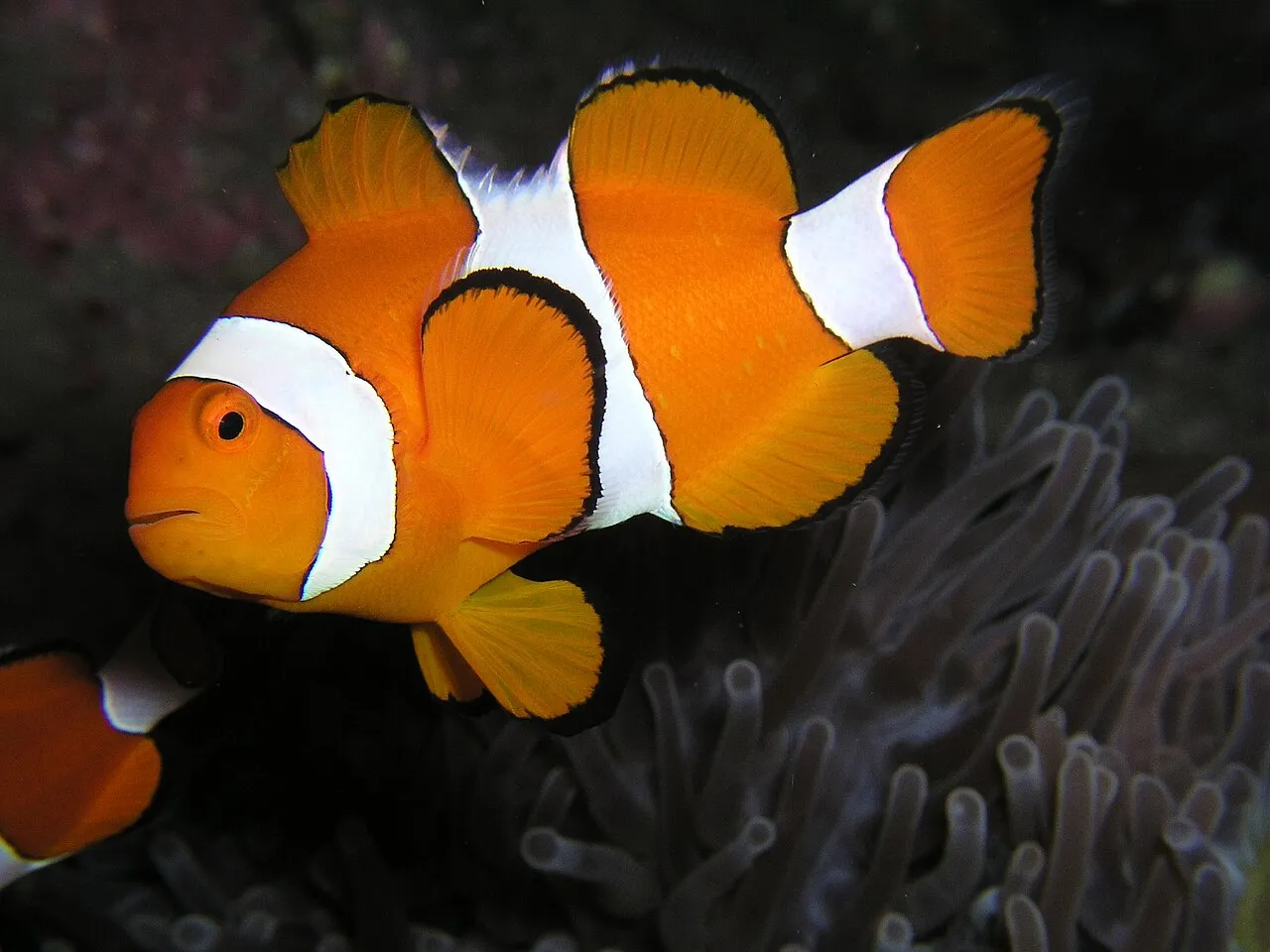
Nhobgood Nick Hobgood · CC BY-SA 3.0
The false clown anemonefish is Amphiprion ocellaris, described by the French naturalist Georges Cuvier in 1830. The genus name is usually explained as combining Greek words for 'on both sides' and 'saw', referring to the serrated edges of the gill covers. Ocellaris is Latin for 'bearing little eye-spots'.
Anemonefish belong to the damselfish family, Pomacentridae, in the subfamily Amphiprioninae. Damselfish are abundant on reefs worldwide, and anemonefish are the branch that took up life with anemones. Almost all species are in the genus Amphiprion; the spine-cheek or maroon clownfish has traditionally been placed in its own genus, Premnas, though some researchers now fold it into Amphiprion.
| Species | Notes |
|---|---|
| False clown (A. ocellaris) | Nemo's species; orange with three white bands and thin black edging |
| True or orange clown (A. percula) | Nearly identical, with thicker black edging |
| Clark's anemonefish (A. clarkii) | The most widespread species; reaches southern Korea and Japan |
| Tomato clownfish (A. frenatus) | Red body with a single white head band |
| Pink skunk clownfish (A. perideraion) | Pinkish body with a white stripe along the back |
| Maroon clownfish (P. biaculeatus) | Dark red, cheek spines, larger than most |
A. ocellaris and A. percula are so similar that even specialists confuse them. One common way to tell them apart is the number of dorsal fin spines: usually 11 in ocellaris and 10 in percula. The two are close relatives whose ranges barely overlap.
In Korean, the name huindonggari originally referred to Clark's anemonefish, the species found off Jeju and the south coast; it is now used loosely for anemonefish in general.
3. Evolution
Anemonefish are thought to have branched off from other damselfish relatively recently. Molecular studies place their common ancestor roughly 10 to 15 million years ago, after which they diversified rapidly into many species. Researchers widely see the anemone partnership as the key that unlocked this burst: once a fish could shelter among stinging tentacles, it could specialise on particular anemone hosts and particular regions, and new species followed.
The group likely originated in the Coral Triangle around Indonesia and the Philippines, the global hot spot of reef biodiversity, and spread outward across the Indian and Pacific Oceans. Many species have small ranges, such as those found only in the Red Sea or around particular island groups.
There is also evidence of hybridisation. At Kimbe Bay in Papua New Guinea, for example, hybrids between different anemonefish species have been documented, and interbreeding is thought to have contributed to the group's diversity.
Even the white bands have an evolutionary story. Studies suggest the ancestral pattern was three bands, with some species losing one or two over time, and band number may help fish recognise members of their own species.
4. Range and habitat
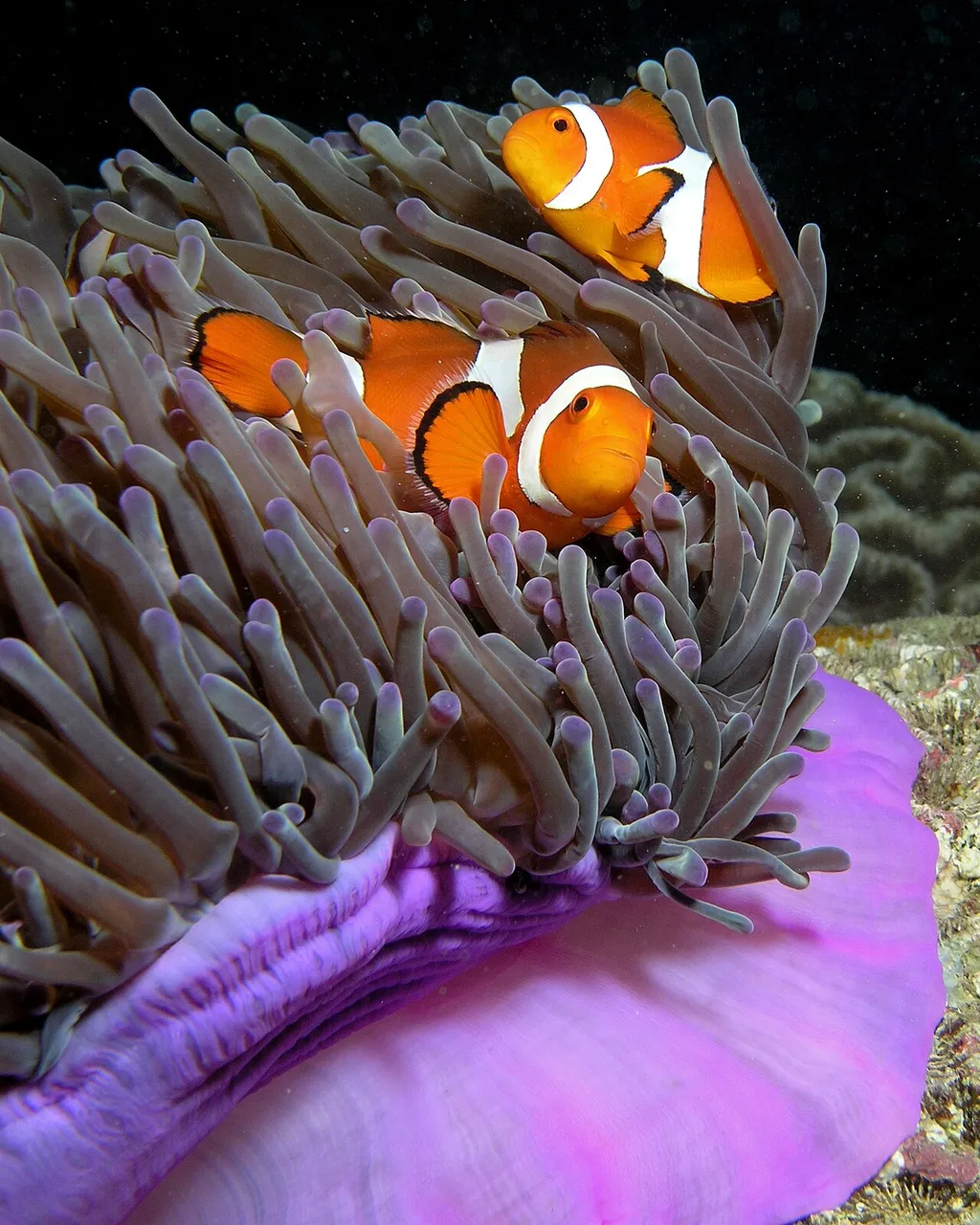
The false clown anemonefish lives in the tropical eastern Indian Ocean and western Pacific: the Andaman Sea, the coasts of Thailand and Malaysia, Indonesia, the Philippines, north-western Australia, Taiwan and parts of Japan's Ryukyu Islands. Its look-alike, A. percula, occupies areas further east, including Papua New Guinea, the Solomon Islands and north-eastern Australia.
Anemonefish live on shallow reefs, lagoons and sheltered bays, mostly between about 1 and 15 metres deep. They need sunlit water because their host anemones rely on photosynthetic algae living in their tissues. In practice, the distribution of a clownfish species closely follows that of its hosts.
Host anemones commonly used by A. ocellaris include:
- Magnificent sea anemone (Heteractis magnifica)
- Giant carpet anemone (Stichodactyla gigantea)
- Mertens' carpet anemone (Stichodactyla mertensii)
Of more than a thousand anemone species worldwide, only about ten host anemonefish. Some clownfish are generalists; Clark's anemonefish can live with nearly all of them. Others are specialists, tied to just one or two hosts.
A. ocellaris does not occur naturally in Korean waters, but Clark's anemonefish has been recorded around Jeju and parts of the south coast, and sightings of tropical fish in Korea have been increasing as seas warm.
5. Body
A. ocellaris is small, reaching about 8 to 11 centimetres. Its oval, slightly compressed body and rounded tail suit short bursts and sharp turns around a host anemone rather than long-distance cruising.
| Feature | False clown anemonefish |
|---|---|
| Length | About 8 to 11 cm (females larger) |
| Colour | Bright orange; some populations black |
| White bands | Three: head, mid-body, base of tail |
| Band edging | Thin black line |
| Dorsal spines | Usually 11 |
| Lifespan in the wild | Roughly 6 to 10 years estimated; captive fish have lived over 20 |
Around Darwin in northern Australia there is a population of A. ocellaris that is jet black with crisp white bands, showing how much colour can vary within a single species.
The white bands appear one by one as a young fish develops: first the head band, then the body band, then the tail band. Research in the 2020s found that the speed at which bands appear differs depending on which anemone species the young fish settles in.
The mucus coating the skin is crucial to the fish's survival, since it prevents or greatly reduces the firing of the anemone's stinging cells. Males and females look alike; size is the best clue, and within a group the largest fish is the female.
6. Behaviour and ecology
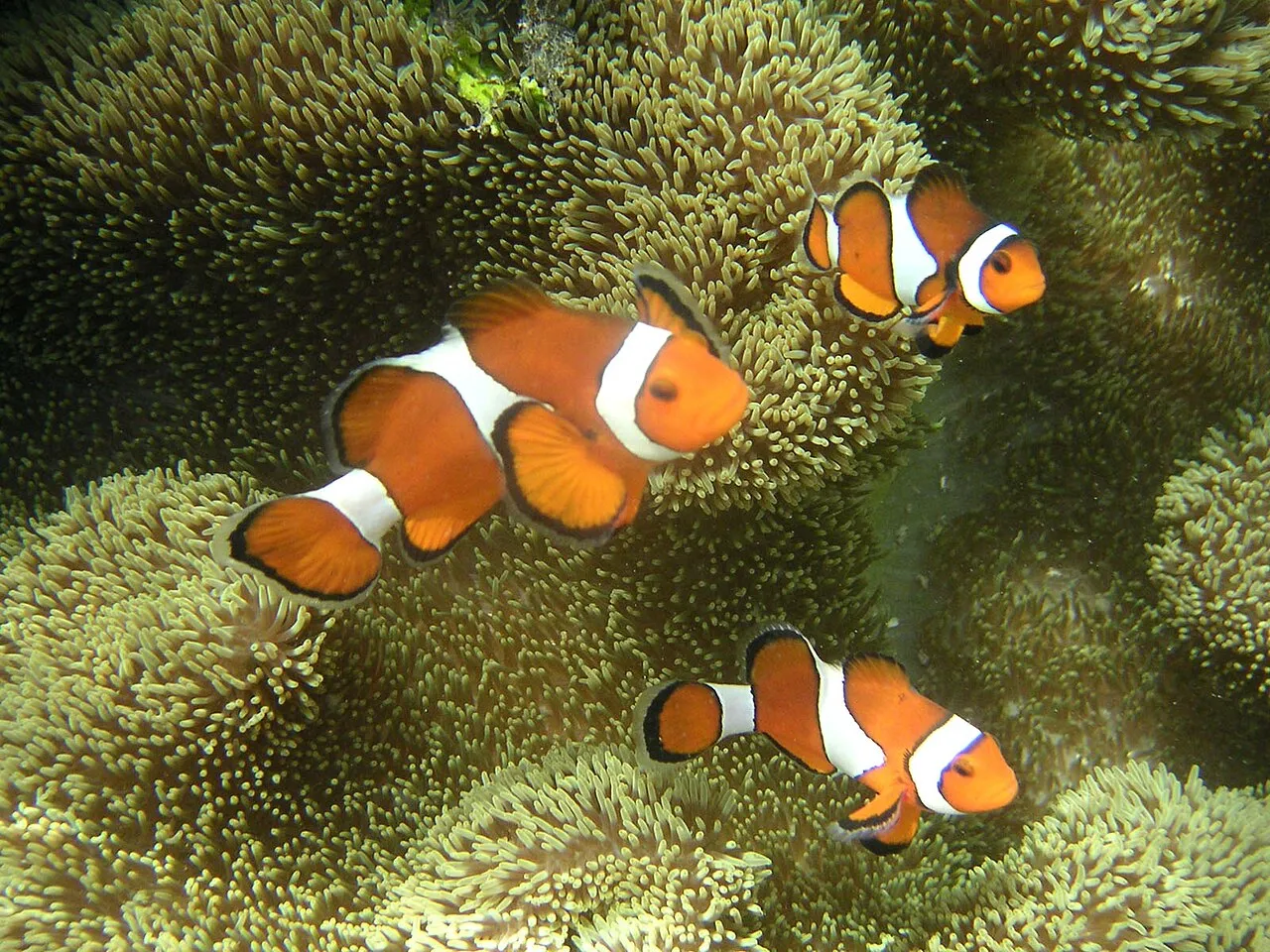
Metatron · CC BY-SA 3.0
6.1. Life with anemones
Anemone tentacles are packed with stinging cells called nematocysts that paralyse most fish that touch them. Clownfish move among them freely. Several explanations have been offered: their mucus may lack the chemical triggers that make nematocysts fire; newly settled fish often go through an acclimation period, touching the tentacles briefly and repeatedly; and the fish may coat themselves with anemone mucus so the host treats them as part of itself. Most likely several mechanisms work together.
The relationship benefits both partners:
- The fish gains shelter from predators, a safe place to lay eggs and leftover scraps of the anemone's meals.
- The anemone gains a bodyguard against anemone-eating fish such as some butterflyfish, nutrients such as nitrogen and phosphorus from the fish's waste, and better water flow, which brings oxygen and carries away waste.
Studies have found that anemones hosting clownfish tend to grow faster and reproduce more than those without. At night, clownfish fanning their fins among the tentacles appear to help circulate water around the host.
6.2. Hierarchy and territory
Each anemone usually hosts a single group: one large breeding female, one slightly smaller breeding male and a few smaller non-breeders. Within the group, size is rank.
Remarkably, lower-ranking fish regulate their own growth. If a subordinate grows too close in size to the fish just above it, it risks being evicted, so subordinates slow their growth to maintain a consistent size gap. Studies found that neighbouring ranks keep a length ratio of roughly 0.8, which keeps order without constant fighting.
Clownfish rarely stray more than a few metres from their anemone. They defend it boldly, darting at much larger fish and even at divers, and many divers have had a clownfish nip at a finger or a mask.
7. Diet and feeding
Clownfish are omnivores. They feed mainly on zooplankton drifting past the anemone, especially copepods and the larvae of small crustaceans, and they also graze on algae. They snatch bits of prey captured by the anemone, eat leftovers around its mouth and have been seen removing and eating dead tentacles, which may help keep the host clean.
Feeding happens mostly by day, with the fish picking food out of the passing current without venturing far. Larger, higher-ranking fish tend to forage a little further out, while small subordinates stay close to the tentacles, so the fish that can afford more risk get the better feeding spots.
Clownfish sometimes carry larger pieces of food back to the anemone. Whether they are deliberately feeding their host or simply retreating to a safe place to eat is still debated.
8. Reproduction and life cycle
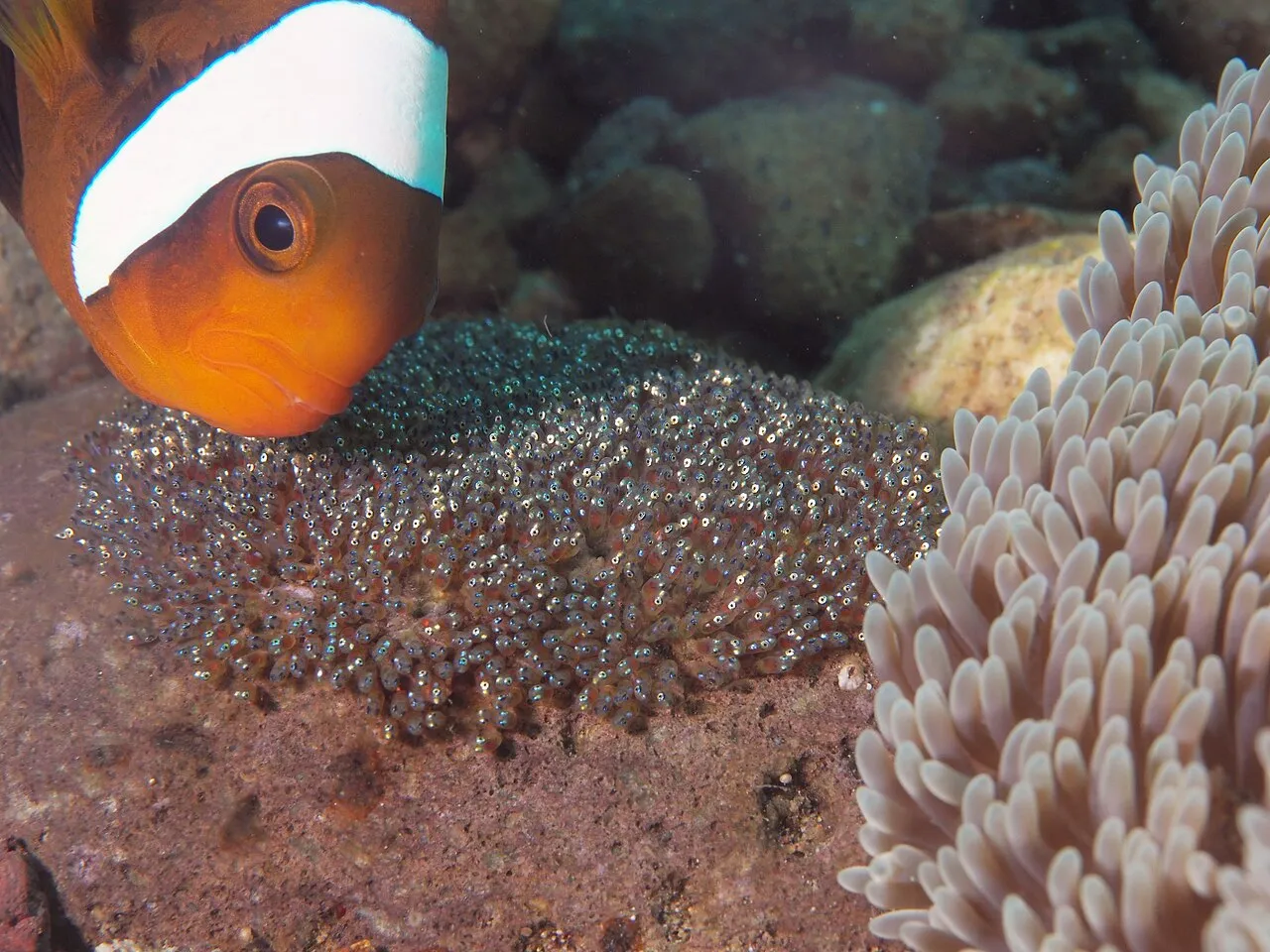
Rickard Zerpe · CC BY-SA 2.0
All clownfish start life as males and can later become female, a pattern called protandrous hermaphroditism. If the female of a group dies or disappears, the breeding male changes sex over a period of weeks to months, and the largest non-breeder steps up to become the new breeding male. The change is one-way. Biologists like to joke that if Finding Nemo followed real biology, Marlin would have become a female after losing his mate.
In warm waters breeding can happen nearly year-round, and some observations suggest a tendency to spawn around the full moon. The male prepares a nest by cleaning a patch of rock beside the anemone with his mouth. The female lays a cluster of several hundred to about a thousand eggs there, and the male fertilises them.
The male does most of the parental care, fanning the eggs with his fins to keep them oxygenated and removing dead or fungus-infected eggs. Depending on temperature, the eggs hatch after about 6 to 10 days, typically just after dark.
| Stage | Duration | Notes |
|---|---|---|
| Egg | About 6 to 10 days | Attached to rock, tended by the male |
| Planktonic larva | About 8 to 12 days | Drifts in open water |
| Settlement | After metamorphosis | Finds an anemone using smell and sound |
| Non-breeder | Months to years | Bottom of the hierarchy, growth regulated |
| Breeding male | Rank two | Guards the eggs |
| Breeding female | Rank one | Largest fish in the group |
The hatchlings leave the anemone and drift as plankton, where most are eaten. Survivors return to the reef and use chemical and sound cues to find a suitable host. A newcomer joining an existing group enters at the very bottom of the ladder.
Lifespan in the wild is estimated at roughly 6 to 10 years for A. ocellaris, and studies of some anemonefish species suggest they may live for decades, which is exceptionally long for such a small fish.
9. Communication and special abilities
Clownfish are vocal. They produce popping and clicking sounds, generated by snapping their jaws together, mainly during disputes over rank or when warning off intruders. Subordinates perform submissive displays, quivering and shaking their heads in front of dominant fish, sometimes with accompanying sounds, which helps avoid real fights.
Young clownfish are skilled navigators. At the end of the larval stage they use reef sounds and chemical cues from anemones and from their own species to find a place to settle. Studies have shown that a surprisingly high proportion of larvae return to the reef where they were born rather than drifting far away; at one island off Papua New Guinea, many new recruits turned out to be locally born.
There has been concern that ocean acidification could disrupt these abilities. Experiments reported that larvae raised in water with high carbon dioxide failed to recognise predator odours and even swam toward them. Later attempts to replicate those findings did not reproduce the effect, and the topic remains contested.
Sex change itself is a special ability. The way social cues alone can rewire a fish's brain and gonads has made clownfish an important model for studying how sex is determined in animals.
10. Predators and survival
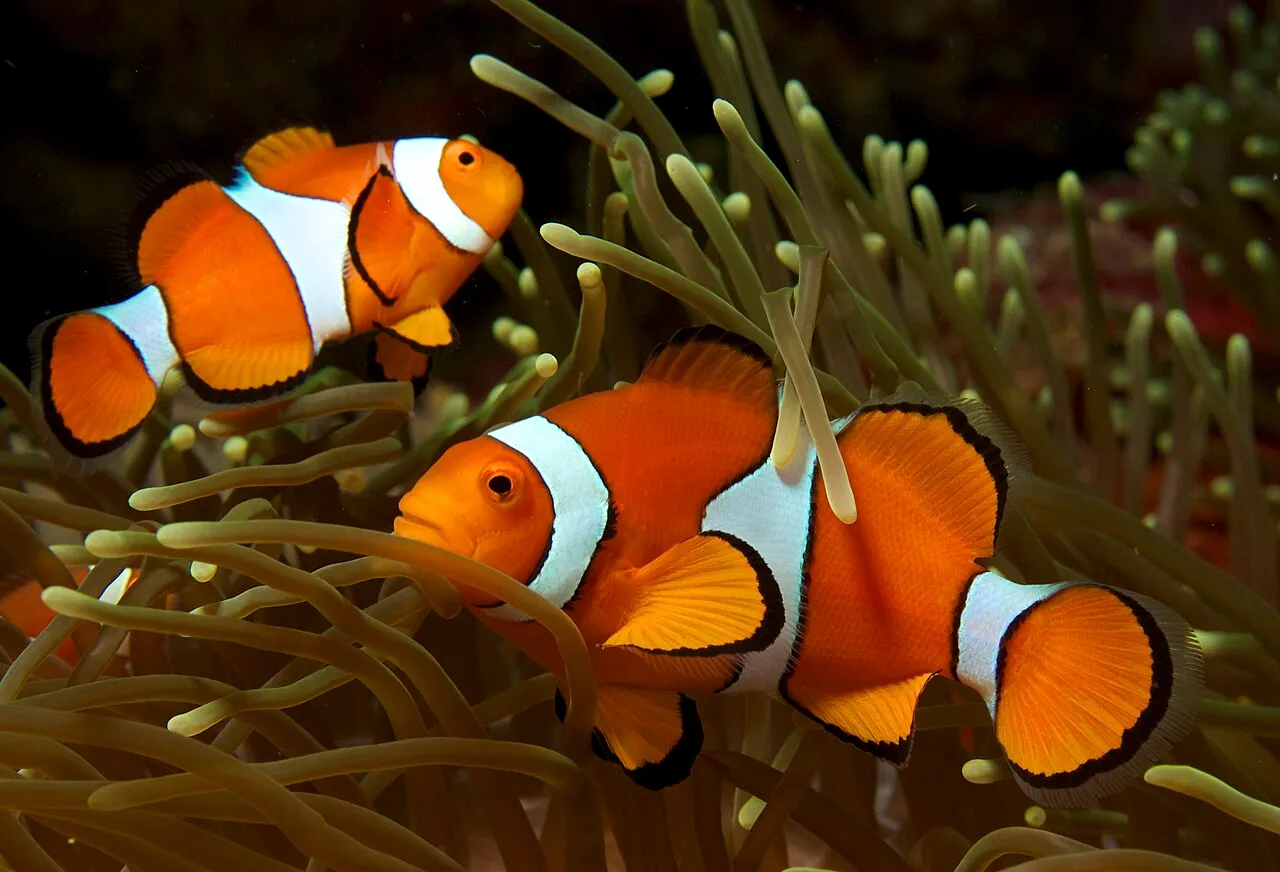
Nick Hobgood · CC BY-SA 3.0
Being small, clownfish have many predators: groupers, scorpionfish, moray eels, lizardfish, snappers and large wrasses, among others. Retreating into the anemone's tentacles foils most of them, which is exactly why clownfish stay so close to home.
The riskiest stages are the egg and larva. The male guards the eggs, but wrasses and damselfish look for openings. Larvae drifting in open water are eaten by countless plankton feeders, and only a tiny fraction survive to settle. A juvenile that fails to find a host anemone has little chance.
Reef bleaching is now a major threat. Anemones, like corals, depend on symbiotic algae, and in overheated water they expel those algae and turn white. Studies found that clownfish living in bleached anemones had higher stress hormone levels and laid far fewer eggs. If the anemone dies, the fish lose their home and their protection.
11. Relationship with humans
Clownfish are among the most traded fish in the marine aquarium hobby. Their colours, small size and anemone lifestyle made them popular long before 2003, but demand soared after Finding Nemo. In some areas heavy collection of wild clownfish and anemones led to noticeable local declines, a phenomenon sometimes called the 'Nemo effect'.
Fortunately, clownfish were one of the first marine aquarium fish to be bred in captivity at scale. Many A. ocellaris sold today are captive-bred, and breeders have developed numerous designer varieties with extended white patterns or black bodies. Some fish are still collected from the wild, and host anemones in particular are hard to farm and are often taken from reefs. Anemones are believed to live for decades or longer in the wild but frequently die in home aquariums.
Anyone keeping clownfish should choose captive-bred fish and know that clownfish do not actually need an anemone in a tank; they will adopt a coral or a corner instead. Stories circulated after the film of children flushing fish down toilets to 'set them free', which simply kills the fish and could, in some settings, introduce species where they do not belong.
On the reef, clownfish are a highlight for snorkellers and divers. Touching anemones or chasing the fish stresses both, so the rule is to look but not touch.
12. Conservation
The false clown anemonefish is listed as Least Concern on the IUCN Red List, reflecting its wide range and apparently large overall population. Most other anemonefish species are also Least Concern or lack enough data for assessment. Local pictures can differ, though: surveys in heavily collected areas of the Philippines and Indonesia have found sharply reduced densities of clownfish and host anemones.
Main threats include:
- Collection of wild fish and anemones for the aquarium trade
- Bleaching of anemones and corals as seas warm
- Ocean acidification, pollution and sediment runoff
- Destructive fishing such as cyanide and blast fishing
- Coastal development that damages reefs
Conservation measures include promoting captive-bred fish, certifying sustainable collection, establishing marine protected areas and restoring reefs. Because clownfish cannot survive without anemones, protecting them means protecting anemones and the reefs around them.
Clownfish are not listed under CITES, although some corals traded alongside them are.
13. In aquariums
Clownfish are a fixture in public aquariums, and an anemone tank with clownfish is often where young visitors linger longest. Aquariums value them as a way to explain symbiosis, sex change and reef conservation, and captive-breeding techniques refined by aquariums and research institutes have genuinely reduced pressure on wild populations.
Much of the ethical debate centres on the home aquarium trade rather than public aquariums. Marine tanks are demanding, many beginners lose their fish quickly, and anemones are even harder to keep alive. Buying clownfish on a wave of film-inspired enthusiasm without proper preparation is widely discouraged.
Those who do keep captive-bred clownfish need a properly cycled marine tank of reasonable size, stable temperature around 24 to 27 degrees Celsius and stable salinity, good filtration and regular water changes. Wild-caught fish and wild-collected anemones are best avoided.
14. In culture
Pixar's Finding Nemo (2003) turned the clownfish into a global star. The story of anxious father Marlin crossing the ocean to find his son Nemo made the clownfish a children's favourite almost overnight, and the pair returned in Finding Dory (2016). Nemo's undersized 'lucky fin' resonated with many families as a story about disability and parenting.
The film's influence spread widely. 'Nemo' became an informal name for clownfish in many languages, and toys, books and merchandise followed in huge numbers. Aquarium shops and seafood restaurants around the world borrowed the name.
Clownfish are also a staple of science communication. They are the go-to example for explaining sex change, symbiosis and the coral reef crisis, and a clownfish peeking out of an anemone has become a visual shorthand for reef life in documentaries. Many island nations have featured them on stamps and in tourism campaigns.
15. Trivia
- When settling into a new anemone, a clownfish may touch the tentacles with its tail or fins and dart away dozens of times, a kind of acclimation dance, before diving in fully.
- Clownfish look like clumsy swimmers, but they are expert at slipping quickly through the tight gaps between tentacles.
- Clownfish eggs are orange at first and turn silvery as hatching approaches, with the embryos' eyes visible as dark dots.
- Genome studies are revealing which cells create the white bands; the white comes from light-reflecting pigment cells called iridophores.
- Fish sharing an anemone are usually unrelated, because each arrived separately as a drifting larva.
- Amphiprion ocellaris may be one of the most widely recognised fish species in the world, even if few people know its scientific name.
- Clark's anemonefish has the widest range of any clownfish, recorded from the Persian Gulf region to Japan and southern Korea.
Wild animals are not pets. Catching, trading or keeping them is illegal in most places. If you find an injured wild animal, call your local wildlife rescue centre.
FAQ
Why don't anemones sting clownfish?
Mainly thanks to a special mucus coating that does not trigger the stinging cells, combined with a gradual acclimation period when the fish first settles in. Several mechanisms probably work together.
Is the Korean huindonggari the same as Nemo?
Strictly, no. The Korean name originally meant Clark's anemonefish, which reaches Jeju, while Nemo is the false clown anemonefish. Today the name is used for both.
Is it okay to keep clownfish at home?
If you do, choose captive-bred fish and learn marine aquarium care first. Wild-caught fish and anemones put pressure on reefs, and clownfish can live without an anemone in a tank.
Photo credits
Photos are freely licensed images from Wikimedia Commons. Authors and licenses are listed below.
- Clown fish in the Andaman Coral Reef.jpg — Ritiks · CC BY-SA 3.0
- Amphiprion ocellaris (Clown anemonefish) Nemo.jpg — Nhobgood Nick Hobgood · CC BY-SA 3.0
- Anemone purple anemonefish.jpg — Nhobgood - Nick Hobgood · CC BY-SA 3.0
- Ocellaris clownfish.JPG — Metatron · CC BY-SA 3.0
- Ocellaris clownfish (Amphiprion ocellaris) (14424465463).jpg — Rickard Zerpe · CC BY-SA 2.0
- Amphiprion ocellaris (Clown anemonefish) by Nick Hobgood.jpg — Nick Hobgood · CC BY-SA 3.0