TailVille
1. Overview
A conical snout rising out of the gloom, rows of serrated triangular teeth, a slate-grey back and a snow-white belly: for most people this is what 'shark' means. The great white shark is the largest predatory fish on Earth, reaching 4 to 6 metres and well over a tonne, and it sits at the top of the food web in temperate seas around the world.
It is famous for ambushing seals and sea lions from below, sometimes launching itself clear of the water in the attempt. Special blood-vessel heat exchangers keep parts of its body warmer than the surrounding sea, giving it speed and power even in cold water. It is also a long-distance traveller, crossing ocean basins on journeys of thousands, even tens of thousands, of kilometres.
Since the 1975 film Jaws, the great white has been cast as a man-eater. In reality it very rarely targets people, and most bites are thought to result from mistaken identity or curiosity. The threat runs far more strongly the other way. Decades of fishing for fins, jaws and teeth, along with accidental capture in nets and longlines, have driven declines, and the species is now listed as Vulnerable on the IUCN Red List.
Because great whites take decades to mature and have few young, populations recover slowly once depleted. This article looks past the movie monster at the real animal: a remarkable, still mysterious predator and a key part of ocean ecosystems.
2. Name and classification
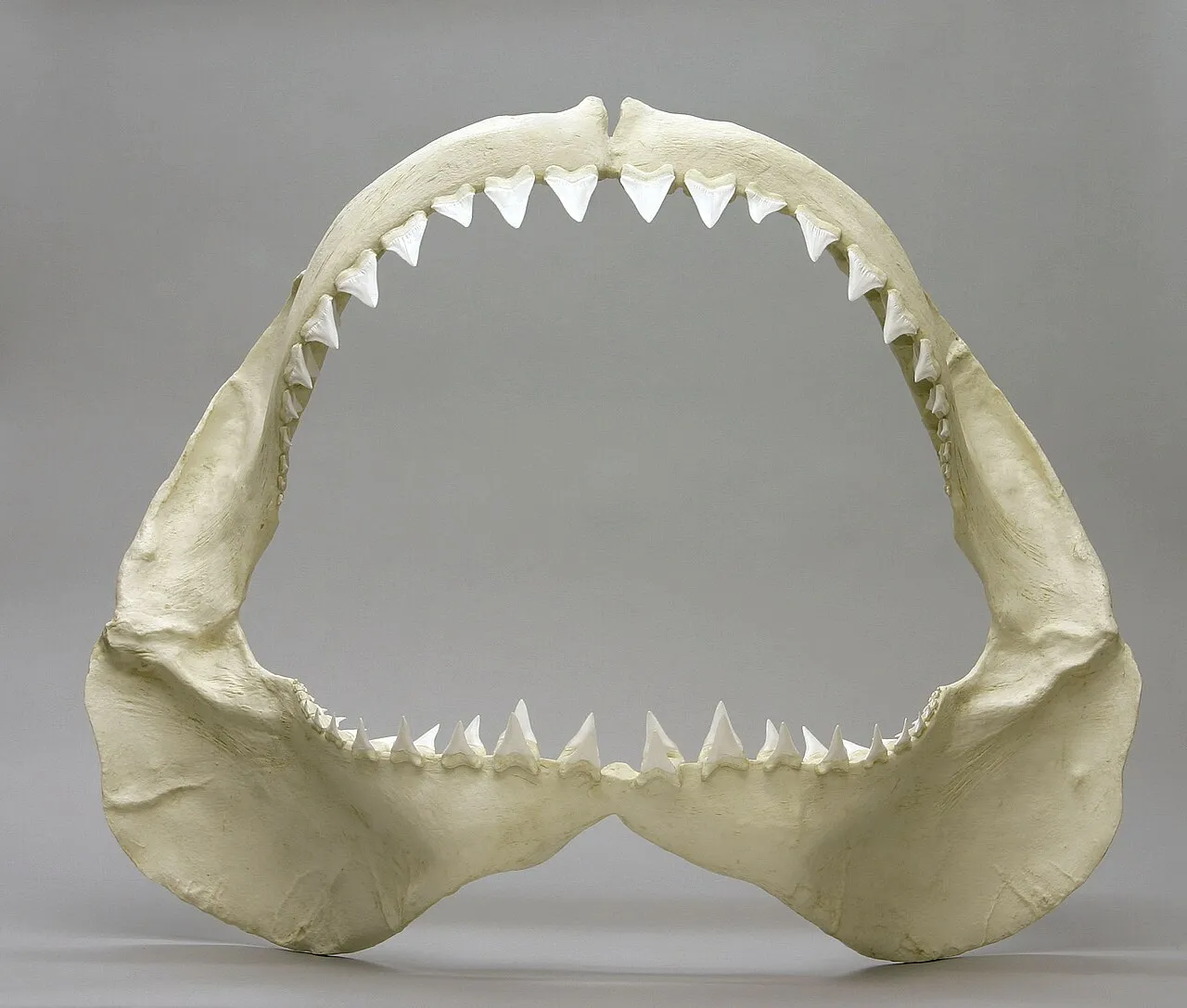
Bone Clones · CC BY-SA 3.0
The English name refers to the white underside; in Australia and South Africa it is also called the white pointer or simply the white shark. Its scientific name, Carcharodon carcharias, comes from Greek karcharos, 'jagged' or 'sharp', and odous, 'tooth'. Carl Linnaeus described it in 1758. The Korean name, baek-sang-ari, joins baek, 'white', to sang-ari, an old or dialect word for shark.
The great white belongs to the family Lamnidae, the mackerel sharks, in the order Lamniformes. Its relatives include the shortfin and longfin makos, the salmon shark and the porbeagle. All share regional endothermy, the ability to keep parts of the body warmer than the water. The great white is the only living species in its genus.
| Rank | Name |
|---|---|
| Class | Chondrichthyes (cartilaginous fishes) |
| Order | Lamniformes (mackerel sharks) |
| Family | Lamnidae |
| Genus | Carcharodon |
| Species | C. carcharias |
'Man-eater' has been used as a nickname for well over a century, but it is misleading: humans are not on the great white's normal menu.
3. Evolution
Sharks have a history stretching back more than 400 million years, but their skeletons are cartilage rather than bone and rarely fossilise. Teeth, and occasionally vertebrae, are what survive, so the great white's history has been read mostly from fossil teeth.
For decades the great white was thought to be a direct descendant of the giant extinct shark megalodon, since both had big triangular teeth. That view has largely been overturned. Megalodon is now placed in a separate family, Otodontidae, while the great white is generally thought to descend from an extinct broad-toothed mako, Carcharodon (or Cosmopolitodus) hastalis.
Key evidence comes from Peru's Pisco Formation, where a fossil shark around six to eight million years old was described in 2012 as Carcharodon hubbelli. Its teeth show a mix of smooth mako-like edges and the beginnings of white-shark serrations, making it a transitional form. Modern great whites appear in the fossil record from roughly four to five million years ago.
Great whites and megalodon shared the seas for millions of years. A 2022 study analysing zinc isotopes in fossil teeth suggested the two occupied overlapping positions in the food web, supporting the idea that competition with great whites may have been one factor in megalodon's extinction, alongside climate change and shifts in prey.
4. Range and habitat
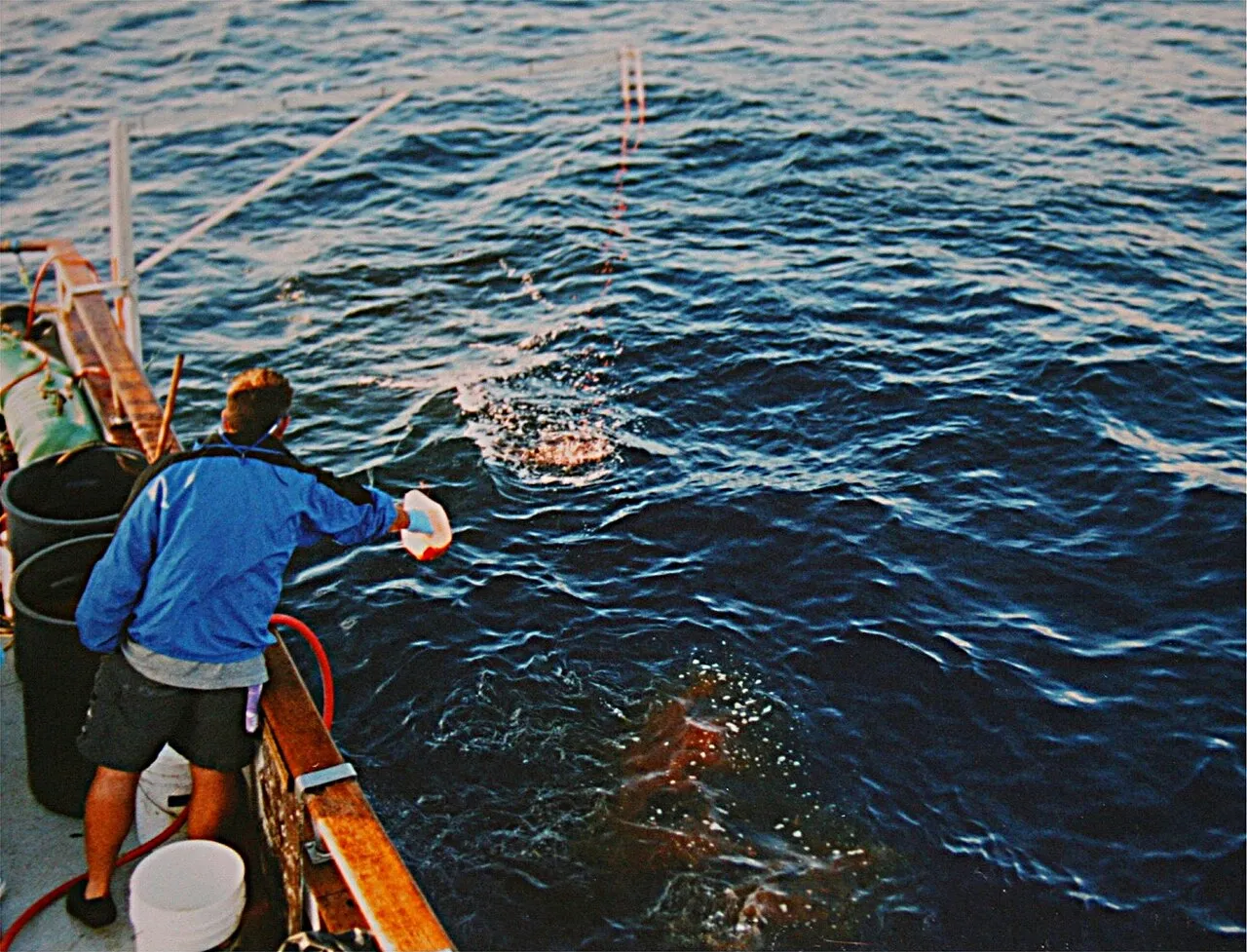
Great whites occur in temperate and subtropical seas worldwide, absent only from the polar regions. They prefer water of roughly 12–24 °C but, thanks to their internal heating, venture into much colder seas and cross the tropics. They range from shallow coastal waters to depths beyond 1,000 metres.
Well-known aggregation areas include:
- The Western Cape coast of South Africa, such as False Bay and Gansbaai
- Southern and western Australia, and New Zealand
- Central California and Guadalupe Island, Mexico
- Cape Cod, Massachusetts, in the northeastern United States
- The Mediterranean (notably the Strait of Sicily), Chile, Japan and elsewhere
Most hotspots lie near colonies of seals and sea lions. Large sharks visit seasonally to hunt, then disperse offshore.
Great whites also turn up, rarely, in Korean waters. There are records of bycatch and sightings in the Yellow Sea, the southern coast and the East Sea, with several spring records off the west coast. Whether these represent a resident population or passing migrants is unclear.
Satellite tagging has revealed how vast their world is. Many Californian great whites spend winter and spring in a remote patch of the central Pacific between Baja California and Hawaii, nicknamed the White Shark Café. What they do there is still uncertain, but repeated deep dives suggest feeding, mating or both.
5. Body
Females grow considerably larger than males.
| Feature | Males | Females |
|---|---|---|
| Length at maturity | About 3.5–4 m | About 4.5–5 m |
| Maximum length | Around 5 m | Reliable records about 6 m |
| Weight | Usually 500–1,000 kg | Large animals 1,000–2,000 kg |
| Newborn | About 1.2–1.5 m | Same |
Stories of 7- or 8-metre great whites circulate regularly, but most involve inaccurate measurements or exaggeration. A reliable maximum of around 6 metres is generally accepted.
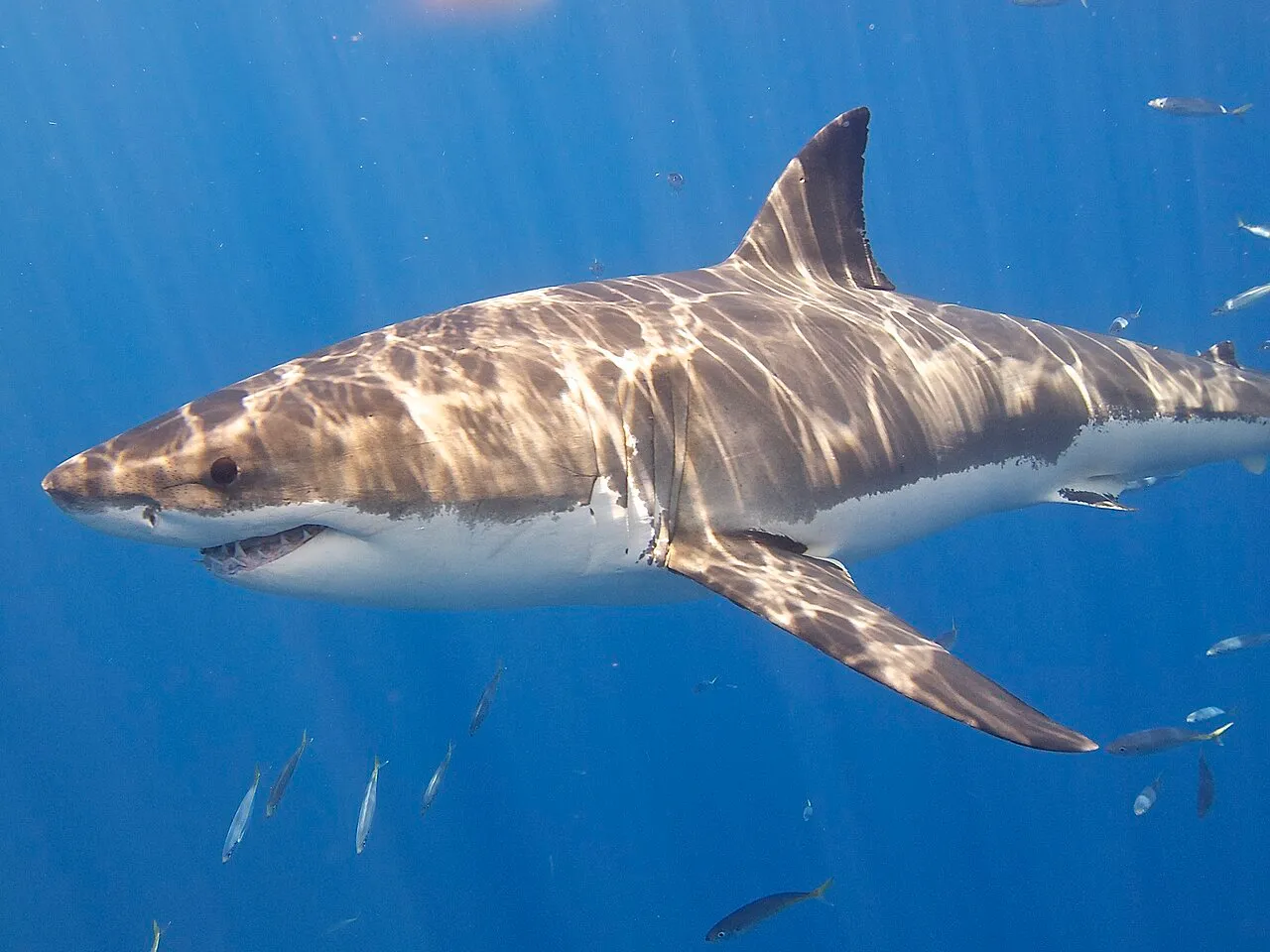
The body is a thick, torpedo-shaped spindle with a crescent tail whose upper and lower lobes are nearly equal. Keels on either side of the tail base add stability to powerful tail strokes. The design suits both explosive acceleration and efficient long-distance cruising. Burst speeds are usually estimated at around 40 km/h; higher figures are sometimes quoted but poorly supported.
Colouring is classic countershading: a dark grey or bluish-grey back blends with the deep water when seen from above, while the white belly blends with the bright surface when seen from below. The boundary between grey and white along the flank is irregular and unique to each shark. Researchers identify individuals by this line and by the notches on the trailing edge of the dorsal fin.
The skin is covered in dermal denticles, tiny tooth-like scales that feel smooth from head to tail and like sandpaper the other way. They reduce drag.
The cartilage skeleton is light and flexible. Sharks have no swim bladder; instead a huge, oil-rich liver provides buoyancy and stores energy.
5.1. Teeth and jaws
Great white teeth are broad triangles with finely serrated edges; in large sharks they can be 5–6 cm tall. Upper teeth are wide and strongly serrated for slicing, lower teeth narrower and pointed for gripping.
The teeth are not set in sockets but anchored in the gums, with several rows of replacements waiting behind the functional row. When a front tooth breaks or falls out, the row behind moves forward like a conveyor belt. Around 300 teeth may be present at any one time, and a shark goes through thousands in a lifetime, which is why shark teeth are among the commonest marine fossils.
The upper jaw is only loosely attached to the skull and swings forward during a bite, widening the gape. The side-to-side head shaking seen during feeding uses the serrated teeth to saw off large chunks.
5.2. Senses
Great whites use a sequence of senses to find prey.
- Smell: the olfactory bulbs are very large, and sharks can detect tiny concentrations of blood or oil in the water. The claim that they can smell a drop of blood kilometres away is an exaggeration.
- Lateral line: a sensory canal along the flanks detects faint vibrations and pressure changes, such as the erratic movements of an injured fish.
- Hearing: sensitive to low-frequency sounds, alerting sharks to struggling animals at a distance.
- Vision: a reflective layer behind the retina improves sight in dim light, and contrast detection is good. Vision matters most at close range.
- Electroreception: jelly-filled pores on the snout called ampullae of Lorenzini detect the minute electric fields produced by muscles and heartbeats, guiding the final approach.
Just before biting, great whites roll their eyes back into their sockets to protect them from claws and teeth, relying on electroreception in the last instant.
6. Behaviour and ecology
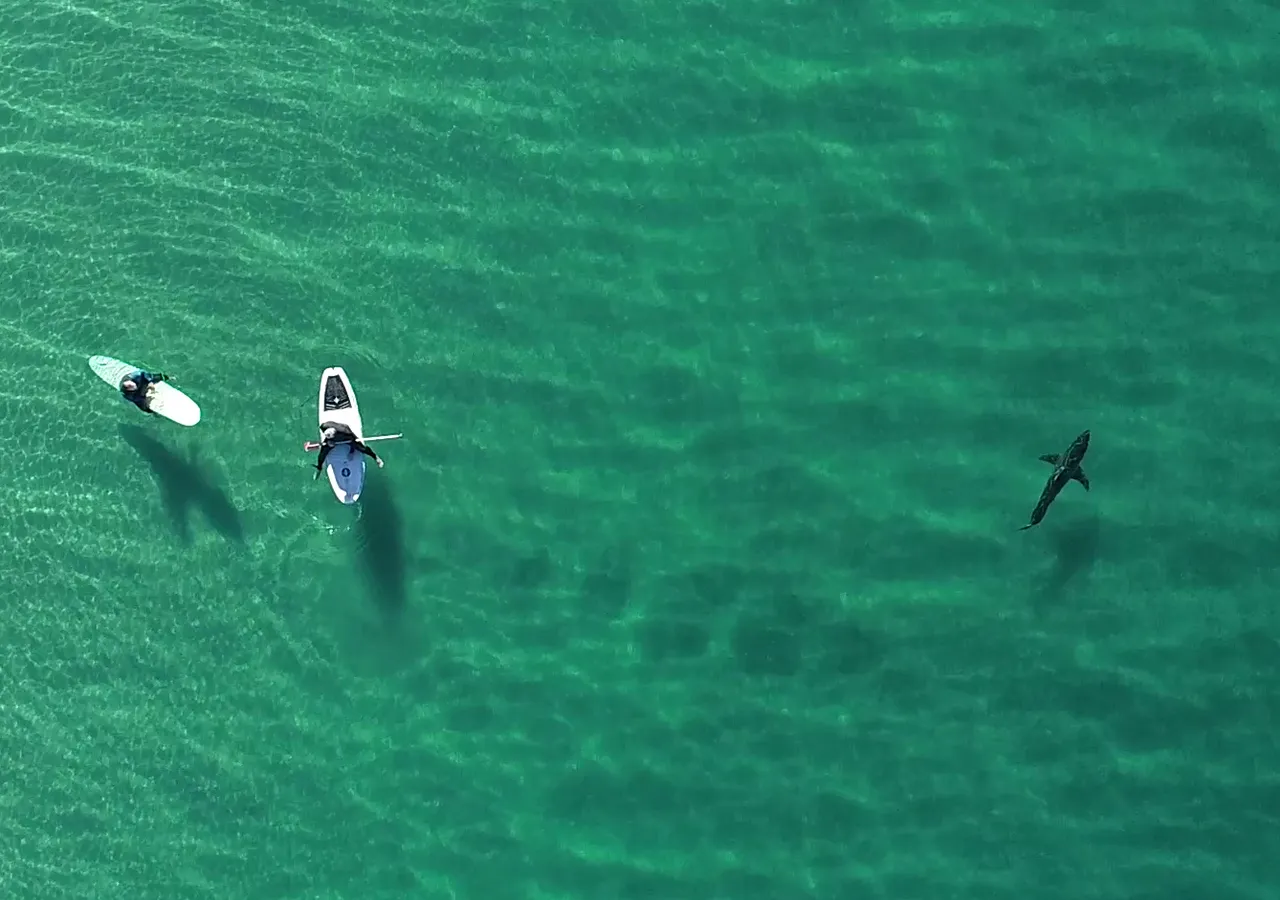
Rex et al. · CC BY 4.0
Great whites are mostly solitary, but at rich feeding sites several may gather, and they appear to follow social rules. Larger sharks tend to dominate smaller ones, females dominate males and residents dominate newcomers. Ritualised displays — parallel swimming, tail slaps that splash water toward a rival, gaping — seem to settle disputes without fights.
They also spy-hop, raising their heads vertically out of the water to look around, apparently to check on seals or boats at the surface. Few sharks are known to do this.
Great whites are obligate ram ventilators: water must keep flowing over their gills, so they swim almost constantly. How they rest was long a mystery; in 2016 a filmed great white off Mexico appeared to be in a restful state, swimming slowly into the current with its mouth open.
Movement patterns vary. Some sharks return to the same sites with remarkable fidelity year after year; others make ocean-crossing migrations. In 2003–2004 a satellite-tagged female from South Africa, nicknamed Nicole, crossed the Indian Ocean to western Australia and returned within about nine months, a round trip of roughly 20,000 kilometres. Her journey suggested that great white populations on distant continents may be linked.
7. Diet and feeding
Diet changes markedly with age and size. Sharks under about 3 metres feed mainly on fish, rays, smaller sharks and squid; their jaws and teeth are not yet robust enough for large mammals. As they grow, the teeth broaden and serrations strengthen, and the sharks begin hunting seals, sea lions and fur seals, as well as dolphins, sea turtles and seabirds.
Seal hunting is the great white's most dramatic act. Often in the low light of early morning, a shark cruises deep, watching for the silhouette of a seal at the surface, then rockets upward almost vertically and strikes from below. The momentum can carry the shark completely out of the water. Seal Island in False Bay, South Africa, became world-famous for these breaches.
Whale carcasses are a feast. Several great whites may gather at a dead whale and feed on its blubber for days. Blubber is so energy-rich that after a big meal a shark may go weeks without eating.
A popular theory held that great whites 'bite and spit' large prey, waiting for it to weaken from blood loss before returning. Field observations show more varied tactics, so the theory does not always hold. One explanation for why bites on people are often single and followed by retreat is that humans, bony and low in fat, are not the high-energy prey the shark was expecting.
8. Reproduction and life cycle
Elias Levy · CC BY 2.0
Reproduction is among the least understood aspects of great white biology. Mating has almost never been observed, and birth has rarely been documented. Fresh bite scars on some females are thought to come from males gripping them during mating.
Great whites are aplacental viviparous, sometimes called ovoviviparous: eggs hatch inside the mother and the young develop there before birth. Embryos first live on yolk, then feed on a stream of unfertilised eggs the mother continues to ovulate, a strategy called oophagy. Gestation is estimated at around 12 to 18 months, though this is uncertain.
Litters typically number two to ten pups, with larger counts occasionally reported. Newborns are already 1.2–1.5 m long and hunt fish independently from birth. Females are thought to give birth every two to three years. Nursery areas include the Southern California Bight, the waters off Long Island, New York, and parts of the Japanese and Mediterranean coasts.
| Stage | Approximate age | Notes |
|---|---|---|
| Embryo | About 12–18 months (estimated) | Grows in the uterus by oophagy |
| Pup | 0 to a few years | Born at 1.2–1.5 m; hunts fish in coastal nurseries |
| Juvenile | Several years to 20s | Passes 2–3 m and starts taking mammals |
| Adult male | Matures at about 26 years | About 3.5–4 m |
| Adult female | Matures at about 33 years | About 4.5–5 m |
| Old age | Can exceed 70 years | Growth becomes very slow |
Age is estimated from growth bands in the vertebrae, but bands become indistinct in older sharks. In 2014 researchers recalibrated ages using the pulse of radiocarbon from 1950s–60s nuclear weapons tests, recorded in vertebrae. Some northwest Atlantic great whites proved to be over 70 years old, and growth turned out much slower than previously believed. A related study put maturity at around 26 years for males and 33 for females.
Late maturity, long pregnancy and small litters make great whites extremely vulnerable to overfishing. When a single generation spans more than three decades, recovery from decline can take many decades.
9. Intelligence, communication, special abilities
Great whites are often portrayed as mindless eating machines, but researchers describe them as curious animals capable of learning. They circle and inspect unfamiliar objects and may give them an exploratory mouthing; without hands, a shark investigates with its mouth. Observations at seal colonies suggest hunting success improves with experience, as sharks refine their technique.
Communication is largely through body language. Besides parallel swimming, tail slaps and gaping, an arched back and lowered pectoral fins are interpreted as signs of tension or threat. Experienced divers read these cues to judge a shark's mood.
The standout physical ability is regional endothermy. Most fish match the temperature of the water, but great whites keep their swimming muscles, eyes, brain and gut substantially warmer than the surrounding sea. The trick is a network of blood vessels called the rete mirabile, 'wonderful net', in which warm venous blood returning from the core runs alongside cold arterial blood coming from the gills, transferring heat so that it is not lost through the gills. Warm muscles contract faster, digestion speeds up and the brain and eyes keep working in cold water.
Other abilities under study include crossing oceans fuelled by oil stored in the liver and navigation that may use Earth's magnetic field.
10. Predators and survival
Adult great whites have almost no natural predators, with one notable exception: the orca. In 1997 near California's Farallon Islands, observers witnessed orcas killing a great white, after which the local sharks abruptly abandoned the area for the rest of the season.
Since 2017, off Gansbaai in South Africa, a pair of orcas has been linked to the deaths of multiple great whites. Carcasses washed ashore with their livers removed with surgical precision. Great whites then largely vanished from an area once famous for shark-viewing tourism, apparently relocating elsewhere. Orcas are thought to flip sharks upside down, inducing tonic immobility, a trance-like state sharks enter when inverted.
Young great whites may be eaten by larger sharks, including bigger great whites. Prey can fight back too: scars from seal and sea lion claws and teeth are common on great white heads.
Today, however, the biggest threat to great whites is human activity, as the following sections explain.
11. Relationship with humans
Any discussion of great whites and people starts with shark bites. According to the International Shark Attack File, unprovoked bites by all shark species number several dozen a year worldwide, with fatalities usually fewer than ten. The great white is responsible for more recorded incidents than any other species. Yet given the hundreds of millions of people who use the sea, the odds of being bitten are tiny, often compared to the odds of being struck by lightning.
Many great white incidents involve a combination of factors: a surfer's silhouette resembling a seal, murky water and proximity to seal colonies. Often the shark bites once and leaves, consistent with the idea that people are not its intended prey. But a single bite from such a large animal can still be fatal.
Korea has had incidents attributed to great whites. Since 1959, several fatal shark attacks — around six or seven, depending on the source — have been reported off the west coast near Boryeong and Gunsan, involving haenyeo divers, commercial divers and swimmers, and many are believed to have involved great whites. Most occurred in May and June as waters warmed. Great whites caught in nets or sighted in the East Sea, South Sea and Yellow Sea still make the news from time to time.
People, however, have done far more harm to great whites than the reverse. In the twentieth century, trophy fishing tournaments targeted 'dangerous' sharks, and jaws and teeth sold for high prices. Finning for shark fin soup, bycatch in nets and longlines, and protective shark nets and baited drumlines at beaches have killed many more.
Today cage-diving tourism in South Africa, Australia and Mexico has become a significant industry, built on the realisation that a living great white is worth far more to local economies than a dead one. Concerns that baiting may alter shark behaviour have led to regulations.
12. Conservation
Globally, the great white is listed as Vulnerable on the IUCN Red List; the Mediterranean population is assessed as Critically Endangered. Because the species roams so widely, there is no reliable global population estimate. Regional studies put populations off central California, South Africa and eastern and western Australia in the hundreds to low thousands each, but estimates vary greatly with method and are hotly debated.
Main threats:
- Bycatch in gillnets, longlines and set nets targeting other fish
- Illegal capture and trade in fins, jaws and teeth
- Shark nets and drumlines at beaches
- Changes in prey availability and marine pollution
- Slow recovery due to late maturity and few young
Protection has grown. South Africa became the first country to protect great whites by law in 1991, followed by Australia, the United States (including California), New Zealand, Malta, Israel and others. The species was added to CITES Appendix II in 2004, so international trade requires permits, and it is listed under the Convention on Migratory Species. In Korea it is regulated as a CITES Appendix II internationally endangered species.
There are signs of recovery in places. Off Cape Cod, rebounding grey seal populations have brought great whites back in large numbers, and juveniles are seen more often off Southern California. More sharks also means more encounters with people, so balancing beach safety and shark conservation is a growing challenge. Non-lethal tools — drone patrols, shark-alert apps and acoustic tags that report when tagged sharks are near — are increasingly used.
13. In aquariums
The great white is the classic example of a large marine animal that has never been kept successfully long term. Many attempts have been made, but most sharks refused food, injured themselves on tank walls, died within days or weeks, or had to be released.
In the 2000s an American aquarium repeatedly displayed young great whites, caught accidentally in fishing nets, for several months before releasing them. The longest stay was a little over six months, and millions of visitors saw a living great white. But some sharks attacked tank mates or developed abrasions and were released early, and the programme was eventually discontinued. In the 2010s an Asian aquarium displayed a great white that died within days.
Reasons usually cited include:
- Tanks are tiny for an animal that travels tens to hundreds of kilometres a day.
- Constant swimming to breathe leads to collisions with walls and corners.
- Capture and transport are extremely stressful.
- One hypothesis suggests electric fields from metal structures may confuse their electroreceptors.
Most scientists and institutions now agree that great whites should be studied in the wild with satellite tags, underwater cameras and drones rather than kept in tanks. The role of aquariums, many argue, is to tell the shark's story through films and exhibits rather than to display living animals.
14. In culture
The great white became a pop-culture icon through Peter Benchley's 1974 novel Jaws and Steven Spielberg's 1975 film adaptation. The story of a giant shark terrorising a beach town was a global sensation that helped invent the summer blockbuster, and its two-note theme still signals an approaching shark.
Jaws also left scars. Shark-fishing tournaments reportedly increased after its release, and the image of sharks as monsters to be eliminated spread. Benchley later expressed regret for fuelling irrational fear and devoted much of the rest of his life to ocean conservation and shark protection.
Great whites have since appeared in countless films and cartoons. Bruce, the reformed shark in Finding Nemo, insists that fish are friends, not food. Films such as Deep Blue Sea, The Shallows and the megalodon thriller The Meg kept shark horror alive, while a long-running American television event devotes a week every summer to sharks.
Korea has its own shark phenomenon: Baby Shark, a children's song video produced by a Korean company in 2016, became one of the most-viewed videos in YouTube history. Its shark family is not a specific species, but some credit it with helping recast sharks as cute and friendly rather than terrifying.
In Hawaiian and other Pacific Island cultures, and among the Māori of New Zealand, sharks have been revered as ancestral spirits or guardians. In South Africa and Australia, the great white has become a symbol of tourism and marine conservation, and many sports teams use sharks as mascots.
15. Trivia
- The whale shark and basking shark are much longer, but both are filter feeders, so the great white holds the title of largest predatory fish.
- Turned upside down, great whites enter tonic immobility; researchers sometimes use this briefly to attach tags or take samples safely.
- The liver can weigh hundreds of kilograms. Its rich oil is why orcas target it.
- A female nicknamed Deep Blue, filmed near Guadalupe Island, was estimated at around 6 metres, making her one of the largest great whites ever filmed, though she has not been precisely measured.
- The notches on the trailing edge of each shark's dorsal fin work like a fingerprint, and researchers build photo-ID catalogues of thousands of individuals.
- Great whites that appear in seas around Korea, Japan and China are thought to belong to a northwest Pacific population, but research in the region remains scarce.
- Scientists have recorded great whites diving to depths of more than 1,000 metres during open-ocean migrations.
- Because many bites on people are followed by retreat, a half-joking explanation is that humans simply taste bad to a great white.
Wild animals are not pets. Catching, trading or keeping them is illegal in most places. If you find an injured wild animal, call your local wildlife rescue centre.
FAQ
Do great whites deliberately hunt people?
No. Most bites are thought to be cases of mistaken identity or investigative bites. Worldwide, great white incidents number only a handful each year.
Is it a descendant of megalodon?
Most researchers now say no. The great white appears to descend from an extinct broad-toothed mako lineage, while megalodon belonged to a separate family.
Are there great whites in Korean waters?
Rarely, yes. There are sightings and bycatch records from the Yellow Sea, the southern coast and the East Sea, and some past shark incidents off Korea's west coast are attributed to great whites.
Photo credits
Photos are freely licensed images from Wikimedia Commons. Authors and licenses are listed below.
- White shark.jpg — Pterantula (Terry Goss) at en.wikipedia · CC BY 2.5
- BC-095-Great-White-Jaw-r2-Lo.jpg — Bone Clones · CC BY-SA 3.0
- Chuming the water.jpg — Brocken Inaglory · CC BY-SA 3.0
- Figure S2 Rex et al White Shark drone (cropped).png — Rex et al. · CC BY 4.0
- Great White Shark (14730744390).jpg — Elias Levy · CC BY 2.0