TailVille
1. Overview
Manta rays 'fly' through the ocean on huge wing-like pectoral fins. Large individuals can span around 7 metres from wingtip to wingtip, making them among the biggest fish in the sea. Their size, graceful movements and curiosity toward divers have made them one of the most sought-after encounters in underwater tourism.
There are two recognised species: the giant oceanic manta ray (Mobula birostris), a wide-ranging open-ocean wanderer, and the reef manta ray (Mobula alfredi), which tends to live around coastal reefs and islands. Mantas used to be placed in their own genus, Manta, but genetic studies showed they sit within the devil rays, genus Mobula, and since around 2018 most scientists have used Mobula for them.
In Korean, the name jwi-gaori, used as this article's title, properly refers to devil rays, the manta's closest relatives in the same genus; mantas themselves are usually called manta-gaori. This article focuses on mantas while covering the wider group.
Despite their size, mantas are gentle filter feeders that strain plankton from the water. They reproduce extremely slowly, and fishing for their gill plates, along with accidental capture, has driven declines. Both species are listed as threatened by the IUCN.
2. Name and classification
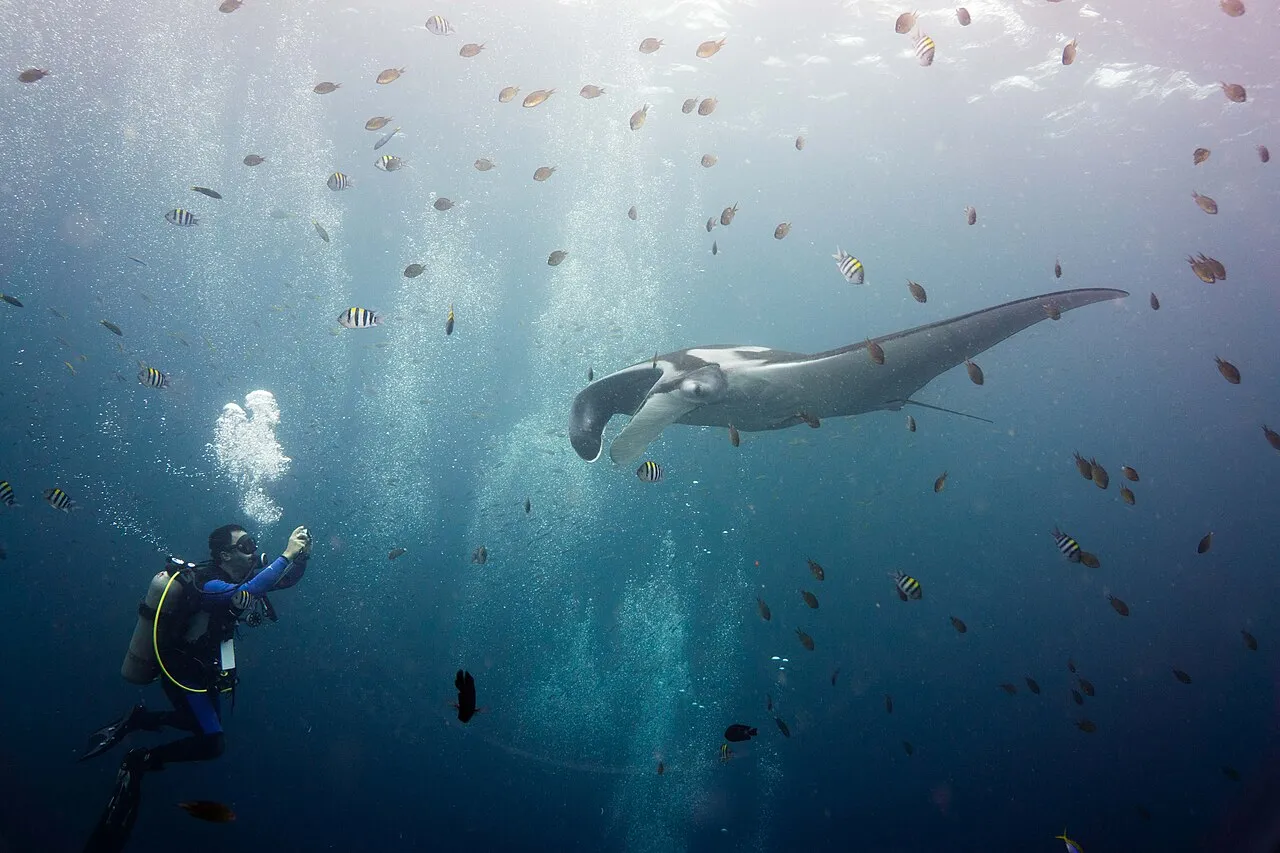
Daniel Sasse · CC BY-SA 4.0
'Manta' means 'blanket' or 'cloak' in Spanish and Portuguese, a fitting name for a broad, flat animal that looks like a blanket spread through the water. The giant manta's species name birostris means 'two snouts', referring to the pair of horn-like cephalic fins at the front of the head. The reef manta's name, alfredi, honours Prince Alfred, after whom it was named when described from Australia in the 19th century.
Mantas belong to the order Myliobatiformes and the family Mobulidae, which also contains the smaller devil rays. Around nine species are generally recognised, though authorities differ.
| Name | Scientific name | Maximum disc width | Notes |
|---|---|---|---|
| Giant oceanic manta | Mobula birostris | About 7 m, larger claims exist | Open ocean; T-shaped white shoulder markings |
| Reef manta | Mobula alfredi | About 5 m | Coastal and reef; Y-shaped shoulder markings |
| Spinetail devil ray | Mobula mobular | About 3 m | Recorded off Korea; spine at tail base |
| Other devil rays | Several Mobula species | 1 to 2 m | Often school and leap from the water |
The Korean name jwi-gaori, 'rat ray', probably refers to the long, thin, rat-like tail. Large rays occasionally caught in nets off Korea's south coast and Jeju are mostly devil rays of this group.
Researchers have proposed that a third manta species may live in the Caribbean and western Atlantic. It has not yet been formally described.
3. Evolution
Rays and sharks together make up the cartilaginous fishes. Rays are thought to have evolved from shark-like ancestors by flattening out and taking up life on the sea floor. Most rays still live on the bottom, but some lineages within the Myliobatiformes returned to open water, flapping their pectoral fins like wings.
The mobulid family is thought to have arisen from eagle-ray-like ancestors that crushed hard-shelled prey on the bottom. As they shifted to filter feeding, crushing tooth plates gave way to filter structures on the gills, and the mouth moved to the front of the head. Mobulid fossils, mostly teeth, appear in Cenozoic rocks, with some studies dating the earliest records to around 30 million years ago, though estimates vary.
Genetic studies suggest the two manta species split relatively recently, perhaps within the last million years. Their ranges overlap in some areas, and individuals that appear to be hybrids have been recorded.
Giant filter feeding has evolved more than once among sharks and rays. Mantas are the most spectacular example on the ray side of the family tree.
4. Range and habitat
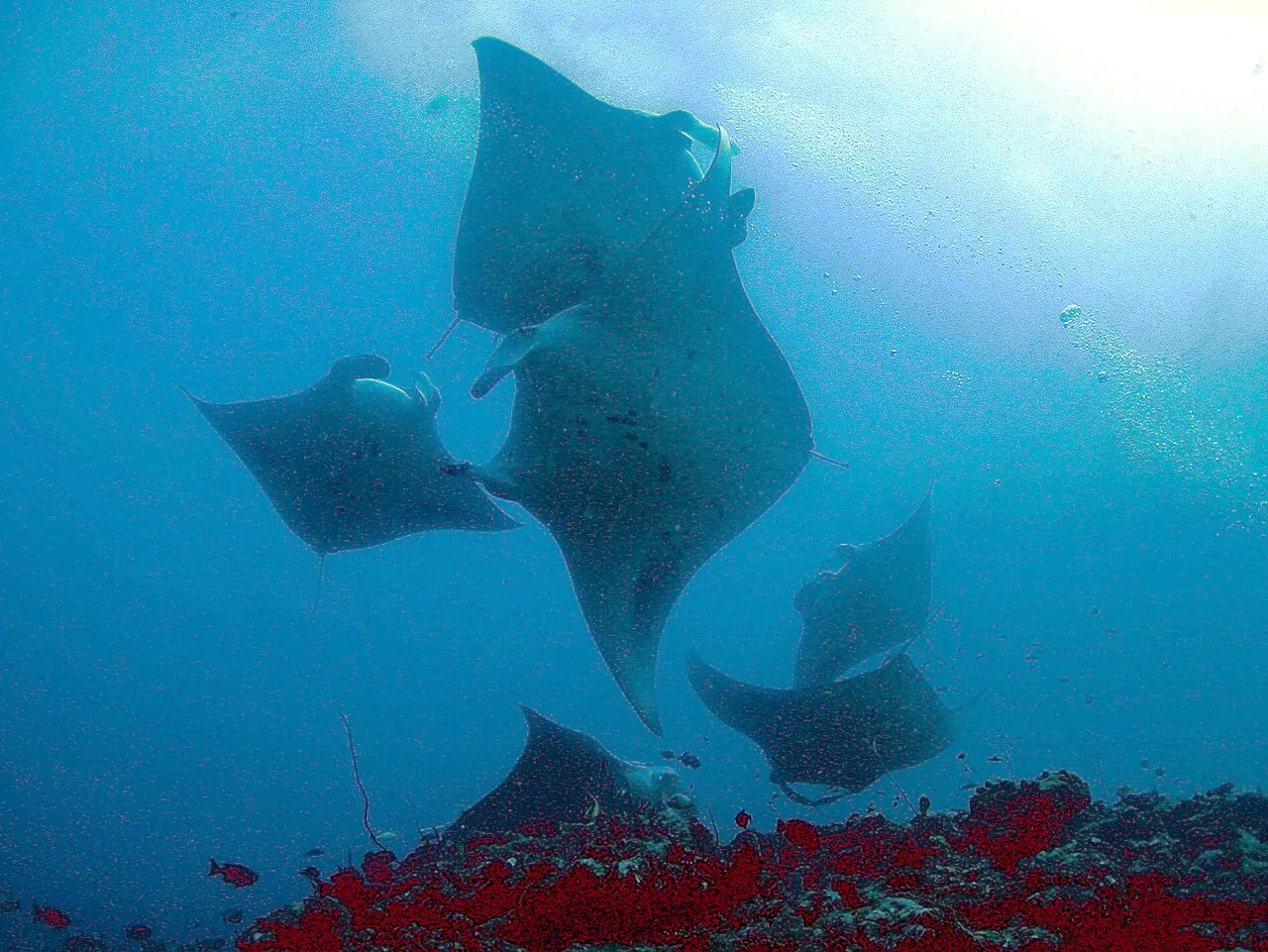
The giant oceanic manta is found in tropical, subtropical and warm-temperate seas worldwide, in the Atlantic, Indian and Pacific Oceans. It frequents offshore islands, seamounts and areas of upwelling where nutrient-rich water fuels plankton growth. It can travel hundreds to over a thousand kilometres, though studies suggest many individuals are more resident than once thought.
The reef manta lives mainly along tropical coasts of the Indian Ocean and western Pacific. It moves between reefs, lagoons and island shallows within a relatively small home range, and many individuals return to the same sites year after year.
| Well-known site | Main species | Notes |
|---|---|---|
| Hanifaru Bay, Maldives | Reef manta | Dozens to hundreds gather during monsoon plankton blooms |
| Raja Ampat, Komodo, Nusa Penida (Indonesia) | Reef and giant | Famous cleaning stations |
| Kona, Hawaii | Reef manta | Night dives where lights attract plankton |
| Tofo, Mozambique | Both | Long-term research site |
| Ecuador and Peru | Giant manta | Large population documented |
| Revillagigedo Islands, Mexico | Giant manta | Big individuals that approach divers |
| Yap, Micronesia | Reef manta | Cleaning stations in channels |
Mantas visit 'cleaning stations' on reefs and seamounts, where small fish pick parasites off their skin, and travel to rich feeding areas to eat plankton. Giant mantas have been recorded diving to nearly 1,000 metres.
Mantas are very rarely seen in Korean waters, though their devil ray relatives occasionally turn up in summer nets off the south coast and Jeju.
5. Body
A manta's body is a flattened diamond-shaped disc with long, triangular pectoral fins. At the front of the head is a pair of cephalic fins, rolled into horn-like shapes while cruising and unfurled during feeding to funnel plankton into the mouth. Those 'horns' earned mantas the dramatic old nickname 'devilfish'.
| Feature | Giant oceanic manta | Reef manta |
|---|---|---|
| Disc width | Usually 4 to 5 m; up to about 7 m | Usually 3 to 3.5 m; up to about 5 m |
| Weight | Estimated up to around 2 tonnes | Estimated up to around 1 tonne |
| Back markings | Crisp T-shaped white shoulder patches | Y-shaped, blurred white patches |
| Belly spots | Dark spots around the midline and behind gills | Spots scattered between gill slits |
| Mouth area | Grey to black | Usually white |
| Tail | Vestigial spine forming a hard knob | No spine |
The mouth spans the front of the head. Small teeth line the lower jaw, but they are not used for feeding; males may use them to grip a female's fin during mating. Filtering is done by gill plates inside the five pairs of gills.
The pattern of dark spots on the belly is unique to each individual and is used for photo-identification. Some mantas are almost entirely black on both sides, a melanistic form reported from the Maldives, Indonesia, Hawaii and elsewhere. A rare pink individual photographed in Australia made headlines.
Mantas have one of the largest brain-to-body ratios of any fish. A network of blood vessels around the brain, a rete mirabile, is thought to help keep the brain warm during dives into cold water.
Males can be identified by their claspers, a pair of mating organs on the inner edge of the pelvic fins. Females grow larger than males of the same age.
6. Behaviour and ecology
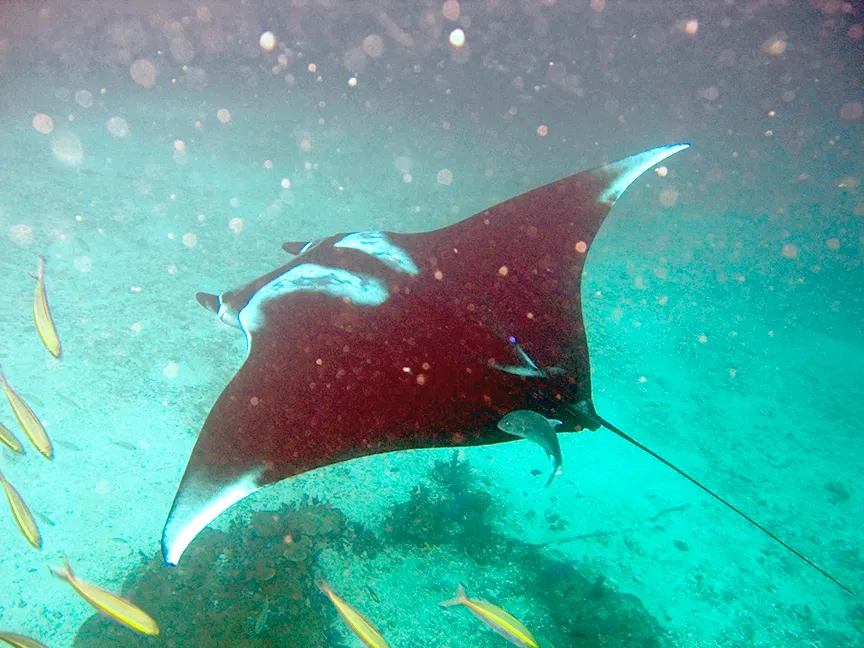
Mantas swim by slowly flapping their pectoral fins, looking much like birds in flight. They usually move at a relaxed pace but can accelerate quickly. Like many sharks, they must keep water flowing over their gills to breathe, so they swim continuously.
A manta's day revolves around cleaning, feeding and travelling. At cleaning stations, wrasses, butterflyfish and other small fish pick parasites and dead tissue from their skin and gills while the mantas circle slowly or hover overhead. Mantas revisit favourite stations again and again, making these sites focal points for observation and research.
Mantas may travel alone but gather at feeding areas and cleaning stations. Research on reef mantas suggests they have preferred companions, associating with some individuals more than others in a kind of social network.
Mantas sometimes launch themselves completely out of the water and crash back down with a loud slap, a behaviour called breaching. The reason is unclear: dislodging parasites, signalling to others and courtship have all been suggested. Smaller devil rays breach in groups of dozens or hundreds, a spectacular sight.
7. Diet and feeding
Mantas are filter feeders that eat zooplankton: copepods, krill, shrimp and crab larvae, arrow worms, fish eggs and larval fish. A large manta is estimated to eat a sizeable fraction of its body weight in plankton each day. Studies in the 2010s found that giant mantas also obtain much of their food from deeper water, suggesting they spend more time feeding at depth than previously realised.
They use several techniques:
- Straight feeding: swimming forward through a plankton patch with the mouth open and cephalic fins unrolled.
- Somersault feeding: performing repeated backward loops through dense plankton to pass through the same patch again and again.
- Chain feeding: several mantas swim nose to tail in a line, feeding together.
- Cyclone feeding: dozens of mantas spiral in a vortex that concentrates plankton in the centre, famously seen at Hanifaru Bay.
- Bottom feeding: feeding on plankton near the sea floor.
The manta's filter is not a simple sieve. Research published around 2018 showed that its gill plates create tiny vortices that bounce particles away from the pores, letting the manta capture food smaller than the gaps without clogging. Engineers have taken an interest in the principle for designing industrial filters.
8. Reproduction and life cycle
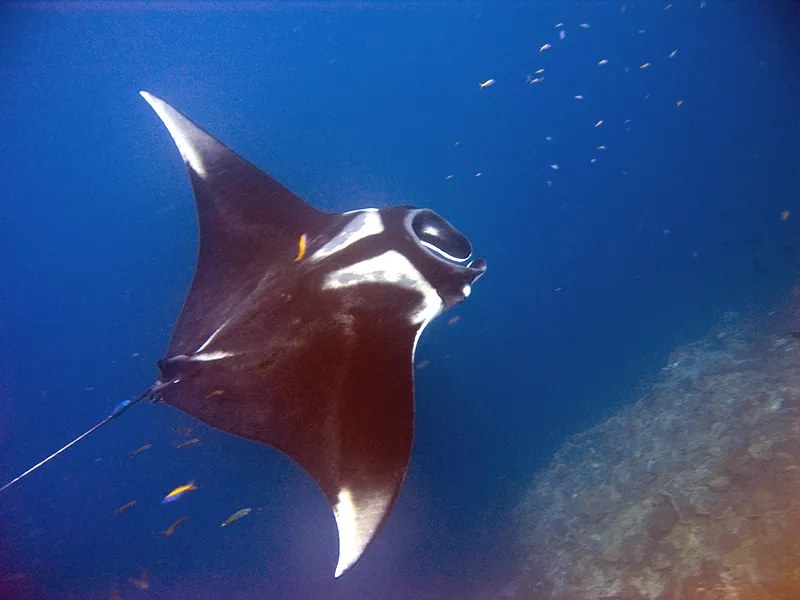
jon hanson from london, UK · CC BY-SA 2.0
Mantas have one of the slowest reproductive rates of any fish. During the breeding season, a female may be pursued by a line of males in a 'courtship train' that can last for hours as they follow her every turn. Eventually one male grips the tip of her pectoral fin in his mouth and they mate belly to belly for a minute or two. Many mature females bear bite scars on their fins as a result.
Mantas are live-bearers. Embryos start out living on yolk, then feed on nutrient-rich fluid secreted by the mother's uterus. With no placenta, the embryo appears to pump fluid over its gills by moving its mouth inside the womb, a form of in-utero breathing described by researchers.
| Trait | Details |
|---|---|
| Gestation | About 12 to 13 months |
| Litter size | Usually one pup, rarely two |
| Interval between births | Usually 2 to 3 years, sometimes 5 or more |
| Size at birth | Disc width about 1.2 to 1.5 m |
| Age at maturity | Females roughly 8 to 15 years, varying by species and region |
| Lifespan | Estimated 40 to 50 years or more |
Put together, a female may produce only around a dozen pups in her lifetime. Pups are independent from birth, and in some regions juveniles have been found using shallow bays and mangrove areas as nursery grounds.
Births and very young mantas are almost never seen in the wild. Much of what is known comes from births in aquariums and long-term photo-identification studies.
9. Intelligence, communication and special abilities
Mantas are often put forward as candidates for the cleverest fish. Their brains are large for their body size, with well-developed regions thought to be involved in learning, memory and social behaviour.
A study published in 2016 reported that captive mantas presented with a mirror behaved unusually, repeatedly flapping their fins, blowing bubbles and turning over in front of it. The researchers suggested this could be self-directed behaviour, a sign the animals recognised their reflection. Because it was not the standard mark test, in which an animal must notice a mark on its own body, others argue that self-recognition in mantas has not been demonstrated.
Wild mantas' behaviour toward divers is also striking. Many circle divers or approach closely, apparently inspecting them. Videos of entangled mantas staying still beside divers who cut away fishing line have gone viral. Interpreting this as 'asking for help' is a stretch, but mantas clearly do not simply avoid people.
Mantas remember the locations of cleaning stations and feeding grounds and return to them at the right seasons, a feat of spatial memory that may relate to their large brains. How they communicate with each other is poorly understood, but posture, swimming patterns and breaching may all serve as signals.
10. Predators and survival
Adult mantas have few natural predators: large sharks such as tiger sharks, great hammerheads, bull sharks and great whites, as well as orcas. Photo-identification studies show that many mantas carry crescent-shaped bites missing from their fins, most likely from sharks. Size, speed and agility help them escape many attacks.
Young mantas are much more vulnerable; a pup about a metre across can be taken by medium-sized sharks. Juveniles sheltering in shallow bays and near mangroves are thought to be avoiding large predators.
People are by far the biggest threat: targeted fishing, bycatch, entanglement in lines and nets, boat strikes and ingestion of marine debris. Research in Indonesia and elsewhere suggests mantas may swallow considerable amounts of microplastic along with plankton. Fishing line wrapped around the cephalic fins or body can cut deep into the flesh.
11. Relationship with humans
Sailors of the past called mantas 'devilfish' and told tales of them capsizing boats or wrapping divers in their wings to drown them, largely because the cephalic fins resembled horns. In reality mantas do not attack people and have no venom. Unlike stingrays, their tails lack a functional sting; in the giant manta only a vestigial spine remains.
From the late 20th century, perceptions turned completely. With the rise of recreational diving, mantas became stars rather than monsters. Manta tourism brings significant income to the Maldives, Indonesia, Hawaii, Mozambique, the Philippines and elsewhere; one study in the Maldives estimated its annual value in the tens of millions of US dollars. Several analyses have concluded that a living manta is worth far more over its lifetime through tourism than as a one-off catch.
At the same time, mantas became targets. From the 2000s, demand grew in some markets for dried manta and devil ray gill plates, marketed as a health tonic. Critics point out that these claims lack scientific support and have little basis even in classical traditional-medicine texts. Large numbers of mantas and devil rays were landed in Sri Lanka, Indonesia, India, Peru and other countries, their gill plates dried for export.
Good practice when diving with mantas includes:
- Never touch a manta; damaging its protective mucus can lead to infection
- Do not hover over or crowd cleaning stations
- Do not block a manta's path or chase it
- Approach from the side or below, never from directly above
- Follow local rules on lights and flash photography
12. Conservation
On the IUCN Red List, the giant oceanic manta (Mobula birostris) is listed as Endangered and the reef manta (Mobula alfredi) as Vulnerable, following assessments around 2018 to 2020. Both have declined sharply in parts of their range, especially where targeted fisheries operated. Global numbers are unknown; most regional populations are estimated in the hundreds to low thousands, although well-protected places like the Maldives have photo-identified thousands of individuals.
Main threats include:
- Targeted fishing for gill plates
- Bycatch in tuna purse-seine, gillnet and other fisheries
- Entanglement and boat strikes
- Ingestion of microplastics and pollutants
- Climate-driven changes in plankton and reef decline
- Disturbance from poorly managed tourism
Manta rays were added to CITES Appendix II in 2013, regulating international trade, and the remaining devil rays followed. They are also listed under the Convention on Migratory Species. Indonesia banned catching and trading mantas throughout its waters in 2014, and the Maldives, Ecuador, Peru, the Philippines, Mexico and Hawaii, among others, protect them by law. In the United States, the giant manta is listed as Threatened under the Endangered Species Act.
Because mantas breed so slowly, depleted populations may take decades to recover. Conservationists argue for combining fishing bans with habitat protection, bycatch-reducing gear and international research cooperation.
13. In aquariums
Only a handful of very large aquariums keep manta rays. An animal several metres across that must swim constantly needs a vast, deep tank and a steady supply of food in place of wild plankton. Births in aquariums have provided valuable information on gestation and birth.
Aquariums argue that seeing a manta up close builds public support for ocean conservation and that research on captive animals, such as the mirror study and birth observations, helps protect wild populations.
Critics argue that confining an animal that travels tens of kilometres a day and dives hundreds of metres to circling a tank raises serious welfare concerns. Injuries from collisions with tank walls and stress-related deaths have been reported, and most displayed mantas were captured from the wild, which adds pressure on populations.
For these reasons, the emphasis is increasingly on responsible viewing in protected areas rather than display in tanks.
14. In culture
With their gliding, flight-like movements, mantas are widely used as symbols of freedom and serenity. They appear on dive-shop logos, conservation emblems and resort names. In Hawaii and other Pacific islands, mantas feature in legends and traditional designs, and some traditions regard them as guardians of the sea.
In animation, Finding Nemo's Mr. Ray carries schoolchildren around the reef on his back. Many video games feature manta-inspired creatures and flying machines, and the manta's silhouette is often cited as inspiration for sleek car and aircraft designs; the name has been used for cars and even for a US military underwater drone programme.
The shift from 'devilfish' to 'angel of the sea' neatly illustrates how human attitudes toward ocean animals have changed.
15. Trivia
- International photo-identification databases hold tens of thousands of manta belly photos, many contributed by recreational divers.
- Mantas never stop swimming, even when resting, because they need water flowing over their gills to breathe.
- Some individuals have been recorded visiting the same cleaning station for more than 20 years.
- When devil rays breach en masse, the slaps on the water can be heard from far away; some fishermen liken it to applause.
- Like sharks, mantas have no swim bladder and rely on an oily liver for buoyancy.
- The cephalic fins stay rolled up to reduce drag and unfurl only for feeding, so the 'devil horns' are really food-gathering scoops.
- Although Manta is no longer used as a genus name, 'manta' remains the everyday name worldwide.
Wild animals are not pets. Catching, trading or keeping them is illegal in most places. If you find an injured wild animal, call your local wildlife rescue centre.
FAQ
Are devil rays and manta rays the same?
They are close relatives in the same genus, Mobula. The Korean name jwi-gaori originally means the smaller devil rays, while mantas are the two largest species. Mantas have been classified in Mobula since around 2018.
Are manta rays dangerous?
No. Unlike stingrays they have no venomous spine and do not attack people. Touching them can damage their protective mucus, so look but don't touch.
Why are manta rays declining?
Mainly fishing for their gill plates, sold as a tonic, and accidental capture. Because they breed so rarely, populations recover very slowly. International trade has been regulated under CITES Appendix II since 2013.
Photo credits
Photos are freely licensed images from Wikimedia Commons. Authors and licenses are listed below.
- Dharavandhoo Thila - Manata Black Pearl.JPG — Shiyam ElkCloner · CC BY-SA 3.0
- Giant oceanic manta ray.jpg — Daniel Sasse · CC BY-SA 4.0
- Manta alfredi maldives.jpg — TANAKA Juuyoh (%u7530%u4E2D%u5341%u6D0B) · CC BY 2.0
- Manta birostris-Thailand3.jpg — jon hanson from london, UK · CC BY-SA 2.0
- Manta birostris-Thailand4.jpg — jon hanson from london, UK · CC BY-SA 2.0