TailVille
1. Overview
In December 1938, a museum curator in a small South African town was called to the docks to look at a strange blue fish brought in by a trawler. It had fleshy, limb-like fins, heavy armoured scales with a metallic sheen and an odd little extra lobe at the tip of its tail. It was a coelacanth, a fish thought to have died out around the same time as the dinosaurs. The discovery, one of the biggest zoological surprises of the 20th century, turned the coelacanth into the very symbol of a 'living fossil'.
This article focuses on that first species, the West Indian Ocean coelacanth, Latimeria chalumnae. Coelacanths belong to a lineage more than 400 million years old, and only two species survive: the West Indian Ocean coelacanth and the Indonesian coelacanth discovered in the late 1990s.
Coelacanths are lobe-finned fishes, with bones and muscles inside their fins. Lobe-finned fishes sit on the evolutionary path that led from fish to four-limbed land animals, so coelacanths are distant cousins of all land vertebrates, including us. It is quite literally true that you are more closely related to a coelacanth than a tuna is.
Coelacanths live quietly in caves and on steep rocky slopes 150 to 700 metres deep off eastern Africa. With a tiny population and extraordinarily slow reproduction, the species is listed as Critically Endangered.
2. Name and classification
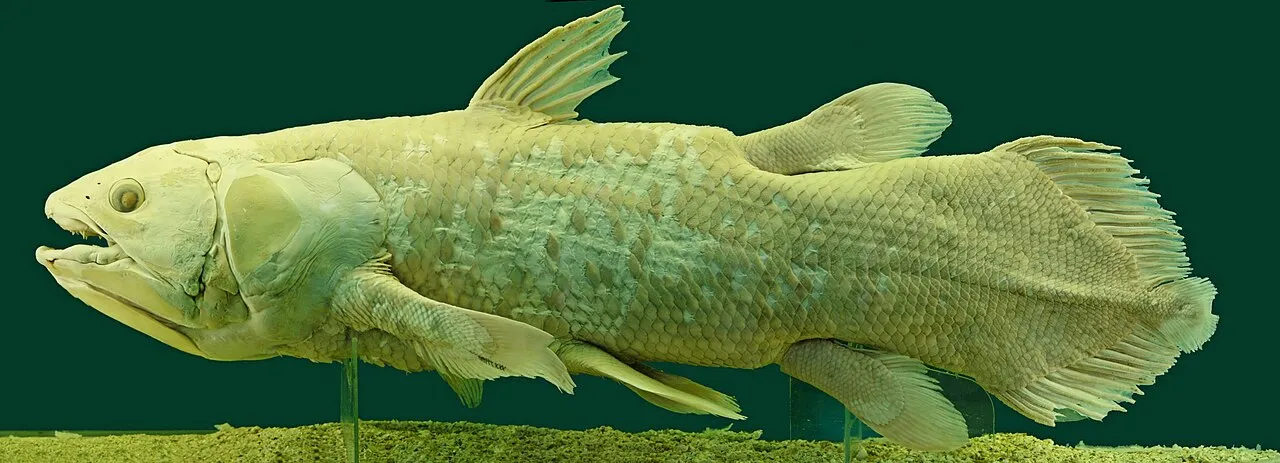
The name 'coelacanth' combines the Greek koilos, 'hollow', and akantha, 'spine', because the fin spines of the fossil coelacanths studied in the 19th century were hollow. In other words, the name was coined for fossils long before anyone knew a living one existed.
The genus Latimeria honours Marjorie Courtenay-Latimer, the curator of the East London Museum in South Africa who recognised the first specimen in 1938, and the species name chalumnae refers to the Chalumna River, near whose mouth it was caught. The fish was described by the South African ichthyologist J. L. B. Smith.
| Rank | Name |
|---|---|
| Class | Sarcopterygii (lobe-finned fishes) |
| Subclass | Actinistia |
| Order | Coelacanthiformes |
| Family | Latimeriidae |
| Genus | Latimeria |
| Species | West Indian Ocean coelacanth (L. chalumnae), Indonesian coelacanth (L. menadoensis) |
Lobe-finned fishes include coelacanths, lungfishes and the tetrapods (amphibians, reptiles, birds and mammals). The prevailing view is that lungfishes are the closest living relatives of tetrapods, with coelacanths a step further out.
In the Comoro Islands, fishermen knew the fish as gombessa. It was oily and unpleasant to eat, so it was not targeted, but it turned up occasionally on deep handlines. There are stories that its rough scales were used like sandpaper, for instance to roughen bicycle inner tubes before patching them.
The Indonesian coelacanth was first noticed in 1997 at a market in Manado, North Sulawesi. It looks very similar but is brownish, and genetic studies show it has evolved separately for millions of years.
3. Evolution
Coelacanths date back to the Devonian period, roughly 410 million years ago. The Devonian, often called the Age of Fishes, saw an explosion of fish diversity, and it was during this time that some lobe-finned fishes took the first steps toward life on land.
Coelacanths flourished through the Palaeozoic and Mesozoic eras, and well over a hundred fossil species are known. Some lived in fresh water, others in the sea, and they ranged from tens of centimetres to several metres long. Mawsonia, from Cretaceous rocks in Brazil and Africa, may have reached several metres. Macropoma, a Cretaceous coelacanth from European seas, looked remarkably like the living Latimeria.
Yet coelacanth fossils essentially vanish from the record after the end of the Cretaceous, about 66 million years ago. Scientists assumed coelacanths had died out in the same mass extinction that ended the non-bird dinosaurs, which is why the 1938 discovery was so astonishing: a living animal had appeared after a fossil gap of more than 66 million years. Organisms that disappear from the fossil record and later turn up alive are called Lazarus taxa, after the biblical figure raised from the dead.
A leading explanation for the gap is that later coelacanths lived in deep-sea habitats where fossils rarely form.
The term 'living fossil' needs care. Modern coelacanths resemble ancient ones but are not identical; no fossils of the genus Latimeria itself are known, and the lineage has continued to evolve. When the West Indian Ocean coelacanth's genome was sequenced in 2013, researchers found that its protein-coding genes have changed more slowly than those of many other vertebrates. That does not mean evolution stopped, only that it proceeded relatively slowly in a stable deep-sea environment.
4. Range and habitat
The core range of the West Indian Ocean coelacanth is the Comoro Islands, between mainland Africa and Madagascar, where relatively stable populations live around Grande Comore and Anjouan. It has also been recorded at the following places:
| Area | Notes |
|---|---|
| Comoro Islands | Largest known population; second specimen caught here in 1952 |
| South Africa | First specimen off East London in 1938; divers found a group in canyons at Sodwana Bay in 2000 |
| Madagascar | Records from fisheries, including in the south-west |
| Mozambique | Records from fisheries |
| Tanzania | Many caught in shark nets from the 2000s, revealing a previously unknown population |
| Kenya | Recorded from catches |
Coelacanths mostly live between about 150 and 250 metres deep, with a wider range of roughly 100 to 700 metres. In the Comoros they shelter in caves and crevices on the steep slopes of volcanic islands, where the water is about 14 to 22 degrees Celsius. They seem to need cool, well-oxygenated water; at higher temperatures their blood carries oxygen less efficiently.
Remarkably, several coelacanths often share a cave. Submersible surveys have seen a dozen or more resting together peacefully in a single cavern.
In 2000, recreational divers at Sodwana Bay in South Africa encountered coelacanths at a little over 100 metres in a submarine canyon, the first time people had seen them in person underwater. In Tanzania, numerous coelacanths caught in nets from 2003 onward revealed a previously unknown population.
The Indonesian coelacanth is known from northern Sulawesi and other parts of eastern Indonesia and Papua, some 10,000 kilometres from its African cousin.
5. Body
Adult coelacanths reach 1.5 to 2 metres in length and up to around 90 kilograms. Females grow larger than males.
| Feature | West Indian Ocean coelacanth |
|---|---|
| Length | Adults usually 1.5 to 1.8 m; up to about 2 m |
| Weight | Up to roughly 90 kg |
| Colour | Deep blue with white blotches in life |
| Scales | Thick, heavy cosmoid-type scales with small surface denticles |
| Fins | Around eight fleshy, lobed fins |
| Tail | Symmetrical tail with a small extra lobe at the tip |
In life the body is deep steel blue scattered with white spots. The spot pattern is unique to each individual, allowing identification from submersible footage. After death the colour fades to brown.
The coelacanth's body preserves many features of an ancient lineage.
5.1. Lobed fins
The pectoral and pelvic fins sit on short, fleshy stalks that stick out from the body like stubby limbs. Inside are bones, joints and muscles whose basic arrangement resembles the limb bones of tetrapods. When swimming, coelacanths move these paired fins in a diagonal alternating pattern, much like the gait of a walking four-legged animal, although they do not actually walk on the sea floor.
5.2. Skull and senses
The coelacanth's skull has a feature found in no other living vertebrate: an intracranial joint. The braincase is divided into front and back sections connected by a hinge, letting the fish lift its upper jaw and open its mouth very wide and very fast. Research published around 2021 suggested the joint helps generate powerful suction when feeding.
Inside the snout is the rostral organ, a jelly-filled sensory structure believed to detect weak electric fields given off by other animals, probably helping the coelacanth find prey in the dark. The large eyes have a reflective layer, the tapetum, that improves vision in dim light.
The brain is tiny, filling only around 1 to 2 percent of the braincase; the rest is filled with fatty tissue.
5.3. Notochord and fatty lung
Even as adults, coelacanths are supported not by a bony spine but by a thick, oil-filled tube called the notochord. Most vertebrates have a notochord only as embryos, replacing it with vertebrae as they develop; coelacanths keep it for life.
They also have a fat-filled organ that is not a swim bladder but a vestigial lung. Studies in the 2010s showed that in embryos the lung is relatively well developed, but it stops growing and becomes a tiny remnant surrounded by fatty tissue in adults. This suggests that the coelacanth's distant ancestors may have breathed air in shallow water. The fatty organ helps with buoyancy in the deep sea.
6. Behaviour and ecology
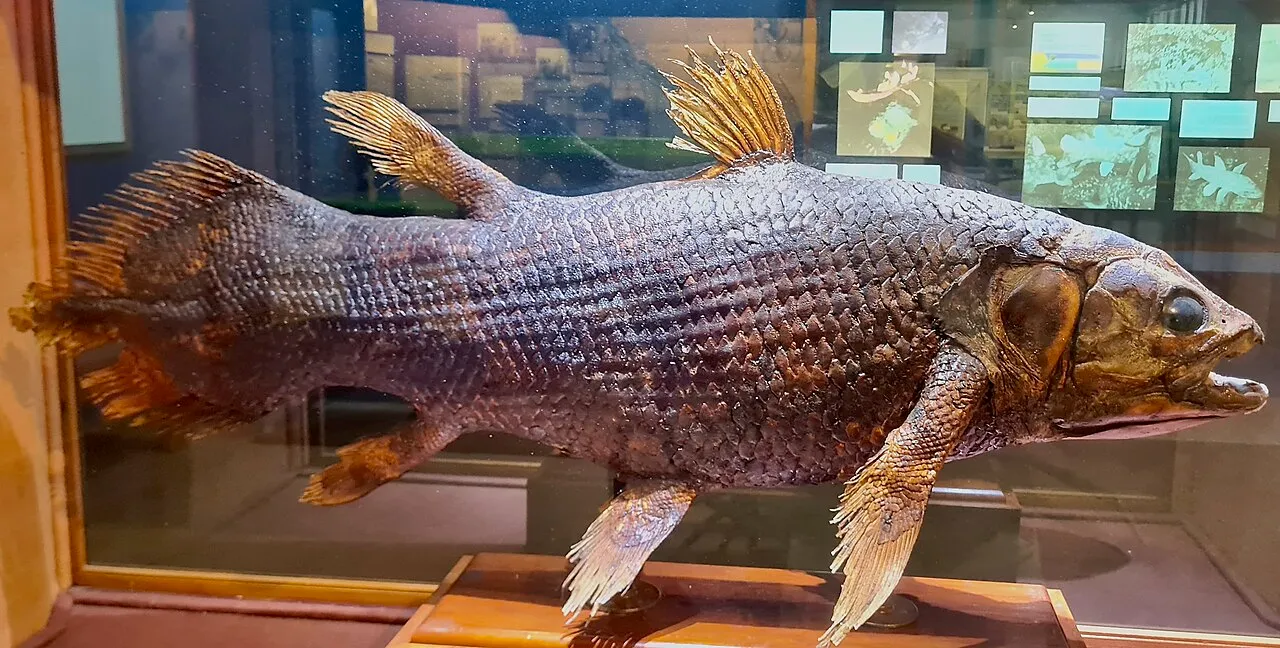
Bernard DUPONT · CC BY-SA 2.0
Living coelacanths were first observed in their natural habitat in the late 1980s, when a German team used a small crewed submersible to explore the waters of the Comoros. Before that, scientists could study only animals hauled up by fishermen, which soon died.
Submersible observations revealed a quiet daily routine. By day, groups of coelacanths rest in caves around 150 to 250 metres deep. At dusk they leave individually and drift deeper, foraging through the night, then return to a cave around dawn. They do not always return to the same cave, often rotating among several nearby.
Coelacanths swim slowly and economically, drifting with currents and making small adjustments with their fins. This passive drift-hunting suits their very low metabolic rate, letting them live on little energy.
One of their oddest behaviours is the headstand. Coelacanths approached by submersibles have been seen hanging head-down, motionless, for minutes at a time. Some researchers suggest this posture helps them scan the bottom for prey with the electrosensory rostral organ, but it might also be a reaction to the submersible's electric field, so the meaning remains uncertain.
Coelacanths sharing a cave tolerate one another, resting close enough to touch without aggression. Territorial defence and dominance fights have rarely if ever been seen.
7. Diet and feeding
Coelacanths are carnivores that feed mainly on fish living near the bottom or in mid-water, along with cephalopods such as squid and octopus. Stomach contents of caught specimens have included deep-sea fish, small sharks, eels and squid.
They are not pursuit predators. At night they drift slowly, scanning for prey with the rostral organ and their large eyes. When prey comes close, they appear to use the intracranial joint to open the mouth suddenly and suck it in. They are opportunists that wait for the right moment and strike briefly.
With a very low metabolic rate, coelacanths can survive on relatively little food. Studies indicate they use far less oxygen than many fish of similar size, which is thought to help them thrive in the food-poor deep sea.
Sharp, conical teeth help them hold on to slippery prey.
8. Reproduction and life cycle
Coelacanth reproduction was long a mystery. They were first assumed to lay eggs, but in 1975 dissection of a female held at the American Museum of Natural History revealed five well-developed pups inside her. Coelacanths, it turned out, are live-bearers: eggs develop and hatch inside the mother.
The eggs are enormous, about 9 centimetres across, roughly the size of an orange and among the largest of any bony fish. Embryos feed on the huge yolk, and some studies suggest the mother may supply additional nourishment.
A 2021 study by French researchers transformed ideas about the coelacanth's life history. Previously thought to live about 20 years, the coelacanth emerged, after a reinterpretation of growth rings in its scales, as an extremely slow-growing fish that may live close to a century.
| Trait | Estimate |
|---|---|
| Gestation | About 5 years (2021 estimate) |
| Litter size | About 5 to 26 pups (documented cases) |
| Size at birth | About 35 to 40 cm |
| Age at maturity | Males roughly 40 to 70 years; females around 55 or older |
| Maximum lifespan | Around 100 years |
A five-year pregnancy would be among the longest of any vertebrate. Combined with maturity at around half a century and long gaps between litters, it means a depleted population would take a very long time to recover. These figures are still estimates and may be revised.
Mating has never been observed. Males lack an obvious copulatory organ, so how internal fertilisation happens is not fully understood. Very young coelacanths have almost never been seen in the wild.
9. Special abilities
The coelacanth's special talents lie less in flashy tricks than in getting by on very little.
- Low metabolism: it uses little oxygen and food, ideal for the deep, food-poor environment.
- Electroreception: the rostral organ in the snout is believed to detect weak electric signals from other animals.
- Intracranial joint: the hinged skull lets it open its mouth wide and fast to suck in prey.
- Tetrapod-like fin movement: its paired fins move in a diagonal, alternating pattern reminiscent of a walking land animal.
- Body-fluid balance: like sharks, coelacanths retain urea in their blood to reduce the difference in salt concentration between body fluids and seawater, unusual among bony fishes.
How coelacanths communicate is almost entirely unknown. Their peaceful cave-sharing hints that they may recognise each other in some way, but research has yet to show how.
10. Predators and survival
The coelacanth's main natural predators are thought to be large sharks. Some captured coelacanths bore wounds that look like shark bites, and sharks have been seen near coelacanth caves. Hiding in caves by day probably helps them avoid such predators, and their thick scales act as armour.
Almost nothing is known about how young coelacanths live, including whether they share adult habitats or spend their early years at different depths or places.
Today the main danger comes from hooks and nets. Coelacanths are rarely targeted, but they are caught on deep handlines set for other fish and in shark nets. Hauled suddenly to the surface, they usually die from the shock of changing temperature and pressure. For a species so rare and so slow to reproduce, even occasional accidental catches can matter.
11. Relationship with humans
On 22 December 1938, Marjorie Courtenay-Latimer, curator of the museum in East London, South Africa, went to the docks after a call from a trawler captain she knew and spotted a bluish fish among the catch. Recognising it as extraordinary, she took it back to the museum by taxi. It was the height of summer and preservation was difficult, so the internal organs were lost and only the skin was mounted. When the ichthyologist J. L. B. Smith saw her sketch, he realised it was a coelacanth, a group known only from fossils, and he published the discovery in 1939.
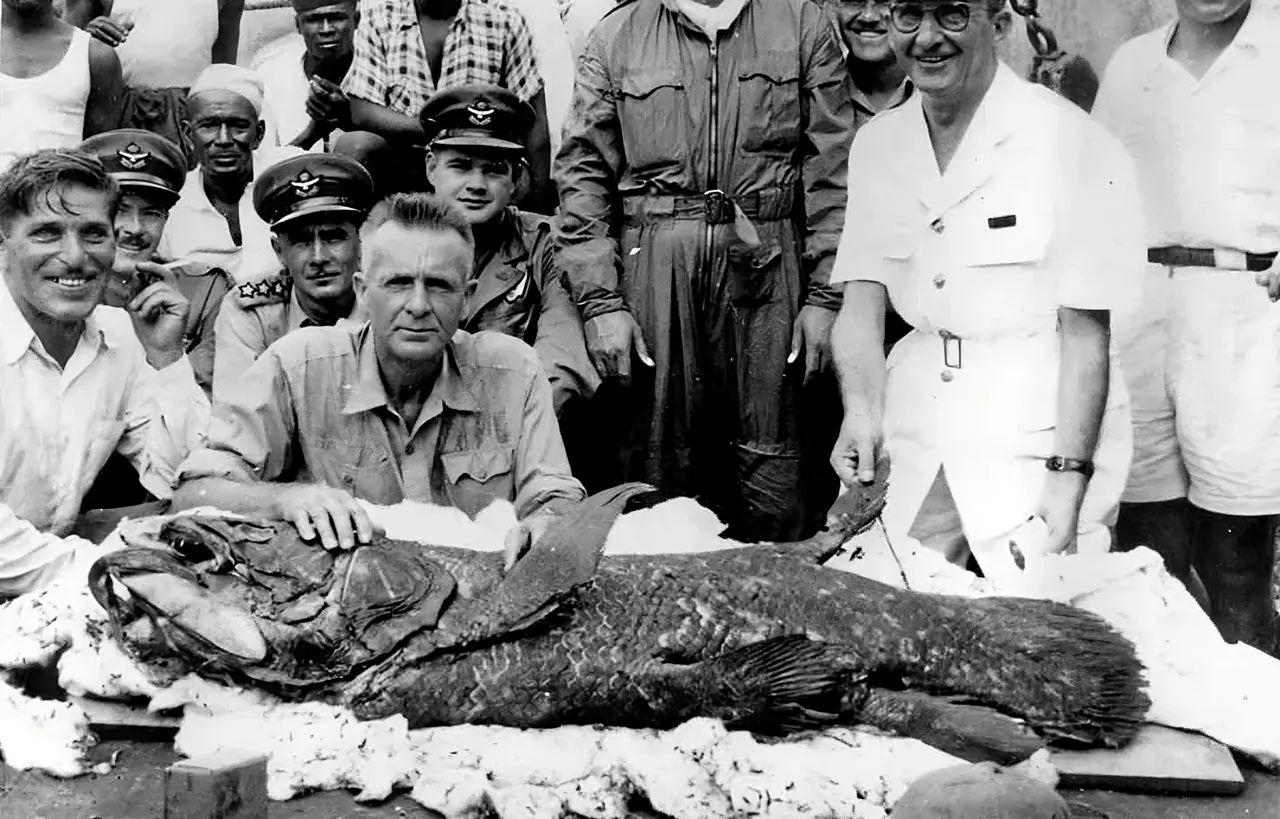
Smith distributed reward leaflets along the East African coast in search of a second specimen. Fourteen years later, in 1952, one was caught in the Comoro Islands, revealing the species' true home. Over the following decades, coelacanths caught by Comorian fishermen were sent to museums and research institutions around the world.
Fame had side effects. Demand for specimens put a price on coelacanths, and in the 1990s there were worries about black-market trade fuelled by baseless rumours that coelacanth body fluids could slow ageing. Attempts to capture live coelacanths for aquariums were discussed, but most experts consider transporting one alive practically impossible.
For the Comoros, the coelacanth became a source of national pride. Fishermen learned to avoid coelacanth depths or to return hooked fish to deep water, and with international support, fish-aggregating devices were installed so fishermen could catch other species away from coelacanth habitat.
Coelacanths have no direct connection to Korea, but models and preserved specimens have been displayed in science museums, and textbooks routinely cite them as the classic 'living fossil', making the name familiar to Korean readers.
12. Conservation
The West Indian Ocean coelacanth is listed as Critically Endangered on the IUCN Red List, and the Indonesian coelacanth as Vulnerable. Categories may change with reassessment.
Submersible surveys that identified individuals one by one have estimated the Comoros population at roughly 300 to 400 fish. The total across all areas is unknown and estimates vary widely. Discoveries in Tanzania and elsewhere suggest the species may be more widespread than once thought, but there is no doubt it remains extremely rare.
Main threats include:
- Accidental capture on deep handlines and in shark nets
- Possible expansion of deep-water trawling, for example off Tanzania
- Habitat disturbance from coastal development and port construction
- Ocean warming, since coelacanths struggle to use oxygen in warmer water
- Potential illegal trade in specimens
The coelacanth was listed on CITES Appendix I around 2000, banning commercial international trade. The Comoros and Tanzania have established marine protected areas that include coelacanth habitat, and the Sodwana Bay area in South Africa lies within a marine protected area.
Because coelacanths reproduce so slowly, the top conservation priority is simply to catch fewer of them. Fisher education, deep-sea fishing regulations and techniques for releasing hooked fish alive are all part of the effort.
13. In aquariums and museums
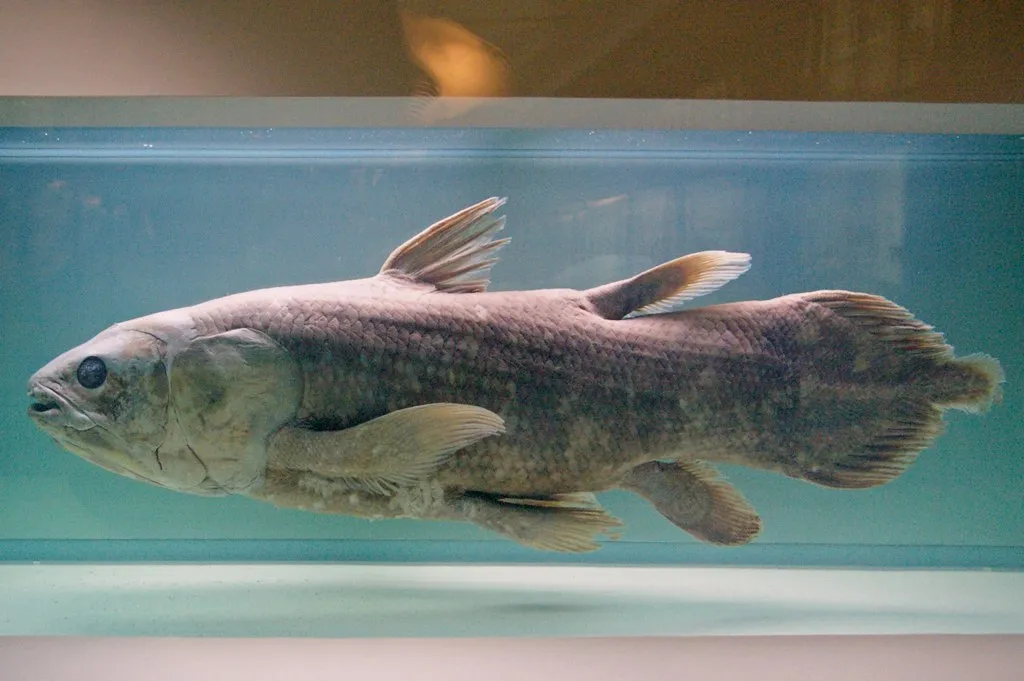
No aquarium has ever kept a living coelacanth. Adapted to cold, high-pressure, dark water, coelacanths almost always die as they are brought to the surface, and the few caught alive have survived only hours. Given the species' rarity and extremely slow reproduction, most experts agree that attempting to keep one in captivity would be unwise.
Instead, coelacanths are star exhibits in natural history museums worldwide, displayed as preserved specimens, mounts and detailed models. The mounted skin of the original 1938 specimen is still kept at the museum in East London, South Africa. Some Japanese aquariums display frozen specimens obtained through cooperation with the Comoros and have taken part in submersible filming expeditions.
Today, the best way to 'meet' a coelacanth is through footage from submersibles and remotely operated cameras, which lets people see the living animal without taking it from the sea.
14. In culture
Paired forever with the phrase 'living fossil', the coelacanth has become a staple of popular science. The story of a creature presumed extinct turning up alive in the deep fired imaginations and inspired novels and films about prehistoric survivors and deep-sea monsters.
In the Comoro Islands the coelacanth is a national emblem, featured on banknotes, coins and stamps and in tourism material. South Africa has also issued stamps and commemorative coins celebrating the discovery.
Games and animation love the coelacanth. Relicanth in the Pokémon series is based on it and is said to have remained unchanged for a hundred million years, and in the Animal Crossing series the coelacanth is a rare catch available only on rainy days, a prized goal for collectors.
In textbooks, the coelacanth illustrates evolution, extinction and the limits of the fossil record, carrying the lesson that missing fossils do not necessarily mean a missing species.
15. Trivia
- The Indonesian coelacanth was first noticed by an American marine biologist on his honeymoon. He photographed an unfamiliar fish at a market in Manado and, the following year, obtained a live specimen that confirmed it was a new species.
- Coelacanths can hang almost motionless in the water for hours while waiting for food.
- The small extra lobe at the tip of the tail is a feature practically unique among living fish.
- J. L. B. Smith devoted much of his life to coelacanths and wrote a popular book about the hunt for them.
- Coelacanth flesh is oily and rich in substances that reportedly cause diarrhoea, so it was never valued as food.
- The 2013 genome study identified changes in regulatory DNA linked to functions important for life on land, shedding light on how fish made the transition to land.
- The coelacanth is the most famous Lazarus taxon, but not the only one. The dawn redwood, Metasequoia, was likewise described from fossils before living trees were found in China.
Wild animals are not pets. Catching, trading or keeping them is illegal in most places. If you find an injured wild animal, call your local wildlife rescue centre.
FAQ
Has the coelacanth really not changed for hundreds of millions of years?
It resembles ancient relatives but is not identical. No fossils of the genus Latimeria are known, and its genes have kept evolving, just relatively slowly in a stable deep-sea environment.
Is it true that coelacanths are related to us?
Yes. Coelacanths are lobe-finned fishes, like lungfishes and the ancestors of all land vertebrates, so they are more closely related to us than to fish like tuna.
How many coelacanth species are there?
Two living species: the West Indian Ocean coelacanth found in 1938 and the Indonesian coelacanth recognised in Sulawesi in the late 1990s. Well over a hundred fossil species are known.
Photo credits
Photos are freely licensed images from Wikimedia Commons. Authors and licenses are listed below.
- Coelacanth off Pumula on the KwaZulu-Natal South Coast, South Africa, on 22 November 2019.png — Bruce A.S. Henderson · CC BY 4.0
- Latimeria Chalumnae - Coelacanth - NHMW.jpg — Alberto Fernandez Fernandez · CC BY-SA 3.0
- Smith with the second coelacanth ever caught-transformed.png — Unknown authorUnknown author · Public domain
- West Indian Ocean Coelacanth (Latimeria chalumnae) holotype.jpg — Bernard DUPONT · CC BY-SA 2.0
- Latimeria Paris.jpg — sybarite48 · CC BY 2.0